National Housing Policy 2026 in Pakistan: What It Means for Buyers and Renters
Pakistan's cabinet approved the National Housing Policy 2026, the first since 2001. What it proposes for buyers, renters and katchi abadis, and what is not law.
The National Housing Policy 2026 is a plan, not a scheme. The Federal Cabinet approved it in August 2026, the first national housing policy since 2001. It does not give anyone a loan, a plot or a flat today. It sets the direction that federal and provincial bodies are meant to follow next.
The Press Information Department announced the approval on 11 August 2026. The Ministry of Housing and Works has published the approved text. We read both on 3 October 2026, along with the ministry's own news page on the decision.
One detail will confuse readers. PID calls it the National Housing Policy 2026. The ministry's news page and the cover of the document call it the National Housing Policy 2025. They are the same policy. The file on the ministry's server is named "Revised Final approved NHP-2026".
What the cabinet approved in August 2026
The cabinet approved a national framework for housing and urban growth, replacing the 2001 policy after about 25 years. It sets nine themes, from land and finance to katchi abadis and green building. It is guidance, so most of it needs provincial laws and budgets.
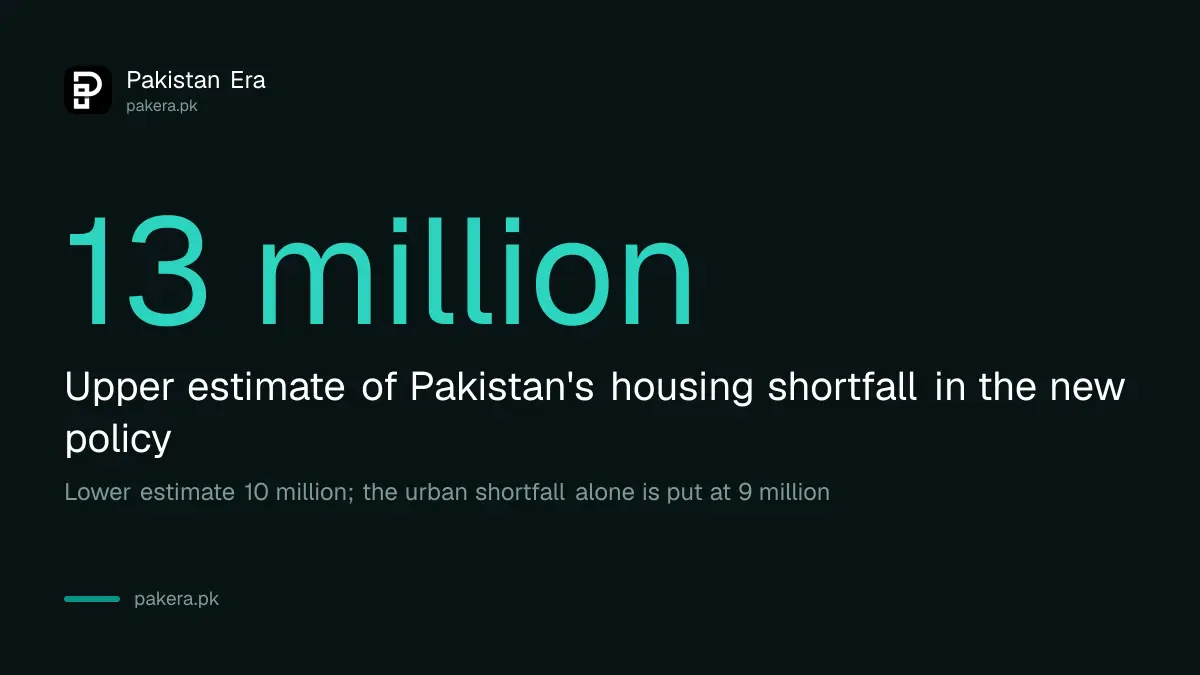
The PID release of 11 August 2026 says the policy's vision is "adequate, affordable and sustainable housing for all". The policy document itself gives the size of the problem. It puts Pakistan's housing shortfall at 10 to 13 million homes, with about 9 million of that in cities.
The nine themes in the approved text are:
- Land for housing
- Planning of intermediate and secondary towns
- Housing finance
- Construction services, technology and building materials
- Slums, katchi abadis and squatter settlements
- Affordable, low-cost, rural and rental housing
- Institutional and legal framework
- Green, energy efficient and disaster resilient housing
- Capacity building and knowledge sharing
Housing became a provincial subject after the 18th Amendment, as the policy itself notes. So the federal role is to set direction and coordinate. The provinces decide most of what happens on the ground.
Approved is not the same as in force
Cabinet approval means the government has adopted the plan. It does not create new rights you can claim, and it does not change any law. Each proposal still needs a provincial law, a rule, a bank product or a budget line before it reaches you.
The policy's own implementation section makes this clear. It asks each province and federal area to set annual housing targets. It gives several tasks a window of one to two years "after approval of the policy". It asks provinces for affordable housing action plans within two to three years, wants a real estate regulator (RERA) working within financial year 2026-27, and sets a midterm review after five years.
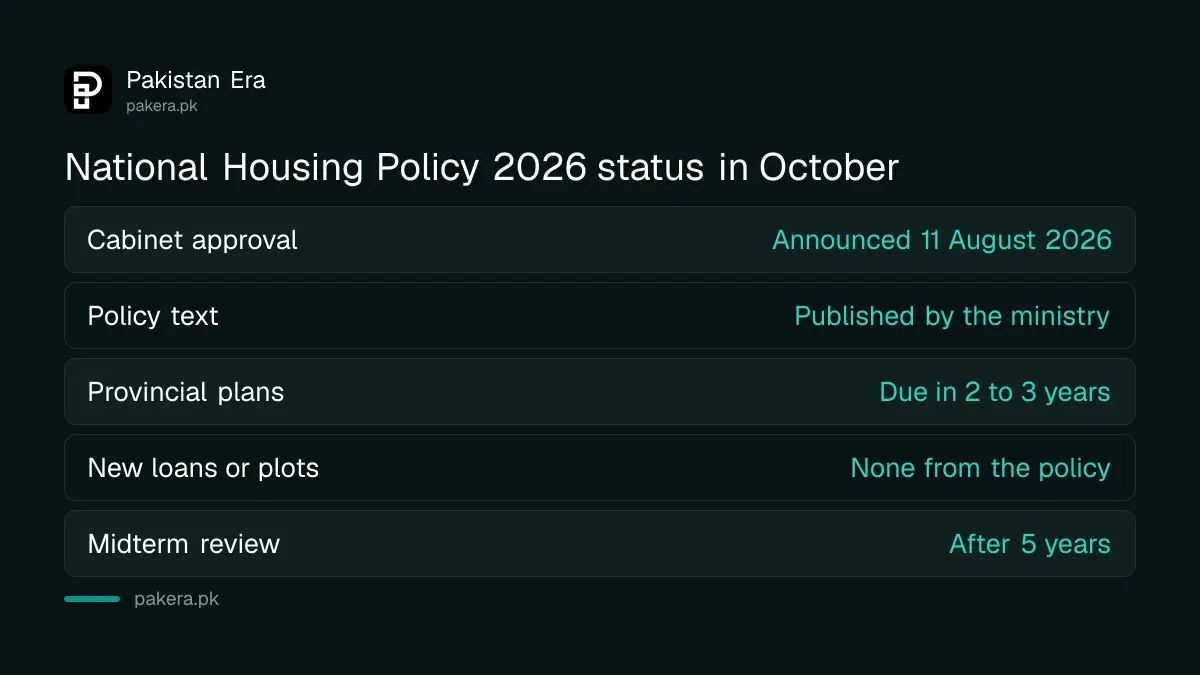
| Stage | Status on 3 October 2026 | What it means for you |
|---|---|---|
| Cabinet approval | Done, announced 11 August 2026 | The plan is official government policy |
| Policy text | Published by the Ministry of Housing and Works | You can read what is proposed |
| Provincial action plans | Asked of each province, not yet seen by us | Most local changes wait for these |
| New loans, plots or flats | None created by the policy itself | Ignore anyone selling a "policy" plot |
| Midterm review | Set for five years after approval | Targets may change then |
One more trap: the ministry's National Housing Policy page links to a file that returns "404 File or directory not found". The approved text sits at a different address, linked in the sources below.
What the policy means for home buyers
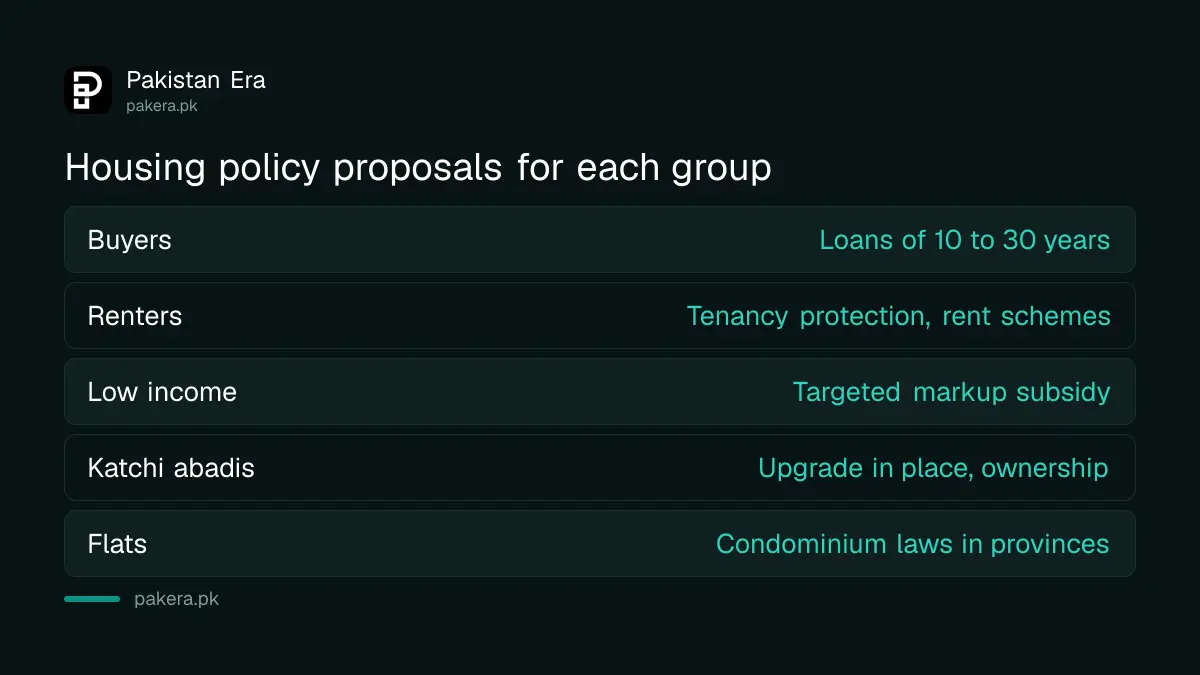
For buyers, the policy proposes longer and cheaper home loans: fixed terms of 10, 20 and 30 years, priority for first-time buyers, and targeted markup subsidies for low-income families. These are proposals for banks and the State Bank, not loans you can apply for today.
The document is blunt about why. It says only about 2% of housing deals in Pakistan use a bank. It puts the mortgage to GDP ratio at 0.3%, against 10% in India and 1.9% in Bangladesh. It names short loan terms of 3 to 5 years and weak foreclosure laws as two reasons.
Other ideas include loans to build a house in stages, help-to-buy loans for first-time buyers and Takaful-based housing insurance.
If you want a home loan now, the live option is still the existing government scheme. The Apna Ghar housing loan is already running through banks, and the usual bank rules on income and age still apply. The new policy does not change either.
What the policy means for renters and low-income families
For renters, the policy backs formal rental markets with tenancy protections and subsidised rental schemes for workers, students and vulnerable groups. For low-income families, it favours upgrading katchi abadis in place, with ownership rights, rather than forced eviction.
The policy estimates that over 50% of Pakistan's urban population lives in slums or katchi abadis. It counts about 63 underserved slums in Islamabad alone. Its answer is "in situ upgrading": improving water, sewerage and roads where people already live, and giving long-term residents land or apartment ownership rights.
It also proposes protection for women's ownership rights and housing finance for women-headed households.
None of this changes your rent today. Rent and tenancy are provincial laws. If your landlord raises the rent this month, the rules that apply are the ones in your province, covered in what to do when a landlord raises the rent.
What changes for apartments and new buildings
The policy pushes for compact, vertical building to save farmland. It asks every province to pass a multi-storey buildings law covering shared spaces and maintenance, and it wants building codes for energy efficiency, earthquake safety and high-rise firefighting.
The document notes that Sindh has a Condominium Act from 2014. Its action plan asks Punjab, Balochistan and Khyber Pakhtunkhwa to pass condominium laws within one to two years. It describes Islamabad's law as already in place, but the National Assembly's records show the Islamabad condominium bill passed by the Assembly in May 2026 and not yet listed among Acts of Parliament.
For buyers of flats, the practical point is simple. A policy cannot make an unapproved building safe or legal. Approval still comes from the local development authority, so check a housing scheme before buying a plot or a flat in it, whatever the advert says about the new policy.
How to protect yourself from "policy" sales pitches
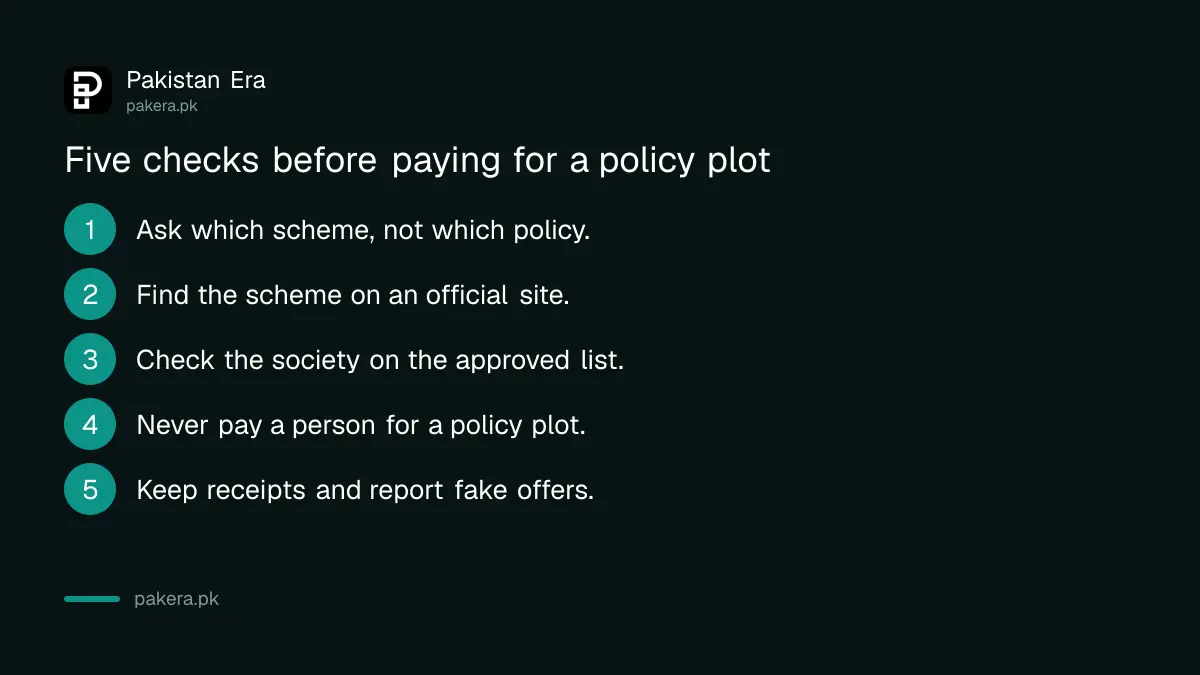
Expect dealers and schemes to use the new policy in adverts. The policy itself sells nothing and allots nothing. Before paying, ask for the name of a specific scheme, check it on an official website, and pay only into an official account.
- Ask which scheme the offer is under. "The National Housing Policy" is not a scheme.
- Find that scheme on the website of the authority or bank that runs it.
- Check the housing society or building on the development authority's approved list.
- Never pay a "registration fee" to a person or a private wallet for a policy plot.
- Keep every receipt, and report fake offers to the authority named in the advert.
Common questions
Is the National Housing Policy 2026 the same as the 2025 policy?
Yes. PID calls it the 2026 policy. The ministry's news page and the document cover say 2025. The file is named as the approved 2026 version.
Can I apply for a house under the National Housing Policy?
No. The policy is a framework. It does not run applications. Housing loans and plots still come through specific schemes, banks and development authorities.
Does the policy cut home loan markup?
Not by itself. It proposes targeted markup subsidies for verified low-income families and long fixed-rate loans. Banks and the government still have to create those products.
Will katchi abadi residents be evicted under the policy?
The policy argues against forced eviction. It favours upgrading settlements in place and giving long-term residents ownership rights. Provinces carry this out under their own laws.
Who is in charge of putting the policy into action?
The Ministry of Housing and Works leads at the federal level. The policy proposes a National Housing Council to oversee it, and asks provinces for their own action plans.
How we verified this
What we checked, where we read it, and what we could not confirm.
Last checked on 3 October 2026. The cabinet approval, the 2001 predecessor, the nine themes and the minister's statement are read in the approved policy text on the Ministry of Housing and Works website, PID press release No. 113 of 11 August 2026, and the ministry's news page on the approval. The 10 to 13 million shortfall, the 9 million urban shortfall, the 2% bank share of housing deals, the 0.3% mortgage to GDP ratio, the 50% slum estimate, the 63 Islamabad slums, the loan proposals, the National Housing Council, the condominium law targets and the five-year review are read in the policy document. We did not see any provincial action plan under the policy, and the ministry's own policy page link returned a 404 when we tried it.
About the author

Senior Writer, Public Services and Technology
Shahid joined us in 2024 as an author. He is a senior contributor to Pakistan's leading technology websites. He writes detailed articles, mostly covering his expertise in the latest tech, mobiles, apps, gadgets, and step-by-step guides. His ideology is to help people understand the latest trends and explain complex methods through very easy-to-understand guides.