NEPRA's August Fuel Decision Records 132 GWh From Solar Users, 59 GWh From Iran and a 2.5% Loss Cap
NEPRA's 7 October fuel decision records 132.167 GWh from solar net metering users, 58.894 GWh from Iran at Rs 26.9091 a unit and a 2.50 per cent grid loss cap.
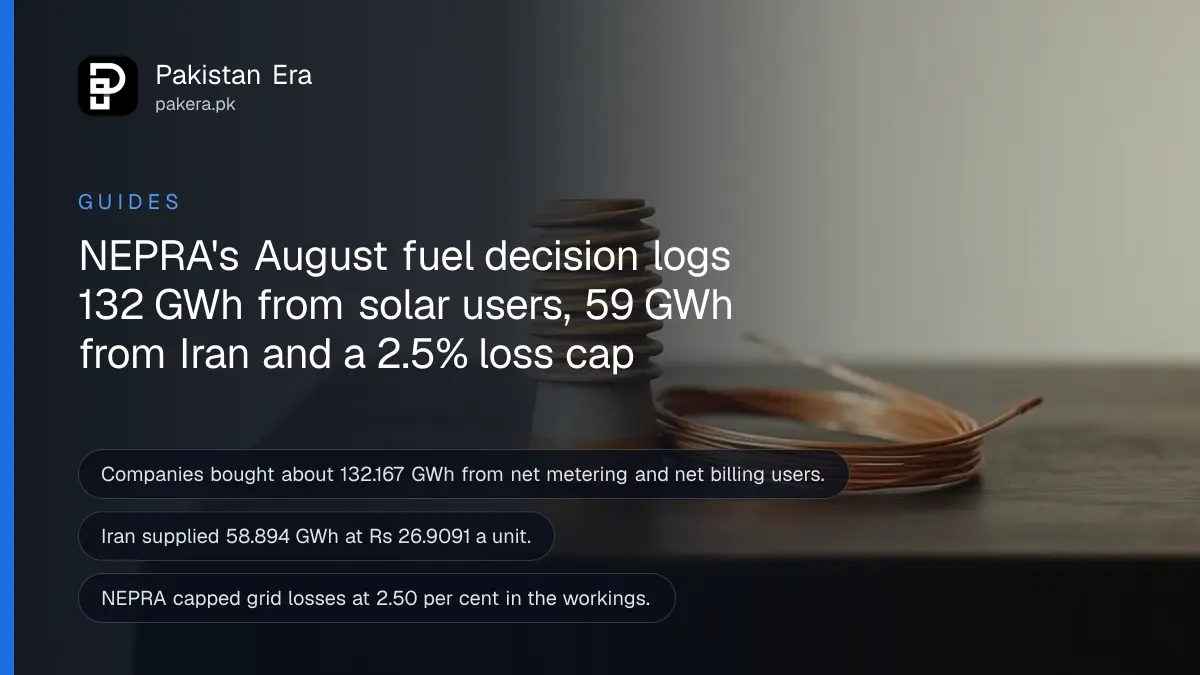
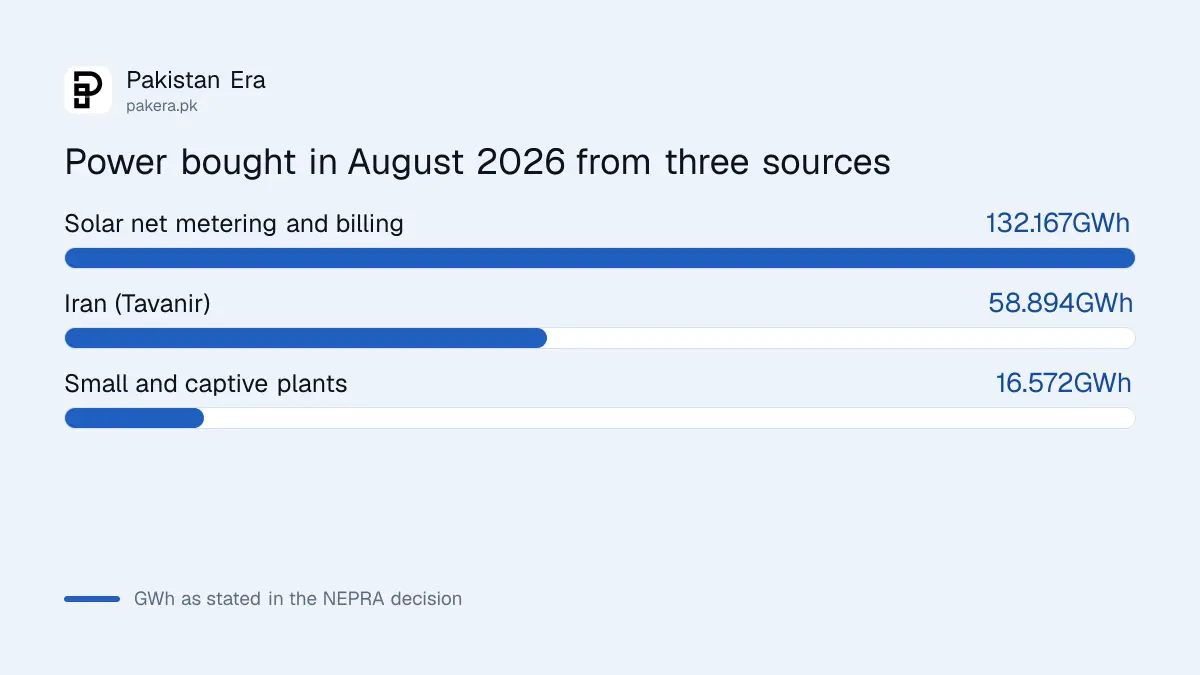
NEPRA's fuel charge decision for August 2026 records that distribution companies bought about 132.167 GWh from net metering and net billing solar users that month. It also shows 58.894 GWh imported from Iran at Rs 26.9091 a unit, and a cap on grid line losses at 2.50 per cent. These details sit inside the 7 October 2026 decision.
We downloaded the decision from nepra.org.pk and read the paragraphs on solar, Iran, captive plants and losses. The scan did not read cleanly in its tables, so we use only figures stated in the text. A GWh, or gigawatt hour, is a million kilowatt hours, which is a million "units" on your bill.
Solar users supplied about 132 GWh in August
CPPA-G gave NEPRA data showing that distribution companies procured about 132.167 GWh from net metering and net billing consumers in August 2026. NEPRA adds that this includes units imported from solar systems that exceeded their allowed capacity.
Net metering lets a home with solar panels send extra power to the grid and be credited. Net billing, the newer system, pays for the extra at a set buyback rate. Our guide to net metering rules in 2026 explains the difference, and the piece on the solar export tariff covers the night rate.
The decision says the companies' FCA workings account for net metering within each company's own supply "basket". It does not give a rupee cost for the 132.167 GWh in the text we could read.
Captive and small plants supplied 16.572 GWh
CPPA-G also reported that small power producers and captive power plants with bilateral deals with distribution companies supplied about 16.572 GWh in August. Captive plants are factories' own generators.
No cost was claimed for that energy. NEPRA therefore counted it at the reference fuel cost approved in each plant's contract. It said this avoids a one-time burden on consumers later.
NEPRA also ordered the distribution companies to reconcile the energy and the cost they verified against what NEPRA allowed. From now on they must send monthly details, and a monthly certificate that the purchases followed the economic merit order, meaning cheapest first.
Imports from Iran cost Rs 1,585 million
CPPA-G reported importing 58.894 GWh from Tavanir, Iran's power company, in August 2026, at a cost of Rs 1,585 million or Rs 26.9091 a unit. NEPRA noted that on 23 May 2026 it approved an extension of the contract between NTDC and Tavanir.
NEPRA told CPPA-G to submit a full reconciliation of what it claimed in monthly fuel charges against what is payable under the approved tariff. Any difference will go into a coming monthly charge.
In the same decision NEPRA allowed, on a provisional basis, a positive previous adjustment of Rs 528 million for Tavanir, saying the reconciliation provided is still under review.
| Item in the August 2026 decision | Figure |
|---|---|
| Net metering and net billing units | 132.167 GWh |
| Small and captive plants with bilateral deals | 16.572 GWh |
| Imports from Tavanir, Iran | 58.894 GWh at Rs 26.9091 a unit |
| Cost of Iran imports | Rs 1,585 million |
| Allowed grid loss on 500kV and 220kV lines | 2.50% |
NEPRA capped line losses at the approved level
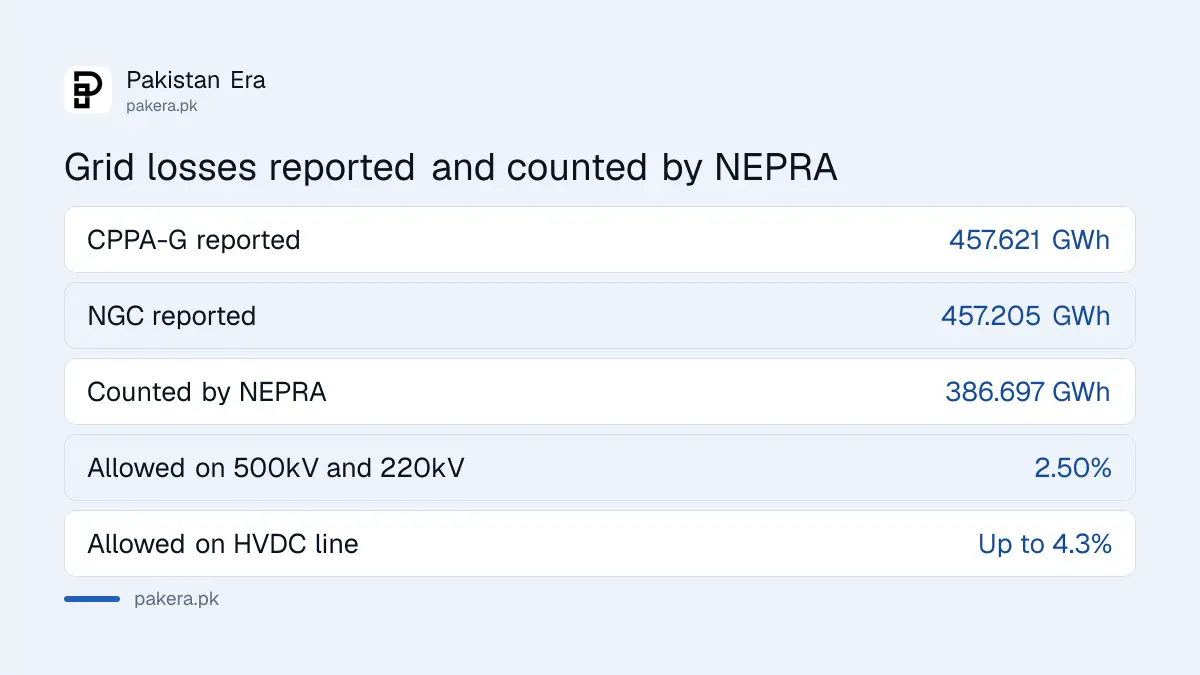
Transmission losses are electricity lost on the high voltage grid. CPPA-G reported 457.621 GWh of losses. The grid company NGC reported 457.205 GWh, including 57.222 GWh on the HVDC line, which is a separate long distance line.
NEPRA's approved loss limit is 2.50 per cent for the 500kV and 220kV network, and up to 4.3 per cent for the HVDC line. NEPRA counted NGC's losses at 386.697 GWh, capping them at 2.50 per cent. The HVDC losses were within their cap and were accepted.
The decision says that if NGC stays within the allowed share over the whole year, the units deducted now may be allowed back in its next tariff.
What it means for your bill
These items change what consumers are asked to pay through the fuel charge, but not by a figure we can calculate from the text. The headline charge stays Rs 1.1086 a unit on the units you used in August. See our piece on the decision for what it adds to a bill.
If you have a solar system, your net metering credit is a separate part of your bill and this decision does not change it. If your bill looks wrong, the steps are in the NEPRA electricity complaint guide.
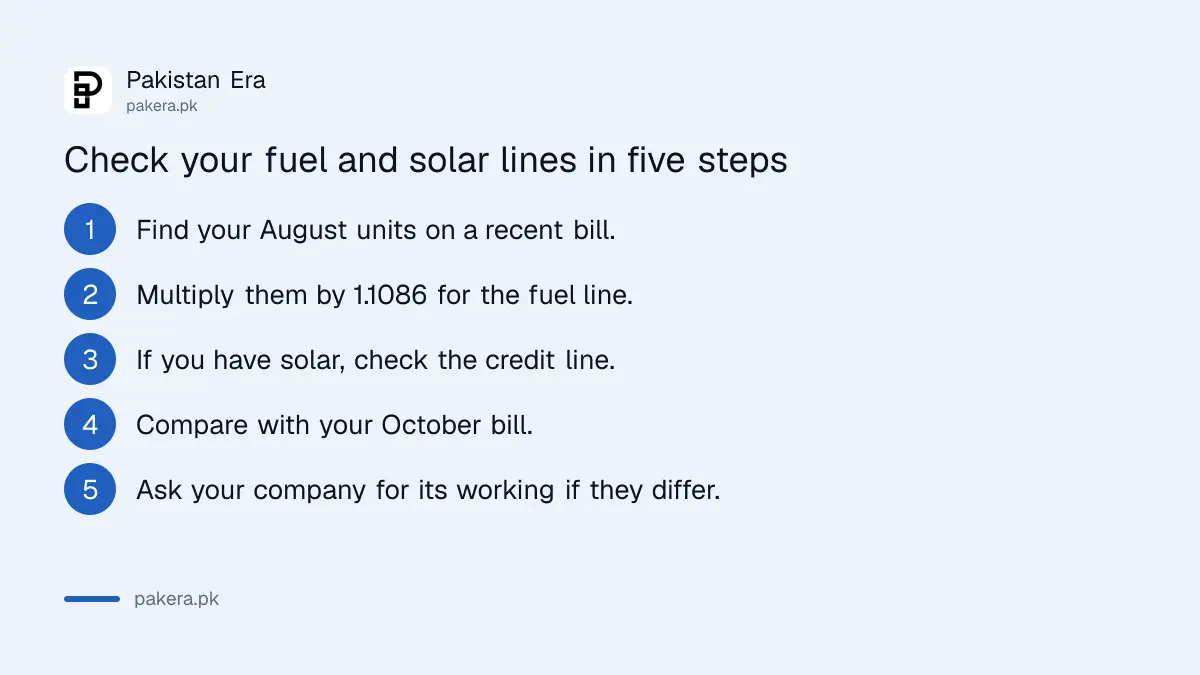
- Find your August units on a recent bill.
- Multiply them by 1.1086 for the fuel line.
- If you have solar, check the credit line separately.
- Compare with your October bill.
- Ask your company for its working if the figures differ by a lot.
Common questions
How much solar power did distribution companies buy in August 2026?
About 132.167 GWh from net metering and net billing consumers, according to data CPPA-G gave NEPRA.
How much electricity did Pakistan import from Iran in August?
58.894 GWh at Rs 26.9091 a unit, a cost of Rs 1,585 million, as reported by CPPA-G.
What did NEPRA say about line losses?
It counted grid losses at 2.50 per cent, the approved cap, which gave 386.697 GWh instead of the higher reported figure.
Does this change my net metering credit?
Nothing in the text we read changes a consumer's credit. It records the units in the fuel charge workings only.
Is the fuel charge the same for K-Electric customers?
Yes. The decision says the charge applies to K-Electric consumers over the same period.
How we verified this
What we checked, where we read it, and what we could not confirm.
Last checked on 13 October 2026, Pakistan time. We read NEPRA's fuel charges adjustment decision for August 2026. It is a scanned PDF and several tables were unreadable, so we state only the figures given in its paragraphs. The figures are claims reported by CPPA-G and NGC and recorded by NEPRA, and we have not checked them against any other source.
About the author

Public Services and Education Journalist
Fajr Riaz is a journalist and content writer at Pakistan Era, based in Lahore. She covers the questions people meet in everyday life in Pakistan: how a public service works, what a change in the rules means, and where to find a reliable answer.