Open a Business Bank Account in Pakistan: Documents by Business Type Under SBP Rules
SBP lists the papers a bank may ask for when you open a business account in Pakistan, from sole proprietors to companies. A missing NTN is no reason to refuse.
Short answer: The State Bank of Pakistan (SBP) lists the papers a bank may ask for by business type. A sole proprietor needs a CNIC and any one business paper. A partnership, LLP or company needs more, including a deed or resolution. A bank should not refuse you only because you do not yet have an NTN.
Many small owners walk into a bank with a CNIC and a shop photo and are sent away twice. One branch wants a letterhead. Another wants an NTN. A third asks for a document that does not exist for your type of business. SBP's customer onboarding framework has one table that every bank has to follow, and it is public.
We read SBP's updated Consolidated Customer Onboarding Framework, Annex C, and the March 2026 circular that amended it, on 13 October 2026. The table says what banks "shall obtain". A bank can ask for extra papers for a risky customer, but it must record why.
Sole proprietors and small businesses need a CNIC and one business paper
A sole proprietor gives a valid ID document and any one of four papers: a sales tax or NTN certificate where it applies, proof of trade body membership, a declaration of sole proprietorship on business letterhead, or an account opening request on letterhead.
A small business or professional, including a freelancer, gives an ID document and any one of these: a registration certificate if registered, a sales tax or NTN certificate where it applies, trade body membership, or proof of source of funds or income. Our guide to registering as a sole proprietor with FBR shows how to get the tax paper later.
Firms, LLPs and companies must bring all the listed papers
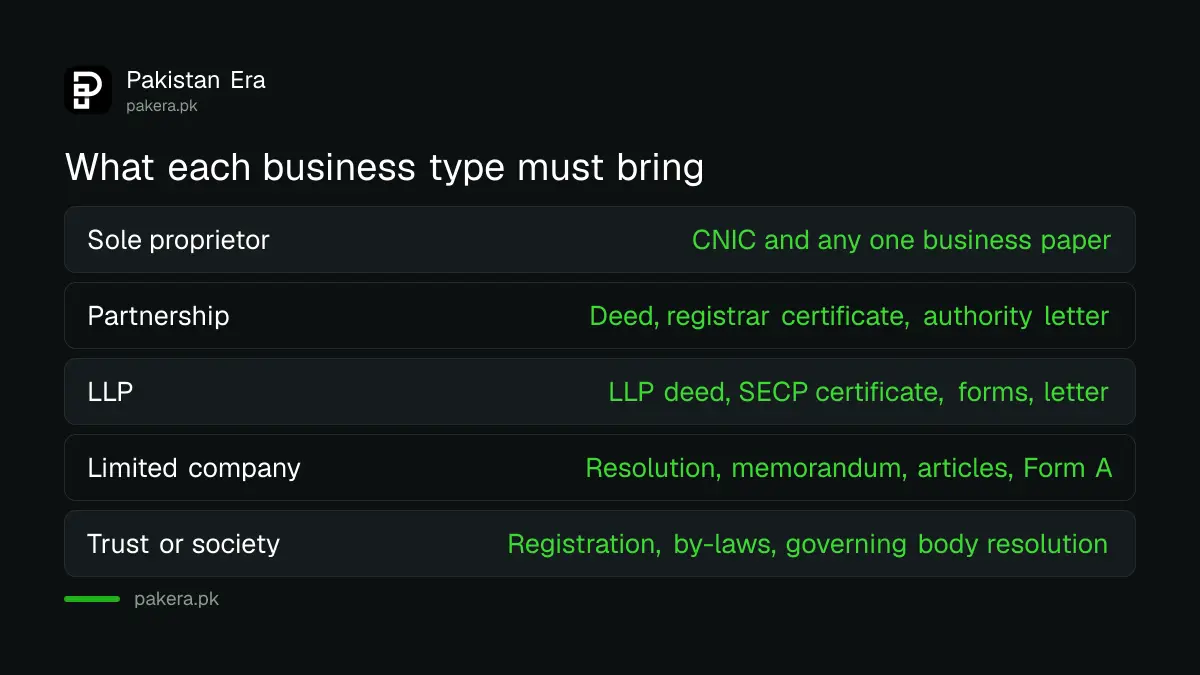
For these types the framework says "all of the following", not "any one". The table below shows what each type must bring, besides CNIC copies of the partners, directors and people who will sign.
| Business type | All of the following papers |
|---|---|
| Partnership | Attested partnership deed signed by all partners, registration certificate from the Registrar of Firms, original authority letter signed by all partners |
| Limited liability partnership | Certified LLP deed, LLP Form III for a new LLP, SECP registration certificate, LLP Form V for changes, authority letter signed by all partners |
| Limited company | Board resolution naming signatories, memorandum and articles, latest Form A, Form 1 for a new company or Form A and Form 9 for an old one |
| Branch or liaison office of a foreign company | Board of Investment permission letter, list of directors, Form 2 and Form 5, authority letter from the principal officer |
| Trust, club, society or association | Registration certificate or trust instrument, by-laws, governing body resolution, a declaration on control and source of funds |
An unregistered partnership is still allowed. The framework says the fact that it is unregistered must be stated clearly on the account opening form. Partners should simply state it. Our guides to registering a partnership firm in Punjab and in Islamabad cover the registration, if you want it.
A bank should not refuse you only for lack of an NTN
One footnote in the table is easy to miss. It says the NTN requirement should not be a reason to refuse financial services, especially where the account is itself needed to get the NTN under FBR's criteria. Banks should help the customer open the account and add the NTN later.
That is the loop many new businesses fall into. FBR asks for a bank account, and the bank asks for an NTN. If the branch says "NTN first", show the footnote and ask for the branch manager. If the branch still refuses, ask for the refusal in writing.
Beneficial owners are named, and the decision takes five working days
For a company or similar entity, the bank must also identify the people who own or control it. The framework sets the threshold at 20 percent ownership, or 10 percent where the account needs enhanced due diligence. The bank asks for their details whether or not they are signatories.
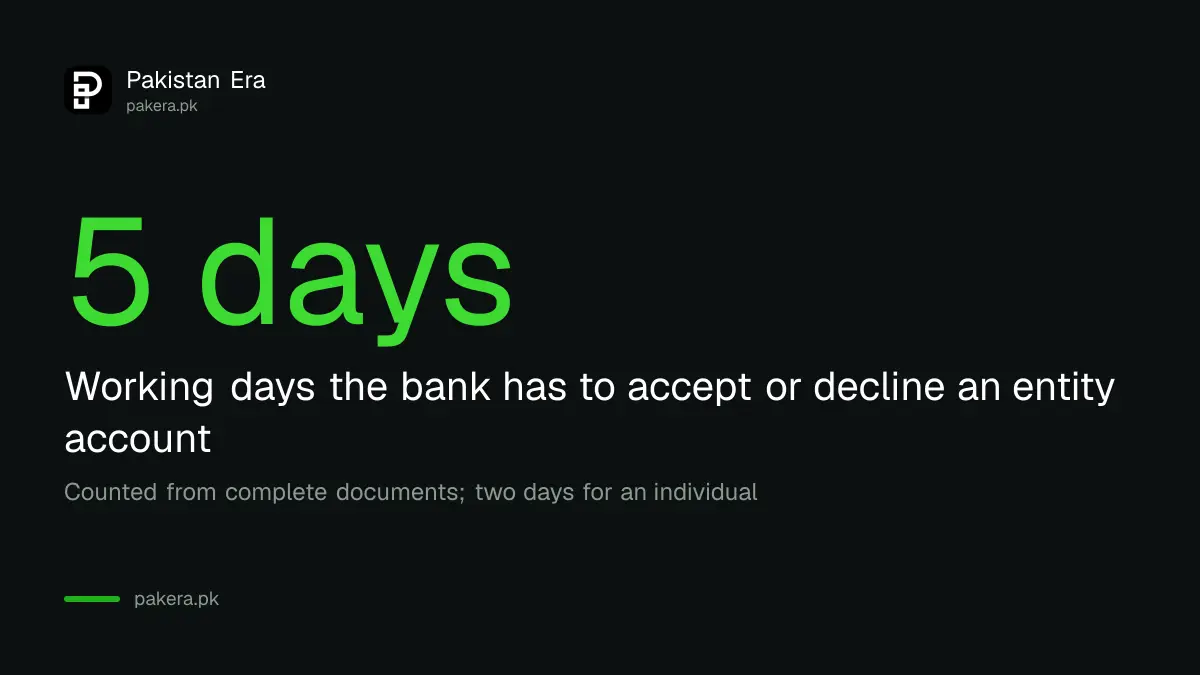
The framework gives a bank five working days from complete documents to accept or decline an entity account. It must give a tracking ID, tell you about gaps within that time and give a written reason if it declines. This is three days longer than the two days for an individual. Our guide to filing the Form 19 beneficial owner declaration with SECP explains how to identify yours.
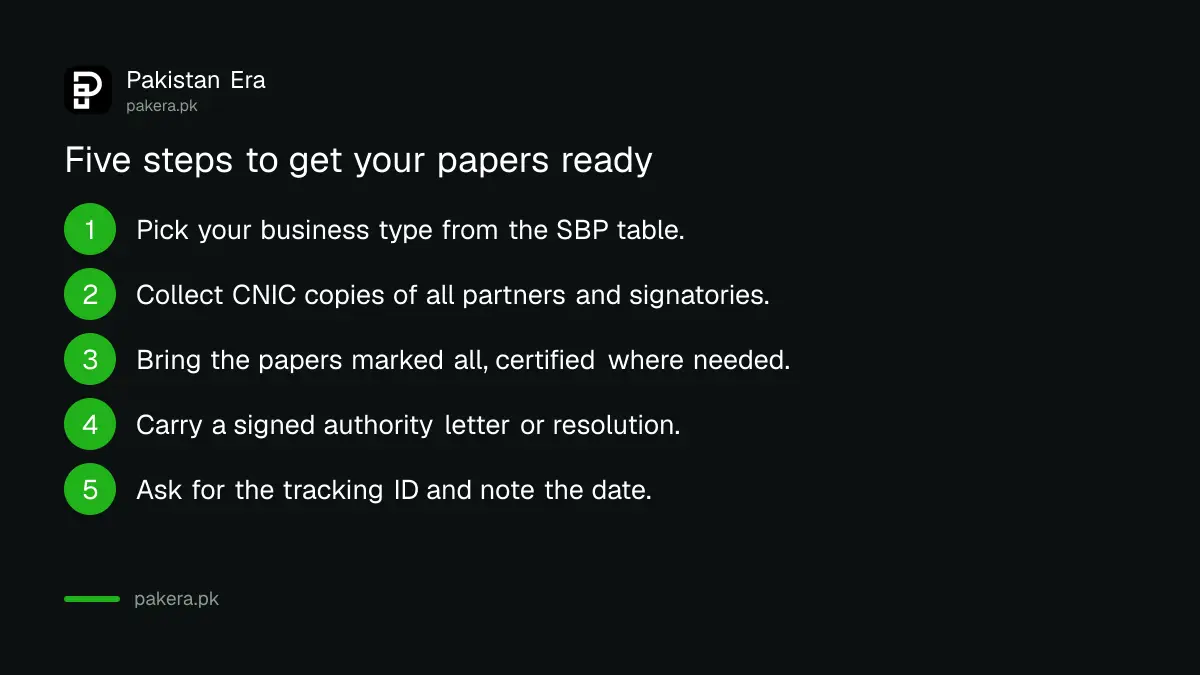
- Pick your business type from the table above.
- Collect CNIC copies of every partner, director and signatory.
- Bring the papers marked "all", in attested or certified copies where the table says so.
- Carry a signed authority letter or board resolution naming who may operate the account.
- Ask for the tracking ID and note the date you gave complete papers.
Common questions
Can a bank refuse my business account because I have no NTN?
It should not, according to SBP's footnote. The NTN should not be the reason for refusal, particularly when the account is needed to obtain the NTN.
Do I need a company to open a business account?
No. A sole proprietor and a small business can open an account with a CNIC and one business paper, such as a declaration on letterhead.
Are freelancers treated as small businesses?
The framework lists freelance professionals under small businesses and professions. They need an ID document and one of the listed papers, such as proof of income.
How long does the bank have to decide on a company account?
Five working days from complete documents. The bank must give a tracking ID and a written reason if it declines.
Do the papers need to be attested or certified?
For partnerships, LLPs, companies and trusts the framework says attested or certified copies for the key documents. Ask your bank what stamp it accepts.
How we verified this
What we checked, where we read it, and what we could not confirm.
Last checked on 13 October 2026, Pakistan time. We read SBP's Consolidated Customer Onboarding Framework, Annex C and sections E and I, and BPRD Circular Letter No. 09 of 2026. Banks can add their own risk checks, so your bank may ask for more than the table. We did not visit a branch.
About the author

Senior Writer, Public Services and Technology
Shahid joined us in 2024 as an author. He is a senior contributor to Pakistan's leading technology websites. He writes detailed articles, mostly covering his expertise in the latest tech, mobiles, apps, gadgets, and step-by-step guides. His ideology is to help people understand the latest trends and explain complex methods through very easy-to-understand guides.