Typhoid and Cholera Cases in Pakistan, Week 42 2026: 2,429 Typhoid, 405 Suspected Cholera, Balochistan Rises
Pakistan had 2,429 suspected typhoid and 405 suspected cholera cases in week 42 of 2026, NIH says. Balochistan rose most. See districts, lab results and steps.
یہ صفحہ اردو میں پڑھیں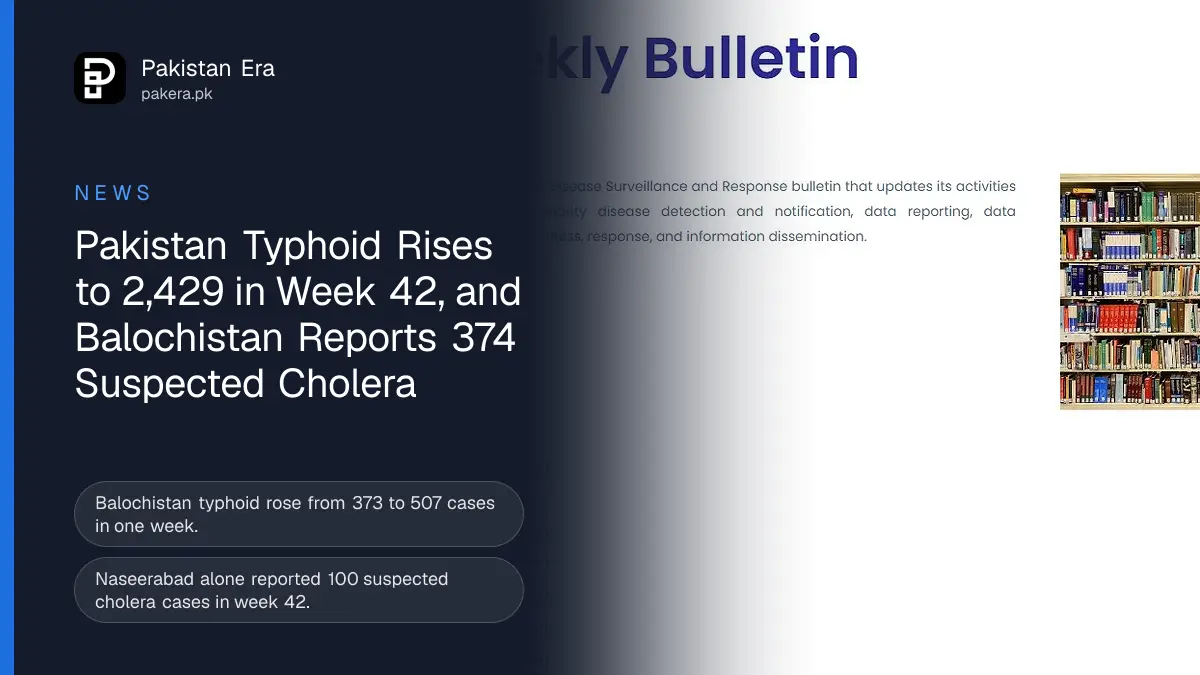
Pakistan reported 2,429 suspected typhoid cases and 405 suspected cholera cases in week 42 of 2026, both up from a week earlier, the National Institutes of Health (NIH) said in its weekly bulletin posted on 11 November 2026. Balochistan drove both rises, with 507 typhoid and 374 suspected cholera cases.
Ordinary diarrhoea fell slightly to 98,005 cases, still the most reported illness in the country. All three spread through dirty water and food, so boiling water and washing hands remain the best protection. Below are the province and district figures, the lab results and what to do when someone in the house falls ill.
Typhoid rose to 2,429 and suspected cholera to 405 in week 42
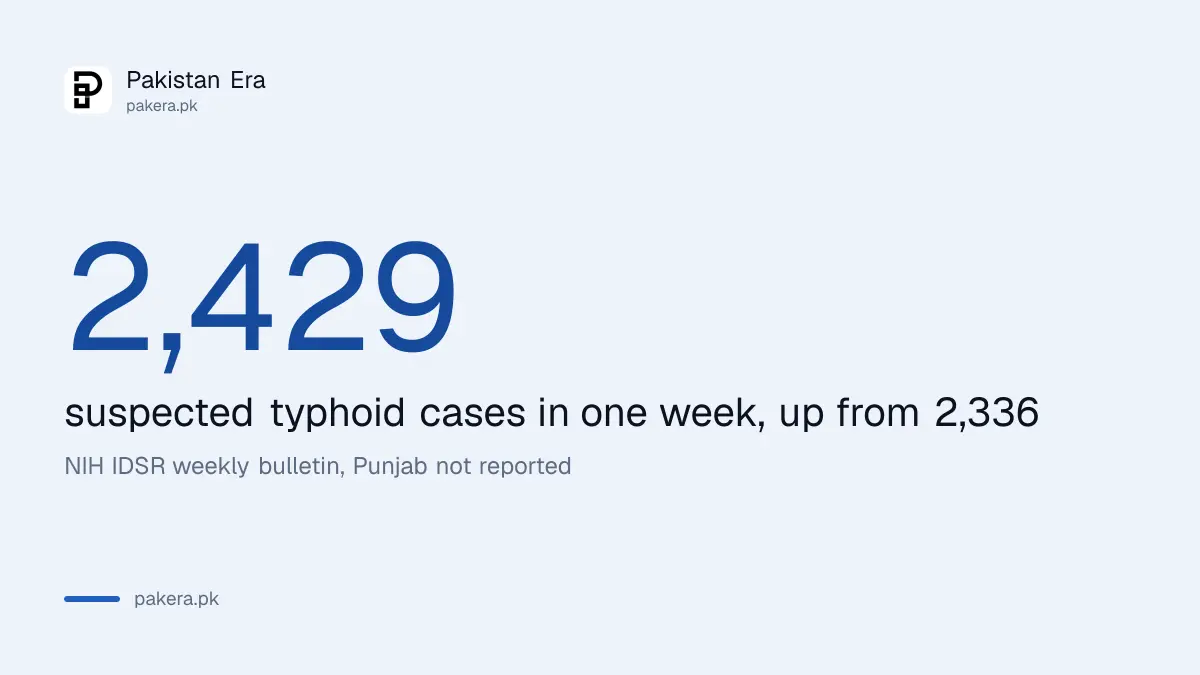
NIH counted 2,429 suspected typhoid cases in week 42, against 2,336 in week 41, a rise of 93 or about 4 per cent. Suspected cholera, which the bulletin calls acute watery diarrhoea (AWD), rose from 374 to 405.
Acute diarrhoea that is not cholera fell from 99,316 to 98,005. Bloody diarrhoea, often a sign of dysentery, rose from 6,333 to 6,597. Punjab did not report, so every national figure leaves out the largest province.
| Illness | Week 41 | Week 42 | Change |
|---|---|---|---|
| Acute diarrhoea, not cholera | 99,316 | 98,005 | down 1,311 |
| Bloody diarrhoea | 6,333 | 6,597 | up 264 |
| Typhoid | 2,336 | 2,429 | up 93 |
| Suspected cholera (AWD) | 374 | 405 | up 31 |
Balochistan's typhoid count jumped 36 per cent to 507
Sindh still has the most typhoid, 1,261 cases, up from 1,198. But the sharpest rise was in Balochistan, from 373 to 507. Khyber Pakhtunkhwa fell from 655 to 566.
| Province or area | Typhoid, week 41 | Typhoid, week 42 |
|---|---|---|
| Sindh | 1,198 | 1,261 |
| Khyber Pakhtunkhwa | 655 | 566 |
| Balochistan | 373 | 507 |
| Gilgit-Baltistan | 90 | 78 |
| Azad Jammu and Kashmir | 18 | 17 |
| Islamabad | 2 | 0 |
| Punjab | not reported | not reported |
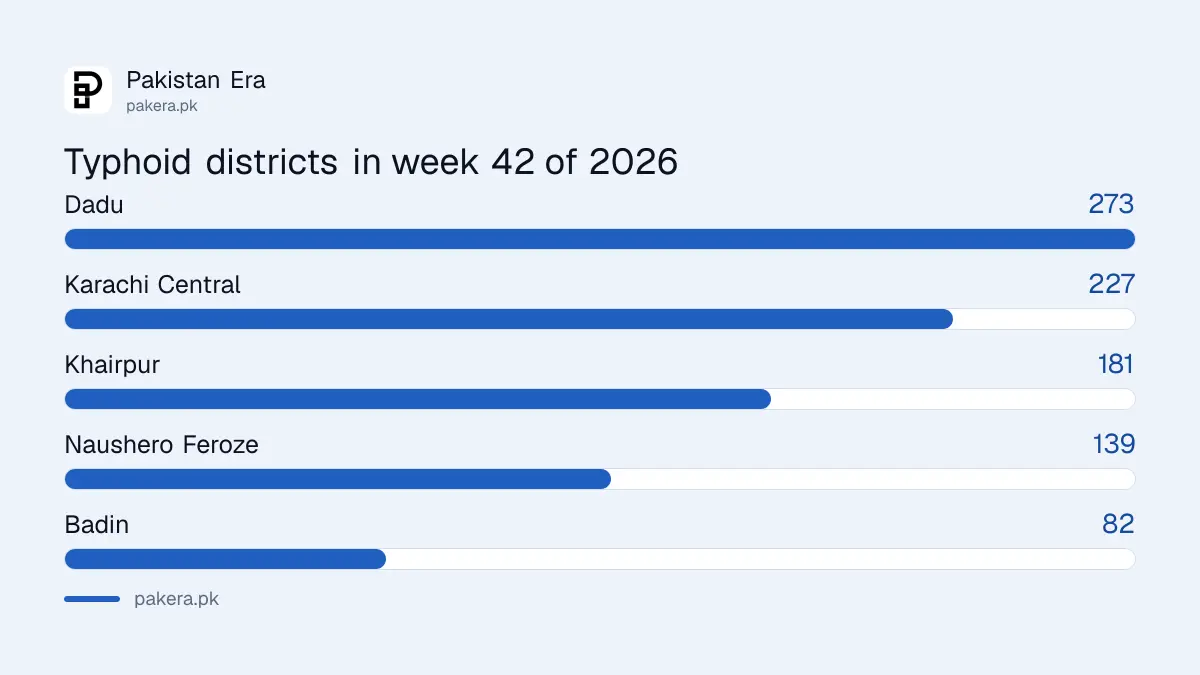
By district, Dadu had the most typhoid in Sindh with 273, then Karachi Central with 227 and Khairpur with 181. In Khyber Pakhtunkhwa, Charsadda had 73, Swat 70 and Bannu 63. In Balochistan, Khuzdar had 70, Kohlu 52 and Naseerabad 43.
Nine in ten suspected cholera cases are in Balochistan
Balochistan reported 374 of the 405 suspected cholera cases. Naseerabad had 100 on its own, followed by Nushki with 47, Quetta and Ziarat with 38 each, and Panjgur with 33. Gilgit-Baltistan had 11 and Azad Kashmir 8.
These are suspected cases, meaning watery diarrhoea that could be cholera. In Sindh, the labs tested 36 stool samples for cholera in week 42 and found none positive, and a further 213 stool cultures were also negative. The bulletin gives no lab result for Balochistan's cholera samples. Our guide on spotting cholera early explains the warning signs.
Labs confirmed typhoid in 48 of 844 samples
Public health labs tested 844 samples for typhoid in week 42 and 48 were positive, about 6 per cent. Sindh found 25 positive of 543, Balochistan 13 of 112, Gilgit-Baltistan 8 of 122 and Azad Kashmir 2 of 67. In week 41, labs tested 341 samples and found 22 positive.
The low share is normal. Many people with fever are logged as suspected typhoid, and only a blood culture confirms it. Our guide to typhoid tests in Pakistan explains why the Widal test alone is not enough.
What to do when someone in the house has diarrhoea or typhoid fever
- Give oral rehydration salts (ORS) after every loose stool, and zinc for children as a doctor advises.
- Go to a hospital at once for many watery stools in a few hours, sunken eyes, or a child who will not drink.
- For fever lasting more than three days, see a doctor and ask for a blood culture before antibiotics.
- Take any antibiotic for the full course the doctor gives, and never buy one over the counter.
- Boil drinking water, wash hands with soap before eating and after the toilet, and keep the patient's cup and plate separate.
Our guide to treating a child's diarrhoea with ORS and zinc has the home care steps.
How we read the week 42 bulletin, and where it trips readers up
We opened the NIH weekly bulletin page on 12 November 2026. The week 42 file sits at the top of the list as a PDF of about 2.6 MB and 25 pages. The typhoid, cholera and diarrhoea figures by province are in Table 1 on page 5, and the district tables follow on pages 7 to 11, with lab results in Table 5 on page 16.
Two things slowed us down. Punjab's column reads NR, short for not reported, in every row, so the national total is not truly national. And the bulletin files are not named the same way each week: week 42 is 'Weekly Report-42-2026', but week 41 is 'IDSRS Weekly Report-41-2026-NA'. When we typed the week 41 address in the week 42 style, the site returned a web page instead of the PDF. Use the links on the list rather than guessing the address. Our guide to checking disease cases in your district from the NIH bulletin shows how to find your own district.
Common questions
How many typhoid cases did Pakistan report in week 42 of 2026?
2,429 suspected cases, up from 2,336 in week 41, according to the NIH bulletin posted on 11 November 2026.
Where is cholera in Pakistan this week?
Mostly in Balochistan, which reported 374 of 405 suspected cases. Naseerabad had 100.
Is diarrhoea going down?
Slightly. Acute diarrhoea fell from 99,316 to 98,005 cases, but it is still the most reported illness.
How many typhoid cases were confirmed by a lab?
48 of 844 samples tested in week 42, about 6 per cent.
Which district has the most typhoid?
Dadu in Sindh, with 273 suspected cases, then Karachi Central with 227.
How we verified this
What we checked, where we read it, and what we could not confirm.
We downloaded the NIH IDSR bulletins for weeks 41 and 42 of 2026 from the NIH weekly bulletin page on 12 November 2026 and read Tables 1 to 5. Health steps are general advice, not from the bulletin. Our week 38 typhoid report has the figures from four weeks ago.
About the author

Public Services and Education Journalist
Fajr Riaz is a journalist and content writer at Pakistan Era, based in Lahore. She covers the questions people meet in everyday life in Pakistan: how a public service works, what a change in the rules means, and where to find a reliable answer.