Spot Cholera in Pakistan: 3 Watery Stools in 24 Hours Is a Suspected Case, NIH Says
NIH treats 3 watery stools in 24 hours as suspected cholera in Pakistan. See the ORS and zinc steps, when to get a stool test and how to make water safe.
Short answer: NIH treats anyone with three or more watery, non-bloody stools in 24 hours as a suspected cholera case. Start oral rehydration salts (ORS) at once, sip often, avoid juices and soft drinks, and see a doctor the same day. A child between 6 months and 5 years should also get zinc.
A man in Quetta wakes at night with stools that look like rice water. By morning he has had four. He is thirsty, his legs cramp and he feels weak. Is it ordinary diarrhoea, or cholera? The answer decides how fast he needs help.
We read the National Institute of Health (NIH) advisory on acute watery diarrhoea (cholera), No. F.1-22/Advisory/CDC/2024, dated 3 June 2024, on 13 October 2026. It is written for health departments, so we have turned it into steps for a family. It is an advisory, not a medical prescription, and a doctor decides your treatment.
Three watery stools in 24 hours is the NIH signal
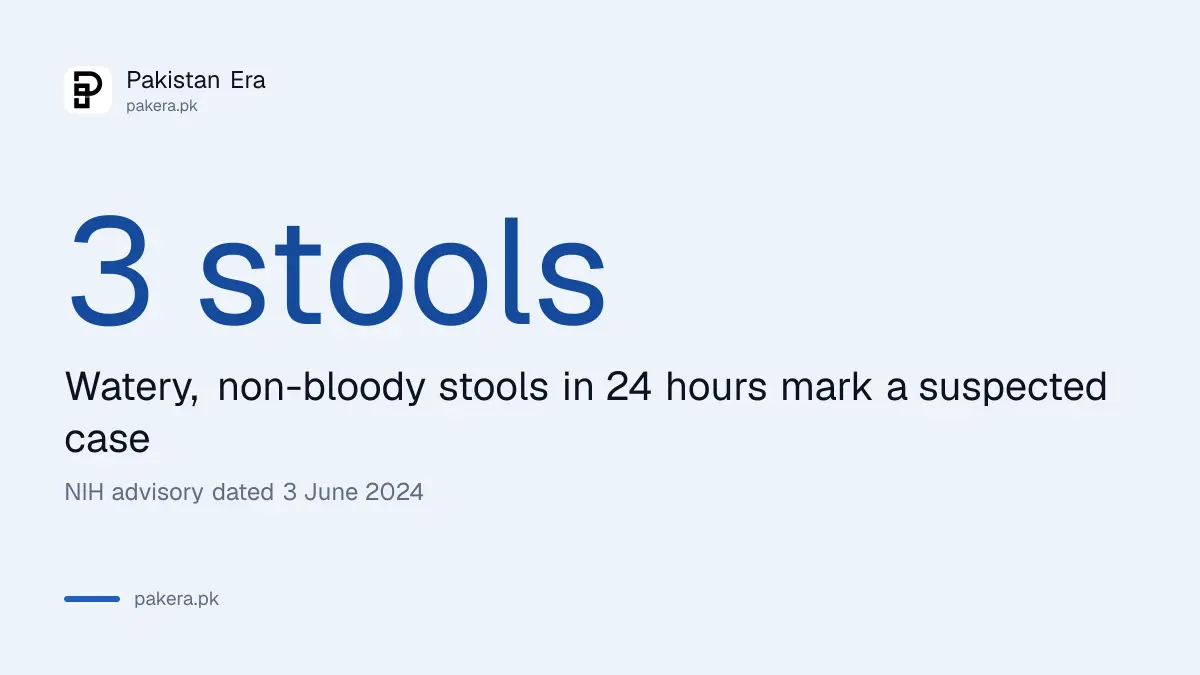
NIH defines a suspected cholera case as any patient with three or more watery, non-bloody stools, described as rice watery stools, in the last 24 hours. Dehydration may or may not be present. A death from acute watery diarrhoea also counts as suspected.
That rule is a warning light, not a diagnosis. Cholera is confirmed only when the germ Vibrio cholerae is found in a stool sample. NIH adds that most infected people have no symptoms or mild ones.
Severe disease is rarer. NIH says about 5 to 10 percent of infected people in the early stages become severely ill, with heavy watery diarrhoea, vomiting and leg cramps, and can lose body fluid fast enough to go into shock.
Start ORS first, and keep sipping
NIH says cholera is treated by replacing fluid. Give low osmolar ORS by mouth, and give it often. Avoid fruit juices and soft drinks, because the high sugar content can make diarrhoea worse. Severe dehydration needs a drip in hospital.
For a child, the home steps are in the guide to treating a child's diarrhoea with ORS and zinc. NIH's cholera advice adds that children aged 6 months to 5 years with suspected cholera should start zinc supplements immediately.
Delay in rehydration can also lead to kidney failure, NIH warns. So do not wait to see whether it passes if the stools are watery and frequent.
What to do in the first hours
Move in this order. The aim is to replace fluid, get a stool test taken early and keep other people safe, which is what NIH's advisory asks of doctors and families.
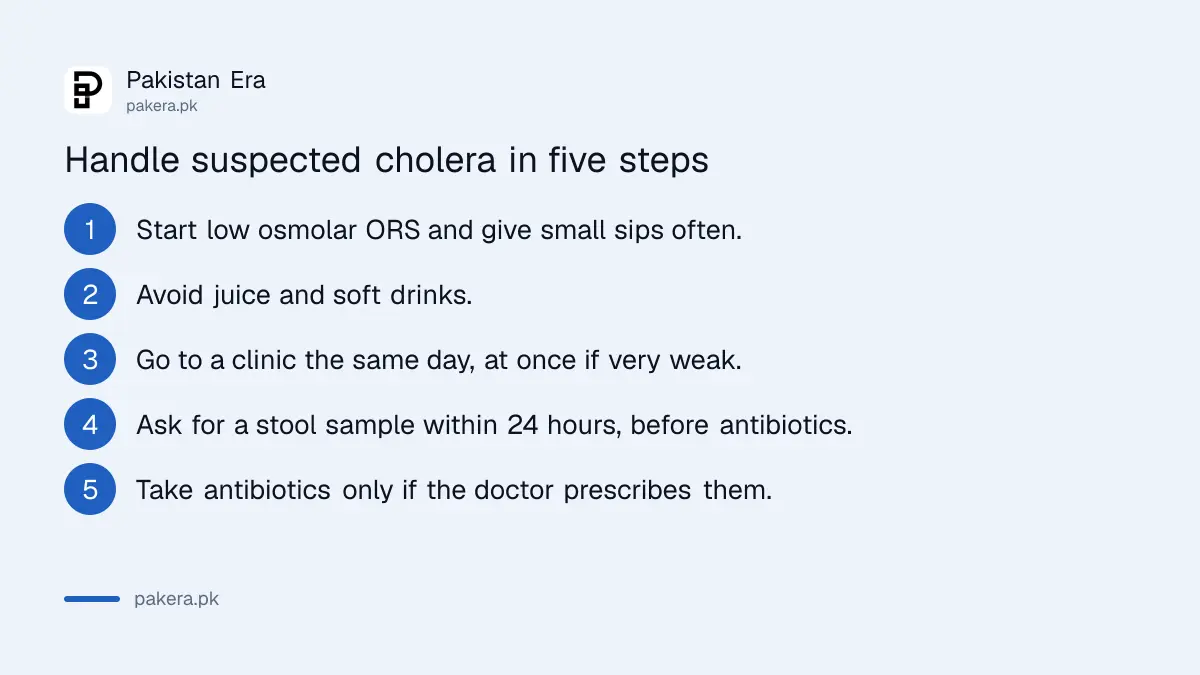
- Start low osmolar ORS and give small sips often.
- Avoid juice and soft drinks while the diarrhoea lasts.
- Go to a clinic or hospital the same day, and go at once if the person is weak, confused or cannot drink.
- Ask for a stool sample to be taken early, within 24 hours of onset and before antibiotics.
- Take antibiotics only if the doctor prescribes them.
NIH names doxycycline, ciprofloxacin, cefixime, co-trimoxazole and erythromycin as antibiotics that shorten the illness and the time the germ is passed in stool. It does not say a family should pick one. The doctor chooses.
One confirmed case or six cases together is an outbreak
NIH's surveillance rule is that one suspected case is an alert. One lab confirmed case, or a cluster of six or more watery diarrhoea cases in one place, is an outbreak. Cases in one mohalla, school or camp should be reported to the health department.
This matters now. In NIH's week 38 bulletin, Balochistan reported 247 suspected cholera cases in a week, 83 percent of the national total. The wider diarrhoea picture is in the week 38 diarrhoea count.
NIH says cholera can occur all year in Pakistan, but cases usually peak from May to November, in the hot, humid and wet season. We are still inside that window.
| Sign or step | What NIH says |
|---|---|
| Suspected case | 3 or more watery, non-bloody stools in 24 hours |
| Severe disease | About 5 to 10 percent of infections |
| Fluids | Low osmolar ORS, often, no juices or soft drinks |
| Children 6 months to 5 years | Zinc supplements immediately |
| Stool sample | Within 24 hours of onset, before antibiotics |
| Outbreak | One confirmed case or 6 or more cases in one place |
Boil or chlorinate water, and wash hands with soap
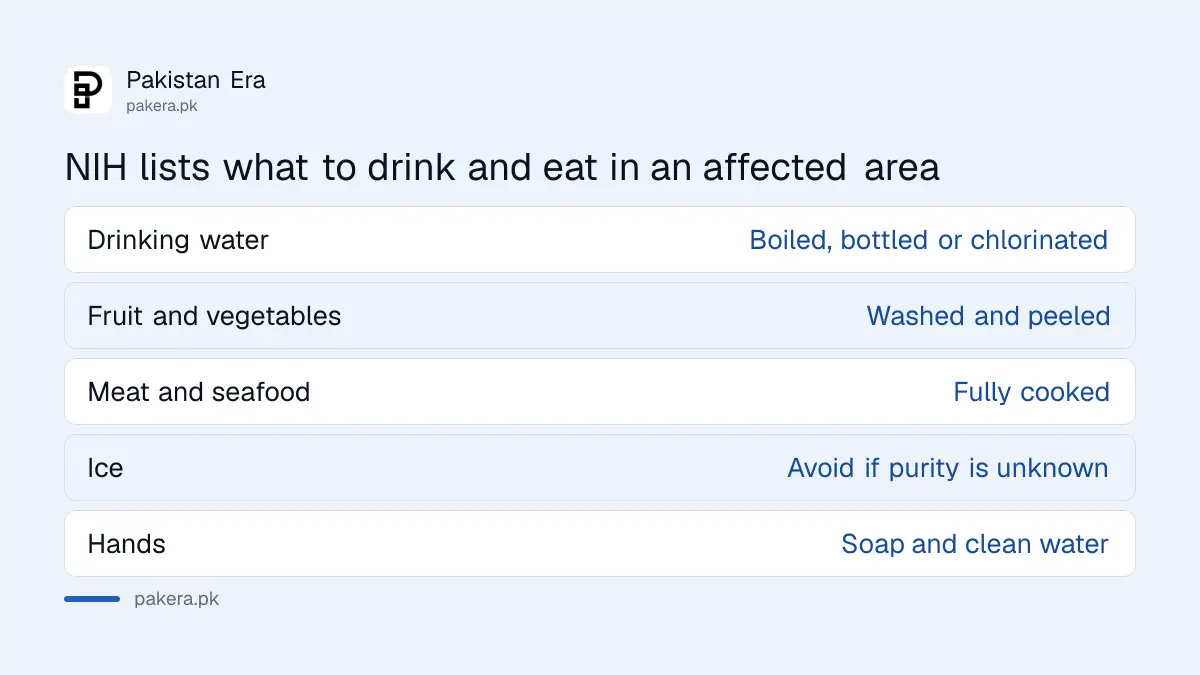
NIH says safe drinking water and sanitation break the chain. To make water safe, boil it or chlorinate it. In an affected area, drink only bottled, boiled or chemically treated water, and check that a bottle's seal is unbroken.
The advisory also asks people to avoid raw or undercooked meat and seafood, unpeeled or unwashed fruit and vegetables, and ice of unknown purity. Wash hands with soap and clean water. If there is none, use a hand cleaner with at least 60 percent alcohol.
For vaccination, NIH names a single dose oral cholera vaccine, Vaxchora, for adults aged 18 to 64 who travel to an area with active cholera. It says no cholera vaccine is 100 percent protective and none replaces clean water and hygiene. We did not check whether Vaxchora is registered or sold in Pakistan.
Common questions
How many loose stools mean suspected cholera?
Three or more watery, non-bloody stools in 24 hours. NIH uses this as its case definition, with or without signs of dehydration.
Can I give juice or a soft drink to someone with watery diarrhoea?
No. NIH says drinks with a high sugar content, such as juices and soft drinks, can make diarrhoea worse. Use low osmolar ORS instead.
Should a child get zinc?
Yes, if the child is aged 6 months to 5 years with suspected cholera. NIH says to start zinc supplements immediately, on a doctor's or health worker's advice.
When is a stool sample taken?
Early. NIH says fresh stool or a rectal swab should be collected within 24 hours of onset and before antibiotics, then sent to a lab for culture.
Do I need antibiotics for every watery diarrhoea?
No. NIH treats most cases with fluids. Antibiotics shorten the illness in cholera, but a doctor should choose and prescribe them.
How we verified this
What we checked, where we read it, and what we could not confirm.
Last checked on 13 October 2026, Pakistan time. We read the NIH advisories page and the advisory PDF on acute watery diarrhoea (cholera) dated 3 June 2024. Its list showed no newer cholera advisory. NIH gives the cholera contact as the Centers for Disease Control on 051-9255237. We could not check the current case counts beyond week 38, and this page does not replace a doctor.
About the author

Public Services and Education Journalist
Fajr Riaz is a journalist and content writer at Pakistan Era, based in Lahore. She covers the questions people meet in everyday life in Pakistan: how a public service works, what a change in the rules means, and where to find a reliable answer.