Pay Passport Fee by Raast QR in Pakistan, and KP Goes Cashless
DGIP now takes passport fees only by Raast QR scan, and KP wants every fee and fine paid digitally. How to pay, and what to do when the QR fails.
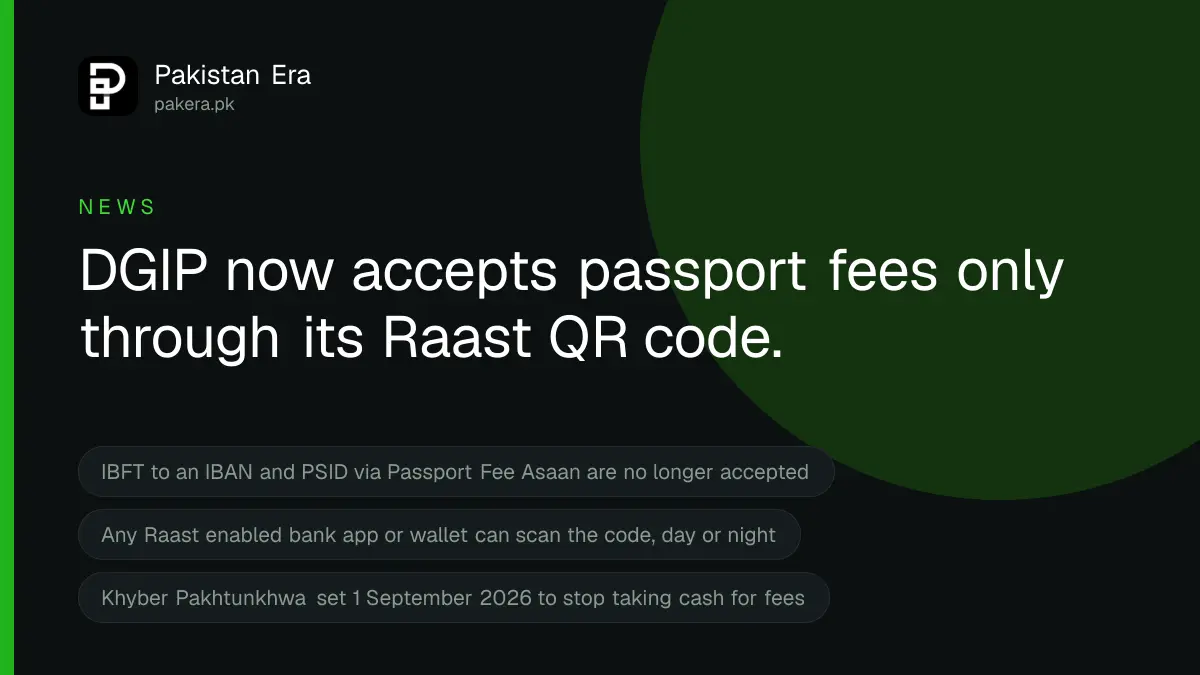
The Directorate General of Immigration and Passports now accepts passport fees only by scanning its Raast QR code. Its public notice says payments by IBFT to an IBAN, or by PSID through the Passport Fee Asaan app, will not be accepted. The change was reported on 11 September 2026, the same day National Bank of Pakistan announced it had switched passport fee collection to Raast person to merchant QR. Separately, Khyber Pakhtunkhwa set 1 September 2026 as the date every payment to the provincial government goes cashless.
Both changes push the same idea. The fee counter is closing, and the phone in your pocket is the new counter. The passport change is national and already in force. The KP change covers fees, fines and licences inside one province, and rests on a provincial gateway called PAYMIR. We read DGIP's notice, NBP's releases, SBP's Raast page and KP's own Cashless KP report to work out what a citizen actually has to do.
What changed for the passport fee?
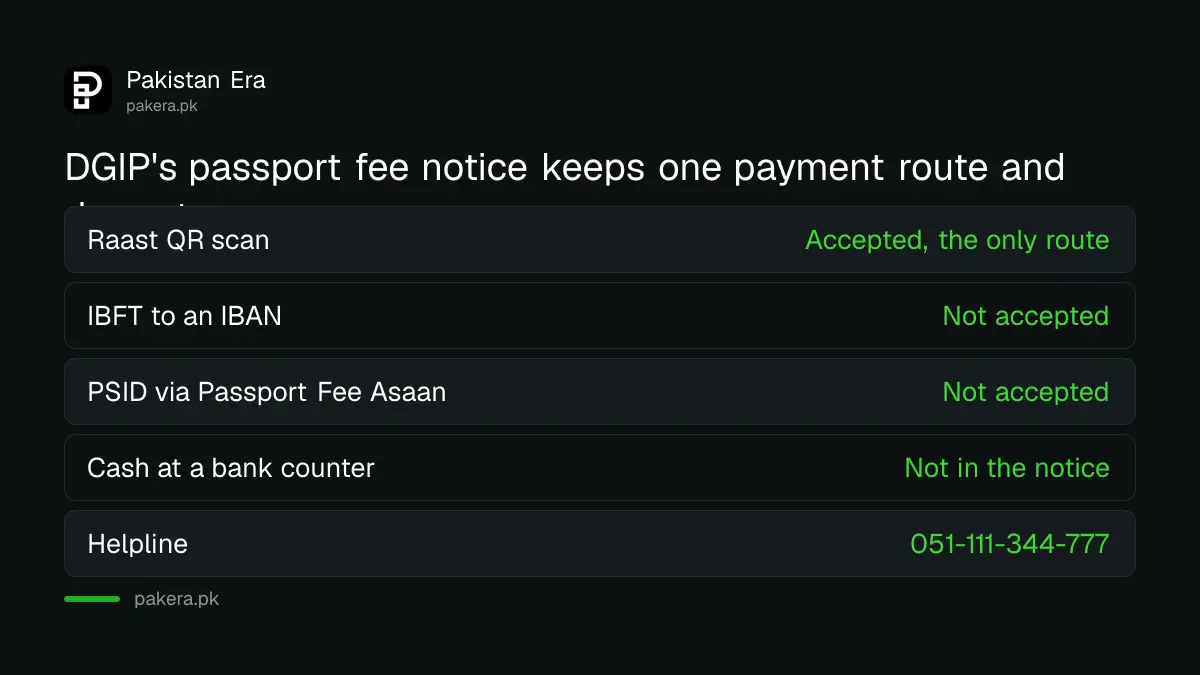
One route stays and two go. DGIP's notice, published as a graphic on dgip.gov.pk, says passport fee payments "will be accepted exclusively through scanning the RAAST QR Code", and that payments made through IBFT using an IBAN or through PSID via Passport Fee Asaan "will not be accepted".
The notice is undated. ProPakistani reported it on 11 September 2026, and it sits alongside an earlier DGIP graphic dated 1 July 2026 headed "Cashless Passport Fee Payment", in Urdu, which says: scan the QR code, pay, get your passport, with payment possible 24 hours a day from any banking app or digital wallet, and instant confirmation.
The bank behind the change is NBP. On 11 May 2026 it announced State Bank approval for the commercial launch of Raast person to merchant acquiring, which is the bank side of a QR payment. On 11 September 2026 it said it had "successfully enabled digital passport fee collections through Raast Person-to-Merchant (P2M) QR", allowing payment "through the mobile applications of participating banks". That release was carried by Business Recorder and ProPakistani; NBP's own press release list had not been updated past 28 August when we checked on 17 September.
| Payment route | Status under the DGIP notice |
|---|---|
| Scan the designated Raast QR in a bank app or wallet | Accepted, and the only route named |
| IBFT transfer to an IBAN | Not accepted |
| PSID generated in Passport Fee Asaan | Not accepted |
| Challan at a bank counter | Not mentioned in the notice |
One oddity is worth knowing before you go. DGIP's site still carries its Passport Fee Asaan poster, advertising PSID generation and payment under 1Bill and 1Link. The app has not been withdrawn from the page, only from the list of accepted payments. Do not let the poster talk you into a PSID.
How do you pay a passport fee by Raast QR?
Open a bank app or wallet that has Raast switched on, tap the scan option, point it at DGIP's passport fee code, check the payee name, pay the exact amount and keep the confirmation. The whole thing takes about a minute if your app already has Raast enabled.
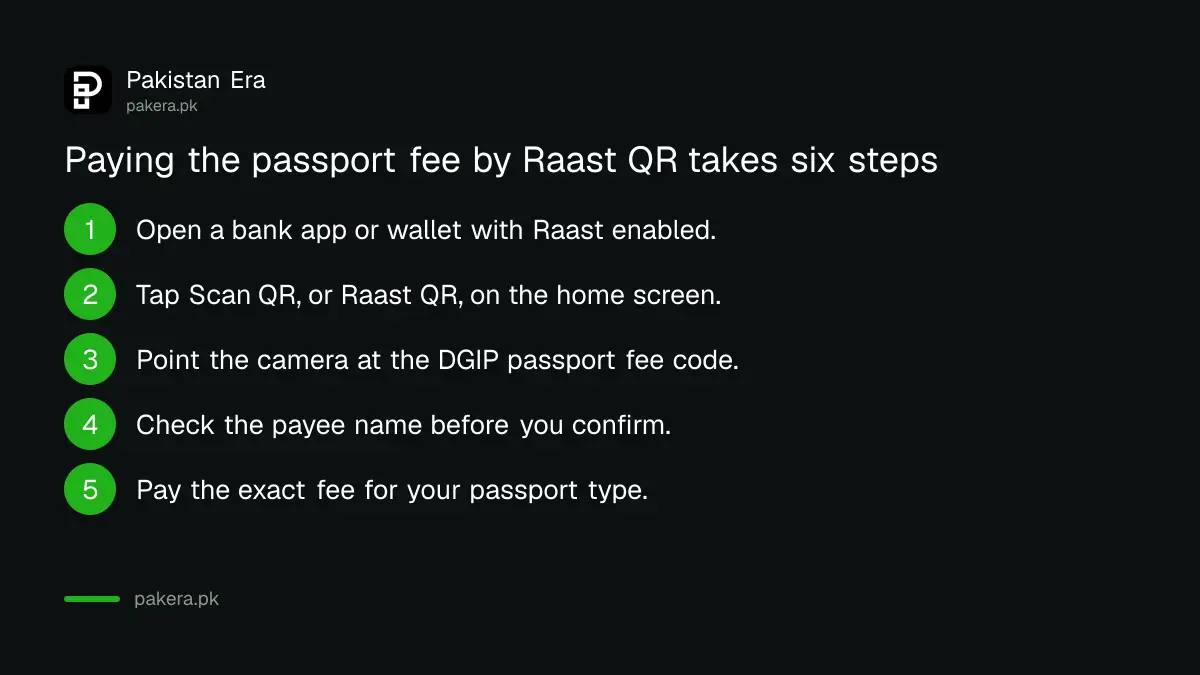
- Check that your bank app or wallet has Raast enabled. Most apps show it as Raast, Raast QR or Scan and Pay. If you have never set it up, the steps for linking Raast to your bank account take a few minutes and only need to be done once.
- Get to the fee step. DGIP's own process for applying for a passport puts the fee at the end, after registration and biometrics, so the code is presented when the fee falls due.
- Tap Scan QR and point the camera at the designated Raast QR code.
- Read the payee name on screen before confirming. It should name the passport directorate or its collecting bank, not a person.
- Pay the exact fee for your passport type and validity. Overpaying does not speed anything up, and underpaying leaves the application stuck.
- Save the confirmation screen and the transaction ID. The DGIP graphic promises instant confirmation, and that confirmation is your receipt at the counter, and the point from which tracking the passport by SMS starts.
Any Raast enabled app should work, because Raast is built for exactly this. SBP describes it as the national instant payment system for payments among individuals, businesses and government entities, run by Raast Payments Pakistan, a wholly owned SBP subsidiary, and designed for low cost, universal access across banks, microfinance banks and licensed wallets. DGIP's July graphic says the same in plainer words: any banking app or digital wallet, any hour.
Which banks had QR scanning live on the day is the part nobody has published. NBP's release says "participating banks", and we could not find a list. If your app shows no scan option, the fix is a different app, not a transfer.
What if the QR does not scan or the payment fails?
Try a second app before you try anything else, and never fall back to an IBFT. DGIP has said in writing that an IBAN transfer will not be accepted, so a failed QR followed by a bank transfer leaves you with money out and a fee still unpaid.
- The camera will not read the code. Clean the lens, add light, and hold the phone still. If the code is on a screen, raise the brightness.
- The app has no Raast option. Update it, or use another bank's app or a wallet on the same CNIC.
- Money left the account but no confirmation came. Wait a few minutes and check the app's transaction history. If it shows failed, the amount reverses through your bank, and the complaint goes to the bank first.
- The counter cannot see the payment. Show the transaction ID and ring DGIP's helpline on 051-111-344-777.
A PSID route may return. NBP's release says the bank and DGIP "explored further digital payment options, including a PSID-based alternate payment mechanism". Until DGIP says so on its own site, the notice stands and PSID is out.
Before you pay anything, make sure you are at the right office for the job. Renewals go through a different door from first applications, and what a NADRA centre can do for a passport renewal is narrower than most people assume.
How much is the passport fee right now?
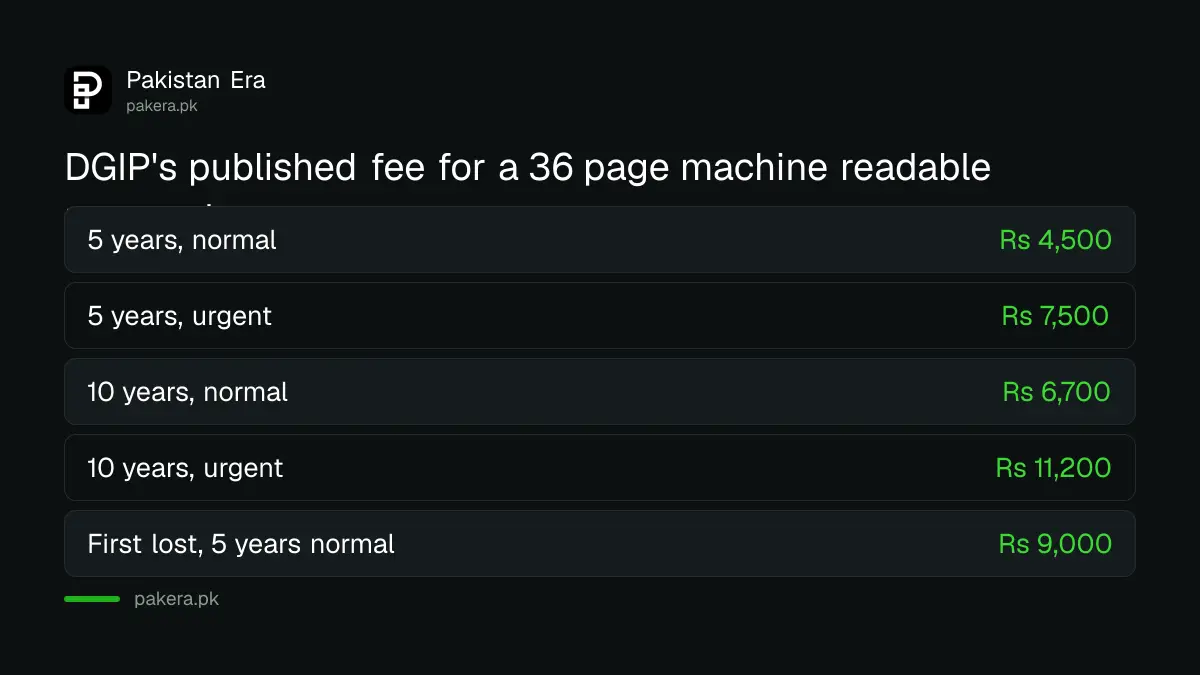
DGIP's published chart for the machine readable passport starts at Rs 4,500 for 36 pages with five years' validity on normal processing, and Rs 7,500 urgent. Ten years' validity is Rs 6,700 normal and Rs 11,200 urgent. The e-Passport carries its own fee table.
| Machine readable passport | 5 years normal | 5 years urgent | 10 years normal | 10 years urgent |
|---|---|---|---|---|
| 36 pages | Rs 4,500 | Rs 7,500 | Rs 6,700 | Rs 11,200 |
| 72 pages | Rs 8,200 | Rs 13,500 | Rs 12,400 | Rs 20,200 |
| 100 pages | Rs 9,000 | Rs 18,000 | Rs 13,500 | Rs 27,000 |
Those figures are from the fee chart image on dgip.gov.pk, headed as the enhanced fee. A first lost 36 page passport costs double, Rs 9,000 for five years normal. Fast track and e-Passport rates, and the Rs 12,500 fast track figure that most sites get wrong, are set out with the official passport fee rates, which is the page to read before you type an amount into the app.
The fee is the last step. DGIP's e-Passport page says an application can be converted from normal to urgent by paying the difference, so choose the validity and processing speed first, then scan.
What did Khyber Pakhtunkhwa change from 1 September 2026?
KP said every person to government payment, meaning fees, fines, permits and licence charges, goes cashless from 1 September 2026, through a provincial gateway called PAYMIR that takes Raast, 1Link, wallets, cards, QR at the counter and a USSD code for people without a smartphone. The province's own report says cash handling in government offices "shall be eliminated".
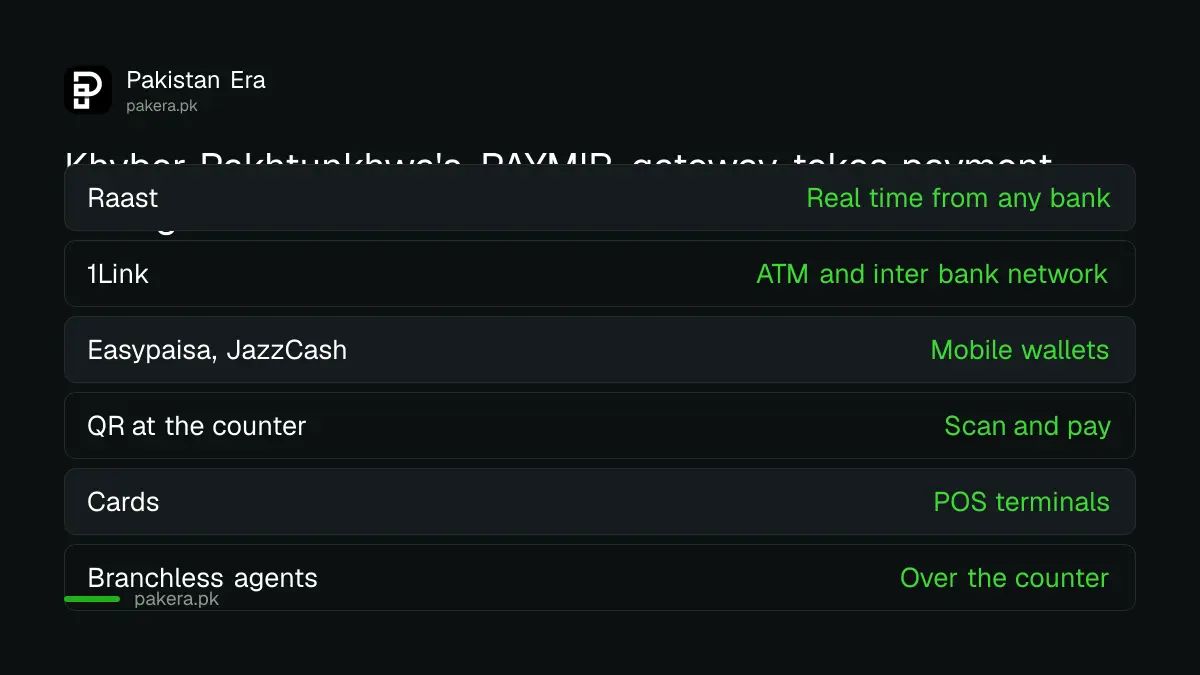
The target date comes from Dawn's report of 23 June 2026, in which officials said 170 services across 34 departments would be cashless by 1 September, with 148 already digitised. The mechanism comes from the Cashless KP Annual Report 2026 published by the Performance Management and Reforms Unit, which we read in full. PAYMIR is described as Pakistan's first provincial payment gateway, and every citizen payment to any department flows through it with real time credit to the right revenue head.
What that means at a district office, according to the report's own plan:
- A QR code at every public counter in district and tehsil offices, hospitals, police stations and excise offices, across all 35 districts, including challan counters at district police headquarters.
- Payment from any bank in Pakistan through Raast, or from a basic phone by dialling *786# for an Asaan Mobile Account, with no smartphone or internet needed.
- Citizen Facilitation Centres as assisted digital points for people who cannot do the payment themselves, with staff helping on the application, the payment and the QR verification.
- A dispute button built into the payment SMS, so a wrong or double payment can be flagged from the phone.
- Disciplinary action against any official who accepts cash or issues a manual paper receipt for a notified service, under what the report calls a sunset clause.
The money already moving through it is real. The report puts digital receipts into Account-I, the main government revenue heads, at Rs 7,969,822,684 between March 2025 and March 2026, from a standing start of zero in March 2025.
Two cautions. First, we could not find a KP Finance Department notification confirming that counters stopped accepting cash on 1 September, so the date is a target announced to the press and repeated in the report, not a notified cutoff we have read. Second, the Khyber Pakhtunkhwa Promotion of Digital Payments Bill 2026, which would make shops and clinics accept digital payment, shows on the Provincial Assembly's own site as introduced on 6 April 2026 and referred to the finance committee. Express Tribune reported its passage on 22 August 2026, and until the Assembly's page catches up that is reported. For a traffic fine, the routes to check an e-challan in any province already end in a digital payment, which is what KP is now making the only option.
Common questions about paying government fees by Raast QR
Can I still pay the passport fee at a bank counter?
The DGIP notice does not mention counters at all. It names Raast QR as the exclusive route and rules out IBFT and PSID. Ask the passport office before you queue at a bank.
Does a Raast QR payment cost extra?
DGIP's notice mentions no charge, and SBP describes Raast as a low cost system. Whether your own bank adds a fee is a question for the bank, and the app shows any charge before you confirm.
Which app should I use?
Any bank app or wallet with Raast enabled. NBP says "participating banks" without naming them, so if one app has no scan option, try another on the same CNIC.
I paid by IBFT before the notice. Is my fee lost?
Ask the passport office with your transfer receipt. The notice is about payments from now on, and we have not seen DGIP say anything about transfers made earlier.
Does the KP change affect the passport fee?
No. Passports are federal and the Raast QR rule is national. KP's cashless rule covers provincial fees, fines, permits and licences paid to KP departments.
I do not have a smartphone. How do I pay a KP fee?
KP's report says you can pay from a basic phone by dialling *786# for an Asaan Mobile Account, or get help at a Citizen Facilitation Centre.
How we verified this
What we checked, where we read it, and what we could not confirm.
Last checked 17 September 2026. We read DGIP's public information graphic on dgip.gov.pk, which says passport fee payments will be accepted exclusively through scanning the Raast QR code and that payments through IBFT using an IBAN or through PSID via Passport Fee Asaan will not be accepted, with the helpline 051-111-344-777; the graphic carries no date, and ProPakistani reported it on 11 September 2026. We read DGIP's Urdu graphic dated 1 July 2026 headed Cashless Passport Fee Payment, which says to scan the QR code, pay and get your passport, with payment available 24 hours a day from any banking app or digital wallet and instant confirmation. We read DGIP's fee chart image headed Enhanced Passport Fee, which is the source for every rupee figure in the fee table, and DGIP's Passport Fee Asaan poster, still on the site on 17 September. We read NBP's press release of 11 May 2026 on approval for the commercial launch of Raast P2M acquiring on nbp.com.pk, and NBP's press release list, which on 17 September ended at 28 August 2026. NBP's release on passport fee collection through Raast P2M QR, including the visit by Director General Immigration and Passports Ch. Muhammad Ali Randhawa to NBP's Karachi head office, the quote from Abdul Wahid Sethi and the PSID based alternate mechanism under discussion, is taken from Business Recorder of 12 September 2026 and ProPakistani of 11 September 2026 and is reported. The Director General's own test payment by QR in August 2026 is from Daily Ausaf of 12 September 2026 and is reported. We read SBP's Raast page at sbp.org.pk, which describes Raast as the national instant payment system operated by Raast Payments Pakistan (Private) Limited. We read the Government of Khyber Pakhtunkhwa's Cashless KP Annual Report 2026 from the Performance Management and Reforms Unit at pmru.kp.gov.pk, which is the source for PAYMIR, its seven payment channels, the elimination of cash handling, the QR deployment plan for 35 districts, the *786# Asaan Mobile Account route, Citizen Facilitation Centres, the dispute button, the disciplinary sunset clause and the Rs 7,969,822,684 in Account-I digital receipts from March 2025 to March 2026. The 1 September 2026 date, the 170 services in 34 departments, the 148 already digitised and the Mahasil app are from Dawn of 23 June 2026 and are reported. We read the Provincial Assembly of Khyber Pakhtunkhwa's pages for the Promotion of Digital Payments Bill 2026, Bill No 84, introduced 6 April 2026 and referred to Standing Committee No 10 on Finance, and for the Finance Bill 2026, passed 24 June 2026; the report that the Assembly approved the digital payments bill is from Express Tribune of 22 August 2026. We could not confirm which banks' apps had Raast QR scanning live for the passport fee, whether any bank charges for the payment, or that KP counters stopped taking cash on 1 September, and the article says so at each point.
About the author

Tax, Bills and Technology Writer
Ali Akhtar is a young and curious voice here at Pakistan Era. He is currently pursuing his A-Levels and has a growing interest in Pakistan’s changing industrial landscape and educational trends. Ali likes to write in a way that helps him explain and explore the world around him. His writing reflects the perspective of the new generation navigating the evolving trends of Pakistan where technology, youth innovation, and shifting opportunities are reshaping the country’s future.