Pink Eye in Pakistan: What the NIH Advisory Says to Do, and Not to Do
NIH says viral pink eye is contagious and usually clears alone. See its advisory on staying home, hand washing, no antibiotics and when to see an eye doctor.
Short answer: The National Institute of Health (NIH) in Islamabad says viral conjunctivitis, or pink eye, is highly contagious and usually clears by itself. Its advisory tells people with symptoms to stay home for 5 to 7 days, wash hands often, not share towels or eye drops, and avoid antibiotics, which do not work on a virus. Go to an eye doctor if it is severe or does not improve.
Pink eye spreads fast in homes, schools and offices because the virus passes on hands, towels and pillows. Parents often rush to the pharmacy for antibiotic drops. The NIH advisory says that is the wrong move for a viral infection.
We read the NIH advisory on conjunctivitis on 12 October 2026. It is dated September 2025, and it is the latest conjunctivitis advisory on the NIH list. We could not find a 2026 one, and we have no official figure for cases this season.
NIH says viral conjunctivitis is contagious and mostly mild
NIH describes viral conjunctivitis as a highly contagious eye infection, usually caused by an adenovirus. The eye becomes pink or red, with watery or pus-like discharge, a gritty feeling, swollen lids and sensitivity to light. It often starts in one eye and moves to the other.
The advisory says symptoms are typically mild and settle without treatment. It also says there is no cure for the viral form, so treatment aims at easing symptoms. Bacterial and allergic types exist, and the advisory is about the viral kind. An eye doctor can tell you which one you have.
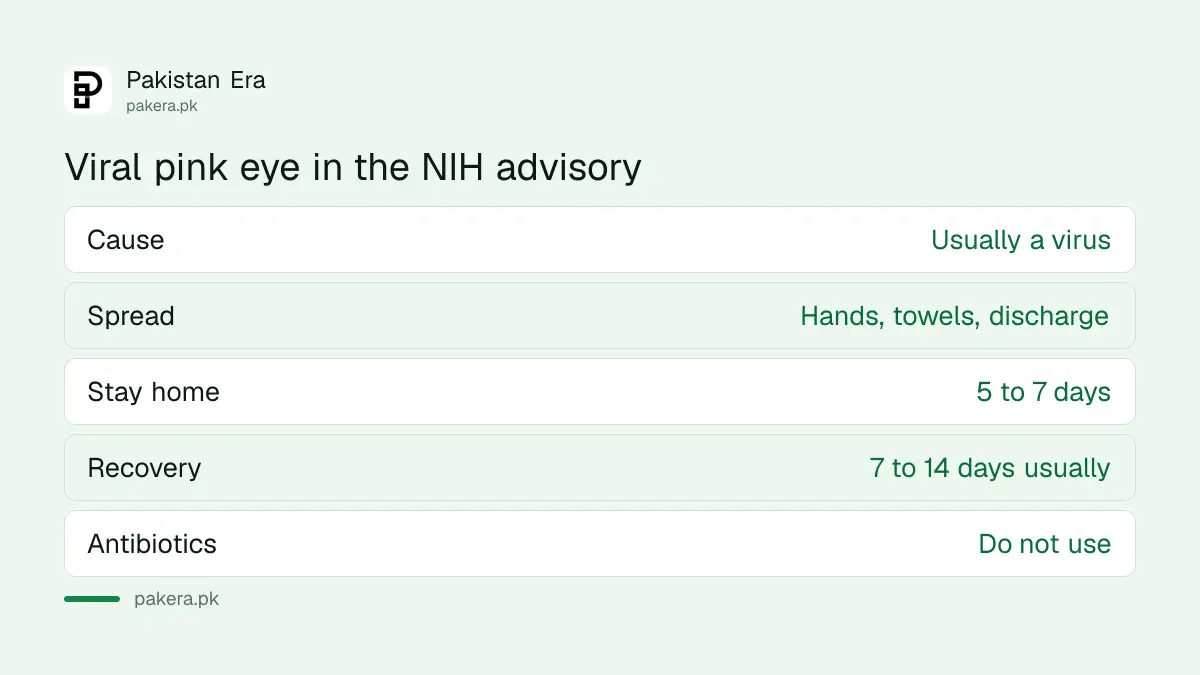
| Point | What the NIH advisory says |
|---|---|
| Cause | Usually a virus, often an adenovirus |
| Spread | Eye discharge, contaminated hands, shared towels, bedding, makeup |
| Incubation | Up to 12 days |
| Recovery | Usually 7 to 14 days, up to 2 to 3 weeks in all |
| Antibiotics | Do not use, they are ineffective against viruses |
Stay home for 5 to 7 days and keep children out of school
The advisory says anyone with symptoms should stay home for 5 to 7 days to stop the spread. It says children with conjunctivitis should not go to school or daycare until their symptoms have gone. The NIH wording is "until their symptoms have resolved".
Its prevention list is simple. Wash hands with soap and water for at least 20 seconds, or use an alcohol-based sanitiser if there is no soap. Do not touch or rub the eyes. Do not share towels, pillows, handkerchiefs, makeup or eye drops.
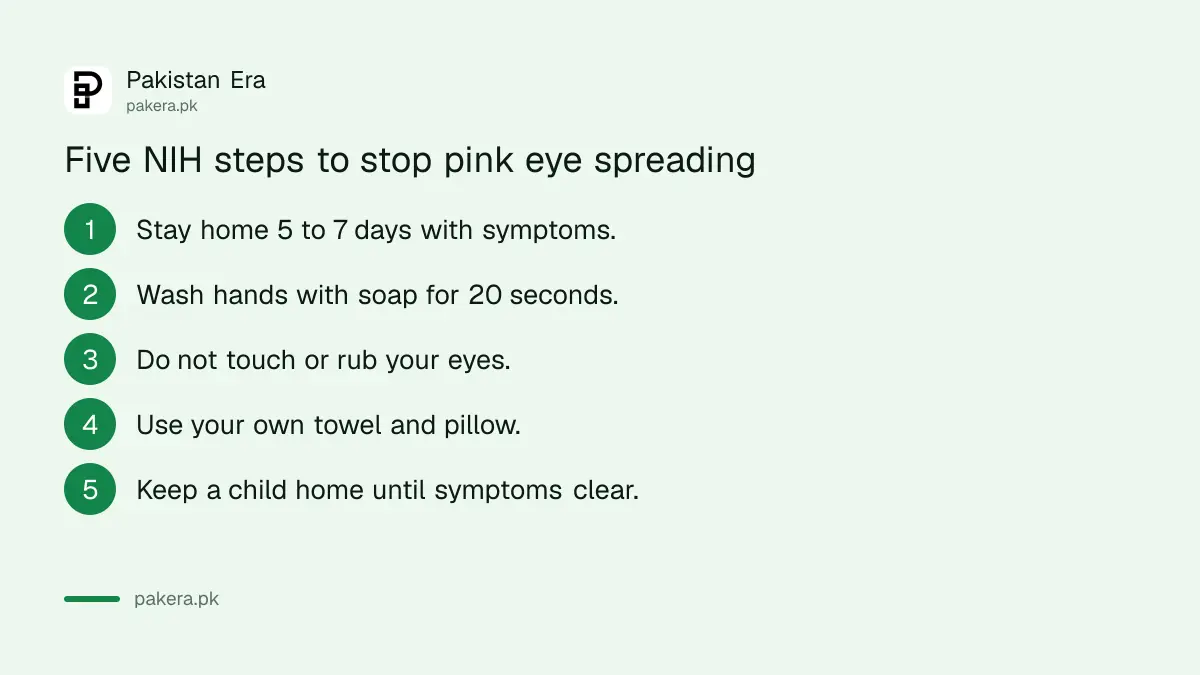
- Stay home for 5 to 7 days if you have symptoms.
- Wash your hands with soap for at least 20 seconds, often.
- Do not touch or rub your eyes.
- Use your own towel, pillow and handkerchief.
- Keep an affected child at home until symptoms have gone.
Eases symptoms only: compresses and artificial tears, no antibiotics
NIH lists warm or cool compresses and lubricating eye drops, called artificial tears, to ease discomfort. It says not to use antibiotics because they are ineffective against viral infection. Severe cases, or cases that do not improve, should be referred to an ophthalmologist, an eye specialist.
We give no further treatment advice. Contact lens wearers, babies, and anyone with pain, a change in vision or an eye injury should see a doctor and not wait. The advisory itself says a suspected case is a red eye without another obvious cause such as injury or contact lens use.
Before you buy any eye drops, you can check a medicine is registered with DRAP, and you can check a doctor is registered with PMDC before a visit. If you need a low cost eye clinic, our guide to free eye care and cataract surgery in Pakistan lists where to go.
The NIH figures on stay-home and recovery time do not all match
The advisory says a case usually clears within 7 to 14 days. It also says the whole course is two to three weeks, and that symptoms often worsen for the first three to five days. These are not contradictory, but a reader may take "stay home 5 to 7 days" to mean it is over by then.
The advisory gives no rule for returning to work. For a child, it says to wait until symptoms have resolved. For adults, ask your doctor. Keep up the hand washing after the stay-home period, because eye discharge is the way the virus spreads.
Floods and crowded shelters raise the risk, and NIH asks for isolation areas
The advisory was written after the 2025 floods. It says floodwater is often mixed with sewage, and tells people to avoid contact, to wear goggles if they must enter it, and to wash with clean, boiled or disinfected water. It asks relief workers to set up isolation areas in shelters and give out soap.
That advice is aimed at flood-hit districts and relief camps. For homes and schools, the five steps above are the main ones. Our guide to the NIH weekly bulletin shows how to look up which diseases are being reported in your district.
Common questions
Do I need antibiotic eye drops for pink eye?
NIH says not to use antibiotics for viral conjunctivitis, because they are ineffective against viruses. See an eye doctor to learn which type you have.
How long does viral pink eye last?
NIH says it usually clears in 7 to 14 days, with a total course of two to three weeks. Symptoms often get worse for the first three to five days.
How long should I stay home?
NIH says 5 to 7 days for anyone with symptoms. A child should stay out of school or daycare until symptoms have resolved.
How does pink eye spread?
It spreads through eye discharge, contaminated hands and shared items such as towels, bedding and makeup. Washing hands and not sharing items cuts the risk.
Is there a pink eye outbreak in Pakistan right now?
We could not find a 2026 NIH advisory or an official case count. The advisory we read is dated September 2025, so we do not claim a current surge.
When should I see an eye doctor?
NIH says severe cases, or those that do not improve, should be referred to an ophthalmologist. Pain, a change in vision or an eye injury should not wait.
How we verified this
What we checked, where we read it, and what we could not confirm.
We read the NIH Center for Disease Control advisory on conjunctivitis, issued September 2025, from the list at nih.org.pk, on 12 October 2026. The NIH list shows no newer conjunctivitis advisory. This page is general information and not medical advice.
About the author

Public Services and Education Journalist
Fajr Riaz is a journalist and content writer at Pakistan Era, based in Lahore. She covers the questions people meet in everyday life in Pakistan: how a public service works, what a change in the rules means, and where to find a reliable answer.