How to Reactivate a Dormant Bank Account
A dormant account still holds your money. How dormancy works, what counts as activity, and the branch steps that clear it, including from abroad.
A dormant account is not a closed account and the money is still yours. An account in Pakistan is generally marked dormant after one year with no customer activity, and reopening it takes a written request at the branch with a valid CNIC. The balance does not disappear at that point.
What does change is access. A dormant account stops accepting the ordinary debit instructions, so the card fails, the transfer is refused and the cheque bounces, usually at the worst possible moment. Here is how the status works and how to clear it.
Dormant, then unclaimed, and the gap between them is long
Two different things happen at two very different points, and people confuse them.
| Stage | When | What it means |
|---|---|---|
| Active | Normal use | Everything works |
| Dormant | After about one year of no activity | Debits blocked, money still in the account |
| Unclaimed deposit | 15 years with no transaction and no statement requested (section 31, Banking Companies Ordinance 1962, as amended in 2024) | Surrendered by the bank to the State Bank after 3 months' notice, and still claimable. See how to claim an unclaimed deposit |
| Claimed back | Any time after that | Recoverable through the bank, with verification |
Even at the last stage the money is not lost. It is held rather than forfeited, and it is claimed through the bank where the account was opened, or through another branch of the same bank if that one has closed. The State Bank verifies the claim and returns the amount to the bank to credit.
The reason to act early is not that the money vanishes. It is that every extra year adds verification steps, and old addresses, expired cards and changed phone numbers make each one harder.
What counts as activity, and what does not
This is where accounts get caught out. Interest or profit credited by the bank, and charges deducted by the bank, are usually the bank's own entries rather than yours. An account that only shows those can still be treated as inactive because the customer has not operated it.
A deposit, a withdrawal, a transfer you instruct, or a cheque you issue is customer activity. If you keep an account open for occasional use, put one small transaction through it a year and the question never arises.
Reopening it at the branch
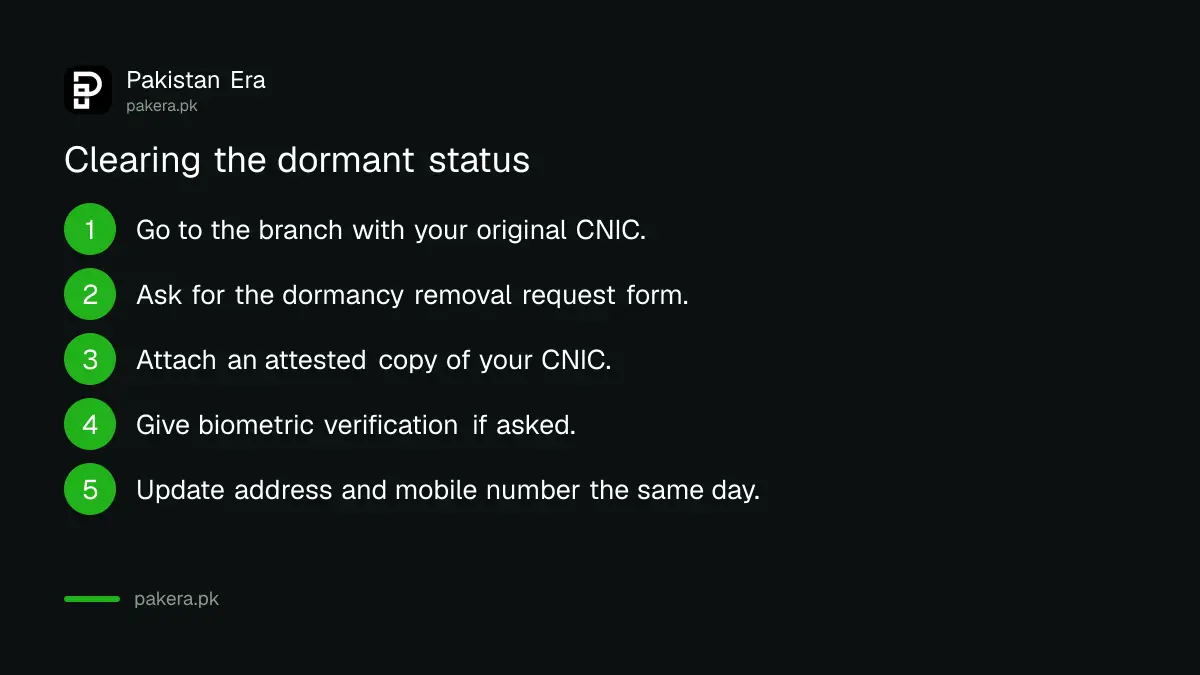
- Go to the branch where the account is held, in person, with your original CNIC.
- Ask for the dormancy removal request form and complete it.
- Attach an attested copy of your CNIC, or let the officer see the original and mark it.
- Give a biometric verification if the branch asks for one.
- Update your address, mobile number and any expired documents at the same visit.
Expect a customer due diligence check. The bank is required to satisfy itself about who you are and, in some cases, where the funds came from, so answer plainly and bring supporting paperwork if the balance is significant.
An expired CNIC is the usual reason it fails
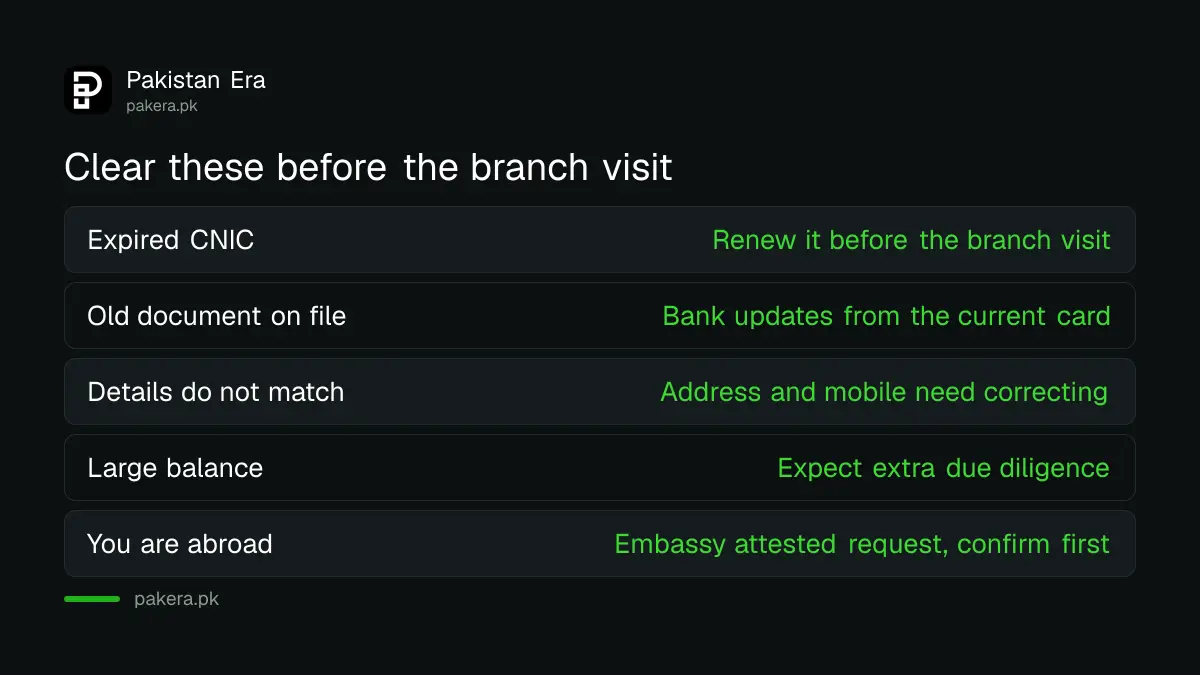
Accounts and identity documents tend to lapse together. If the CNIC the bank holds has expired, or the account was opened on a document you no longer have, the branch cannot complete the check no matter how cooperative it wants to be.
Renew the card first. Our guide on renewing an expired CNIC covers the routes, and doing it before the branch visit saves a second trip. Take the new card and let the bank record it, because the account details are updated from the current document.
If you are overseas
Reactivation normally expects you in person, which is a problem from abroad. The reported route is a scanned written request attested by the Pakistani embassy or high commission, sent from your registered address or email, together with scanned identity documents, the passport pages, visa and proof of residence, and an undertaking covering the absence of biometric verification.
Requirements differ between banks and change, so confirm the current list with your own bank before you pay for attestation. Numbers for the major banks are in our list of bank helplines, and getting the requirement in writing by email is worth the extra day.
Nobody needs a fee to unfreeze your account
Dormancy removal is a branch procedure done on a form. It is not a service that requires an agent, and no legitimate process asks for your PIN, your one time password or a payment to a personal account to release your own money.
Treat a call about a frozen or dormant account with suspicion, particularly one that arrives with urgency and asks you to confirm details. Banks do not restore access over the phone by collecting your codes. Go to the branch instead and let them look up the account. If a card attached to the account has gone missing in the meantime, deal with that separately and immediately, and blocking the card is the first move rather than the last.
Common questions about dormant accounts
Does a dormant account lose the money in it?
No. The balance stays, and even after long term unclaimed deposits are surrendered to the State Bank the amount remains recoverable through the bank.
Can I reactivate it through the app?
Usually not. Dormancy removal is normally a branch procedure with identification, though some banks offer partial help through their helpline. Ask your own bank.
How long does reactivation take?
Often the same day once the paperwork and verification are complete. Delays come from an expired CNIC, a mismatch in recorded details, or a balance that triggers extra checks.
Is there a charge to remove dormancy?
Practice varies between banks. Ask what the schedule of charges says before you sign, and be wary of any amount requested outside the bank's own counter or system.
What if the branch has closed down?
Go to another branch of the same bank. Mergers and closures are common and the account record moves with the bank, not with the building.
How we verified this
What we checked, where we read it, and what we could not confirm.
Last checked 26 August 2026. The dormancy period, the long term surrender of unclaimed deposits to the State Bank, the written request and attested CNIC requirement, and the overseas attestation route are as published by banks in their own account terms and as reported of State Bank rules. We could not read a single State Bank circular setting all of it out in one place, so the periods and requirements here are described as general practice rather than quoted from one instrument, and individual banks differ in detail. We hold no dormant account and did not reactivate one, so nothing here describes a case we ran ourselves. Confirm the current requirement with your own bank before travelling or paying for attestation.
About the author

Public Services and Education Journalist
Fajr Riaz is a journalist and content writer at Pakistan Era, based in Lahore. She covers the questions people meet in everyday life in Pakistan: how a public service works, what a change in the rules means, and where to find a reliable answer.