Respond to a Gas Utility Court Summons From SNGPL or SSGC in Pakistan: You Have 21 Days
A Gas Utility Court summons gives you 21 days to apply for leave to defend. See the 2016 Act time limits, the papers you need, appeal rights and penalties.
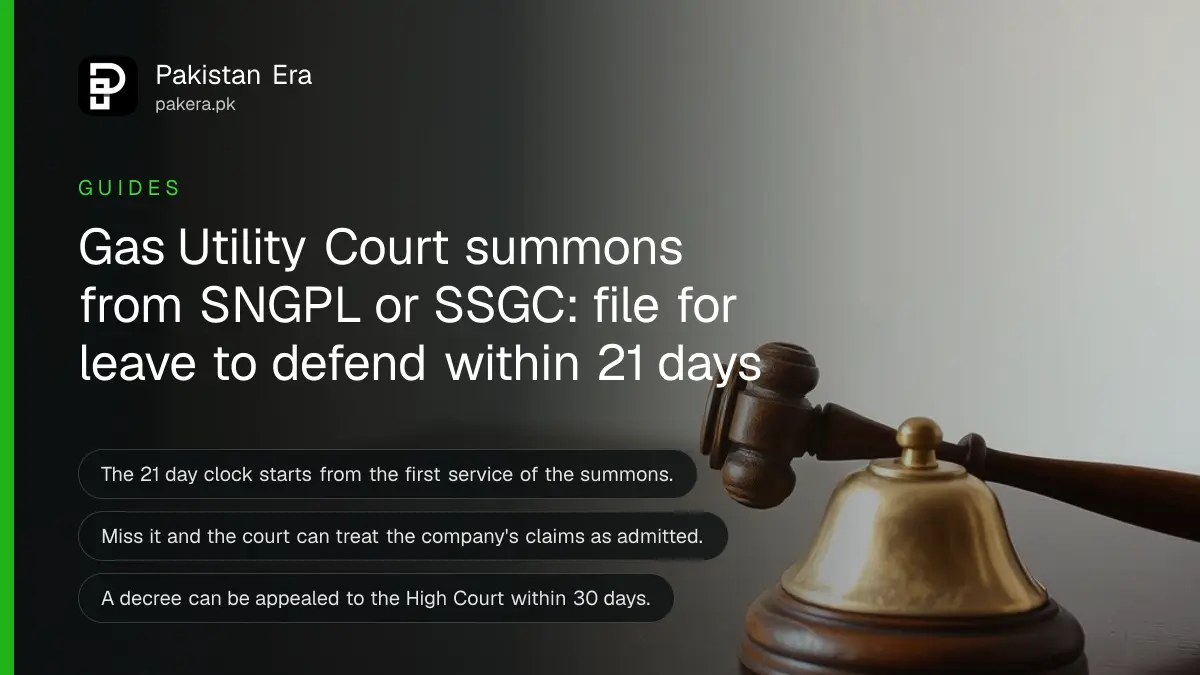
Short answer: If a Gas Utility Court summons you over a gas bill, you have 21 days from the first service to file an application for leave to defend. Miss it and the court can treat the company's claims as admitted and pass a decree. This is general information, not legal advice. Speak to a lawyer at once.
The envelope says "Gas Utility Court". It names SNGPL or SSGC and a large number. Many people put it aside because it looks like another bill. That is the costly mistake.
We read the Gas (Theft Control and Recovery) Act, 2016 on 13 October 2026, as published on the Pakistan Code website. The sections and numbers below come from it. The Act applies to all of Pakistan. We are not lawyers, and a court order in your case will always decide what applies to you.
Gas Utility Courts hear billing disputes and recovery suits
A Gas Utility Court is a special court run by a District and Sessions Judge. Under section 6 it hears three things: gas offences, sums due or recoverable, and a consumer's dispute with a gas company about billing or metering.
Both sides can file. A company can sue for unpaid dues. You can file a complaint about a bill or a meter. The plaint must be supported by a gas sales agreement, a gas bill or similar papers. Section 4 gives the court exclusive jurisdiction over matters the Act covers.
A Supreme Court ruling reported in January 2025 is said to confirm that billing and metering disputes belong to this court. We could not open the judgment on the court's own site, so treat that as reported.
The 21 day clock starts when the summons is served
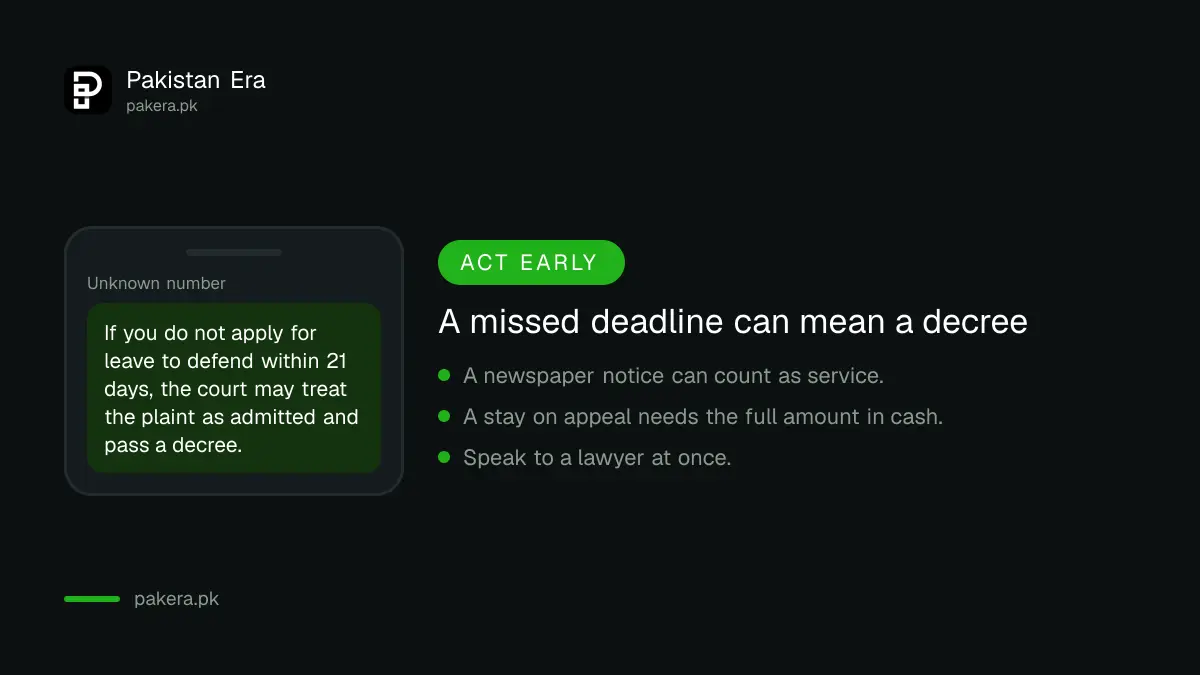
Under section 7, you may not defend the suit unless the court gives you leave to defend. You must file the application within 21 days of the first service of the summons. If you do not, the allegations in the plaint are treated as admitted and the court may decree against you.
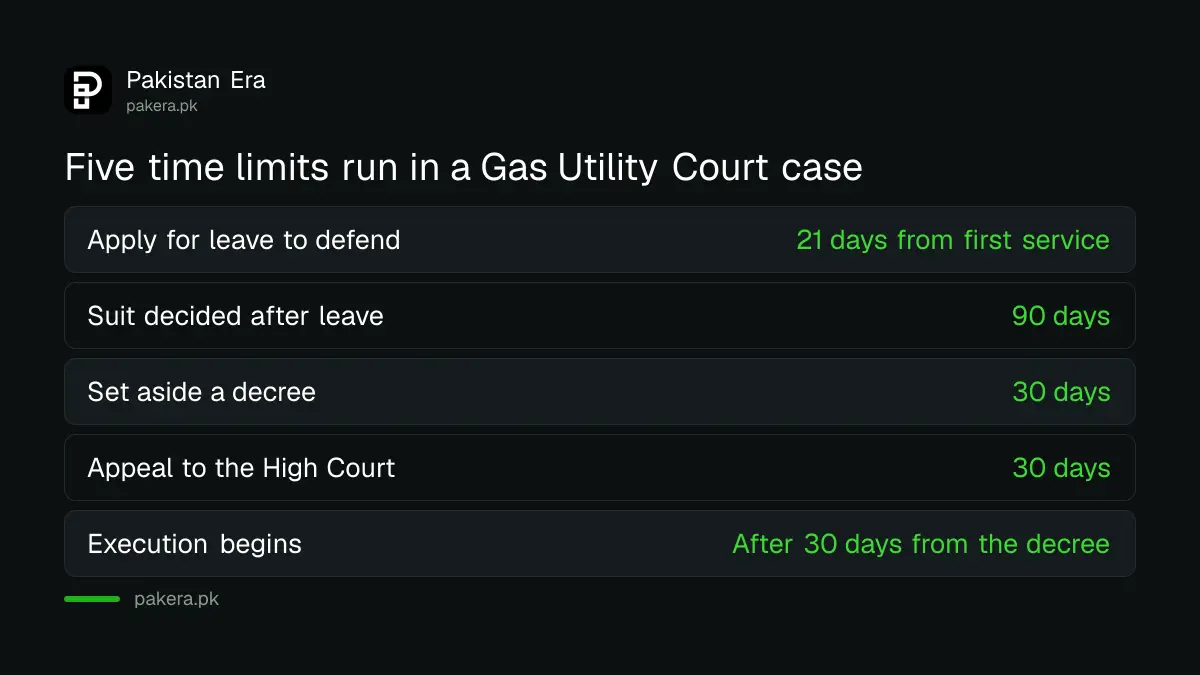
| Step | Time limit | Section |
|---|---|---|
| Apply for leave to defend | 21 days from first service | 7(2) |
| Suit decided after leave is granted | 90 days from the grant | 9(1) |
| Apply to set aside a decree | 30 days from the decree | 8 |
| Appeal to the High Court | 30 days from the decree | 13(1) |
| Decree starts to be executed | On expiry of 30 days from the decree | 10(1) |
The summons can reach you in four ways: by the court's bailiff, by registered post, by courier, or by notice in an English and an Urdu newspaper. Service by any one of these counts as valid. A newspaper notice can start your clock even if you never saw the envelope. If service was only by newspaper, the court may extend the time when you show you did not know.
What your application for leave to defend must contain
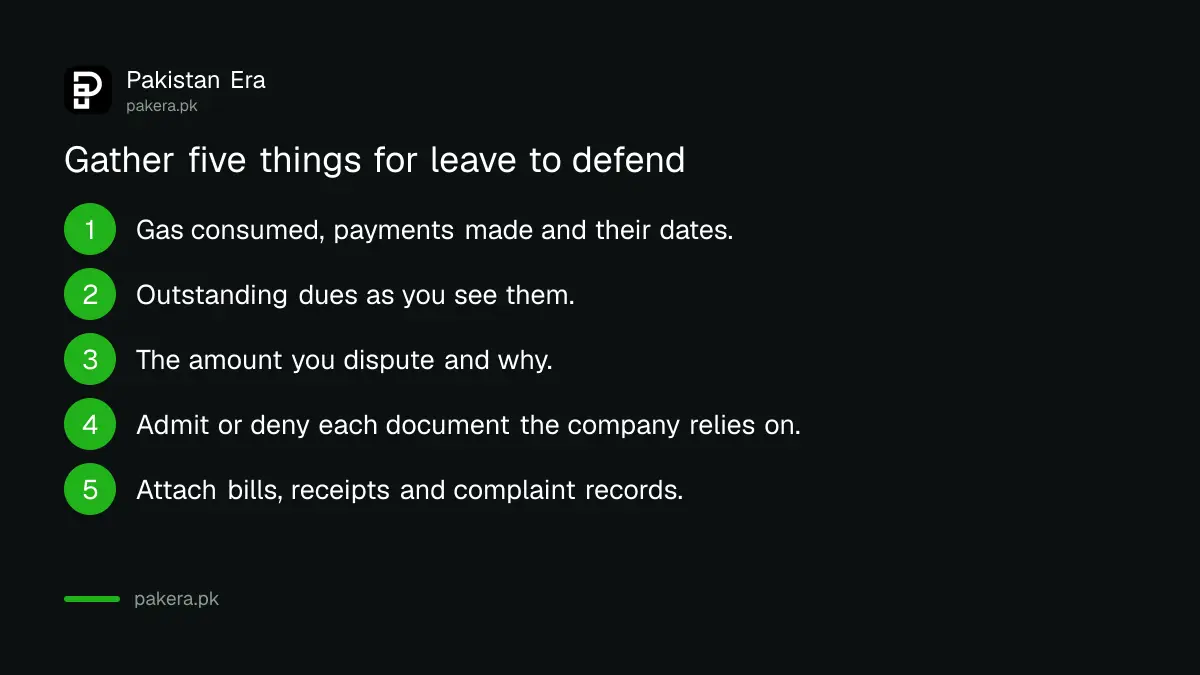
The application is a written statement. It must raise substantial questions of law or fact that need evidence. It must also set out the figures, so gather your papers before you see a lawyer.
- The gas supplied and consumed, what you paid and the dates of payment, up to the date the suit was filed.
- The outstanding dues, as you see them.
- The amount you dispute, and the facts behind that.
- A statement that admits or denies each document the company relies on.
- All your supporting documents attached: bills, receipts, meter photographs, complaint numbers.
Section 7(6) says an application that misses these requirements shall be rejected unless you show sufficient cause. If the court grants leave, it may attach conditions, including a cash deposit or security. Receipts and complaint records are the strongest papers, so keep every one. The steps in why a gas bill is estimated or minimum and in reading an SSGC bill show what to look for on the bill itself.
If you miss the deadline or lose the case
A decree passed because you did not defend can be challenged. Under section 8 you may apply within 30 days of the decree to set it aside, if you were prevented by sufficient cause or the summons was not duly served. The court may set conditions, such as a cash deposit or security.
Appeals go to the High Court within 30 days. A stay is not automatic. Section 13 says that no stay is granted unless the appellant deposits in cash the full decretal amount with costs in the High Court, though the court may reduce that if the stay covers only part of it. A stay lapses after six months.
The decree is executed as an ordinary decree or as arrears of land revenue, with help from the police if needed. The company has a second route too. Section 27 lets it apply to the District Collector with a certificate of the amount outstanding, and the Collector recovers it as arrears of land revenue.
Tampering and theft carry fixed penalties
The Act is not only about bills. Sections 14 to 19 create offences. Section 16 punishes a domestic consumer who tampers with a meter, regulator or connection with imprisonment up to six months, a fine up to Rs 100,000, or both. Section 17 sets five to ten years or a fine up to Rs 5 million for industrial and commercial consumers.
Section 22 suspends gas supply for one year to anyone convicted under sections 14 to 19, unless the court orders an earlier resumption. A Gas Utility Court cannot take cognizance of an offence except on a written complaint by a person the company has authorised.
Tenants should note one definition. The Act's "successor-in-interest", the person who can be chased for earlier dues on a premises, does not include a person who occupies it merely as a tenant. How that applies to your case is for a lawyer. How to report theft is in the guide to reporting gas theft.
Common questions
Is a Gas Utility Court summons the same as a bill?
No. It is a court summons for a suit or a complaint. A bill asks for payment. A summons starts a legal clock, which is 21 days to apply for leave to defend.
Can I still complain to the gas company instead?
You can, and the steps are in how to complain to SNGPL or SSGC. A complaint does not stop a court clock. Section 5 gives the Gas Utility Court exclusive reach over its matters, with a saving for remedies otherwise available, so ask a lawyer which forum fits.
Do I need a lawyer?
We advise one. The application for leave to defend has strict content rules, and a defective one is rejected.
Can the court make me pay a deposit?
Yes. If leave to defend is granted, the court may impose conditions, including a cash deposit or security. In an appeal, a stay needs a cash deposit of the decretal amount.
What if the court finds the case was frivolous?
Section 9(4) lets the court direct compensation of up to one million rupees to be paid to the other party when proceedings are frivolous or vexatious.
How we verified this
What we checked, where we read it, and what we could not confirm.
Last checked on 13 October 2026, Pakistan time. We read the Gas (Theft Control and Recovery) Act, 2016 on the Pakistan Code website, sections 2 to 13, 14 to 22 and 27. We could not open the January 2025 Supreme Court judgment, so that line is reported, not verified. Rules made under the Act, and High Court rulings since 2016, may change how it works in practice. This page is information, not legal advice.
About the author

Senior Writer, Public Services and Technology
Shahid joined us in 2024 as an author. He is a senior contributor to Pakistan's leading technology websites. He writes detailed articles, mostly covering his expertise in the latest tech, mobiles, apps, gadgets, and step-by-step guides. His ideology is to help people understand the latest trends and explain complex methods through very easy-to-understand guides.