Sale of FESCO, GEPCO and IESCO in Pakistan: 10 Bids for IESCO and What It Means for Your Electricity Bill
The Privatisation Commission received 10 bids for IESCO, FESCO has 10 prequalified and GEPCO 11 offers. We read its pages: stakes, profits and your bill today.
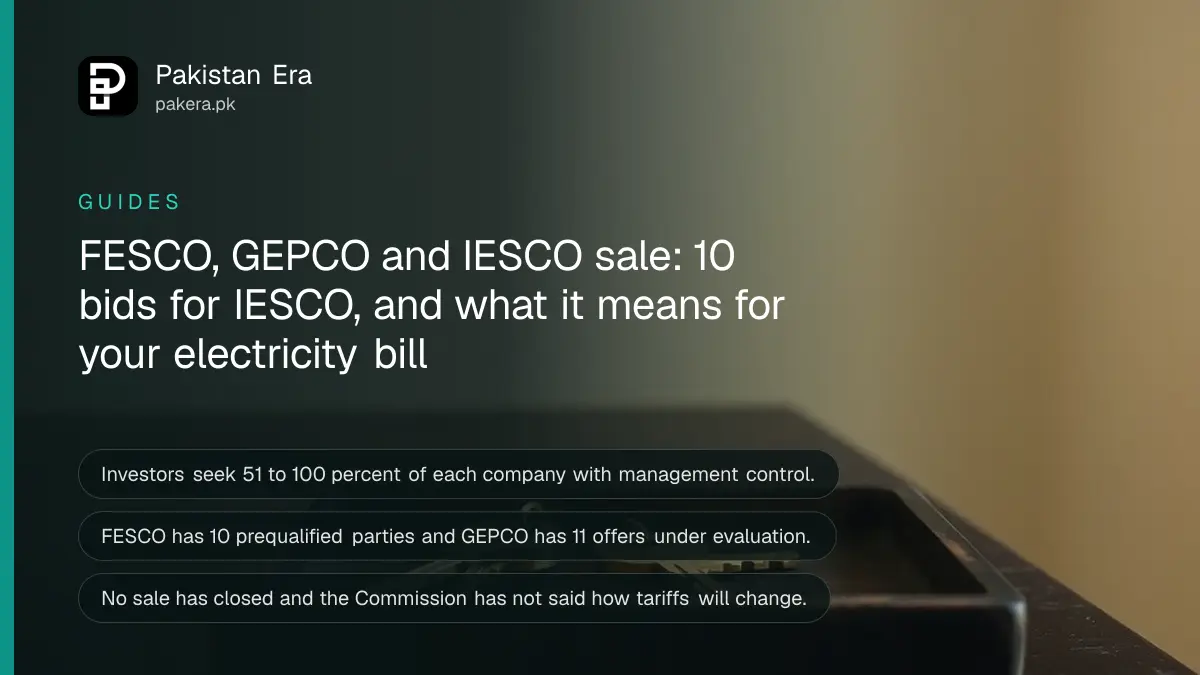
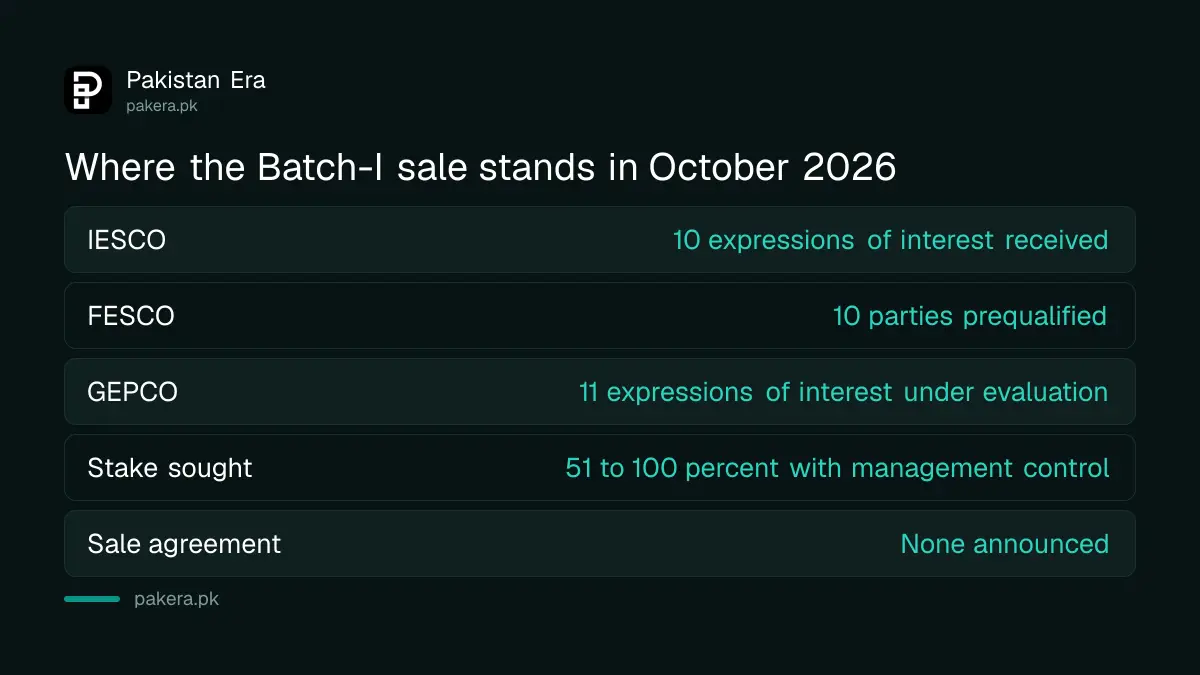
Pakistan's Privatisation Commission received 10 expressions of interest for the Islamabad Electric Supply Company (IESCO) on 21 September 2026. FESCO has 10 prequalified parties and GEPCO has 11 expressions of interest under evaluation. Buyers want 51 to 100 percent of each company with management control. Nothing has been sold yet.
If you live in Faisalabad, Gujranwala, Islamabad or Rawalpindi, the company that sends your electricity bill may change owners. This page explains where the sale stands, how the three companies performed in July to December 2025, and what you can and cannot say today about your bill. We read the Commission's pages and the Finance Division's state company report on 13 October 2026.
The sale covers three companies in Batch-I
Batch-I of the distribution company (DISCO) sale has three names: FESCO in Faisalabad, GEPCO in Gujranwala and IESCO in Islamabad and Rawalpindi. The Commission's page lists the call for expressions of interest, dated 19 May 2026, and the forms for each company.
The IESCO deadline was extended and ended on 21 September 2026. Ten parties applied for IESCO: three Turkish companies (Aktor Elektrik, Genvera Enerji and Cengiz Enerji) and seven Pakistani entities or groups, including Engro Energy, Hub Power Holdings and Sapphire Fibers.
The Commission says investors seek 51 to 100 percent shareholding with management control. Prequalified parties next get access to a virtual data room for due diligence, the step where a buyer reads the company's books in detail.
The Commission's board met on 5 October but gave no details
The Commission's website says its board held its 259th meeting on 5 October 2026. It "considered and approved key measures to advance ongoing privatisation transactions across the power, aviation and financial sectors".
The page does not say which measures. We do not guess. The IMF also lists "advancing privatization" among Pakistan's duties, as set out in our report on the IMF staff-level agreement.
Two of the three companies made a profit in July to December 2025
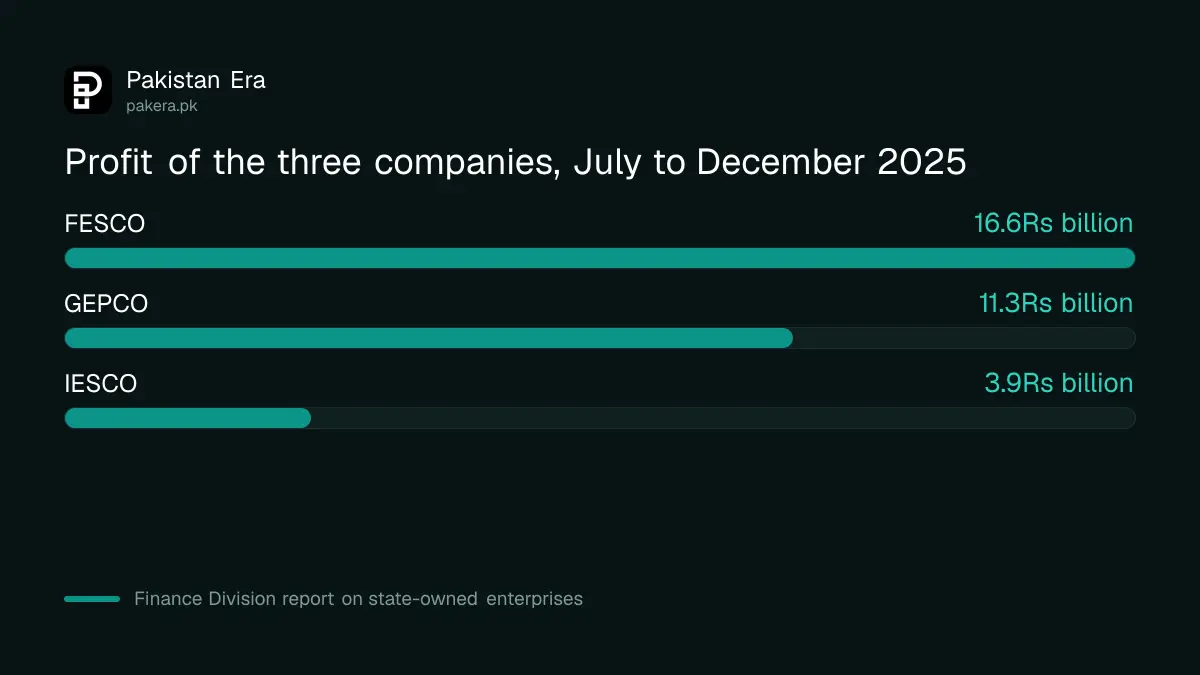
The Finance Division's report on state-owned companies covers July to December 2025. FESCO earned Rs 16.6 billion and GEPCO earned Rs 11.3 billion. IESCO is in the profit list at Rs 3.9 billion. The report is dated 2 June 2026 and was posted on 5 October 2026.
| Company | Profit, Jul to Dec 2025 | Cost recovery ratio | Subsidy for the period |
|---|---|---|---|
| FESCO | Rs 16.6 billion | 1.06 | Rs 42.1 billion |
| GEPCO | Rs 11.3 billion | 1.04 | Rs 16.9 billion |
| IESCO | Rs 3.9 billion | 1.01 | Rs 47.8 billion |
The cost recovery ratio shows how many rupees of revenue a company earns for each rupee of operating cost. A figure above 1.00 means it covers its running cost. All three are above 1.00, which is better than most other DISCOs. The state company debt behind these figures is explained in what the state companies owe.
Profit here is the report's accounting profit. It includes government subsidies, so it does not mean consumers paid less.
What this means for your bill today
Nothing on the pages we read says that bills, slabs or complaint routes will change after a sale. The Commission pages do not discuss tariffs after a sale, and no sale has closed. Today's rates are still those in the 2026 electricity slab rates.
Electricity tariffs for distribution companies are determined by NEPRA, the power regulator, and NEPRA also hears consumer complaints. If a sale closes, NEPRA notices are where a change would appear first. For a wrong bill, the route is still the Provincial Office of Inspection and then NEPRA.
Reports that a sale will "end load shedding" or "cut bills" are guesses. We did not find any such promise in the Commission's own text.
How to follow the sale without relying on rumours
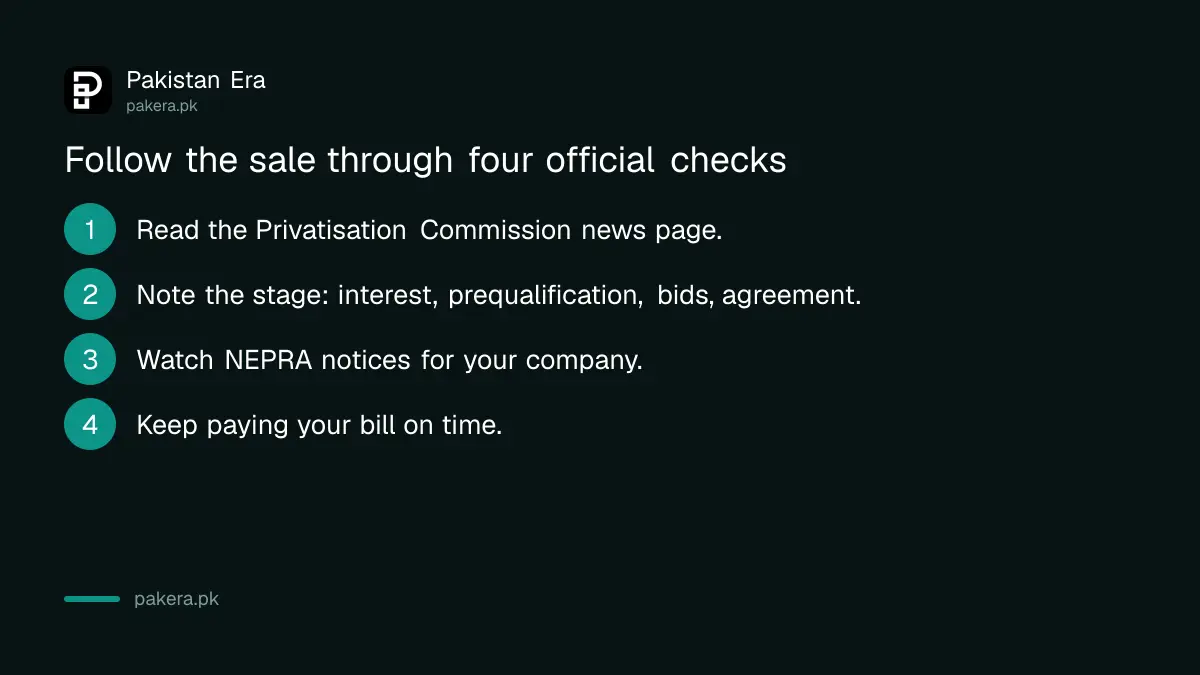
- Open the Privatisation Commission news page and look for the Batch-I DISCO items.
- Note the stage: expressions of interest, prequalification, data room, bids, then a sale agreement.
- Check NEPRA notices for any change in the licence or tariff of your company.
- Keep paying your bill on time. A change of owner does not cancel your connection or your bill.
The first sign of a real sale is a signed agreement, not a list of interested buyers. The Commission has not announced one.
Common questions
Has FESCO, GEPCO or IESCO been sold?
No. The Commission page shows expressions of interest and prequalification only. No sale agreement has been announced.
How many bids did IESCO receive?
Ten expressions of interest arrived by the deadline of 21 September 2026. Three came from Turkish companies and seven from Pakistani entities or groups.
How much of each company is being sold?
The Commission says investors seek 51 to 100 percent shareholding with management control.
Will my electricity bill go up after a sale?
We found no statement on this. Tariffs are determined by NEPRA, so watch NEPRA notices instead of rumours.
Did these companies make a profit?
In July to December 2025, FESCO earned Rs 16.6 billion, GEPCO Rs 11.3 billion and IESCO Rs 3.9 billion, says the Finance Division report.
Where do I complain if my bill is wrong?
Start with your DISCO, then the Provincial Office of Inspection, then NEPRA. The steps do not change because of the sale process.
How we verified this
What we checked, where we read it, and what we could not confirm.
Last checked on 13 October 2026, Pakistan time. We read the Privatisation Commission website, including its news item on IESCO and the Batch-I expression of interest page, and the Finance Division's Central Monitoring Unit report on state-owned enterprises for July to December 2025. We could not read the sale documents themselves or any statement on post-sale tariffs, and the 5 October board meeting gave no detail.
About the author

Global Affairs & Political Economy Writer
Muhammad Hatim is a book lover who started writing because he enjoys it. At Pakistan Era he writes about international relations, geopolitics and the global economy, with a particular interest in South Asia and the forces behind current events.