Paying by Card at Petrol Pumps in Pakistan: What the SBP Fee Cap Means
SBP capped the card fee at fuel stations at Rs 1.00 a litre until 31 January 2027, with interchange at Rs 0.20. See what it covers and what it does not.
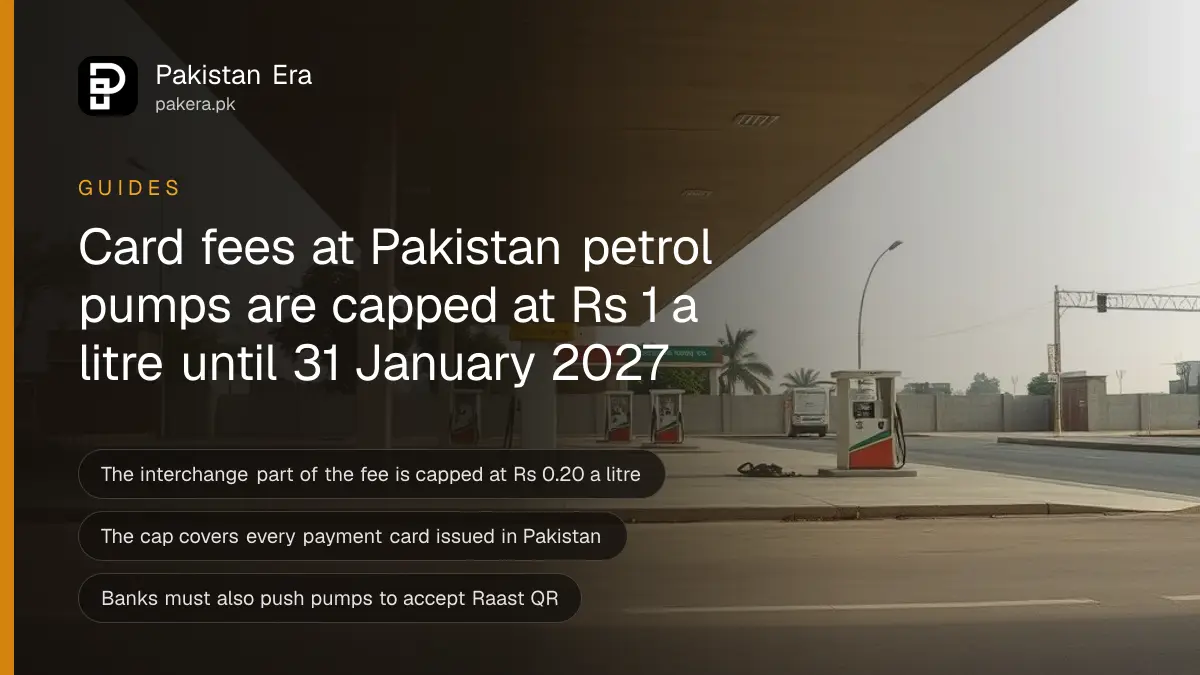
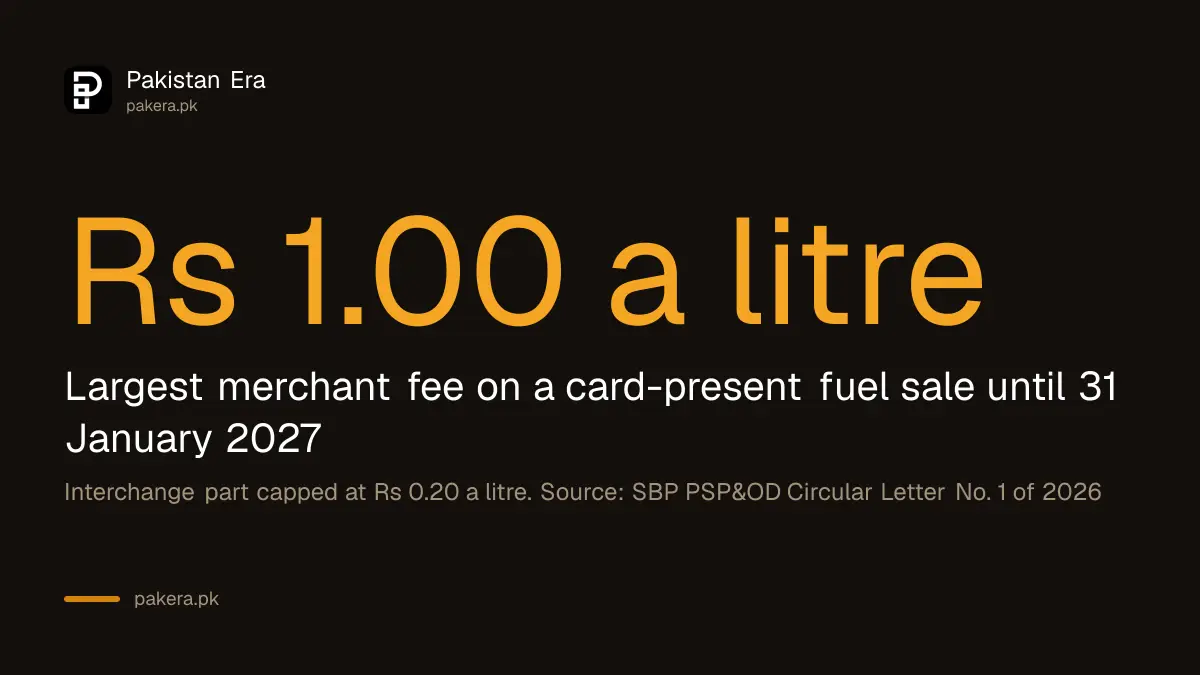
The State Bank of Pakistan has capped what a petrol pump pays to accept your debit or credit card. Until 31 January 2027, the merchant fee on a card-present fuel sale cannot go above Rs 1.00 a litre, and the interchange part cannot go above Rs 0.20 a litre. The cap applies to every payment card issued in Pakistan.
The cap comes from PSP&OD Circular Letter No. 1 of 2026, dated 3 August 2026, and it took effect immediately. We read it on sbp.org.pk on 7 October 2026. The circular is addressed to banks, microfinance banks, e-money institutions and payment firms, not to drivers, so most drivers have never heard of it.
It matters because a card at a petrol pump is a small, steady cost for the pump. The State Bank wants that cost low enough that more pumps take cards, and then Raast QR. Here is what it says, what it does not say, and where to go if your bank or pump treats you badly.
Card fees at fuel stations are capped at Rs 1.00 a litre
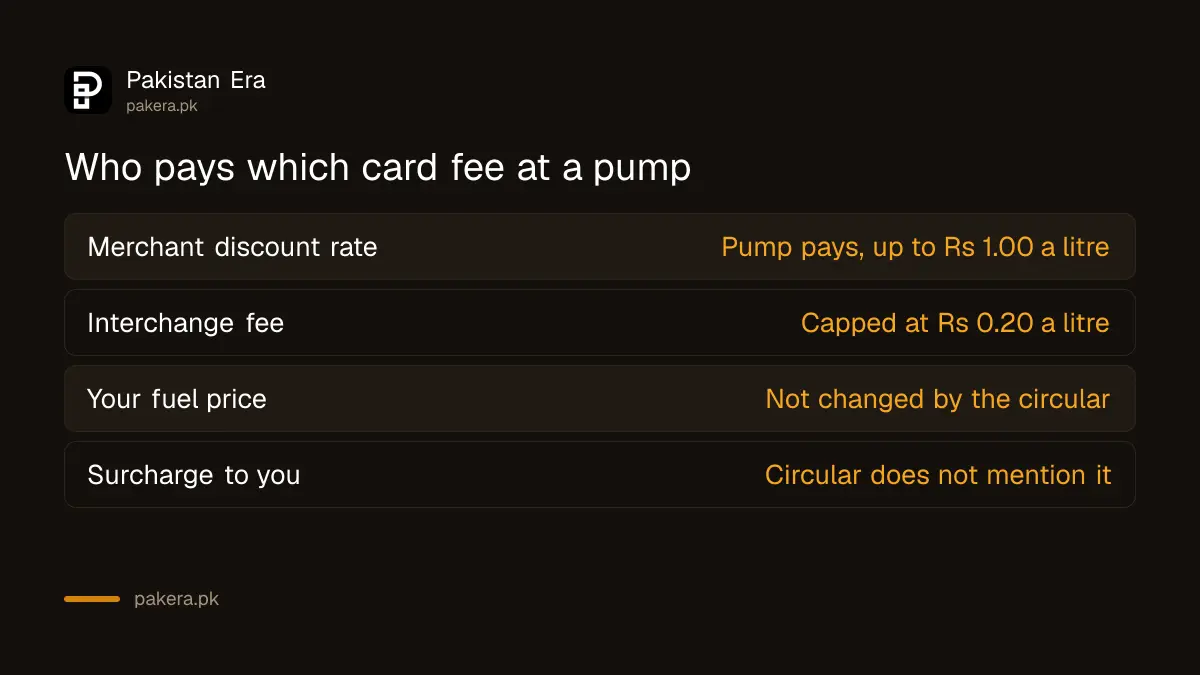
The merchant discount rate, the fee a pump pays its bank on each card sale, is capped at Rs 1.00 per litre. The interchange fee, the part passed to the bank that issued your card, is capped at Rs 0.20 per litre. Both caps run until 31 January 2027.
The cap covers card-present sales of fuel and related products at fuel stations, which means you tap, dip or swipe the card at the pump's terminal. It applies to all payment cards issued in Pakistan. The circular does not set a cap for online payments or for cards issued abroad.
| Item | Cap | Who pays it |
|---|---|---|
| Merchant discount rate (MDR) | Rs 1.00 per litre | The petrol pump, to its bank |
| Interchange reimbursement fee (IRF) | Rs 0.20 per litre | Paid to the bank that issued your card |
| Period | Until 31 January 2027 | Reviewed on or around that date |
Take a 40 litre fill as an example. The pump fee on that sale cannot go above Rs 40, and the interchange fee on it cannot go above Rs 8. That is our arithmetic from the caps. The circular does not give an example.
Banks must push pumps to take Raast QR as well
The State Bank tells banks and payment firms to work with fuel stations so that Raast QR payments are available for fuel and related products. Raast QR is the State Bank's shared QR code, so you can pay from any bank or wallet app that supports it.
The circular says the cap is meant to speed up card acceptance and "accelerate the deployment of interoperable Raast QR-based payment acceptance". In plain words, the cheap card rate is a push to get pumps connected to digital payments. Our guide on using the Raast payment system shows how a customer pays, and the guide on registering a shop for Raast QR payments shows the merchant side.
Whether your local pump has a Raast QR code today is something we could not check from the circular. Look at the counter and ask.
The circular does not force a pump to accept your card
The circular sets a ceiling on fees the pump pays. It does not say a pump must take cards, and it says nothing about a surcharge a pump may add for you. We did not find either rule in the text, so we do not claim one exists.
That is the honest limit of this change. A lower fee gives a pump less reason to refuse cards or to ask for cash, but the circular does not stop it. If a pump adds a charge on top of the fuel price, ask for the reason before you pay and keep the slip.
If the fee comes from your own bank, for example a charge added to your card statement for a fuel purchase, the circular does not cover it either. Our guide to bank charges in Pakistan and how to avoid them lists the common ones.
The State Bank will review the cap around 31 January 2027
The circular says the State Bank will revisit the instructions on or around 31 January 2027, "in the light of market response to this pricing mechanism". It does not promise that the cap will continue, rise or end. Plan on it being temporary.
If the cap goes, pumps may pay more to accept cards again. We cannot say whether they would pass that on to you. Check the State Bank's circulars page near the end of January for a new letter.
If your bank or pump ignores the rules, complain in order
You have no direct complaint against a pump under this circular, because it binds banks and payment firms. If a bank handles a card dispute badly or charges you wrongly on a fuel sale, you can complain through the usual route.
- Write to your bank's complaint unit and keep the reference number. Attach the fuel slip, the SMS alert and your statement line.
- If the bank does not fix it, lodge the matter on the SBP Sunwai complaint portal.
- If you are still unhappy after the bank has had its waiting period, take it to the Banking Mohtasib, as explained in our Banking Mohtasib complaint guide.
For a pump that gives short measure rather than a card problem, our guide on how to complain about a petrol pump giving short measure covers that separate issue.
Common questions
Does this circular make petrol cheaper for me?
No. It caps the fee the pump pays to its bank. It does not change the fuel price or give you a discount.
Can a petrol pump refuse my card?
The circular does not forbid it. It lowers the cost of accepting cards and asks banks to help pumps with Raast QR, but it sets no duty to accept cards.
Can a pump add a surcharge for paying by card?
The circular does not mention surcharges to customers, so it neither allows nor bans them. Ask the pump before you pay, and complain through your bank if you think a charge is wrong.
Does the cap apply to foreign cards?
The circular covers payment cards issued in Pakistan. It does not mention cards issued abroad.
When does the cap end?
It runs until 31 January 2027, and the State Bank will review it on or around that date.
How we verified this
What we checked, where we read it, and what we could not confirm.
Last checked on 7 October 2026. The circular is on the State Bank's website: PSP&OD Circular Letter No. 1 of 2026, Improving Payment Card Acceptance at Fuel Stations in Pakistan, dated 3 August 2026. The caps, the end date and the review date come from that text. We did not test a card payment at any pump, and we could not check which pumps currently take Raast QR.
About the author

Senior Writer, Public Services and Technology
Shahid joined us in 2024 as an author. He is a senior contributor to Pakistan's leading technology websites. He writes detailed articles, mostly covering his expertise in the latest tech, mobiles, apps, gadgets, and step-by-step guides. His ideology is to help people understand the latest trends and explain complex methods through very easy-to-understand guides.