Skip llms.txt and AEO Hacks: What Google Says Pakistan Websites Don't Need for AI Search
Google says llms.txt, chunking and AI rewrites are not needed for Google Search. See the five tasks to skip and the five free checks to do first on your site.
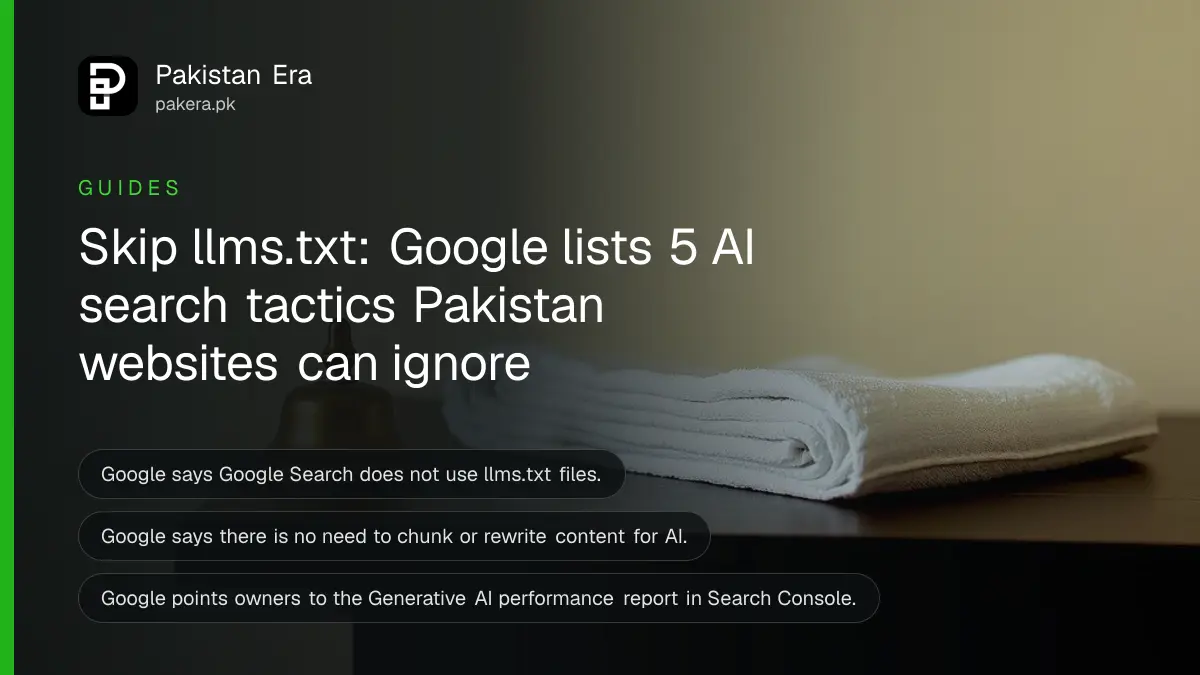
Short answer: Google says you do not need an llms.txt file, special AI markup or Markdown copies of your pages to appear in Google Search, including its AI features. Skip those tasks. Spend the time on getting pages indexed, writing content that others do not have, and watching the AI report in Search Console.
Picture an agency sending a Pakistani shop owner a quote: Rs 25,000 for "AI search optimisation", which includes an llms.txt file and pages cut into small chunks. The invoice looks modern. Google's own guidance says Google Search does not use that file. The Rs 25,000 figure is an invented example, not a real offer.
We read Google's guide on optimizing for generative AI features in Search, last updated on 10 July 2026, and the documentation updates list that records the 15 June 2026 clarification on llms.txt. This check covers Google Search only. We did not test other AI products, so we say nothing about them.
Google Search does not use llms.txt files
Google's guide says you do not need new machine-readable files, AI text files, markup or Markdown to appear in Google Search, including its generative AI capabilities, because Google Search itself does not use them. An llms.txt file is one such file.
Google adds one caution. It may find and index many kinds of files besides HTML. That does not mean a file gets special treatment. Google does not say such a file causes harm, but nothing in the guide says it helps.
The guide's closing summary repeats the point. It tells site owners to ignore tactics such as chunking content, creating unnecessary AI text files like llms.txt, or chasing inauthentic mentions.
Five tasks Google says you can ignore
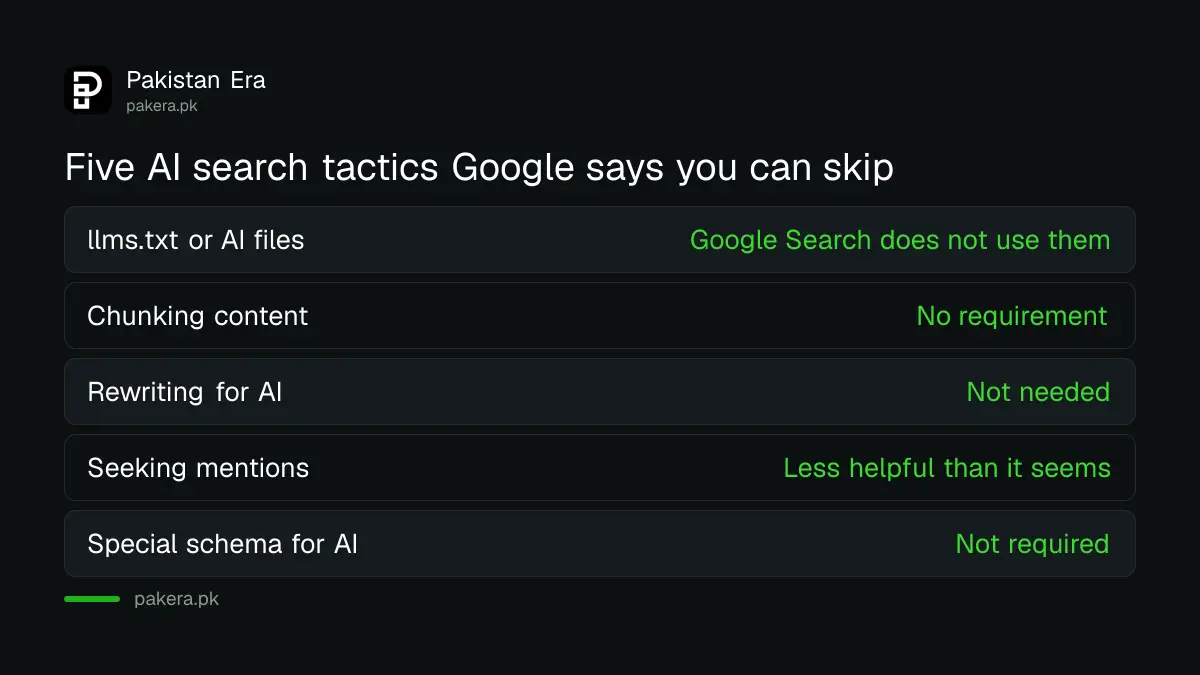
Google lists five popular tactics under what you do not need to do: llms.txt and special markup, chunking content, rewriting content just for AI, seeking inauthentic mentions, and over-focusing on structured data. Each is sold by some agencies as a secret step.
| Tactic sold as "AI SEO" | What Google's guide says |
|---|---|
| llms.txt or other AI files | Not needed. Google Search does not use them. |
| Chunking pages into tiny pieces | No requirement. Google can understand several topics on one page. |
| Rewriting pages just for AI | Not needed. AI systems understand synonyms and meaning. |
| Buying or seeking mentions | Less helpful than it seems. Spam systems and quality systems both apply. |
| Special structured data for AI | Not required, though it still helps for rich results. |
Google says old SEO basics still decide AI visibility
To be shown in generative AI features, Google says a page must be indexed and eligible to appear in Search with a snippet. The guide also says content should be crawlable, load well on all devices and avoid duplicate pages. These are ordinary SEO tasks.
The guide also says a site must be included in Search generative AI features in Search Console to be eligible for display. Check that setting before you pay anyone. The Search Console report that shows your traffic from these features is covered in the AI Overviews and AI Mode report in Search Console.
Local and shop sites have two extra routes. Google says Merchant Center and Google Business Profiles help products and local businesses appear in AI responses. We explain the first in Merchant Center free listings for Pakistani sellers and the second in putting a shop on Google Maps with a Business Profile.
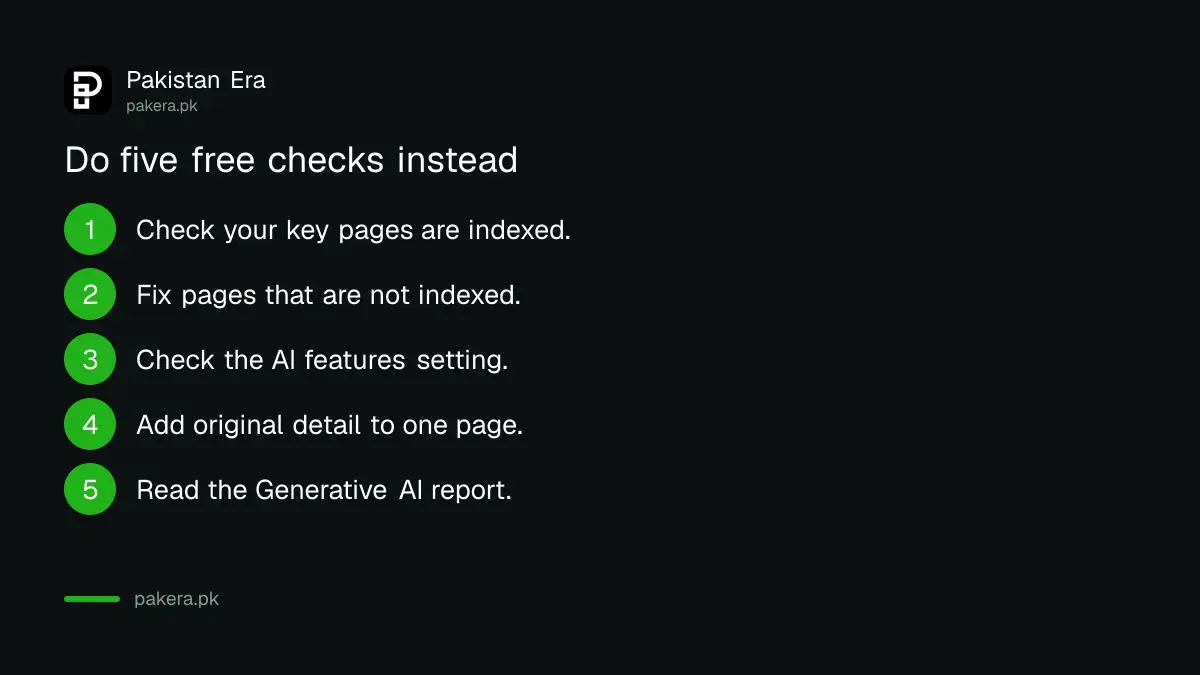
Do these five checks instead, in order
Confirm your pages are indexed, confirm your site is included in the AI features setting, check crawling, improve one page with information others lack, and then read the AI report. Each step is free and uses tools Google provides.
- Open Search Console and use URL Inspection on your five most important pages. Confirm each is indexed.
- If a page is not indexed, follow the fix for Search Console page not indexed.
- Check the Search generative AI features setting for your property in Search Console.
- Pick one page and add what only you know: your own prices, photos, test results or local detail. Google calls this non-commodity content.
- After a few weeks, open the Generative AI performance report and see how your content shows up.
For how AI answers behave for a Pakistani business, see how Google AI Overviews affect a Pakistani business. It is a good place to start before any agency call.
Ask any agency to show the Google page behind its claim
Google's separate guidance on third-party SEO advice says good advice qualifies its claims as opinion or cites official Google guidance. It warns that third-party tools do not have Google's internal ranking data and cannot guarantee performance. Ask for the page.
The same guidance names "AEO" and "GEO" tools in its list of services to evaluate with care. It adds that Google does not evaluate third-party services, so claims that something is "approved" by Google Search deserve suspicion.
That does not make every agency a fraud. A good one will point you to indexing fixes and original content. A weak one will point to a file name.
Common questions
Will an llms.txt file hurt my Google ranking?
Google does not say it will. It says Google Search does not use such files, and that being crawled does not mean special treatment.
Do I need to rewrite my pages for AI Overviews?
No. Google says you do not need to write in a specific way for generative AI search, because its systems understand synonyms and meaning.
Should I split my pages into small chunks?
No. Google says there is no requirement to break content into tiny pieces and no ideal page length.
Is structured data useless for AI search?
No. Google says it is not required for generative AI search, but it is still a good idea for rich result eligibility.
Where can I see how my site does in AI features?
Use the Generative AI performance report in Search Console, which Google points to for this purpose.
How we verified this
What we checked, where we read it, and what we could not confirm.
Last checked on Sunday 11 October 2026. We read Google's guide to optimizing for generative AI features in Search, last updated 10 July 2026, and its guidance on third-party SEO tools and advice, last updated 5 June 2026. This check covers Google Search only. Guidance can change.
About the author

Founder and Editor
Umer Kureshi founded Pakistan Era in July 2024 and runs it as administrator, SEO lead and writer, overseeing website operations, search growth, content strategy and coverage of technology and current affairs.