Transfer a Deceased Family Member's SIM to Your Name in Pakistan
A SIM on a deceased person's CNIC gets blocked. Documents Jazz, Zong and Ufone ask for, who can apply, and how to move the number into your name for free.
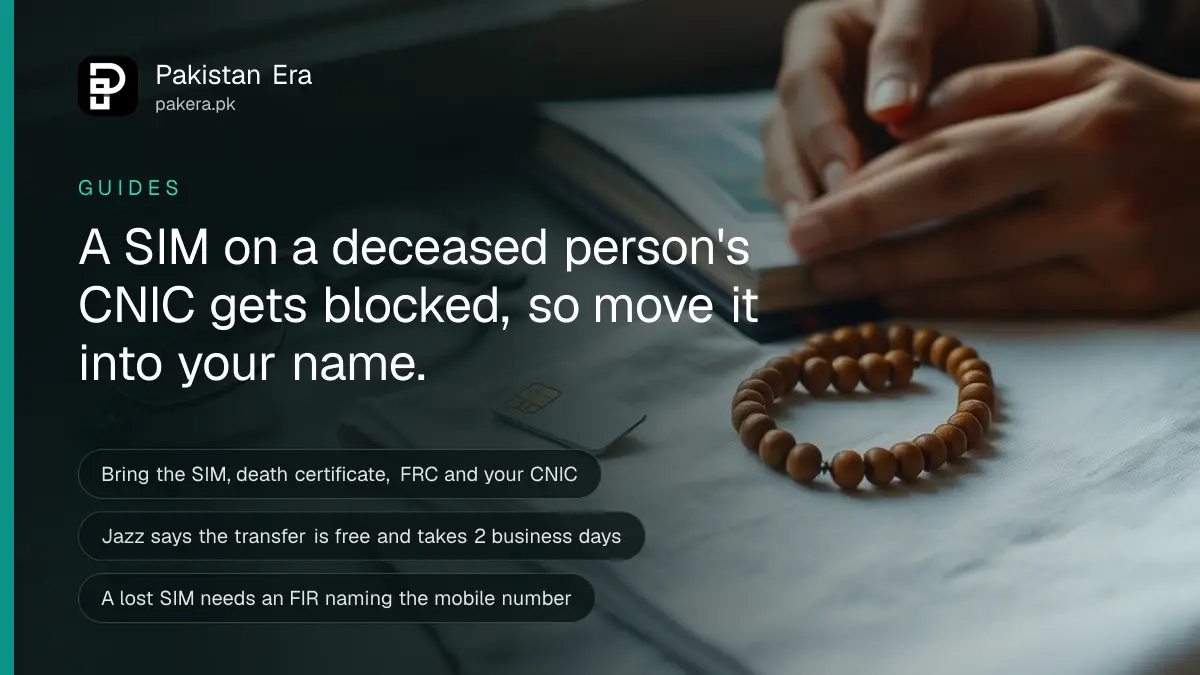
To keep a SIM that was registered on a family member who has died, take the SIM, the death certificate, the NADRA Family Registration Certificate (FRC) and your own original CNIC to the operator's franchise or service centre. Jazz says the transfer is free and takes 2 business days. A SIM left on a deceased person's CNIC will be blocked, so do it soon.
Families often keep using a father's or mother's number for months. It holds bank OTPs, WhatsApp groups and the contacts relatives still call. Then the number stops working. Jazz now says it plainly on its own page: "SIMs on Deceased CNIC Will be blocked!" It adds that this follows Government of Pakistan instructions.
We read the deceased SIM transfer pages of Jazz, Zong and Ufone on 2 October 2026. They ask for much the same papers, with a few differences that can cost you a second trip. Here is what each one asks for, and what to do if the SIM itself is lost.
Only a close relative on the FRC can take the SIM
Only a close family member can move a deceased person's SIM into their own name. Ufone names them: siblings, father, mother, spouse and children, as shown on the NADRA Family Registration Certificate. Jazz says only a blood relative on the FRC can apply.
If you do not have one yet, NADRA issues it. Getting a Family Registration Certificate from NADRA is the first job, because nothing moves at the franchise without it.
Where there are several heirs, the others have to agree. Jazz asks for an NOC or affidavit from the other family members on the FRC, in favour of the person taking the SIM. Ufone asks for an NOC from the other legal heirs where there is more than one.
The documents each operator asks for
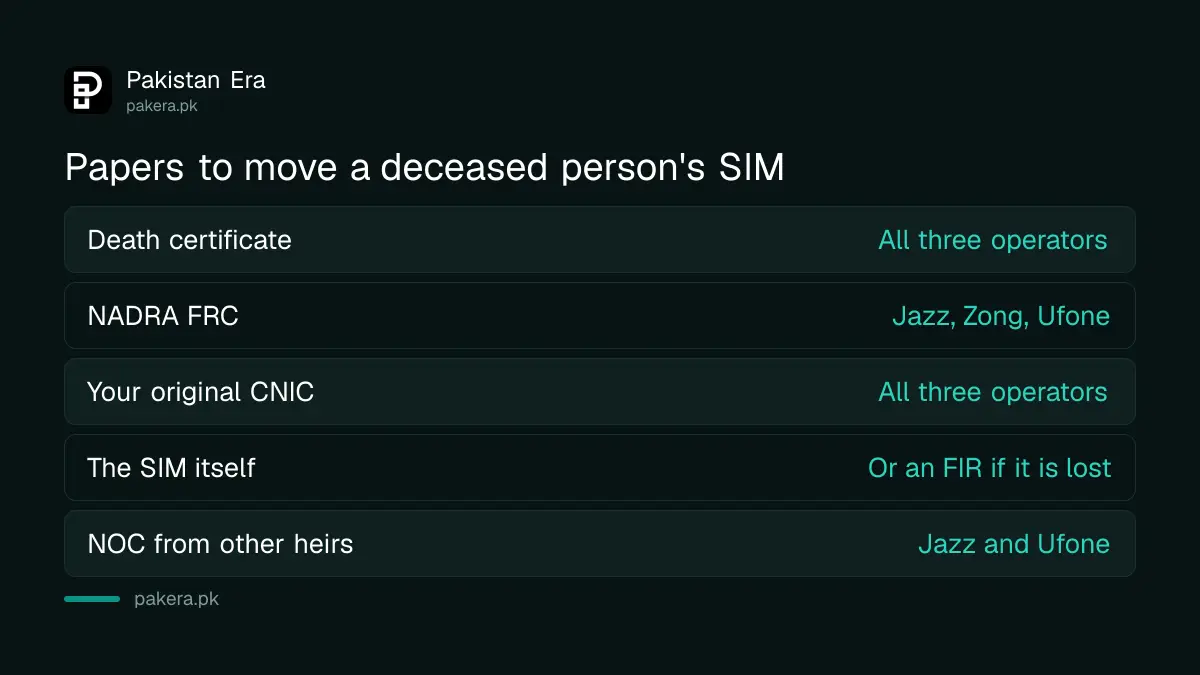
All three operators we checked want the death certificate, the SIM itself, your original CNIC and the last recharge or call details. Jazz and Zong also want the original FRC. Ufone's two pages differ, and one of them adds a succession certificate.
| What to bring | Jazz | Zong | Ufone |
|---|---|---|---|
| Death certificate | Yes, from a government body such as the Union Council or NADRA | Original, from NADRA or the Union Council | Yes, issued through NADRA |
| Family Registration Certificate | Original | Original | Yes |
| Your CNIC | Original | Original, expired CNIC not accepted | Yes |
| Deceased person's CNIC | Original, or the CNIC cancellation certificate | Not listed | Not listed |
| The SIM | Yes | Yes | Yes, and it must be active |
| Last recharge or call history | Checked by Jazz | Checked by Zong | You give it |
| Consent of other heirs | NOC or affidavit | Not listed | NOC, on one of its two pages |
| Form signed at the counter | Undertaking | Company NOC | Not listed |
Ufone has two pages for this service. One asks for a NADRA death certificate, your CNIC, the FRC and the active SIM. The other asks for a "death certificate from the local court", a succession certificate naming the legal heirs, and an NOC from the other heirs. We could not tell which one the counter follows. If a succession certificate from NADRA already exists, take it along. Otherwise call Ufone on 333 before you go.
Telenor has a page called "Transfer of SIMs of Deceased Person", but it showed us a bot check and would not open. Its search listing mentions an FRC, a CNIC cancellation certificate and an affidavit on stamp paper. We could not confirm that list, so ask Telenor before you visit.
How to transfer the SIM, step by step
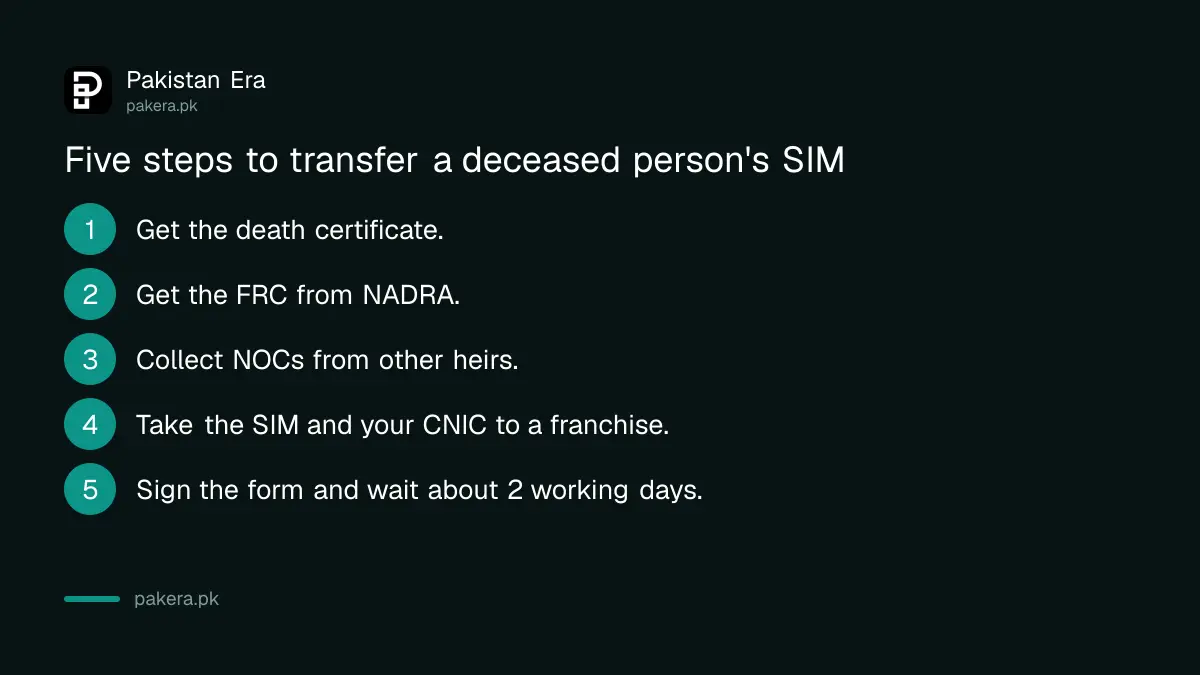
Collect the papers first, then visit any franchise or service centre of the operator with the SIM in hand. The counter checks the FRC and the SIM, verifies you, and asks you to sign a form. Jazz says it finishes in 2 business days.
- Get the death certificate. The Union Council issues it, and NADRA records it. If you have not done this yet, start with how to apply for a death certificate.
- Get the FRC from NADRA. It lists the family and proves your relationship.
- Collect NOCs from the other heirs. Jazz and Ufone ask for them. A short signed statement from each brother, sister or parent saves a second visit.
- Find the SIM and note the last recharge. Write down the last recharge amount and roughly when it was made.
- Visit the franchise with your original CNIC. Expect a fingerprint check, which is the normal rule when a SIM is registered to a new CNIC. Sign the undertaking or company NOC they give you.
- Wait for the change to complete. Jazz gives 2 business days, or 4 for golden numbers. Keep using the SIM in the meantime.
Jazz publishes the cost as "Free of Cost". Zong and Ufone do not publish a fee on these pages. Nobody should charge you a "processing" amount outside the counter receipt.
Jazz has three extra conditions to check first
Jazz refuses the transfer if a JazzCash account is still active on the number, or if the number had a duplicate SIM, a new SIM or a network port in the last 30 days. Deal with those before you go.
The JazzCash rule catches most families. A mobile wallet on the number belongs to the person who died, and the money in it is part of what they left. Jazz does not explain on this page how the wallet should be closed. Ask at the Jazz Experience Centre how the balance is paid out to the heirs before the SIM changes hands.

A lost or missing SIM needs a police report
If the SIM is lost, all three operators ask for something extra. Zong and Ufone want an FIR that states the SIM was lost and names the mobile number. Jazz asks for a police report or FIR together with an NOC.
Make sure the number is written on the report. Zong and Ufone both say the lost SIM's number must appear on it. A report that only says "phone lost" may be turned back.
Keep the FIR number. In several provinces you can check an FIR online once it is registered, and a printed copy is what the franchise will want to see.
Check the deceased person's CNIC for other SIMs
A person who has died may have more than one SIM on their CNIC, and some may be in a relative's phone. Check the full list before you visit, so every number you want to keep is transferred in one trip.
PTA's service lets you check the SIMs registered on a CNIC. Do this before the CNIC is cancelled, and note each number and network.
After the SIMs are moved, the family can apply to cancel the CNIC after the death. Jazz accepts the CNIC cancellation certificate in place of the deceased person's original CNIC, so the order does not have to be perfect.
Common questions
Can I keep using my late father's SIM without transferring it?
Not for long. Jazz says SIMs on a deceased person's CNIC will be blocked under government instructions. Transfer it to keep the number.
How much does it cost to transfer a deceased person's SIM?
Jazz says it is free. Zong and Ufone do not publish a fee on their transfer pages, so ask at the counter.
How long does the transfer take?
Jazz says 2 business days, or 4 business days for golden numbers. Zong and Ufone do not publish a time.
Can a friend or son-in-law take the SIM?
No. Only family on the FRC can. Ufone lists siblings, father, mother, spouse and children. Jazz says blood relatives only.
What if the SIM is lost?
Get an FIR that mentions the lost SIM's mobile number. Jazz also asks for an NOC with the police report.
What about the JazzCash account on the number?
Jazz will not transfer the SIM while a JazzCash account is active on it. Ask Jazz how the balance goes to the heirs first.
How we verified this
What we checked, where we read it, and what we could not confirm.
Last checked on 2 October 2026. We read Jazz's deceased SIM transfer page and its FAQs (free, 2 business days, JazzCash and 30 day conditions), Zong's Transfer of SIM of Deceased Person page, and Ufone's two pages on the same service, which differ from each other. Telenor's page showed a bot check and we could not read it, so its requirements here are unconfirmed. We did not carry out a transfer ourselves. Counter practice can differ from what the pages say, so call the operator before you go.
About the author

Tax, Bills and Technology Writer
Ali Akhtar is a young and curious voice here at Pakistan Era. He is currently pursuing his A-Levels and has a growing interest in Pakistan’s changing industrial landscape and educational trends. Ali likes to write in a way that helps him explain and explore the world around him. His writing reflects the perspective of the new generation navigating the evolving trends of Pakistan where technology, youth innovation, and shifting opportunities are reshaping the country’s future.