How to Wash Your Hands Properly in Pakistan: NIH's 11 Steps in 20 to 40 Seconds
NIH's hand washing poster shows 11 steps to scrub every part of your hands in 20 to 40 seconds with soap and water. See each step and when to wash in Pakistan.
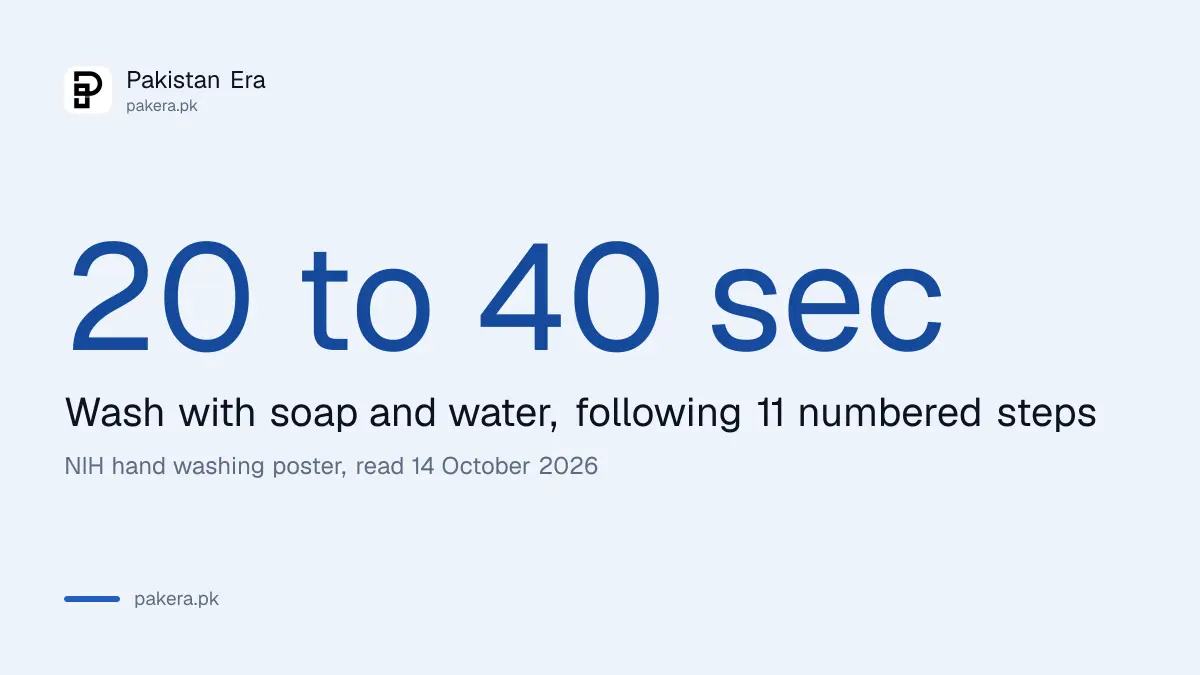
NIH's hand washing poster says to wash for 20 to 40 seconds with soap and water, following 11 steps from wetting your hands to turning off the tap with a towel. You rub the palms, the backs of the hands, between the fingers, the thumbs and the fingertips, then rinse and dry.
This guide follows the National Institutes of Health (NIH) Urdu poster "How to wash your hands?", produced by NIH's Field Epidemiology and Disease Surveillance Division. The poster has no date. NIH's other advisories, from pink eye to cholera and typhoid, all lean on this one habit.
NIH says to wash for 20 to 40 seconds
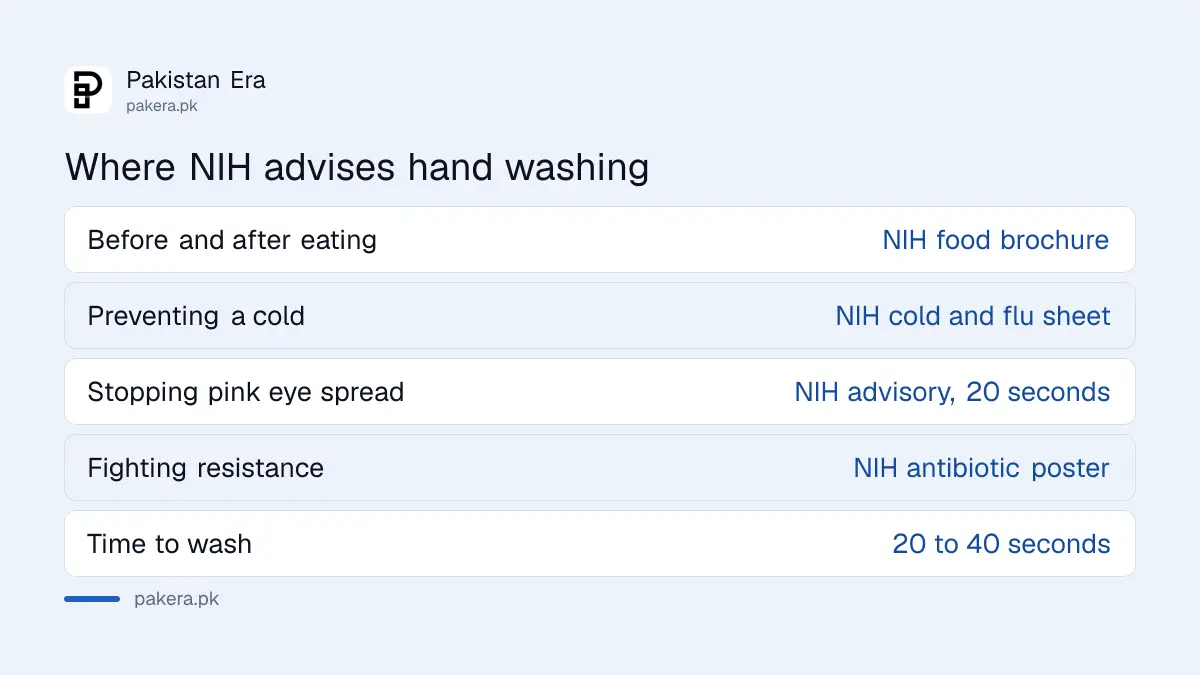
The poster's heading says to wash your hands with the listed method for 20 to 40 seconds to remove germs. That is longer than a quick rinse. Count slowly, or sing a short song, so you do not stop at five seconds.
NIH's pink eye advisory also says to wash hands with soap for 20 seconds. So 20 seconds is the floor, and the full method on the poster can run to 40.
In practice, the 20 second floor is for a quick wash with soap, as in the pink eye advisory. The full 11 step method on the poster can run to 40 seconds. NIH also tells people to wash with soap before and after eating. Use soap and water each time, and follow the steps in the same order.
The poster shows 11 numbered steps
The poster numbers its pictures from 0 to 11. Step 0 wets the hands. Steps 1 to 7 apply soap and scrub every part of both hands. Steps 8 to 10 rinse and dry. Step 11 shows clean hands.
| Step | What NIH's poster shows |
|---|---|
| 0 | Wet your hands with water |
| 1 | Apply soap well |
| 2 | Rub palm against palm |
| 3 | Rub the back of each hand with the other palm, fingers laced |
| 4 | Rub palms together with fingers interlaced |
| 5 | Rub the backs of the fingers against the opposite palm |
| 6 | Clasp each thumb in the other palm and rub in circles |
| 7 | Rub the fingertips of each hand in the opposite palm |
| 8 to 10 | Rinse, dry with a clean towel, turn off the tap with the towel |
Step 10 matters more than it looks. If you touch the tap with clean hands, you pick the germs back up. Use the towel to close it, as the poster shows.
Wash before you eat and after you handle food
NIH's drinking water and food brochure tells people to wash hands well with soap before and after eating. The aim is to keep germs from reaching your mouth through food.
The same brochure links unsafe water to diarrhoea, typhoid and hepatitis A and E. If a child has watery stools, see our steps for treating diarrhoea with ORS and zinc. For the cholera warning signs, read about three watery stools in 24 hours.
Hand washing also slows colds, flu and pink eye
NIH's cold and flu sheet lists hand washing with soap and water as the way to prevent a cold. Its antibiotic poster lists regular hand washing among its six rules. Its pink eye advisory says to wash hands and avoid touching the eyes.
That makes one habit useful in many illnesses. Read how to tell a cold from flu to see where it fits.
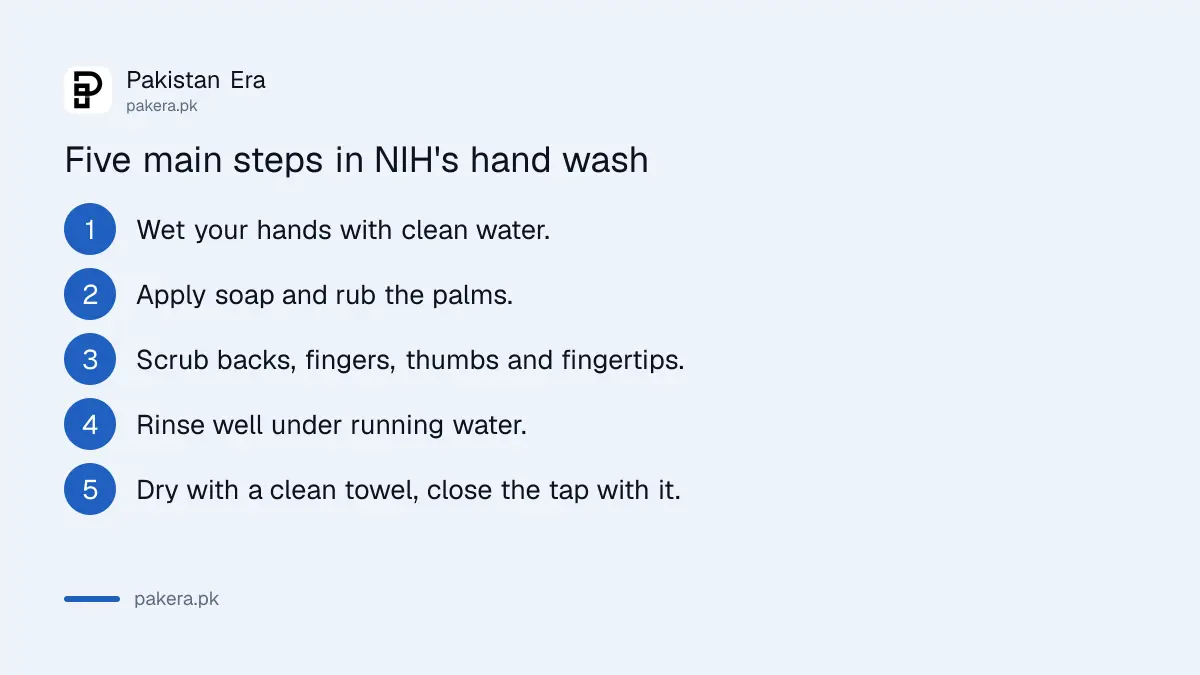
- Wet your hands under clean running water.
- Apply soap and rub the palms.
- Scrub the backs of the hands, between the fingers, the thumbs and the fingertips.
- Keep going for 20 to 40 seconds in total.
- Rinse, dry with a clean towel and close the tap with the towel.
Teach children the full method, not a quick rinse
A child tends to wet the fingers and stop. The poster's picture steps help, because a child can follow images. Stand beside them at the sink and go through the steps once, then let them lead.
The poster is in Urdu with a numbered picture for each step, which makes it easy to print and stick near a basin at home or in a school. The 11 steps take only a little longer than a rushed wash. The extra seconds are the point, since NIH sets the time at 20 to 40 seconds.
Soap matters as much as time. If a shared bar is the only soap at a school or office toilet, check that it is there before you need it.
When there is no soap or running water
The NIH poster only covers soap and water. If soap and clean water are not available, ask a local health worker. We give no medical advice beyond the poster.
Common questions about hand washing in Pakistan
How long should I wash my hands?
NIH's poster says 20 to 40 seconds with soap and water. Its pink eye advisory says at least 20 seconds.
How many steps are there?
The poster shows 11 numbered steps, from 0 to 11. They end with clean hands.
Do I need soap?
Yes. NIH's poster shows soap in step 1, and its other advisories say soap and water.
Why close the tap with a towel?
The poster shows it as step 10. It stops you touching a dirty tap with clean hands.
When should I wash my hands?
NIH's food brochure says before and after eating. Its pink eye advisory also says to wash your hands and avoid touching your eyes.
How we verified this
What we checked and where we read it.
Last checked 14 October 2026. The steps and timing come from NIH's hand washing poster, read on 14 October 2026 and translated from Urdu. Food hygiene points come from NIH's undated drinking water brochure on the NIH health education page.
Free on WhatsApp
Get last dates and rule changes on WhatsApp
We post new last dates, fee changes and fixes for common problems, a few short posts a day.
Follow Pakera on WhatsAppOther followers cannot see your number.
Pakera Solves It
Which online process wasted your time this week?
A portal that will not load, a form nobody explains, a complaint that went nowhere. Tell us. Every week we pick one, solve it step by step and publish the answer.
About the author

Public Services and Education Journalist
Fajr Riaz is a journalist and content writer at Pakistan Era, based in Lahore. She covers the questions people meet in everyday life in Pakistan: how a public service works, what a change in the rules means, and where to find a reliable answer.