Apply for the Fulbright FLTA From Pakistan: Nine Months in the U.S. for Young English Teachers
Fulbright FLTA sends young English teachers from Pakistan to a US college for nine months with costs paid. See who qualifies, the four rounds and the rules.
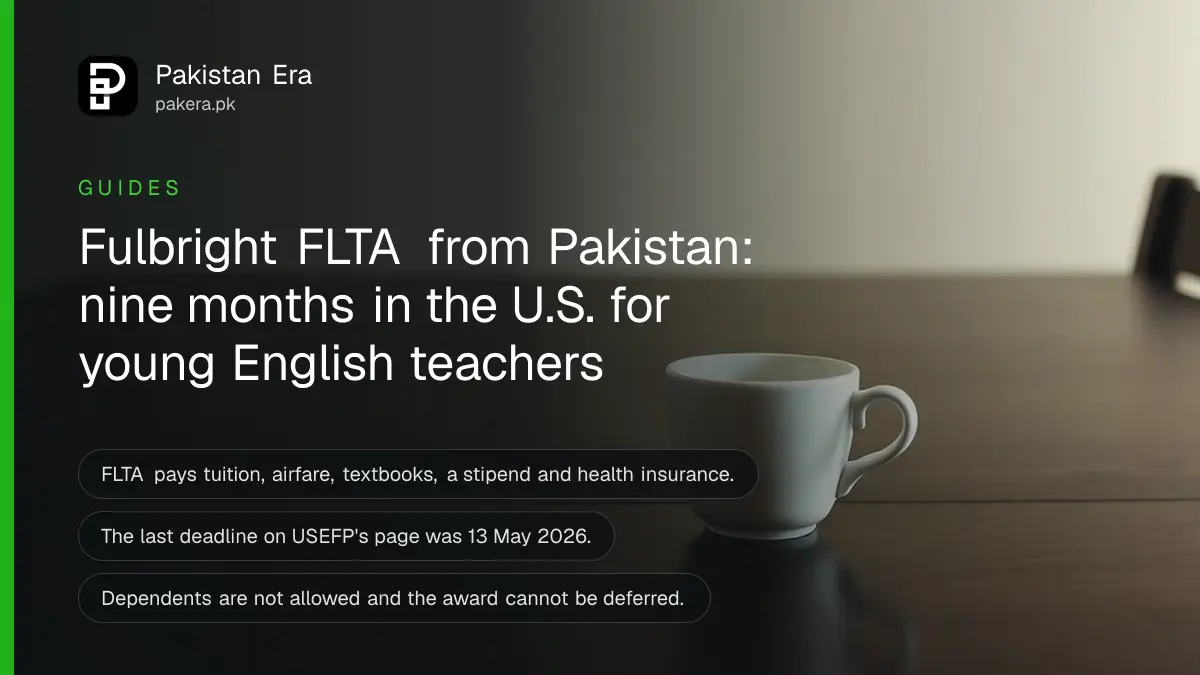
Short answer: The Fulbright Foreign Language Teaching Assistant (FLTA) programme sends young English teachers from Pakistan to a U.S. college for about nine months. It pays tuition, airfare, textbooks, a stipend and health insurance. The last deadline on USEFP's page was 13 May 2026, and the page is now closed. You apply online only.
FLTA is a teaching placement, not a degree. You improve your own teaching and English, and you teach your native language to U.S. students while you are there.
We read USEFP's FLTA page on 12 October 2026. The status, deadline, eligibility and selection steps below are from that page. Dates for the next cycle are not confirmed, and we say so where it matters.
FLTA is a nine-month teaching assistant placement in the U.S.
USEFP describes FLTA as a nine-month, U.S. Department of State funded, non-degree programme. It gives young English teachers a chance to refine their teaching, improve their English and learn about U.S. society and culture.
FLTA participants teach their native language to U.S. students at a college or university and strengthen foreign language teaching there. They also join conversation groups, extracurricular activities and community projects. Everyone must go home right after the programme ends.
| Detail | What USEFP says |
|---|---|
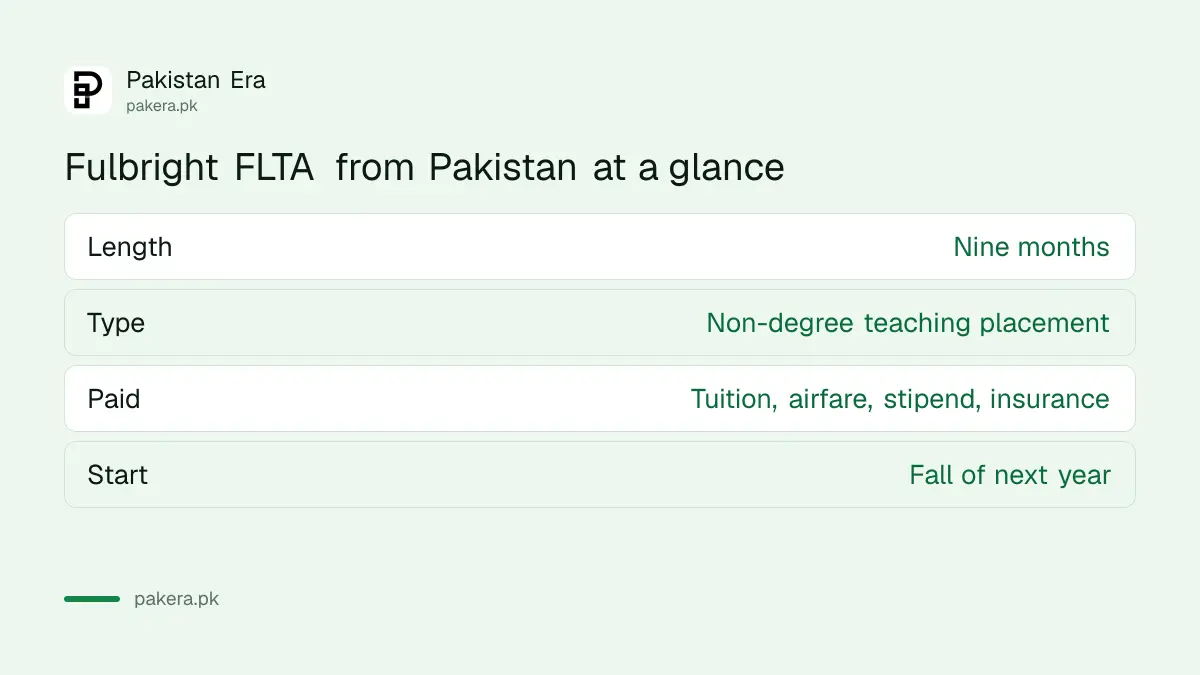
| Length | Nine months, shown as 9 to 10 months |
| Type | Non-degree teaching assistant programme |
| Paid for | Tuition, airfare, textbooks, living stipend, health insurance |
| Start | Fall semester of the next year |
| Partner | Institute of International Education (IIE) |
You must be a young, early-career English teacher in Pakistan
USEFP's rules are short. The first test is the job you do now. A teacher of another subject cannot use FLTA.
- Pakistani national with a valid Pakistani passport.
- Living in Pakistan throughout the selection process.
- A young, early-career educator.
- At least 16 years of formal education.
- A teacher of English or a related field at college or university level.
- English teachers at technical and vocational training colleges are encouraged to apply.
- Prior teaching experience is preferred.
USEFP does not give an age limit on the page. "Young" and "early career" are the words it uses, so do not guess a number. If you are unsure, write to USEFP before you spend time on the form.
The application is online and TOEFL is paid by USEFP if you are selected
A complete package, including academic transcripts and letters of reference, must be submitted online by the deadline. Paper copies are not accepted. USEFP sends an automatic acknowledgement when your online application is received.
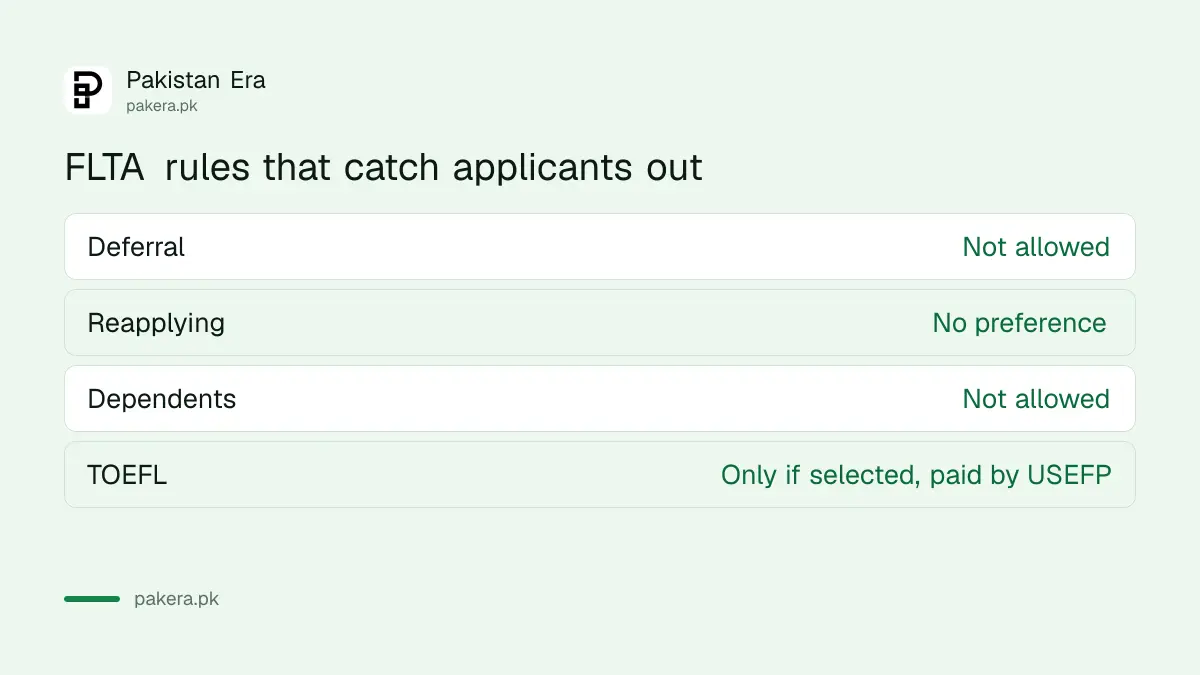
You do not need a TOEFL score at the start. USEFP says only selected candidates take the test, and USEFP pays for it. That saves a lot of money compared with tests you pay for yourself, such as the one in the guide to the IELTS fee in Pakistan.
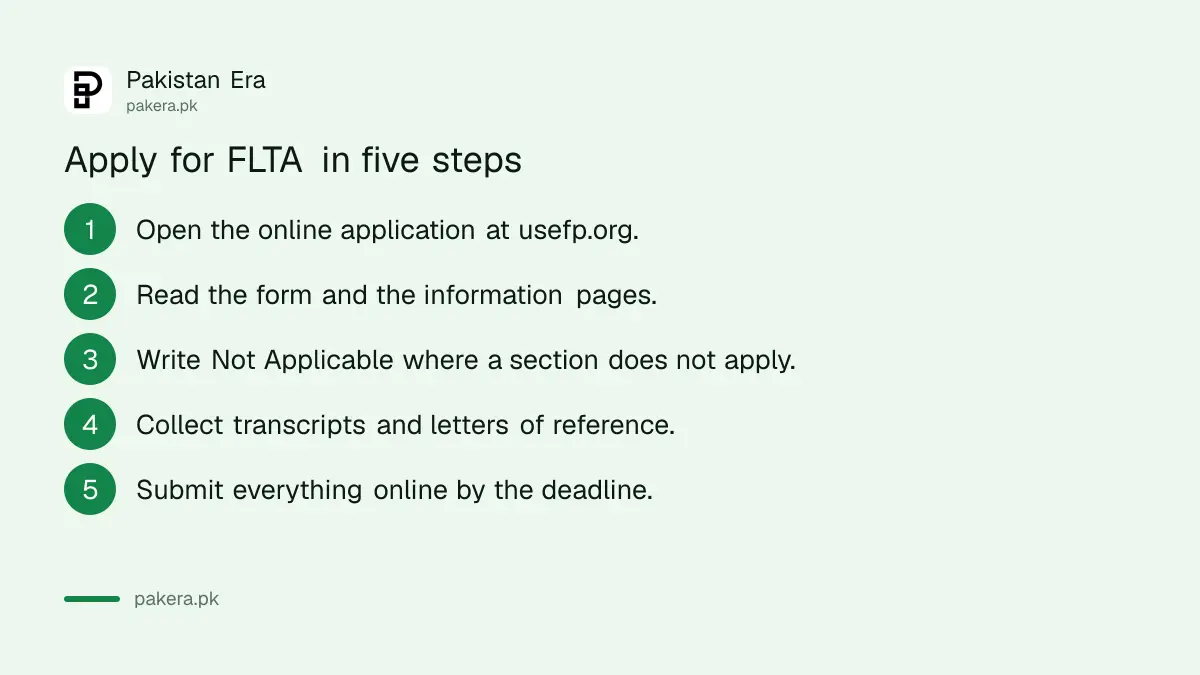
- Open the online application at usefp.org when the call opens.
- Read the application form and the general information pages first.
- Write "Not Applicable" in any section that does not apply to you.
- Ask your referees for letters, using USEFP's reference form.
- Submit the whole package online before the deadline.
The selection has four rounds and finalists are chosen in October
USEFP screens every application for completeness and minimum qualifications. Complete ones are scored and shortlisted. Shortlisted applicants are interviewed in person between July and September by a panel of U.S. and Pakistani citizens.
The last round is in October. Finalists and alternates are told by phone or email. Those not selected are told by email. A finalist must then submit a medical history and examination form, a scanned passport copy and a no-objection certificate from the employer or the Government of Pakistan.
Three rules catch people out. You cannot defer an FLTA award to the next year. Reapplying after you decline does not give you any preference. And dependents are not allowed on this programme.
When the next call is expected
USEFP's page shows the current status as closed, with a last date of 13 May 2026. It also gives "June/July" as the tentative announcement time for the cycle. Those two facts sit uneasily, so do not treat either as a promise for the next year.
What you can do now is get the file ready. Collect your transcripts, ask your referees early and keep your passport valid.
If you want a longer course in the U.S. later, the Fulbright Master's and PhD route is a different and larger programme. A short training for school teachers is described in the guide to the Fulbright TEA programme for government school teachers.
Common questions
Is the FLTA application open now?
No. USEFP's page shows it closed, with a last date of 13 May 2026.
Who can apply for FLTA from Pakistan?
Young, early-career teachers of English or a related field at college or university level, with 16 years of education and a Pakistani passport.
Is FLTA a degree programme?
No. It is a nine-month non-degree programme in which you also teach your native language.
Do I pay for TOEFL?
No. USEFP says only selected candidates take TOEFL, and USEFP pays for it.
Can I take my family?
No. USEFP says dependents are not allowed on the FLTA programme.
Can I postpone the award for a year?
No. USEFP says deferral of the FLTA award is not an option.
How we verified this
What we checked, where we read it, and what we could not confirm.
We read USEFP's Fulbright FLTA page on 12 October 2026. The status, deadline, eligibility rules and selection rounds are from that page. USEFP has not published the date of the next call on that page, so confirm it on usefp.org.
About the author

Public Services and Education Journalist
Fajr Riaz is a journalist and content writer at Pakistan Era, based in Lahore. She covers the questions people meet in everyday life in Pakistan: how a public service works, what a change in the rules means, and where to find a reliable answer.