How to Apply for the ZTBL Asan Qarza Youth Loan of Rs 500,000 in Pakistan
ZTBL's Asan Qarza lends up to Rs 500,000 to rural youth aged 18 to 35, repayable in 5 years. See the four papers, the 10 per cent share and the steps to apply.
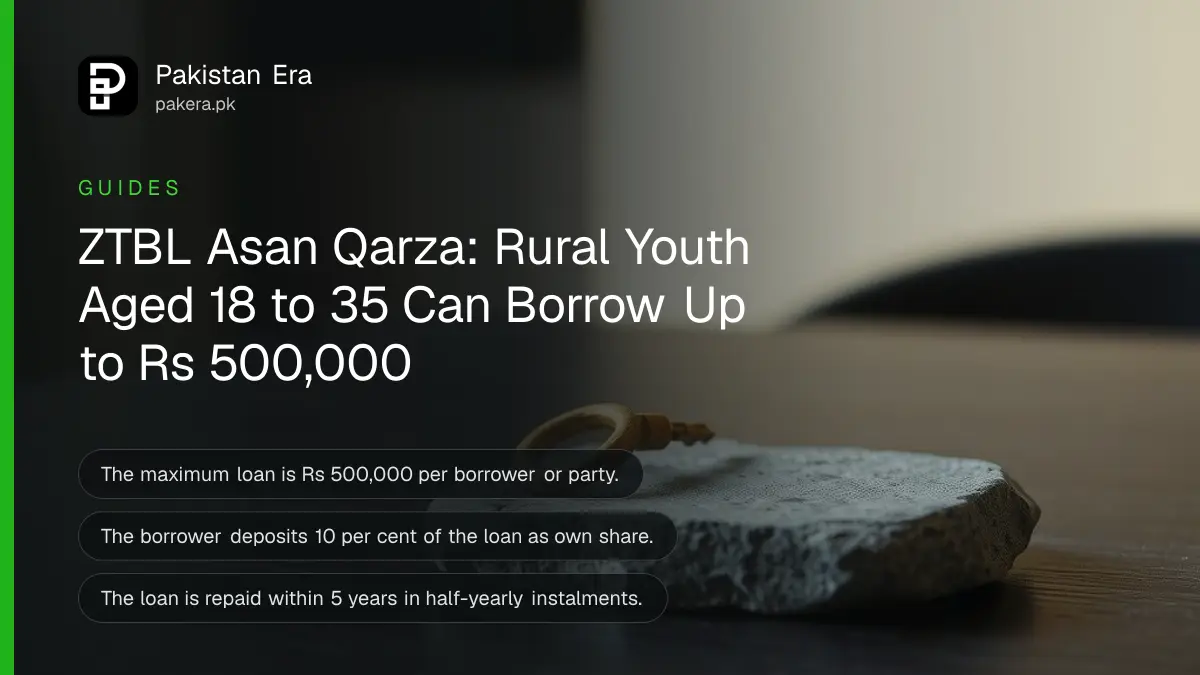
Zarai Taraqiati Bank Limited (ZTBL) lends up to Rs 500,000 per borrower under its Asan Qarza Scheme for rural youth aged 18 to 35. You put in 10 per cent yourself and repay within 5 years in half-yearly instalments. The scheme runs in all ZTBL branches across Pakistan.
A young man in a village often has a plan, a small plot and no money to start. Asan Qarza is ZTBL's answer for that case. We opened ZTBL's Asan Qarza page on 15 October 2026, and every term below comes from it. The page gives no markup rate and no closing date, so we quote neither.
Asan Qarza lends up to Rs 500,000 to creditworthy rural youth
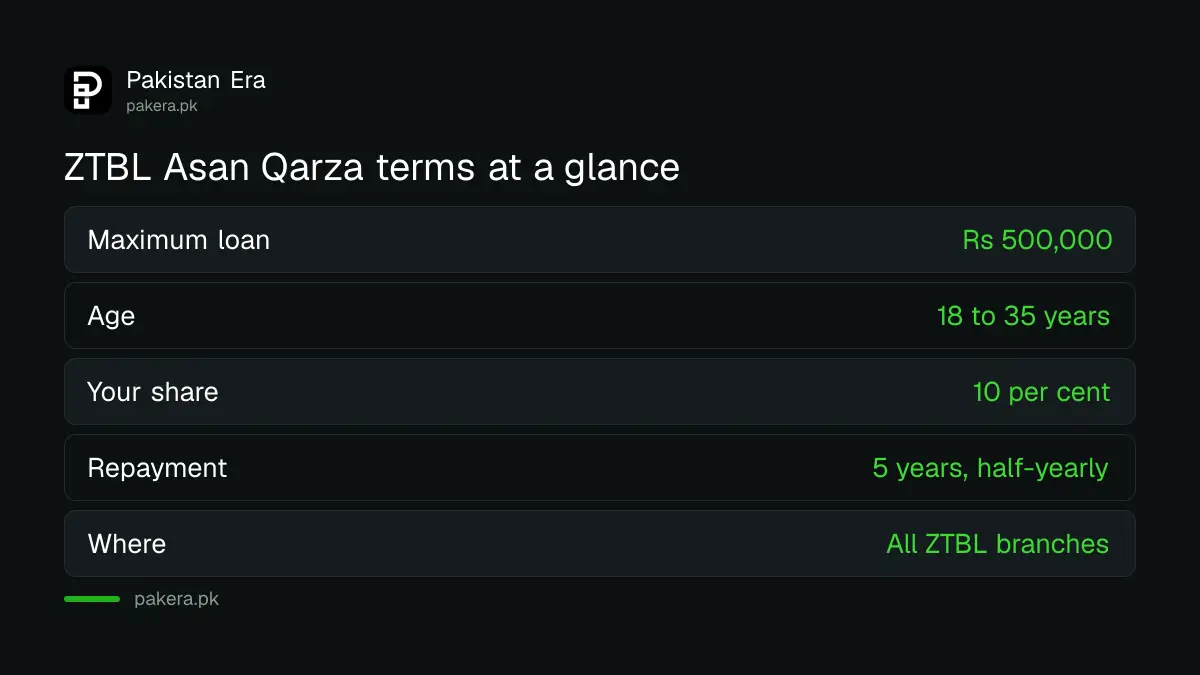
The maximum loan is Rs 500,000 per borrower or party. ZTBL launched the scheme to involve rural youth in national development, to raise their living standard and to slow their move to the cities. It applies in every ZTBL branch across Pakistan.
The page does not list the business activities it will fund. It says only that eligible youth can apply for "a large number of activities". So the branch decides whether your plan fits. Go with a clear plan and a rough cost, not just a wish for a loan.
| Term | What ZTBL's page says |
|---|---|
| Maximum loan | Rs 500,000 per borrower or party |
| Age | 18 to 35 years |
| Your share | 10 per cent of the loan |
| Repayment | 5 years, half-yearly instalments |
| Markup | Prevailing rate on development loans |
| Where | All ZTBL branches |
You qualify at 18 to 35 if the bank judges you able to repay
ZTBL says creditworthy and reputable youth aged 18 to 35, who have the capacity to repay, are eligible. Both tests count. Being in the age band is not enough, because the branch also looks at your income, record and plan before it sanctions anything.
The page does not give a minimum income or a credit score. It does not mention an e-CIB check for this scheme, though other ZTBL schemes list one. A clean record helps with any bank, and you can see yours through the steps in the e-CIB credit report guide. Fix any wrong entry before you apply.
Bring four papers: CNIC, application, land record and two photographs
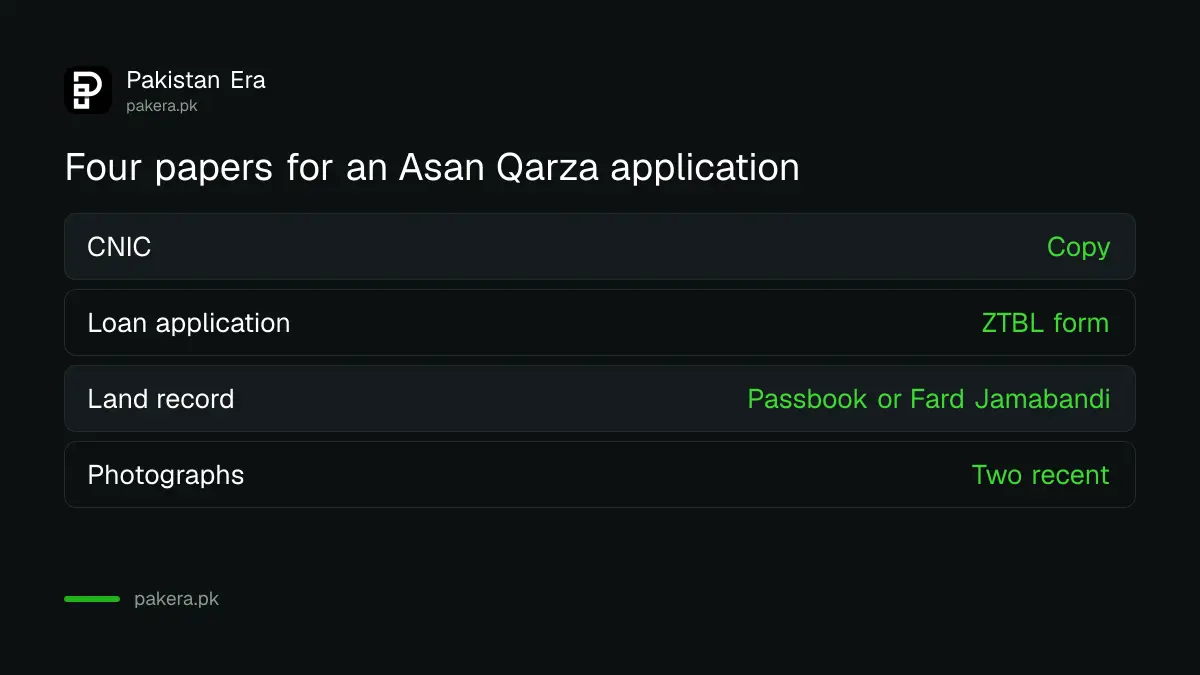
ZTBL lists four documents: a CNIC copy, the loan application, an agricultural passbook or Fard Jamabandi, and two recent photographs. The land record is what makes this an agri bank loan. Get it before you visit the branch.
Fard Jamabandi is the official record of who owns a piece of land. In Punjab you can get a copy online, as shown in the steps to get a Fard online in Punjab. Other provinces use their own offices. If the land is in a parent's name, the family member can sign as co-applicant, which the next section explains.
Pay 10 per cent yourself and offer property as security
You deposit 10 per cent of the loan as your own share. On Rs 500,000 that is Rs 50,000. ZTBL takes tangible property as security. If you own none, a parent's or family member's property can be accepted, with that person as co-applicant.
That last rule matters for young people with no land of their own. It also means a family member shares the risk. Talk to them before you apply, and make sure they have read the loan terms. The page says the cost of credit is "as per the bank's rules", so ask the branch for every charge in writing.
Repay over five years, and ask for the instalment amount before you sign
The loan is recoverable within five years in half-yearly instalments, which means ten payments. The markup is the prevailing development-loan rate, which the page does not state. Ask the branch for your exact instalment and the total you will repay before you sign.
Here is our own arithmetic, not a ZTBL figure. If the full Rs 500,000 is spread evenly over ten half-yearly payments, the principal alone is Rs 50,000 a payment, before any markup. Your real instalment will be higher. Sanction comes from the Credit Review Department at the bank's head office, so the branch cannot promise a result.
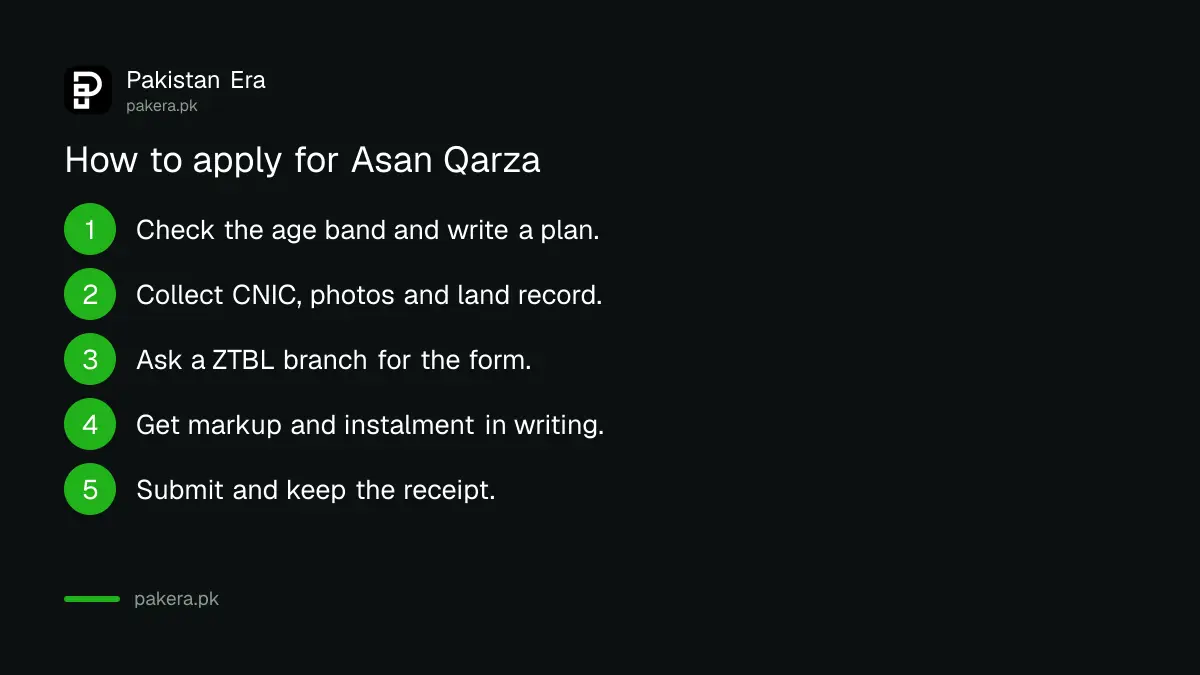
- Check that you are 18 to 35 and have a plan with a rough cost.
- Collect your CNIC, two photographs and the land record.
- Visit the nearest ZTBL branch and ask for the Asan Qarza application.
- Ask in writing for the markup rate, charges and instalment amount.
- Submit the form, keep the receipt and ask when the head office will decide.
ZTBL's home page also lists an "Izhar-e-dilchasbi" form, meaning expression of interest, under its loan tools. We did not submit it. The bank's contact centre number, shown on its site, is 051-111-30-30-30. For a wider view of state farm and youth finance, see the guide to the Prime Minister's youth business loan.
Common questions about the ZTBL Asan Qarza loan
How much can I borrow under Asan Qarza?
Up to Rs 500,000 per borrower or party, according to ZTBL's scheme page.
What is the age limit?
The page says 18 to 35 years. The applicant must also be creditworthy and able to repay.
Do I need my own land?
You need an agricultural passbook or Fard Jamabandi among your papers. For security, a parent's or family member's property can be accepted if you have none, with that person as co-applicant.
What is the markup rate?
ZTBL's page says the prevailing rate on development loans applies and does not state a figure. Ask the branch for the current rate in writing.
How long do I have to repay?
Five years, in half-yearly instalments. The page does not describe a grace period for this scheme.
Who approves the loan?
The Credit Review Department at ZTBL's head office sanctions it. The branch only receives and forwards your application.
How we verified this
What we checked, where we read it, and what we could not confirm.
Last checked 15 October 2026. The loan limit, age band, documents, 10 per cent contribution, security rule, repayment term and sanction authority come from ZTBL's Asan Qarza Scheme page and home page at ztbl.com.pk. The instalment arithmetic is ours. We did not apply or call a branch. ZTBL can change or withdraw a scheme, so confirm the terms at the branch before you commit.
About the author

Public Services and Education Journalist
Fajr Riaz is a journalist and content writer at Pakistan Era, based in Lahore. She covers the questions people meet in everyday life in Pakistan: how a public service works, what a change in the rules means, and where to find a reliable answer.