Bank Savings Rate in Pakistan Is the SBP Floor Minus 0.5%: What 26 October Can Change From 1 November
Bank savings in Pakistan must pay at least the SBP floor minus 0.5 points, 10% now. See what a 26 October rate move does to your profit from 1 November.
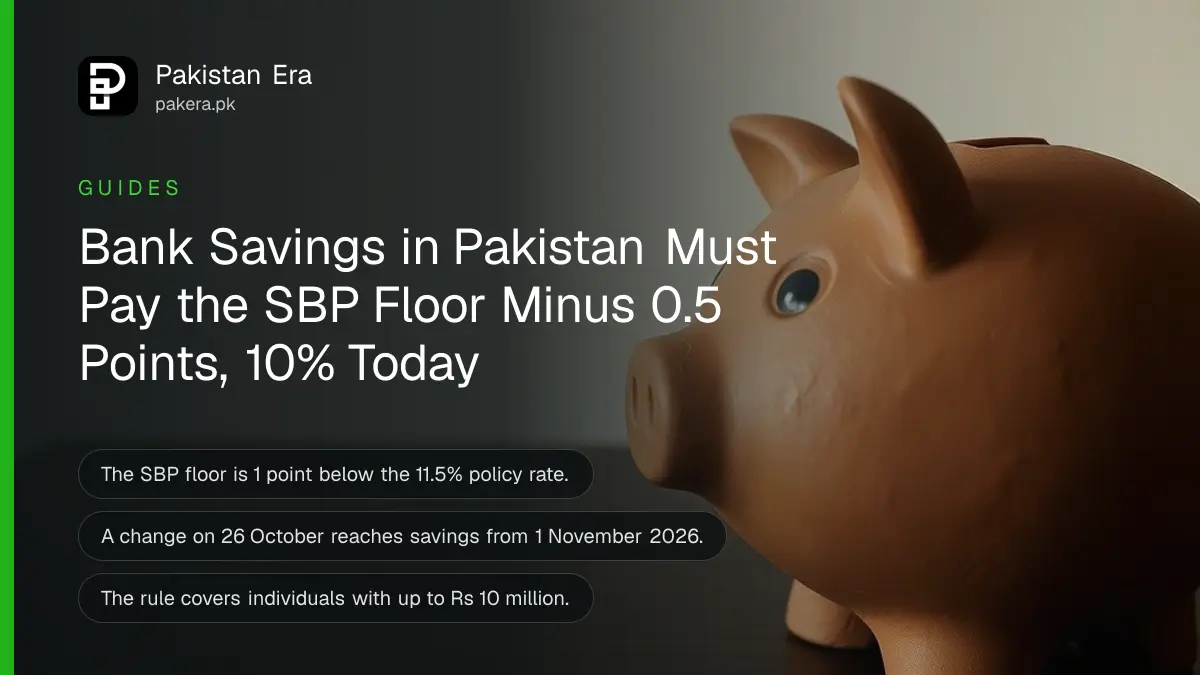
Short answer: The lowest profit a conventional bank in Pakistan may pay on an individual's savings account is 0.5 points below the State Bank of Pakistan's (SBP) floor rate. With the policy rate at 11.5% and the floor at 10.5%, that minimum is 10% today. If SBP changes the policy rate on 26 October 2026, the minimum moves from 1 November 2026.
That is why almost every big bank shows the same 10% on its savings account. It is not a coincidence. It is an SBP rule from 2013, still in force, tied to the interest rate corridor. We read the circulars that set it on 20 October 2026, and this page shows exactly what a decision on 26 October can do to your monthly profit.
Your minimum savings rate is the SBP floor minus 0.5 points
SBP's BPRD Circular No. 7 of 2013 says the minimum profit on rupee savings deposits is 50 basis points below the SBP repo floor rate. The floor is 10.5% now, so the minimum is 10%. A basis point is one hundredth of a percentage point, so 50 basis points is 0.5.
The floor itself follows the policy rate. SBP's monetary policy page says its standing facilities are set 100 basis points below and above the policy rate. So the floor is always 1 point under the policy rate, and the savings minimum is 1.5 points under it. Policy rate 11.5%, floor 10.5%, savings minimum 10%.
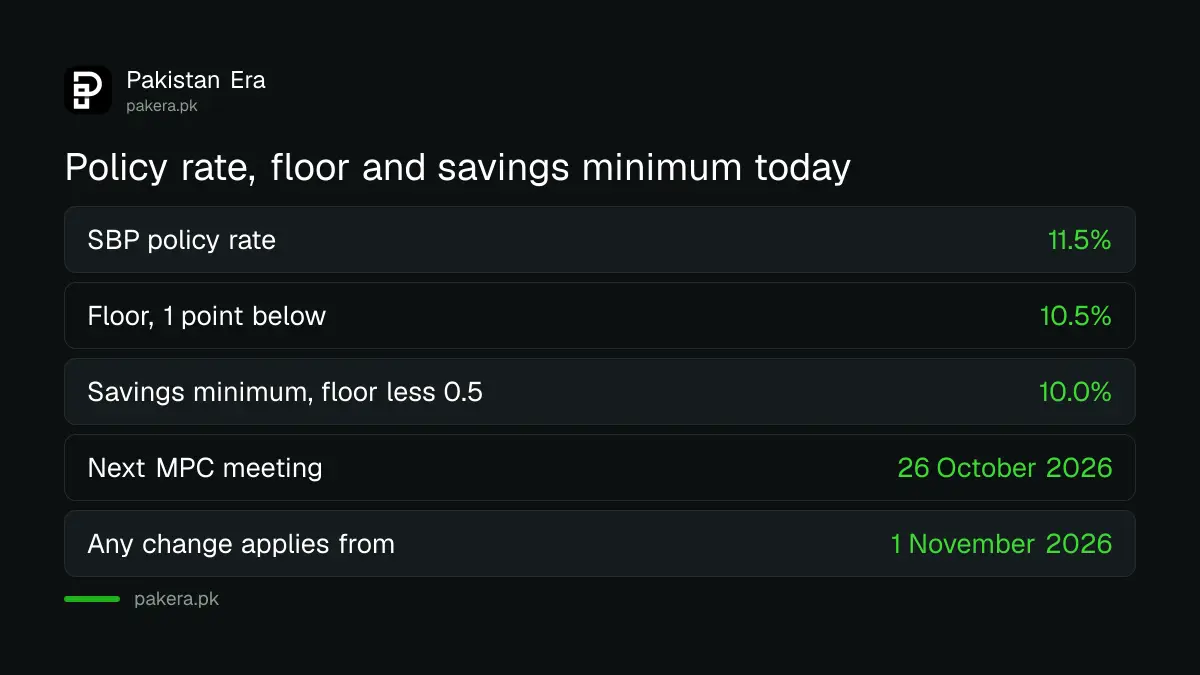
SBP's own pages name that floor differently in different places, "reverse repo" on one and "repo (floor)" on another. The number is the same: 10.50% on SBP's home page on 20 October 2026. For how to read the corridor yourself, see how to check the SBP policy rate and corridor.
A change on 26 October takes effect from 1 November
The 2013 circular says a change in the minimum, after any change in the SBP rate, applies from the first day of the next month. SBP's Monetary Policy Committee meets on 26 October 2026. So any move that day reaches the savings minimum on 1 November 2026, not the next morning.
Here is what the rule gives under each likely outcome. These are our own sums from the rule, and they assume SBP keeps its corridor at 1 point either side of the policy rate, as it is today.
| Decision on 26 October | Policy rate | Floor | Savings minimum from 1 November |
|---|---|---|---|
| Cut by 1 point | 10.5% | 9.5% | 9.0% |
| Cut by 0.5 points | 11.0% | 10.0% | 9.5% |
| Hold | 11.5% | 10.5% | 10.0% |
| Rise by 0.5 points | 12.0% | 11.0% | 10.5% |
| Rise by 1 point | 12.5% | 11.5% | 11.0% |
Nobody outside the committee knows the result. In September, seven of ten members voted to hold and three voted to raise, according to the September meeting minutes. The dates and scenarios for the meeting itself are in the preview of the 26 October monetary policy meeting.
Half a point is worth about Rs 208 a month on Rs 500,000
Profit is worked out on your average monthly balance. On Rs 500,000 at 10%, a month's profit before tax is about Rs 4,167. At 10.5% it would be about Rs 4,375, and at 9.5% about Rs 3,958. So each half point moves the bill by about Rs 208 a month on that balance.
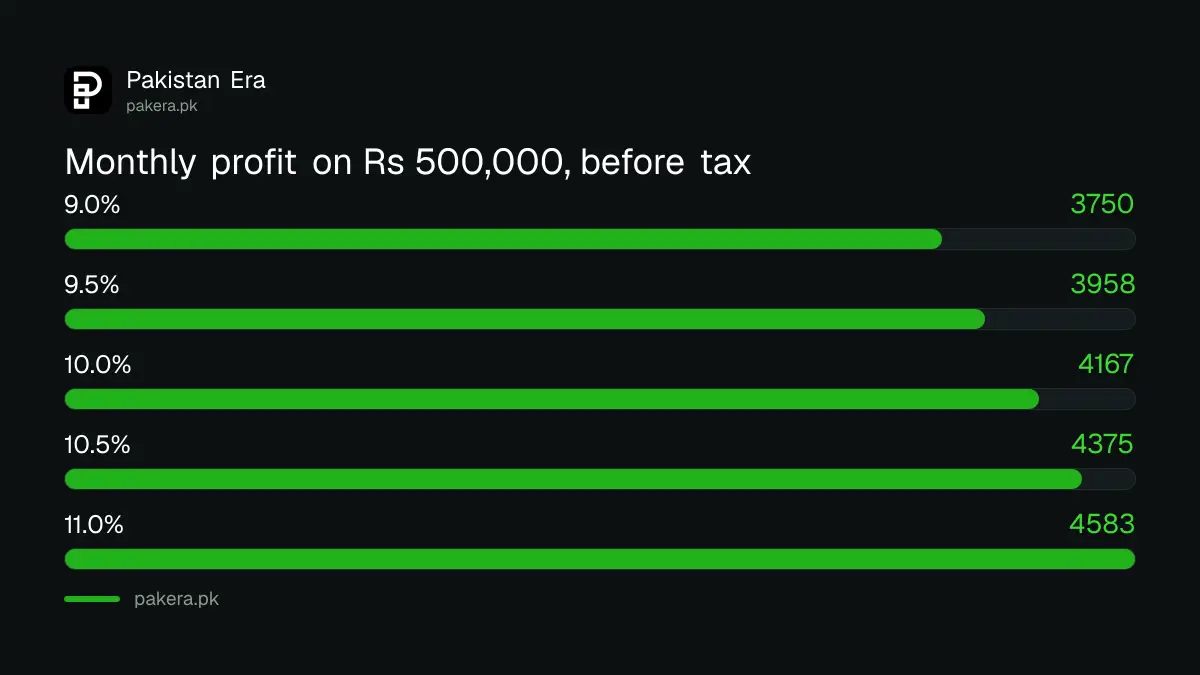
Tax comes out before the profit reaches you, and non-filers pay more. Our comparison of National Savings against a bank savings account works through the after tax figures. Because profit is on the average balance, money that sits for the whole month earns more than money that arrives on the 28th.
The minimum covers individuals with up to Rs 10 million
From 1 August 2026, the minimum applies only to individuals keeping a monthly average balance of up to Rs 10 million, under BPRD Circular Letter No. 15 of 2026. Term deposits are outside it, and so are banks, public sector enterprises and public limited companies.
- Covered: rupee savings accounts and other profit paying deposits with no fixed maturity, held by individuals, on the average monthly balance (BPRD Circular No. 5 of 2014).
- Not covered: term deposits and fixed deposits, which have their own rates. See fixed deposit rates by bank.
- Not covered: deposits of financial institutions, public sector enterprises and public limited companies, from 1 January 2025 (BPRD Circular No. 5 of 2024).
- Not covered: individuals whose monthly average balance is above Rs 10 million, from 1 August 2026.
- Different rule: Islamic banks pay under profit sharing instructions, not this floor. See how Islamic bank savings profit is set.
The Rs 10 million cap was set in the same letter that launched InvestPak, SBP's platform for buying government securities directly. Larger savers can buy treasury bills there instead.
Check your own statement in November
The easiest check is your first statement after 1 November 2026. If SBP moved the rate on 26 October, the profit rate on a conventional savings account should move to the new minimum, unless your bank already pays more.
- Note SBP's decision on 26 October and the new policy rate.
- Take 1.5 points off it to get the new savings minimum.
- Open your bank app or November statement and find the profit rate on your savings account.
- If the rate is below the minimum and your average balance is Rs 10 million or less, ask the bank in writing why.
- If the bank does not fix it, complain through SBP's Sunwai portal.
Banks may always pay more than the minimum. Some digital and smaller banks do. The floor stops you getting less. It does not stop you looking for more. Current offers are in our list of savings account profit rates.
Common questions
Why do most banks pay exactly 10% on savings?
Because SBP's minimum is the floor rate minus 0.5 points, and the floor is 10.5%. Most banks pay the minimum and no more on ordinary savings accounts.
When will my savings rate change if SBP changes the policy rate?
From the first day of the following month. A decision on 26 October 2026 would reach the minimum on 1 November 2026.
Does the minimum apply to fixed deposits?
No. Since 1 June 2014 the minimum covers savings products with no fixed maturity, and term deposits are excluded. Banks set term deposit rates themselves.
I have Rs 15 million in savings. Am I covered?
Not from 1 August 2026. The minimum now applies only to individuals with a monthly average balance of up to Rs 10 million.
Does this apply to Meezan and other Islamic banks?
No. Islamic banks share profit from their pools under separate SBP instructions, so their savings rate can be well below 10%.
Is the minimum before or after tax?
Before tax. The bank deducts withholding tax from the profit it pays, so what reaches your account is lower.
How we verified this
What we checked, where we read it, and what we could not confirm.
Last checked 20 October 2026. We read BPRD Circular No. 7 of 2013 (minimum 50 basis points below the floor, change from the next month), BPRD Circular No. 5 of 2014 (term deposits excluded), BPRD Circular No. 5 of 2024 (institutions and listed companies excluded) and BPRD Circular Letter No. 15 of 2026 (Rs 10 million cap, InvestPak) on SBP's website on 20 October 2026. The 100 basis point corridor and the 26 October meeting are from SBP's monetary policy page, and the 10.50% floor from SBP's home page, both read the same day. The scenario table and the profit sums are our arithmetic and assume the corridor stays 1 point wide. We did not check every bank's November rate, which does not exist yet.
About the author

Public Services and Education Journalist
Fajr Riaz is a journalist and content writer at Pakistan Era, based in Lahore. She covers the questions people meet in everyday life in Pakistan: how a public service works, what a change in the rules means, and where to find a reliable answer.