Islamic Bank Savings Profit in Pakistan: SBP's 75% Pool Rule, and Why Meezan Paid 6.63% in September
Islamic banks in Pakistan pay savers at least 75% of pool yield, not the 10% floor. Meezan paid 6.63% for September 2026. See how the rate is set and compare.
Short answer: Islamic banks in Pakistan do not have to pay the 10% minimum that conventional banks pay on savings. Under State Bank of Pakistan (SBP) rules, they must pay savers at least 75% of the weighted average gross yield of their profit pools. In practice, Meezan Bank paid 6.63% on individual savings accounts up to Rs 10 million for September 2026.
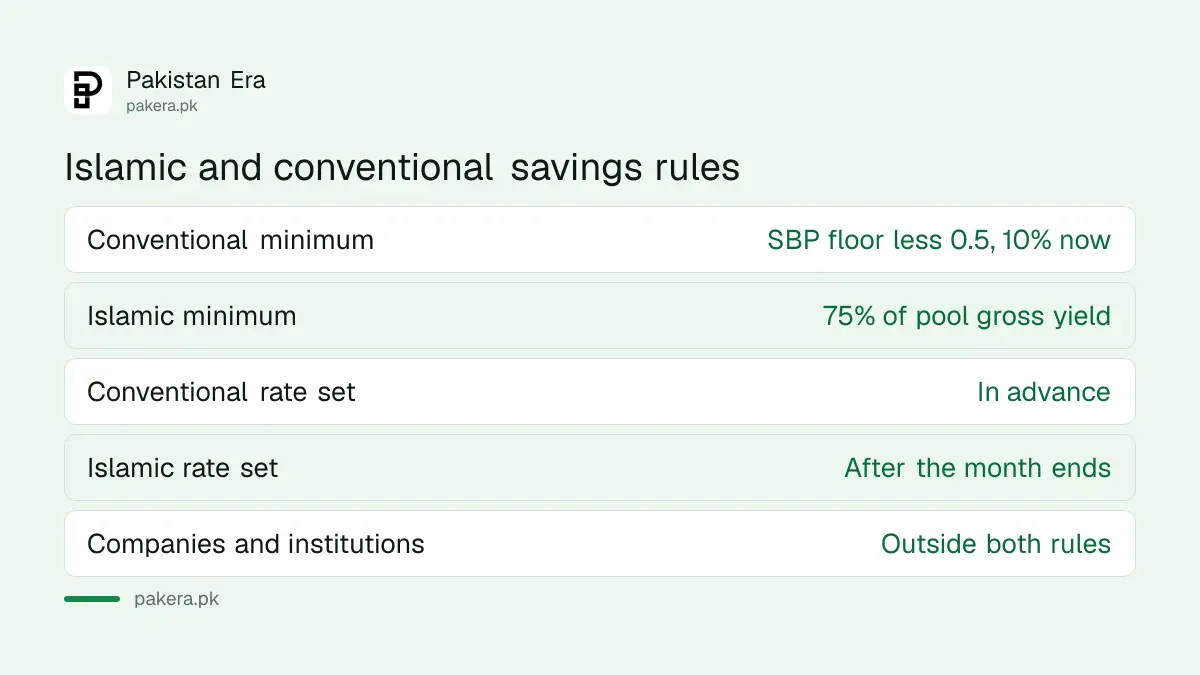
Many savers notice the gap only when they compare statements. A conventional savings account shows 10%. A Meezan savings account shows a figure that changes every month and sits well below it. Both are legal. They follow different SBP rules, and we read both on 20 October 2026. This page explains the Islamic rule, how the monthly rate is set, and where a Shariah-compliant saver can earn more.
Islamic banks follow a 75% pool rule, not the 10% floor
SBP's IFPD Circular No. 09 of 2024, in force from 1 January 2025, says Islamic banks must pay profit on rupee savings deposits of at least 75% of the weighted average gross yield of all their pools. The conventional 10% minimum, tied to SBP's floor rate, does not apply to them.
A pool is the bundle of financing and investments a bank funds with depositors' money. Its gross yield is the month's gross earnings divided by the pool's average assets, leaving out fixed assets. Pools that a bank keeps for SBP's Shariah-compliant liquidity operations are left out of the sum. So the rule ties your profit to what the bank actually earned that month.
The conventional rule works differently. It sets the minimum at 0.5 points below SBP's floor rate, which gives 10% today. That rule, and what the 26 October 2026 meeting can do to it, is in our explainer on the bank savings minimum rate.
Meezan paid 6.63% on individual savings for September 2026
Meezan Bank's profit rate sheet for the month ended 30 September 2026, updated on 2 October 2026, shows 6.63% on its Saving Account for individuals with up to Rs 10 million. Its one year certificate paid 9.18% monthly or 9.56% at maturity. Its Monthly Mudarabah Certificate paid 7.12%.
| Product, September 2026 | Profit rate | Who sets it |
|---|---|---|
| Meezan Saving Account, individuals up to Rs 10 million | 6.63% | Meezan, after month end |
| Meezan Monthly Mudarabah Certificate | 7.12% | Meezan, after month end |
| Meezan certificate, 1 year, monthly profit | 9.18% | Meezan, after month end |
| Conventional bank savings minimum | 10.00% | SBP rule |
| National Savings Sarwa Islamic Saving Account | 11.33% | National Savings, from 1 October 2026 |
We read Meezan's sheet as a PDF. Its two column layout is tight, so we matched each rate to its product line carefully. Rates for balances above Rs 10 million and for companies are lower or set on separate tiers.
Your Islamic profit rate is fixed after the month ends
A conventional bank tells you the rate in advance. An Islamic bank declares it after the month closes, once the pool's earnings are known. Meezan's September rates were published on 2 October 2026. So the rate on your statement is a result, not a promise.
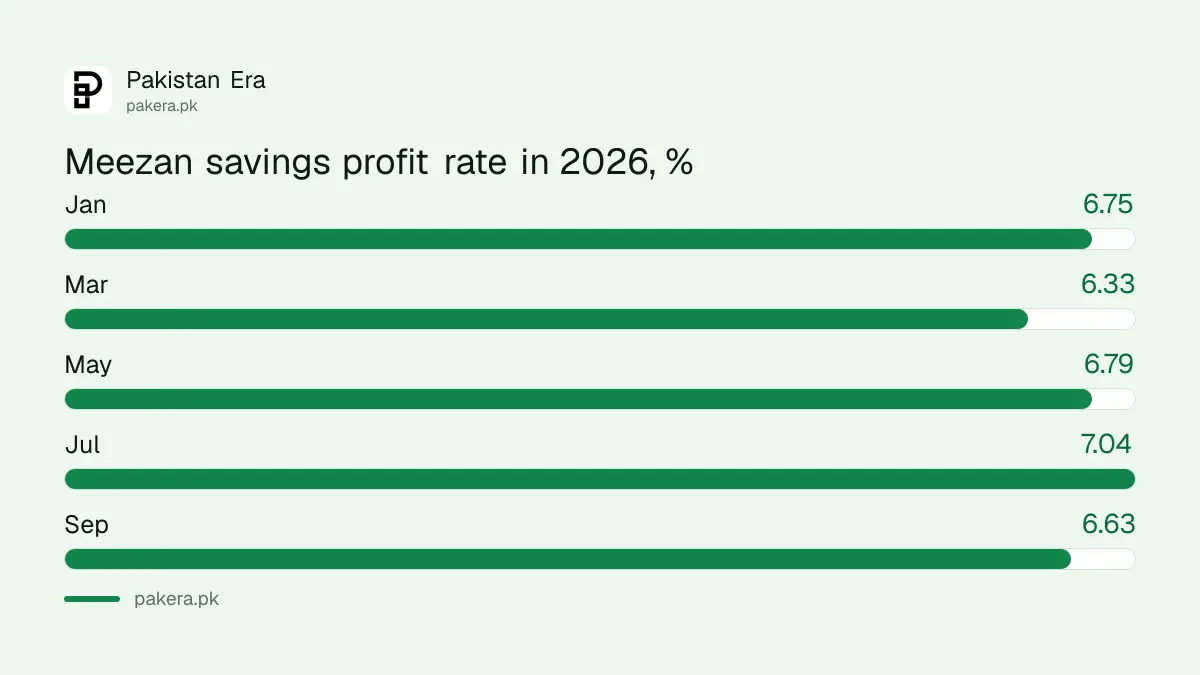
The arrangement is called Mudarabah. You provide the money, the bank manages it, and profit is shared by agreed weightages, which are shares set for each product and balance tier. That is why the rate moves every month. Meezan's Saving Account rate moved between 6.33% and 7.04% from January to July 2026.
SBP also lets an Islamic bank give up part of its own share, or make a gift called hiba to savers, when pool returns are low. The circular allows this to meet market expectations or the minimum profit rate. It does not oblige the bank to match conventional rates.
Shariah-compliant savers can earn more elsewhere
National Savings pays 11.33% on its Sarwa Islamic Saving Account from 1 October 2026, according to its own website. That is 4.70 points above Meezan's September savings rate. Term certificates at Islamic banks also pay more than their savings accounts, at the cost of locking money away.
On Rs 1,000,000 for a year, 6.63% gives about Rs 66,300 before tax and 11.33% gives about Rs 113,300. That gap of about Rs 47,000 is large enough to compare the options properly. The National Savings Islamic accounts are set out in our report on Sarwa Islamic term and saving accounts.
- Open your Islamic bank's latest monthly profit rate sheet on its website.
- Find your product and your balance tier, for example individuals up to Rs 10 million.
- Compare it with the bank's own term certificates for the same month.
- Compare it with the National Savings Sarwa rates.
- Keep money you need every week in the savings account and move the rest to a term product.
A Shariah board approves each bank's products, so ask your own bank's branch if you are unsure which product suits your needs. For Islamic financing rather than savings, see Islamic and conventional car financing compared.
Deposit protection covers Islamic accounts the same way
Islamic deposits at member banks are protected by the Deposit Protection Corporation (DPC) on the same terms as conventional ones. Conventional and Islamic accounts in the same bank share one limit of Rs 1 million per depositor, according to DPC's own FAQ, which we read on 3 October 2026.
So a lower profit rate does not mean weaker protection. The risk you carry is a lower and less predictable return, not the safety of the deposit itself. Details are in our check of bank deposit protection.
Common questions
Why does Meezan pay less than 10% on savings?
Because the 10% minimum is a rule for conventional banks. Islamic banks pay at least 75% of their pools' weighted gross yield instead, and Meezan's result for September 2026 was 6.63% for individuals up to Rs 10 million.
When is the Islamic savings rate announced?
After the month ends. Meezan published its September 2026 rates on 2 October 2026.
Can an Islamic savings account lose money?
Under Mudarabah the saver shares the pool's outcome. Meezan's published rates for every month of 2026 have been positive, and DPC protection covers deposits up to Rs 1 million per depositor per member bank if a bank fails.
Does the 75% rule apply to companies?
No. The circular excludes deposits of financial institutions, public sector enterprises and public limited companies.
Is the National Savings Sarwa account Shariah compliant?
National Savings offers it as an Islamic product, and lists it at 11.33% from 1 October 2026. Check its terms on the National Savings website before you invest.
Will the 26 October SBP decision change Islamic savings rates?
Not directly. Islamic rates follow what the pool earns, so a policy rate change reaches them over the following months as the bank's financing reprices.
How we verified this
What we checked, where we read it, and what we could not confirm.
Last checked 20 October 2026. We read SBP's IFPD Circular No. 09 of 2024 on the 75% rule, hiba and the pool yield method, and BPRD Circular No. 7 of 2013 on the conventional minimum, on 20 October 2026. Meezan's rates come from its profit rate sheets for September 2026 and for January to September 2026, downloaded the same day. The 11.33% Sarwa rate was read on the National Savings website on 20 October 2026, and the DPC limit on DPC's FAQ on 3 October 2026. The yearly profit sums are our arithmetic before tax. Meezan does not publish its pool's gross yield on the sheet, so we could not check its 75% calculation from outside.
About the author

Public Services and Education Journalist
Fajr Riaz is a journalist and content writer at Pakistan Era, based in Lahore. She covers the questions people meet in everyday life in Pakistan: how a public service works, what a change in the rules means, and where to find a reliable answer.