Sarwa Islamic Term and Saving Accounts at National Savings: 11.84% to 12.12% From 21 October 2026
Sarwa Islamic Saving Account pays 11.84% and the Term Account 11.84% to 12.12% from 21 October 2026 at National Savings. See minimums, payouts and tax.
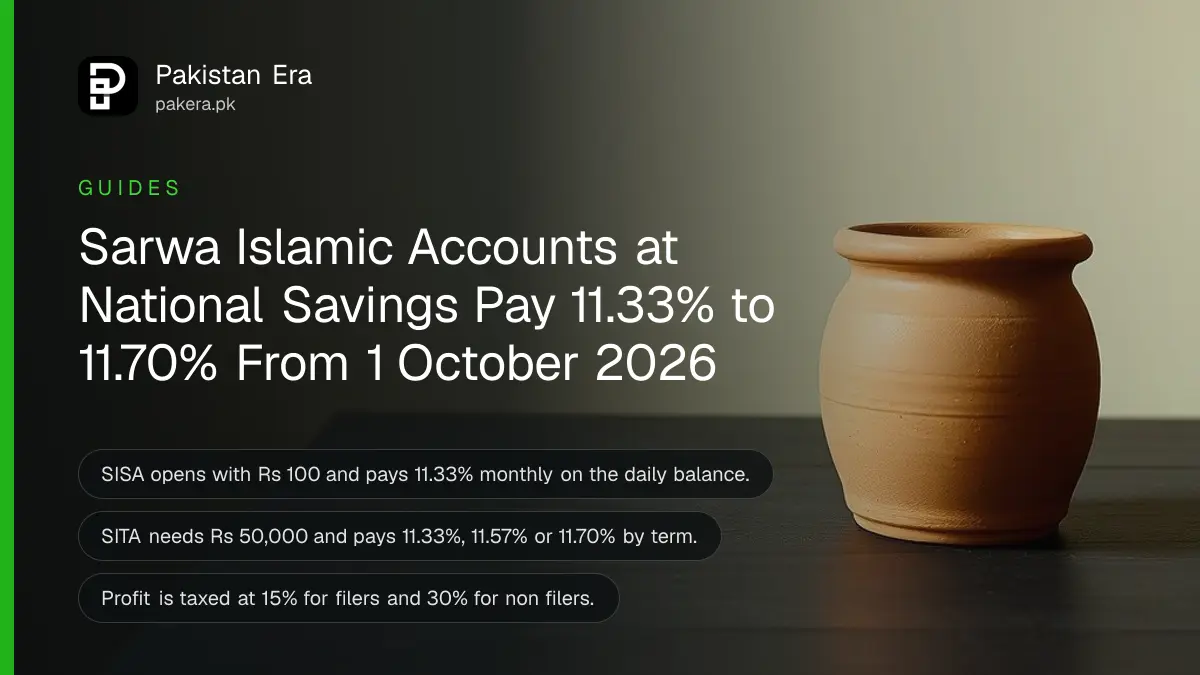
Short answer: National Savings' Sarwa Islamic Saving Account (SISA) pays an anticipated 11.84 per cent a year from 21 October 2026, and its Sarwa Islamic Term Account (SITA) pays 11.84 per cent for one year, 12.10 per cent for three years and 12.12 per cent for five years. SISA opens with Rs 100, SITA with Rs 50,000, there is no upper limit, and profit is taxed at 15 per cent for filers and 30 per cent for non filers.
Correction, 24 October 2026: This article gave the rates from 1 October 2026, 11.33 per cent for SISA and 11.33, 11.57 and 11.70 per cent for SITA. National Savings raised them from 21 October 2026 to 11.84 per cent for SISA and 11.84, 12.10 and 12.12 per cent for SITA, and the figures below are updated. Every other scheme is in the National Savings rates from 21 October 2026.
Both accounts are run by Rafa National Savings, the Islamic window of the Central Directorate of National Savings (CDNS). We read the rates page, the products page and the two rate history sheets on savings.gov.pk on 19 October 2026, and the rate card and updated sheets dated 21 October 2026 on 24 October. The rates are "anticipated", because the money is invested on your behalf and you receive the actual profit, which is how the structure works.
Sarwa is a Wakala contract, so you get the actual profit and the state keeps any excess
Both accounts use Wakala bil Istismar, an agency for investment. You, the account holder, ask Rafa National Savings to appoint the Ministry of Finance as your agent, and the agent invests your money in government projects and revenue generating assets. You receive the actual profit, and the Ministry keeps anything above the anticipated rate as its incentive.
The flip side is written into the terms: you bear a proportionate share of any loss, except a loss caused by the agent's gross negligence, wilful misconduct, breach or fraud. In practice the published rate has been paid as the profit rate, and CDNS resets it when the market moves. The rate sheets show seven new rates so far in 2026: on 29 January, 26 May, 10 June, 18 July, 4 September, 1 October and 21 October.
That is the main difference from the conventional schemes in the National Savings profit rates for October 2026, which promise a fixed return. It is also what makes Sarwa the only Shariah compliant product at National Savings centres, with a Shariah board of its own.
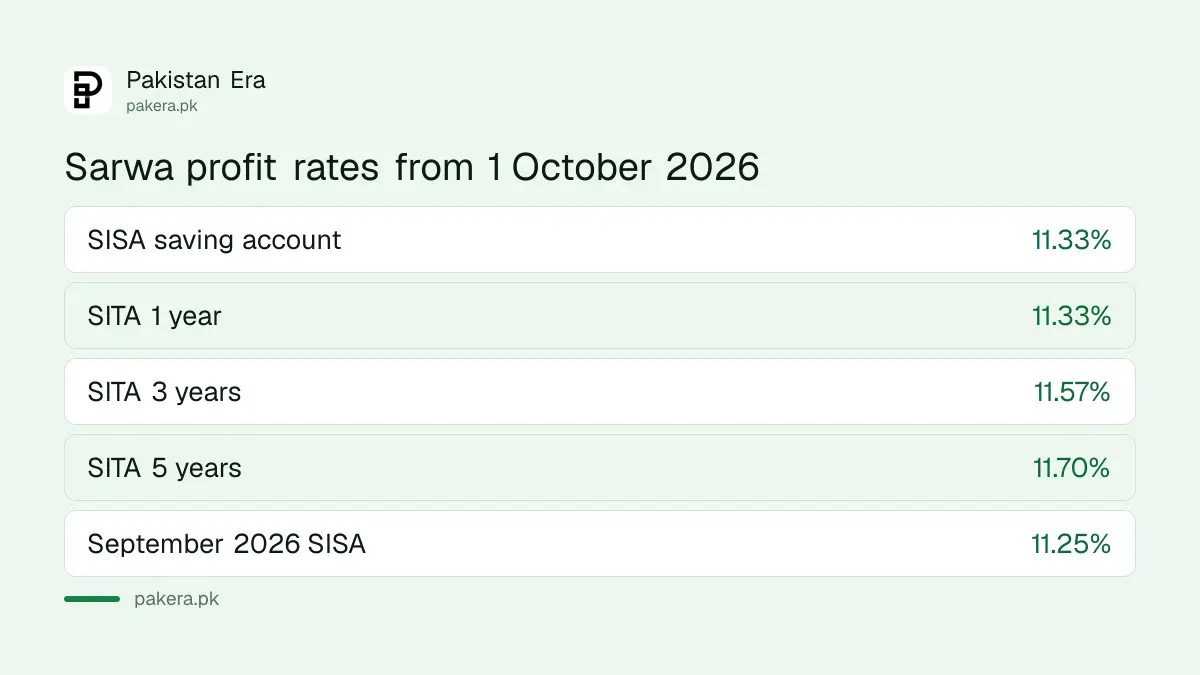
Rates from 21 October 2026 are 11.84, 12.10 and 12.12 per cent, up on 1 October
From 21 October 2026, SISA pays 11.84 per cent, and SITA pays 11.84 per cent for one year, 12.10 per cent for three years and 12.12 per cent for five years. The previous rates, from 1 to 20 October 2026, were 11.33 per cent for SISA and 11.33, 11.57 and 11.70 per cent for the three SITA terms.
| Effective period | SISA | SITA 1 year | SITA 3 years | SITA 5 years |
|---|---|---|---|---|
| 21 October 2026 onwards | 11.84% | 11.84% | 12.10% | 12.12% |
| 1 to 20 October 2026 | 11.33% | 11.33% | 11.57% | 11.70% |
| 4 to 30 September 2026 | 11.25% | 11.25% | 11.16% | 11.16% |
| 18 July to 3 September 2026 | 11.10% | 11.10% | 11.50% | 11.52% |
| 10 June to 17 July 2026 | 11.88% | 11.88% | 9.16% | 11.16% |
| 29 January to 25 May 2026 | 9.00% | 9.00% | 9.16% | 9.36% |
Two things stand out in the history. The three year rate has swung more than the others, from 9.16 per cent in June to 11.50 in July, 11.16 in September, 11.57 on 1 October and 12.10 now. And the one year SITA rate has tracked SISA exactly in every period since January, so a one year term currently earns nothing extra for locking the money.
Profit on all National Savings products is subject to withholding tax of 15 per cent for filers and 30 per cent for non filers, and to Zakat where applicable. The tax mechanics are in our page on tax on savings profit, and which schemes are exempt from Zakat deduction is in Zakat on National Savings schemes.
SISA pays monthly on the daily balance, SITA pays at maturity, half yearly or monthly by term
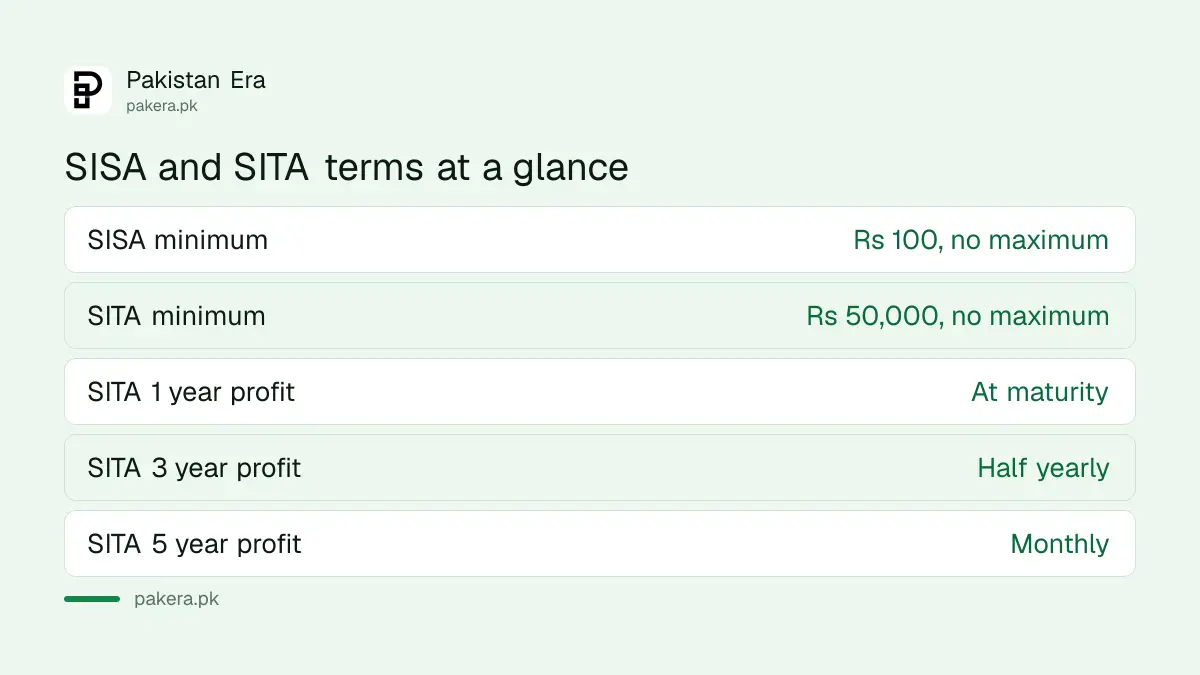
SISA profit is calculated on the daily closing balance and credited on the first day of the following month. SITA profit depends on the term: the one year account pays at maturity, the three year account pays half yearly, and the five year account pays monthly. SITA profit is not compounded; it is credited to your SISA account instead.
That pairing is deliberate. A SITA holder needs a SISA to receive the profit, and the SISA then earns its own 11.84 per cent on whatever sits in it. If you want a monthly income from a lump sum, the five year SITA is the one built for it; the three year pays twice a year.
The products page mentions a two year SITA paying half yearly in one line, while its own tenor list and the rate sheet show one, three and five years only. We treat the rate sheet as the authority and have left the two year term out. Ask at the centre if it is offered.
Rs 100 opens a SISA and Rs 50,000 a SITA, with no upper limit and early withdrawal allowed
SISA opens with Rs 100 and has no maximum, and withdrawals are permitted. SITA needs Rs 50,000, has no upper limit, and can be encashed early: profit on early encashment is paid at the average SISA rate for the completed months. Pakistani nationals and overseas Pakistanis can open SISA, and SITA is available to individual and joint holders.
- Go to a National Savings Centre with your original CNIC; the products page names the centres as the office of issue and encashment.
- Open a SISA first, with Rs 100 or more, because SITA profit is paid into it.
- For a term account, deposit Rs 50,000 or more and choose one, three or five years.
- Give a nominee on the account form, the step covered in adding a nominee at National Savings.
- Give your tax filer status so withholding is 15 per cent rather than 30 per cent.
The process is the same one used for the conventional National Savings account, which also opens with Rs 100 but pays a fixed 10 per cent. The National Savings Digital app handles transfers and refunds for existing holders, and whether it opens Sarwa accounts is not stated on the pages we read.
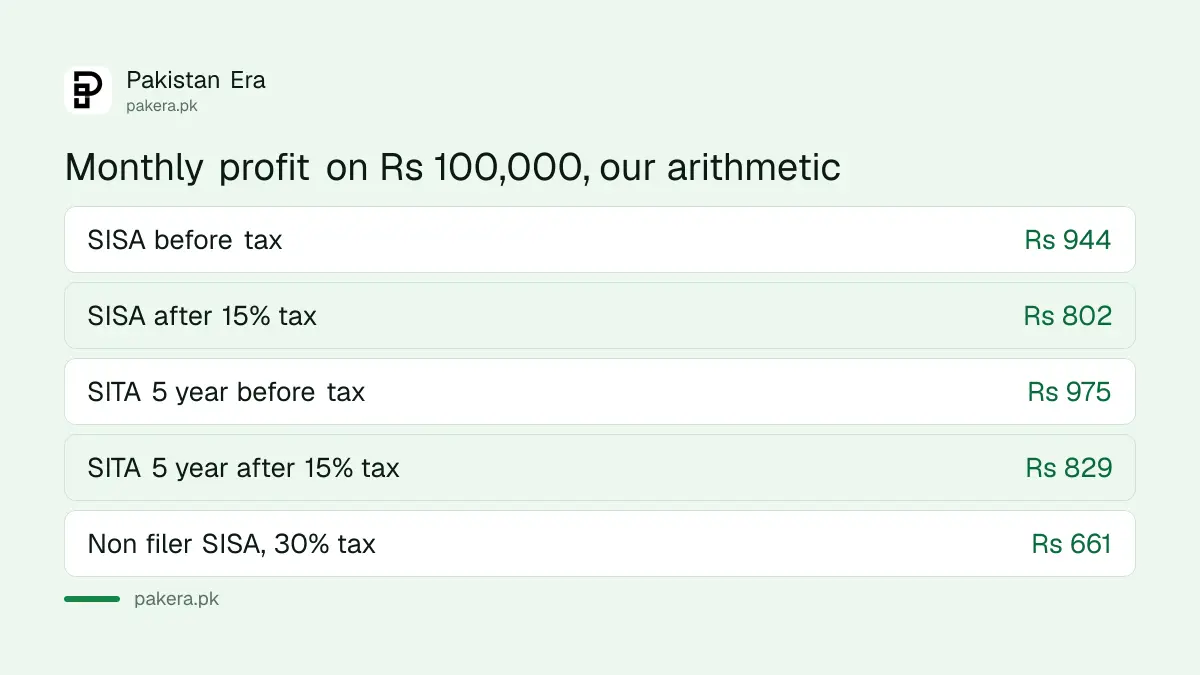
Rs 100,000 in SISA earns about Rs 973 a month before tax, Rs 827 after filer tax
The National Savings rate card of 21 October 2026 puts the expected SISA profit at Rs 973.15 a month on Rs 100,000, which is about Rs 827 after 15 per cent withholding tax. The five year SITA pays Rs 1,010 a month on Rs 100,000, or Rs 858.50 after filer tax. The monthly amounts are from the card; the after-tax figures are our arithmetic.
Against the alternatives: an ordinary bank savings account pays 10 per cent to individuals at most big banks, per our page on savings account rates in October 2026, and a one year Short Term Savings Certificate at National Savings pays 11.72 per cent from 21 October. SISA beats both for a savings account you can draw on. The three and five year SITA terms, at 12.10 and 12.12 per cent, sit just above the 12 per cent the conventional Special Savings Certificate pays for its first five periods, and below its 12.8 per cent last period.
Whether any of these beats inflation is a separate question, worked through in whether your savings beat inflation. The point of Sarwa is not the highest number; it is a government backed return without interest, with the profit variable by design.
Common questions about Sarwa Islamic accounts
What is the Sarwa Islamic Saving Account rate now?
11.84 per cent a year, anticipated, from 21 October 2026, paid monthly on the daily closing balance. It was 11.33 per cent from 1 to 20 October 2026.
What does the Sarwa Islamic Term Account pay?
11.84 per cent for one year, 12.10 per cent for three years and 12.12 per cent for five years from 21 October 2026. One year pays at maturity, three year half yearly and five year monthly.
Is the Sarwa rate guaranteed?
No. It is an anticipated rate under a Wakala contract. You receive the actual profit, the Ministry of Finance keeps any excess, and you bear a proportionate loss unless the agent was negligent or fraudulent.
What is the minimum deposit?
Rs 100 for SISA and Rs 50,000 for SITA. Neither has a maximum.
Can I withdraw a SITA early?
Yes. Profit is then paid at the average SISA rate for the completed months rather than the term rate.
How is Sarwa profit taxed?
Withholding tax of 15 per cent for filers and 30 per cent for non filers, plus Zakat or service charges where the rules apply.
How we verified this
What we checked, where we read it, and what we could not confirm.
Rates last checked 24 October 2026; the rest was last checked 19 October 2026. Rates, effective dates and rate history are from the National Savings latest profit rates page, its rate card dated with effect from 21 October 2026 and its SITA and SISA rate sheets updated on 21 October 2026, read as PDFs; the Wakala structure, minimums, profit payment schedule and early encashment rule are from the National Savings products page, both at savings.gov.pk. The monthly figures on Rs 100,000 are our own arithmetic. We could not verify whether a two year SITA exists, whether the Digital app opens Sarwa accounts, or the names of the Shariah board members, because the pages do not say. We did not open an account.
About the author

Public Services and Education Journalist
Fajr Riaz is a journalist and content writer at Pakistan Era, based in Lahore. She covers the questions people meet in everyday life in Pakistan: how a public service works, what a change in the rules means, and where to find a reliable answer.