How to Open a National Savings Savings Account in Pakistan: From Rs 100, 10% a Year
Open a National Savings Savings Account in Pakistan with Rs 100, form DA-I and your CNIC. See the 10.00% rate, 30 June profit date, withdrawal limit and tax.
Short answer: You can open a National Savings Savings Account in Pakistan with just Rs 100, a CNIC copy and form DA-I at any National Savings Centre. There is no upper limit. The account pays 10.00% a year, credited once on 30 June, and you can withdraw three times a week.
Most people think of National Savings as certificates that lock your money for years. The Savings Account is different. It works more like a bank savings account, but it is run by the government's Central Directorate of National Savings (CDNS). Money you put in earns profit, and you can take it out when you need it.
We read the Savings Account page, the FAQ page and the profit rate page on savings.gov.pk on 14 October 2026. The Savings Account page and the FAQ both show "Last Updated 26 August 2025". We did not open an account.
The account needs only Rs 100 to open
The minimum deposit is Rs 100 and there is no maximum. You may hold one Savings Account per person at each National Savings office. Pakistanis, overseas Pakistanis and guardians opening an account for a child can all use it.
The page says overseas Pakistanis can open it as an individual or a joint account, and a guardian can open it for a minor. That makes it one of the easiest government savings products to start. Compare it with the Special Savings Account from Rs 500, which has a higher minimum and a longer term.
Open it with form DA-I and your identity papers
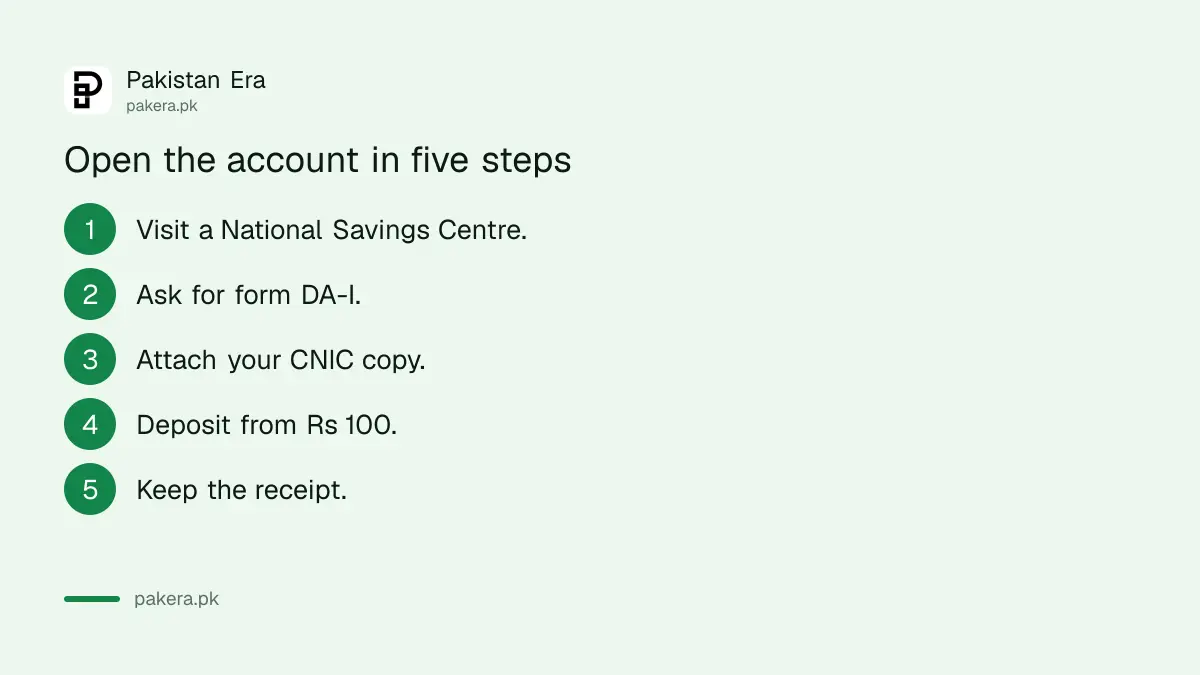
Go to a National Savings Centre, fill in form DA-I and attach the right identity paper. A Pakistani adult brings a CNIC copy. An overseas Pakistani brings a NICOP or Pakistan Origin Card copy. A child's account needs Form B or a Child Registration Certificate.
- Visit any National Savings Centre with your original CNIC.
- Ask for form DA-I. It is filled in at the counter.
- Attach a copy of your CNIC, NICOP or POC. For a minor, attach Form B or the Child Registration Certificate.
- Deposit your amount, from Rs 100 upward.
- Keep the receipt and the account details the centre gives you.
Cash opens the account straight away. If you pay by cheque, draft or pay order, the account opens when the payment clears. For overseas Pakistanis who cannot visit a centre, there is a separate route described in how to invest in National Savings from abroad.
Profit is paid once a year on 30 June
CDNS credits profit on 30 June every year. It is worked out from your lowest balance in each month. The Savings Account rate has stayed at 10.00% a year since at least 1 October 2026, when CDNS said there was no change to it.
Because it is the lowest balance in a month that counts, money you take out mid-month and put back does not earn for that month. Keep a steady balance if you want the full rate. Because profit is paid only once a year, there is no compounding during the year.
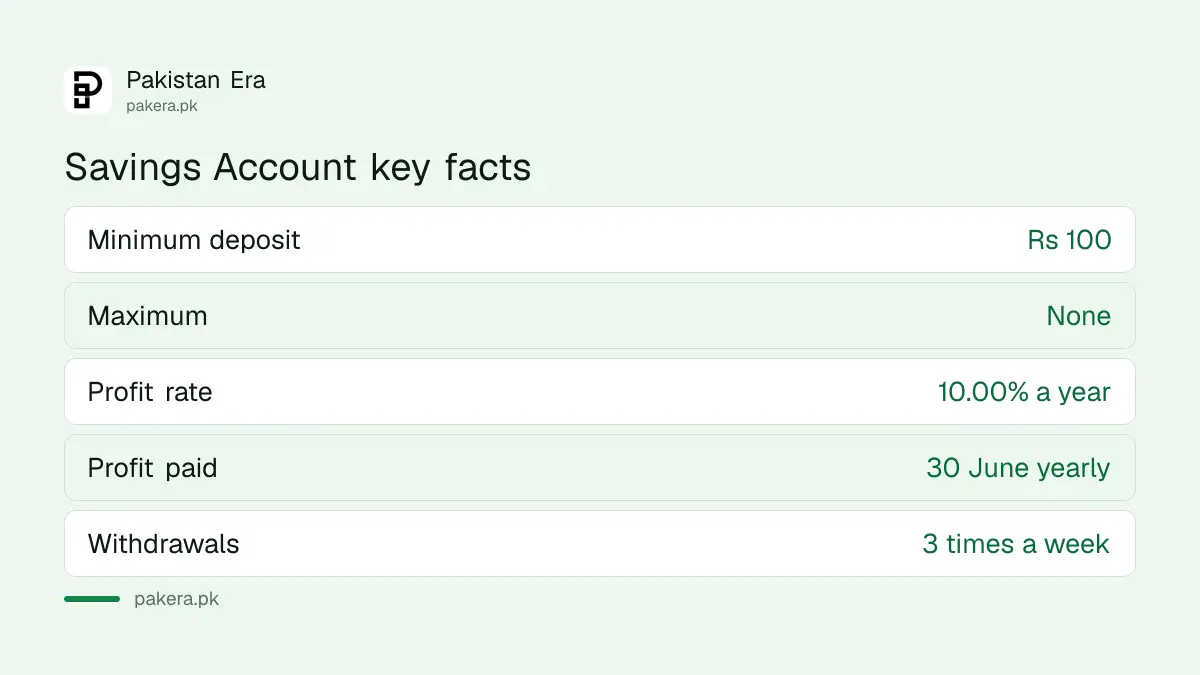
| Feature | What CDNS says |
|---|---|
| Minimum deposit | Rs 100 |
| Maximum | None |
| Profit rate from 1 October 2026 | 10.00% a year, unchanged |
| When profit is paid | 30 June each year |
| Profit is based on | Lowest balance in each month |
| Withdrawals | Three times a week |
| Form | DA-I |
The rates of all schemes are kept in National Savings profit rates from 1 October 2026. Rates change, so check that page before you deposit a large sum.
You can withdraw three times a week
The FAQ says only three withdrawals are allowed in a week. The product page says you can withdraw three times a week after the deposit date. So the account suits an emergency fund more than daily spending.
You can also have your profit sent to a commercial bank account. See how to get National Savings profit paid into your bank account. If you want to nominate someone to receive the money if you die, read about the nominee rules and form SC-3.
The National Savings site also lists a debit card, described on its own page as the CDNS UnionPay debit card. The page says it works at over 12,000 ATMs and over 50,000 point-of-sale terminals. It gives no fee, limit or eligibility rules, so ask the helpline on (051) 111 267 268 before you plan around it.
Tax and Zakat apply to the profit
The FAQ says withholding tax is 15 percent for filers on the Active Taxpayers List and 30 percent for non-filers, and that Zakat is applicable. That page is dated August 2025, so confirm the current rate with the centre before you rely on it.
Tax is taken from the profit, not your deposit. If you are a filer your tax is lower, so it is worth checking your filer status. For which schemes carry Zakat, see Zakat on National Savings.
Judge the account against inflation too. A 10 percent rate before tax may not beat price rises, as shown in check if your savings beat inflation. Higher rates sit in other schemes, such as Behbood for those who qualify.
Common questions
How much do I need to open a National Savings Savings Account?
You need Rs 100. There is no maximum deposit, according to the CDNS page.
What is the profit rate on the Savings Account?
It is 10.00% a year from 1 October 2026, with no change from before, per the CDNS rate page.
When is profit paid?
It is credited on 30 June every year and is calculated on the lowest monthly balance.
Can a child have a Savings Account?
Yes. A parent or guardian opens it with the child's Form B or Child Registration Certificate.
How often can I withdraw?
You can withdraw three times a week after the deposit date.
How we verified this
What we checked, where we read it, and what we could not confirm.
We read the Savings Account page, the FAQ and the profit rate page on the Central Directorate of National Savings website, savings.gov.pk, on 14 October 2026. The account page and FAQ are dated 26 August 2025. The rate page is dated with effect from 1 October 2026. Helpline: (051) 111 267 268.
About the author

Public Services and Education Journalist
Fajr Riaz is a journalist and content writer at Pakistan Era, based in Lahore. She covers the questions people meet in everyday life in Pakistan: how a public service works, what a change in the rules means, and where to find a reliable answer.