How to Add or Change a Nominee on a National Savings Account in Pakistan: Form SC-3
Change the nominee on a National Savings account or certificate in Pakistan with form SC-3 and a stamp paper application. See who can be named for a child.
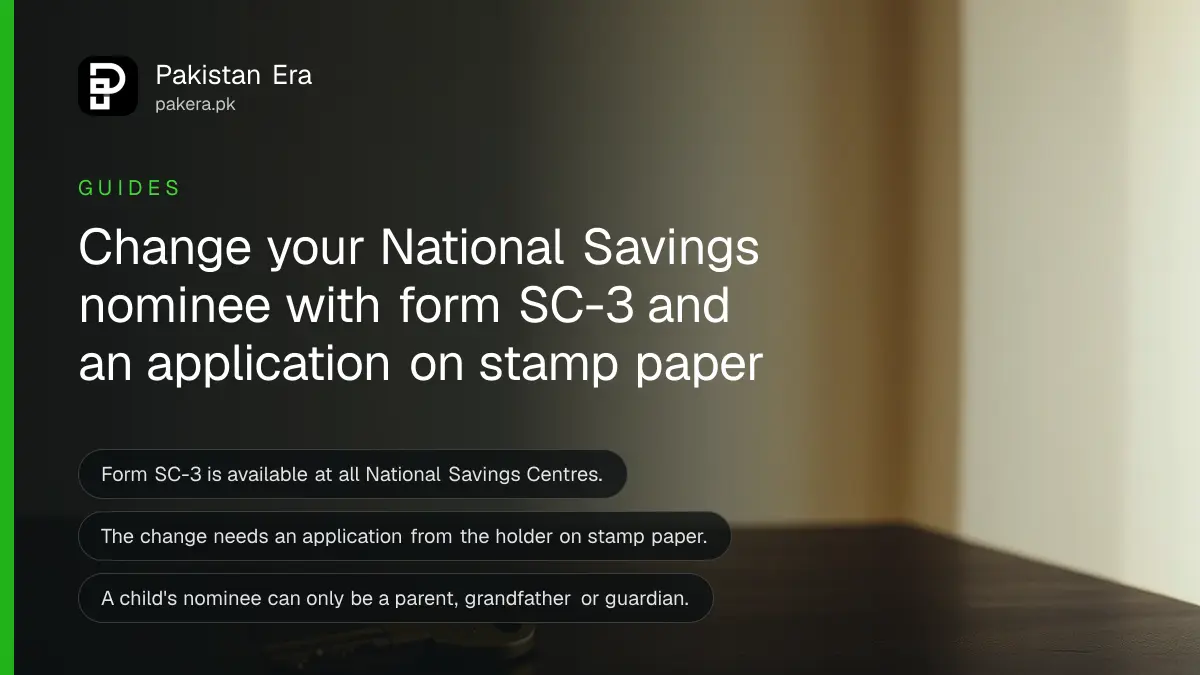
Short answer: To change the nominee on a National Savings account or certificate in Pakistan, take form SC-3 from any National Savings Centre and fill it in. National Savings says you must attach an application on stamp paper. For a child's account, the nominee can only be a parent, the paternal grandfather or the legal guardian.
A nominee is the person you name to receive your National Savings money. Many families set one up at the counter in a hurry and never look at it again. Then a marriage, a death or a quarrel changes who should get the money, and the old name is still on the file.
We read the National Savings FAQ page on savings.gov.pk on 14 October 2026. The footer shows "Last Updated 26 August 2025". We did not file an SC-3 ourselves. The steps below follow the department's own answers, and we say where the page is silent.
A nominee is a person you name on the account
The FAQ describes nomination as a facility that lets the holder or holders of an account or certificate name a person to receive the money. It applies to both accounts and certificates. You can nominate when you open, and change the name later.
A nominee is not the same as a legal heir. Islamic law and the courts decide who inherits. The FAQ does not say that a nominee overrides the legal heirs, and we do not claim it does. For what the department needs after a death, read how to claim a deceased person's National Savings certificates.
Form SC-3 changes the nominee
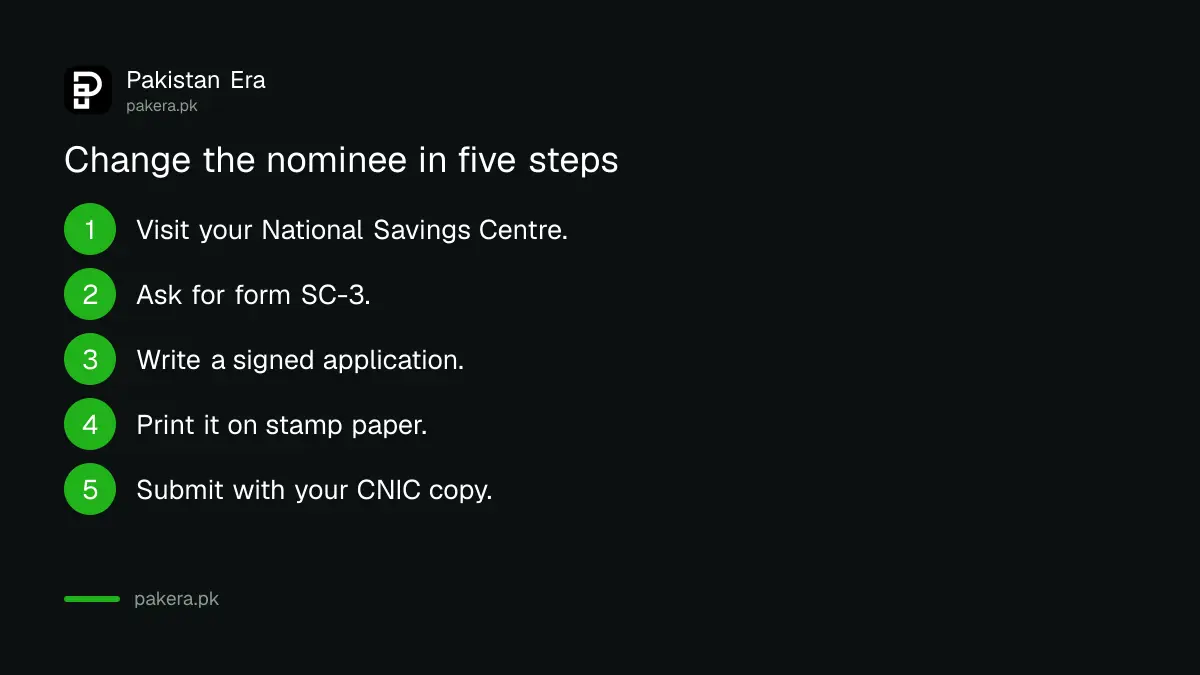
The FAQ says specific nomination forms, called SC-3, are available at all National Savings Centres. To change the nominee at a later stage you fill in the form and attach an application from the holder or holders on stamp paper.
- Visit the National Savings Centre where your account or certificate is held.
- Ask for form SC-3 and fill in every field.
- Write an application stating the change, signed by the holder or holders.
- Print the application on stamp paper. Ask the centre which value it wants.
- Submit the form, the application and your CNIC copy, and ask for a receipt.
The FAQ does not state the stamp paper value, a fee or a processing time. Ask the centre, and keep the receipt. Joint holders should both sign. If your certificate is lost, deal with that first using how to get a duplicate for a lost National Savings certificate.
A child's nominee has a short list
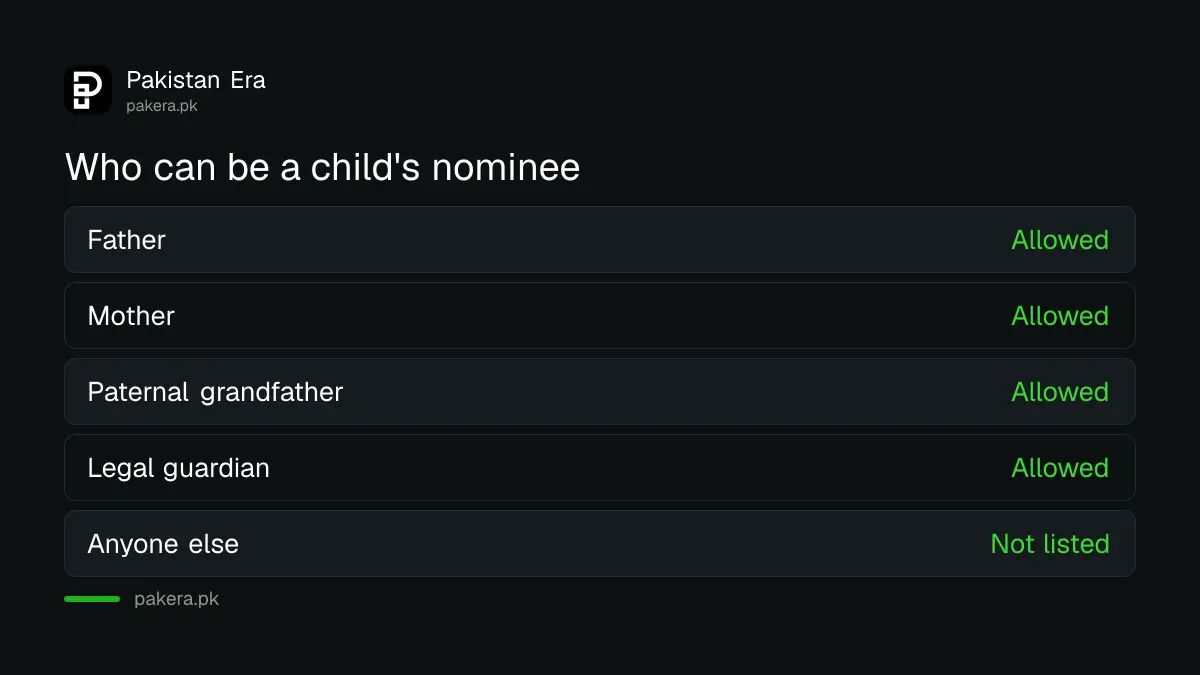
For a minor, the FAQ restricts nomination to the father, the mother, either parent, the paternal grandfather or the legal guardian. A cousin, an uncle or a family friend cannot be named on a child's investment under that rule.
| Who can be named on a child's account | Allowed by the FAQ |
|---|---|
| Father | Yes |
| Mother | Yes |
| Either parent | Yes |
| Paternal grandfather | Yes |
| Legal guardian | Yes |
| Anyone else | Not listed |
A child's Savings Account is opened by a parent or guardian with Form B or a Child Registration Certificate. The steps are in how to open a National Savings Savings Account. For a child's bank account instead, see how to open a bank account for a child.
A joint certificate has its own rules
Certificates are held as Joint-A or Joint-B, and the choice decides who may cash the certificate. It also affects what happens to the money when one holder dies. Decide the joint type before you pick a nominee.
Read how to choose Joint-A or Joint-B on a National Savings certificate. If you are not sure which type you hold, check the certificate itself or ask the centre.
What heirs must bring after a death
The FAQ lists what a claim needs. These include a death certificate, a family registration certificate if the amount is under Rs 100,000, and a succession certificate if it is above Rs 100,000. The department pays by government cheque to the legal heirs named in the succession certificate.
It also asks for proof of address and a photo ID. So even with a nominee on file, expect to bring papers. A nominee who has the correct papers will find the process easier. Our page on how to get a succession certificate from NADRA covers the larger claims. The same page of the FAQ gives no deadline, so act soon after a death.
We found no line saying a nominee skips the succession certificate. So we do not say so. Ask the centre what it will accept in your case.
Check your nominee once a year
Set a reminder to check the nominee whenever your family changes. A changed name takes a trip to the centre, so do it before you need it. Keep a copy of the SC-3 receipt with your certificates.
If the centre refuses a form or asks for something the FAQ does not mention, write down the officer's name and the date. Then call the National Savings helpline on (051) 111 267 268 or email info@savings.gov.pk.
Common questions
What is form SC-3?
It is the National Savings nomination form. The FAQ says it is used to change the nominee later, along with an application on stamp paper.
Where do I get form SC-3?
It is available at all National Savings Centres, according to the FAQ.
Who can be a nominee for a child?
Only the father, the mother, either parent, the paternal grandfather or the legal guardian.
Does a nominee replace the legal heirs?
The FAQ does not say so. For large amounts it asks for a succession certificate, so ask the centre about your case.
Does changing a nominee cost money?
The pages we read give no fee. The stamp paper has its own cost, which you pay yourself.
How we verified this
What we checked, where we read it, and what we could not confirm.
We read the FAQ page on savings.gov.pk, the Central Directorate of National Savings website, on 14 October 2026. It is dated 26 August 2025. We did not find the stamp paper value, a fee or a processing time on it. Helpline: (051) 111 267 268.
About the author

Public Services and Education Journalist
Fajr Riaz is a journalist and content writer at Pakistan Era, based in Lahore. She covers the questions people meet in everyday life in Pakistan: how a public service works, what a change in the rules means, and where to find a reliable answer.