Bulk Supply Electricity Tariff in Pakistan 2026: C-1, C-2 and C-3 Rates for Housing Societies and Buildings
Bulk supply electricity tariff in Pakistan 2026: C-1 at Rs 40.63 and Rs 43.39, C-2 Rs 40.57, C-3 Rs 40.77, Rs 46.31 at peak, and how the fixed charge works.
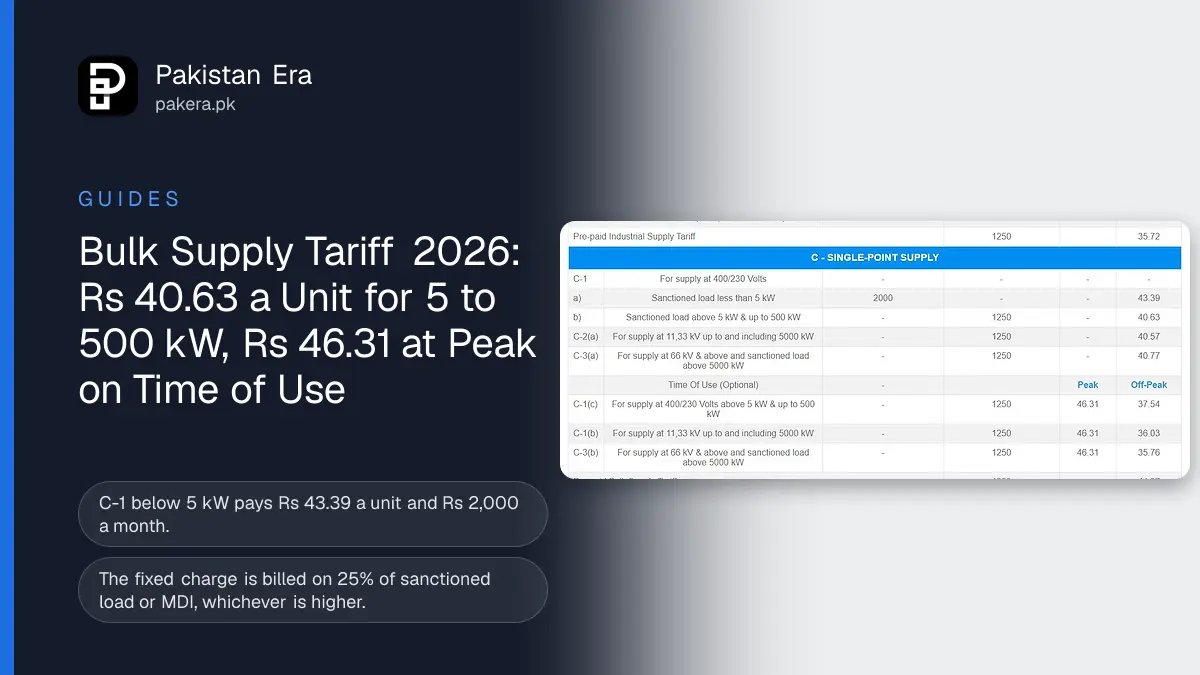
Bulk supply, tariff C, is billed at Rs 40.63 a unit plus Rs 1,250 per kW a month for a single-point connection of 5 to 500 kW at 400 volts in 2026. Below 5 kW the rate is Rs 43.39 with a Rs 2,000 monthly charge, and the optional Time of Use rate is Rs 46.31 at peak and Rs 37.54 off-peak.
Tariff C, which NEPRA's schedule calls "Single-Point Supply", is for a buyer who takes electricity through one meter at one point and runs its own wiring beyond it. Housing societies, large buildings and campuses are the usual examples. We read the rates in the Ministry of Energy's S.R.O. 279(I)/2026 dated 12 February 2026 and in IESCO's tariff guide, which reproduces it, on 9 November 2026. The same uniform rates apply at all ex-WAPDA companies, from LESCO to QESCO, and at K-Electric.
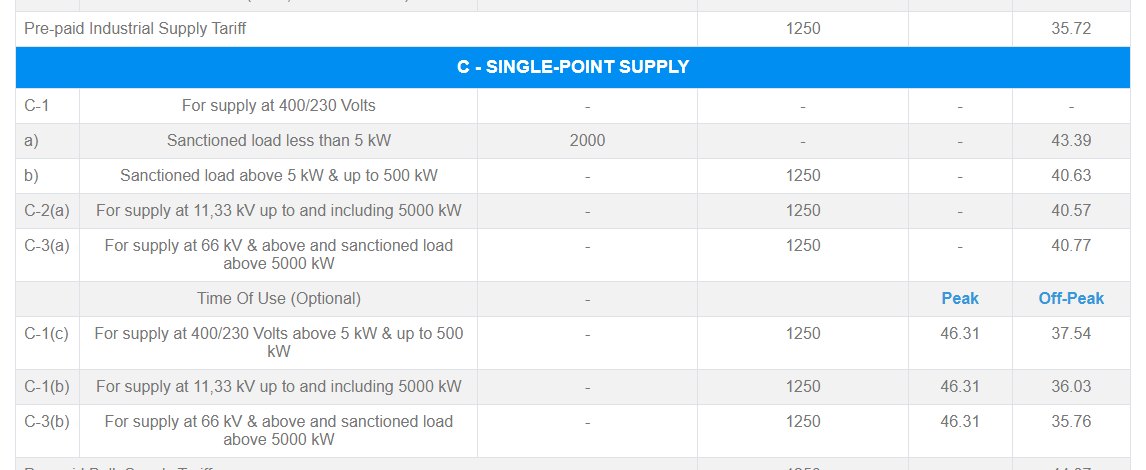
Bulk supply rates for every C category in 2026
There are three bulk categories, set by the voltage at which you take supply: C-1 at 400 or 230 volts, C-2 at 11 or 33 kV, and C-3 at 66 kV and above. Each has a flat rate and an optional Time of Use rate.
| Category | Who it covers | Fixed charge | Rate a unit |
|---|---|---|---|
| C-1(a) | 400/230 volts, below 5 kW | Rs 2,000 per connection a month | Rs 43.39 |
| C-1(b) | 400/230 volts, 5 to 500 kW | Rs 1,250 per kW a month | Rs 40.63 |
| C-2(a) | 11 or 33 kV, up to 5,000 kW | Rs 1,250 per kW a month | Rs 40.57 |
| C-3(a) | 66 kV and above, over 5,000 kW | Rs 1,250 per kW a month | Rs 40.77 |
| Prepaid bulk | Prepaid meter | Rs 1,250 per kW a month | Rs 44.87 |
These are the government's applicable rates. Your bill also adds the monthly fuel charge, the quarterly adjustment, electricity duty and taxes. Our page on the fuel charge in every month of 2026 tracks the first of those.
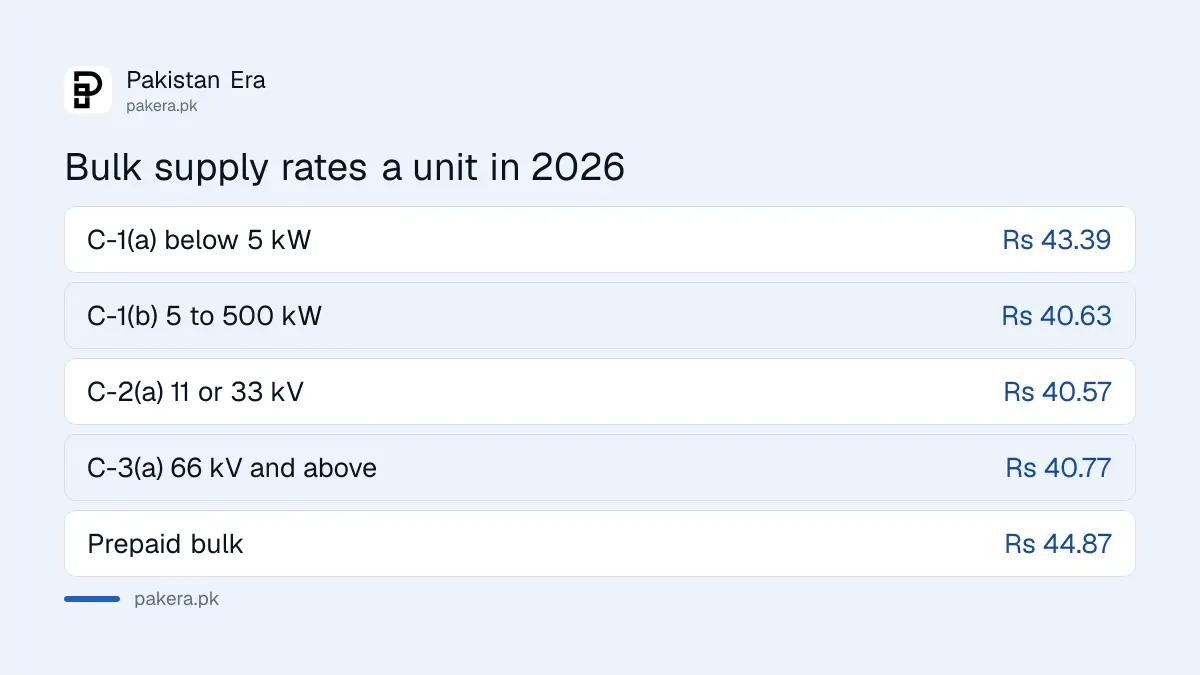
Time of Use rates for bulk supply
Every bulk category above 5 kW can choose a Time of Use meter. The peak rate is Rs 46.31 for all three, and the off-peak rate falls as the voltage rises, from Rs 37.54 at 400 volts to Rs 35.76 at 66 kV and above.
| Time of Use category | Peak rate | Off-peak rate | Gap |
|---|---|---|---|
| C-1(c), 400/230 volts, 5 to 500 kW | Rs 46.31 | Rs 37.54 | Rs 8.77 |
| C-2(b), 11 or 33 kV, up to 5,000 kW | Rs 46.31 | Rs 36.03 | Rs 10.28 |
| C-3(b), 66 kV and above | Rs 46.31 | Rs 35.76 | Rs 10.55 |
IESCO's guide marks this Time of Use option as "Optional". The fixed charge stays at Rs 1,250 per kW a month. Peak hours change with the season, and our peak hours guide lists the current times.
How the fixed charge is worked out
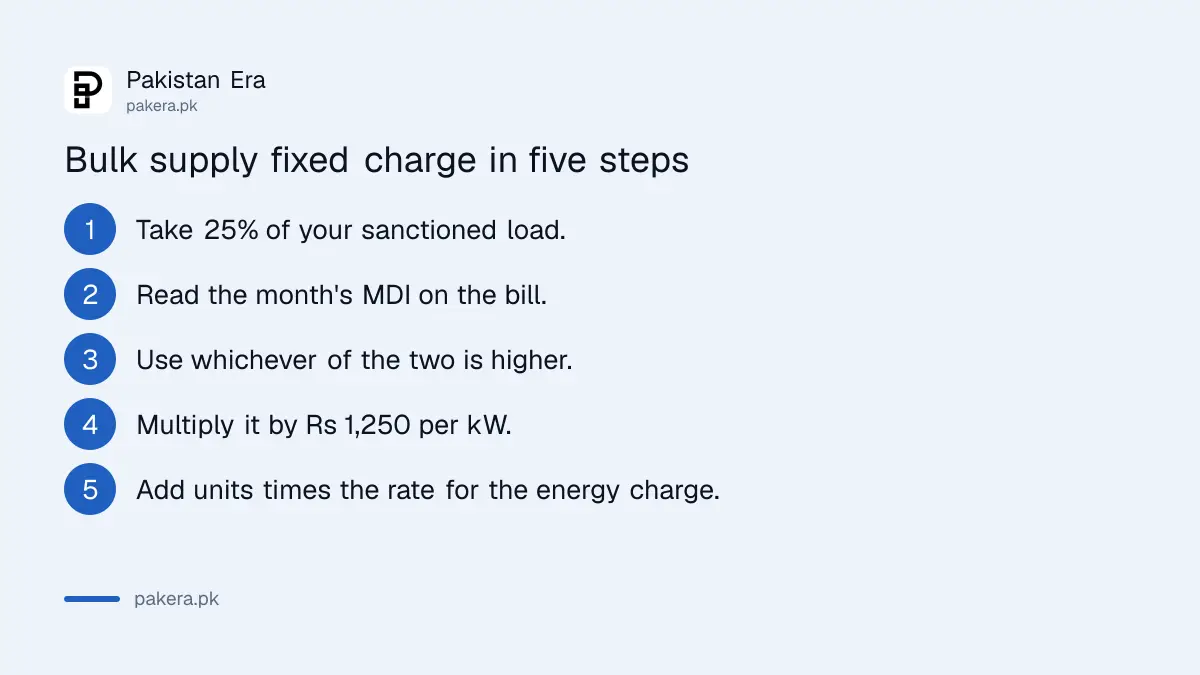
The per kW fixed charge is not billed on your full sanctioned load. The tariff note says it "shall be billed based on 25% of sanctioned load or actual MDI for the month which ever is higher". MDI is the maximum demand indicator, the highest load your meter recorded that month.
Take a housing society with a sanctioned load of 400 kW on C-1(b). Here is the working, by our own arithmetic:
- 25 per cent of 400 kW is 100 kW.
- Say the meter records an MDI of 250 kW this month.
- The higher figure, 250 kW, is used for the fixed charge.
- 250 kW times Rs 1,250 is Rs 312,500 in fixed charges.
- 100,000 units at Rs 40.63 add Rs 4,063,000 in energy charges.
On Time of Use, if 20,000 of those units fall in peak hours, the energy charge would be 20,000 times Rs 46.31 plus 80,000 times Rs 37.54. That is Rs 926,200 plus Rs 3,003,200, or Rs 3,929,400, about Rs 133,600 less than the flat rate. A load that runs mostly in the evening would gain less. The same 25 per cent rule applies to industry, as our industrial tariff guide shows.
Bulk supply against home, shop and industry rates
Bulk supply costs more a unit than industry and less than the top home slabs. NEPRA's own cost figure for C-1 is lower than the rate charged, so bulk buyers pay more than their cost of supply under the 2026 schedule.
- Industry B-2, 25 to 500 kW, pays Rs 26.16 a unit with the same Rs 1,250 fixed charge.
- Homes above 700 units pay Rs 47.20 a unit, and shops below 5 kW pay Rs 37.44, as listed in our slab rates guide and shop rate guide.
- NEPRA's determined rate, the cost NEPRA allows the companies, is Rs 34.11 for C-1(a) and Rs 27.80 for C-1(b) in the notification's Annex A-1. The applicable rates of Rs 43.39 and Rs 40.63 are well above that.
The notification explains the background. NEPRA noted that fixed charges were raised so that the money recovered could "reduce the existing cross subsidy of industrial consumers". Bulk supply was not given the same cut as industry.
Common questions
What is the C-1 electricity tariff rate in Pakistan in 2026?
Rs 43.39 a unit below 5 kW with a Rs 2,000 monthly charge, and Rs 40.63 a unit for 5 to 500 kW with Rs 1,250 per kW a month.
What is single point supply in an electricity tariff?
It is supply through one meter at one point, with the buyer running its own network beyond it. NEPRA's schedule lists it as tariff C.
Can a housing society choose Time of Use billing?
Yes, above 5 kW. IESCO's guide marks Time of Use for C-1, C-2 and C-3 as optional, at Rs 46.31 peak.
How is the bulk supply fixed charge calculated?
On 25 per cent of the sanctioned load or the month's actual MDI, whichever is higher, at Rs 1,250 per kW.
What is the prepaid bulk supply rate?
Rs 44.87 a unit with Rs 1,250 per kW a month, according to IESCO's tariff guide under S.R.O. 279(I)/2026.
Are bulk supply rates different at LESCO, MEPCO or K-Electric?
No. The government applicable rates are uniform. The notification's K-Electric annex lists the same C-1, C-2 and C-3 figures.
What we checked and sources
We read S.R.O. 279(I)/2026 dated 12 February 2026, from NEPRA's tariff notifications: Annex C, the clean schedule for K-Electric consumers, Annex A-1 and Annex A for the determined rates, and paragraph 19 of NEPRA's decision. We cross-checked every applicable rate against IESCO's tariff guide, which is headed S.R.O. No. 279 (I)/2026, on 9 November 2026. The worked examples are our own arithmetic. IESCO's guide still showed these rates on 9 November 2026.
About the author

Tax, Bills and Technology Writer
Ali Akhtar is a young and curious voice here at Pakistan Era. He is currently pursuing his A-Levels and has a growing interest in Pakistan’s changing industrial landscape and educational trends. Ali likes to write in a way that helps him explain and explore the world around him. His writing reflects the perspective of the new generation navigating the evolving trends of Pakistan where technology, youth innovation, and shifting opportunities are reshaping the country’s future.