How Small Exporters Buy Duty-Free Inputs From a Common Export House in Pakistan
A Common Export House sells duty-free raw material to small exporters under EFS. See who can buy, how a house is approved, the 3 year term and monthly reports.
A Common Export House is a customs-approved warehouse that imports raw material free of duty and tax and sells it on to small and medium exporters. A small exporter, one that exports up to USD 5 million a year, can buy from it without importing a full container. The buyer needs its own EFS authorization, and the stock is debited from it.
The rules sit in Sub-Chapter I of Chapter XL of the Customs Rules, 2001, part of the Export Facilitation Scheme (EFS). We read them in the consolidated text that FBR posted on 17 June 2026. This page covers both sides: the small exporter who wants to buy, and the business that wants to run such a warehouse.
A Common Export House holds duty-free stock for exporters
The rules define a Common Export House as a warehouse authorized by the Collector of Customs to import, store and supply input goods without customs duty, sales tax, federal excise duty and withholding tax. It supplies small and medium export enterprises, direct and indirect exporters, and commercial exporters.
The idea is simple. A small garment maker may need 2,000 metres of one trim, not a full shipment. The house imports a large lot once, keeps it in bond, and sells in smaller parts. The rules count a purchase from a Common Export House as an import for the buyer, so the buyer's own duty-free limit is used.
One exception applies. The scheme does not cover raw cotton, cotton yarn or grey cloth, so a house cannot sell those duty free to a buyer. Check the export rules for your goods too, because banned items need extra permission.
A buyer needs its own EFS authorization first
Buying from a Common Export House is not open to anyone. The buyer must hold an EFS authorization as a manufacturer-cum-exporter, indirect exporter, commercial exporter or toll manufacturer. The rules say the system debits the value from the house and credits it to the buyer.
A small exporter should therefore first get an EFS authorization and then ask the house what it holds. For a small or medium exporter, the application includes a recommendation from a chamber of commerce, a trade association or SMEDA.
A buyer must also use the goods in export products. Unused input goods can be moved to another EFS user before the utilization period ends. After that, a domestic sale means duty, tax and a surcharge of KIBOR plus 3 per cent a year.
The house must apply with a site plan and an insurance policy
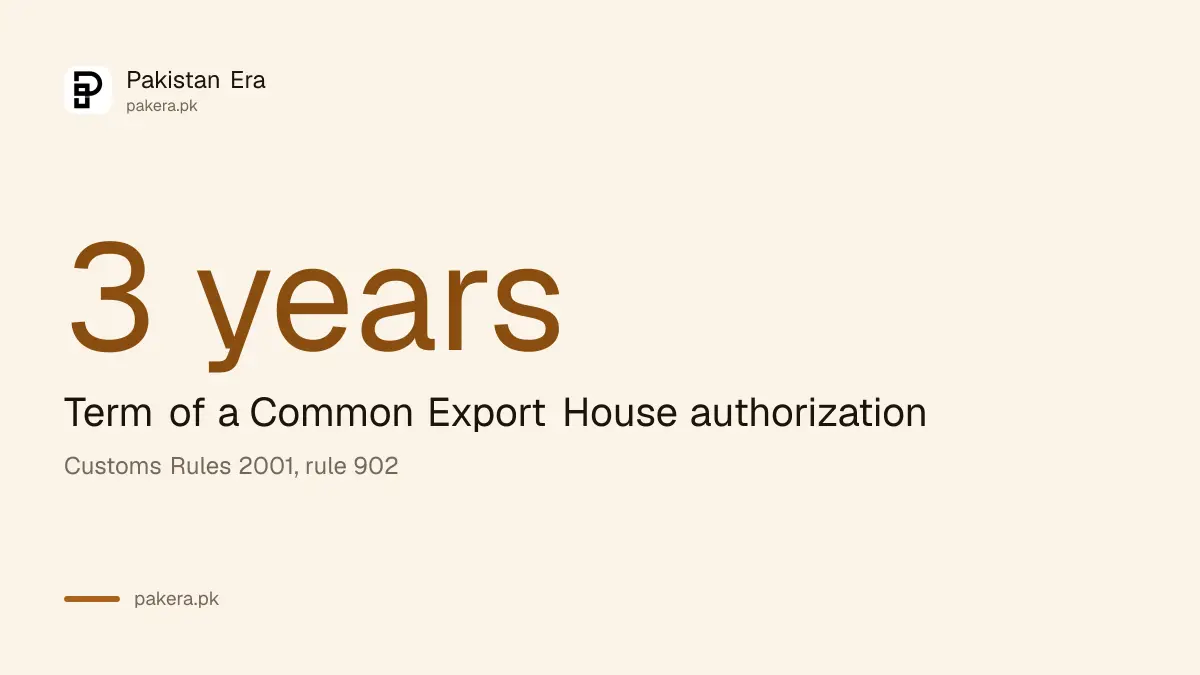
A person who wants to run a Common Export House applies to the Regulatory Collector in the form in Appendix I. The Collector issues the authorization within one month of verification. It lasts three years and renews itself for further three-year terms if no action is pending against the user.
| Paper | What the rules ask for |
|---|---|
| Application form | Appendix I of the EFS rules |
| Site plan | Shows the location, total area and covered area of the warehouse |
| Bank statement | Last two years, or from incorporation |
| Company or firm papers | Memorandum and Articles, or the partnership deed |
| Premises | Ownership document, lease or tenancy agreement |
| Insurance | All-risks policy equal to the duties and sales tax on the stock |
ISO certification is also listed, but only if the applicant has it. A public warehouse already running under the warehousing rules may apply to work as a Common Export House at the same time.
Imports and sales follow bonded warehouse steps
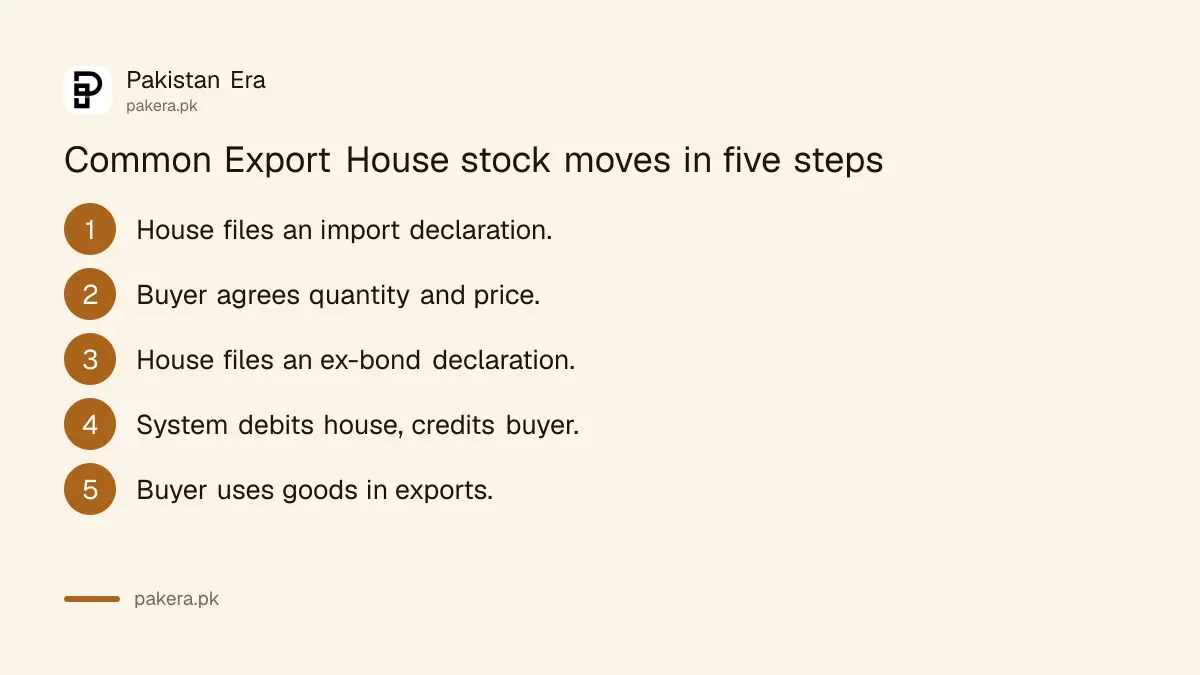
The house imports under a Goods Declaration in its own name and NTN, processed like a clearance into a public bonded warehouse. Goods leave on an ex-bond Goods Declaration that names both the user and the buyer. The system then debits the house and credits the buyer.
- The house files an import Goods Declaration with its NTN, as for a bonded warehouse.
- The buyer, who holds an EFS authorization, agrees quantity and price with the house.
- The house files an ex-bond Goods Declaration naming itself and the buyer.
- The system debits the house and credits the buyer's authorization.
- The buyer uses the goods in export products within its utilization period.
Each of these is a goods declaration, filed in the customs system through WeBOC or PSW.
Time limits and penalties fall on the house
A house must supply its imported stock to small exporters and other users within two years of importing it. It files a monthly reconciliation report showing goods imported, sold and in stock. Goods it cannot explain are charged full duty and taxes, plus a surcharge of KIBOR plus 3 per cent and penalties.
The Collector can suspend an authorization and must give the reasons in writing within 24 hours. Cancellation can follow a conviction, non-use of the authorization or the user's own written request. Ownership of the house cannot be transferred until all duty, excise, sales tax and income tax dues are paid.
Goods that become unfit for sale can be destroyed in front of a customs officer of at least Assistant Collector rank. We did not find a public list of working Common Export Houses in the rules, so ask your Regulatory Collectorate or your trade association which ones operate near you. A small business that also needs money can look at SME loan products on SMEDA's portal.
Common questions about Common Export Houses
What is a Common Export House in Pakistan?
It is a warehouse authorized by the Collector of Customs. It imports inputs without duty or tax and supplies them to small and medium exporters, direct and indirect exporters, and commercial exporters.
Who counts as a small and medium export enterprise?
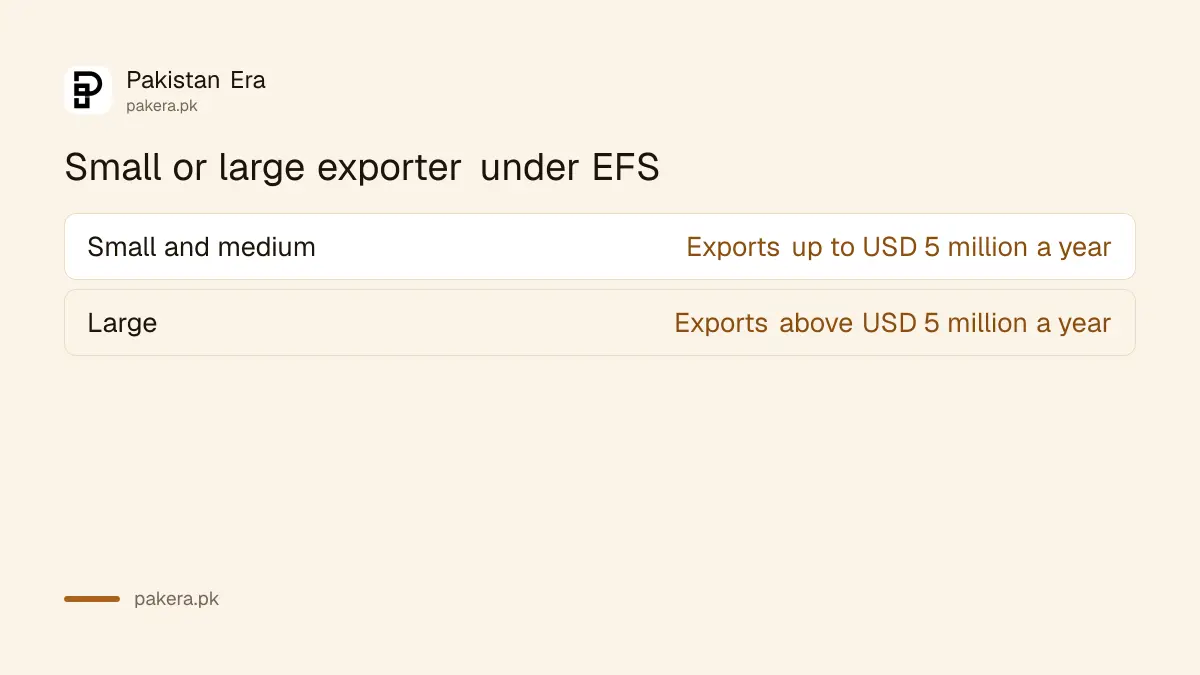
The rules define it as an export unit with exports of up to USD 5 million a year. Above that, a unit is a large export enterprise.
How long does a Common Export House authorization last?
It lasts three years. It renews for further three-year terms without a new application, if the Regulatory Collector is satisfied that no action is pending against the user.
Can I buy raw cotton or yarn duty free from a Common Export House?
No. The rules leave out raw cotton, cotton yarn and grey cloth. Purchases of those from a Common Export House are not treated as duty-free imports.
What does a Common Export House report each month?
It files a reconciliation report in WeBOC or PSW. The report gives complete details of the goods imported, the goods sold and the stock still in the warehouse.
How we verified this
What we checked, where we read it, and what we could not confirm.
Last checked 14 October 2026. Rules 871, 872 and 899 to 910 come from the consolidated Export Facilitation Scheme text posted on the FBR website as of 17 June 2026. We did not find a list of active houses, and we have not dealt with one ourselves. A later SRO may have changed the text, so confirm on fbr.gov.pk before you apply.
About the author

Global Affairs & Political Economy Writer
Muhammad Hatim is a book lover who started writing because he enjoys it. At Pakistan Era he writes about international relations, geopolitics and the global economy, with a particular interest in South Asia and the forces behind current events.