Canada Immigration Levels Plan 2027 to 2029: 380,000 PR Places a Year and 150,000 Students, What It Means for Pakistanis
Canada's 2027 to 2029 levels plan keeps 380,000 PR places a year and caps new students at 150,000. What it means for Pakistani students, workers and spouses.
یہ صفحہ اردو میں پڑھیں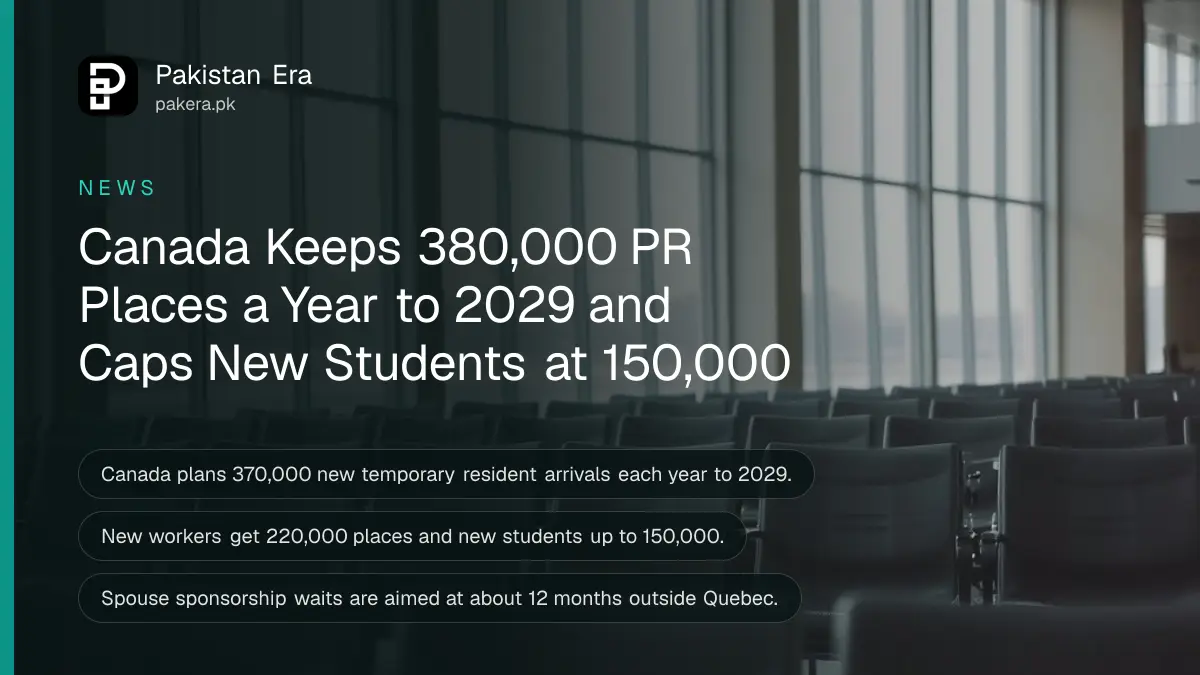
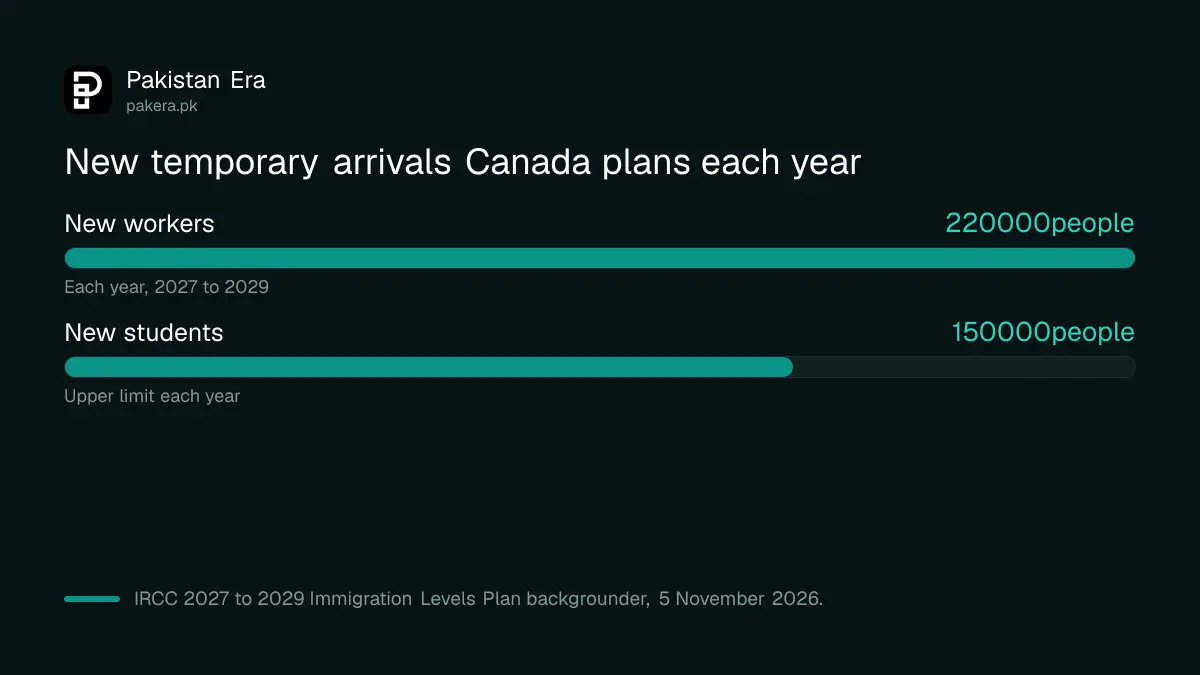
Short answer: Canada published its 2027 to 2029 Immigration Levels Plan on 5 November 2026. It keeps permanent resident admissions at 380,000 a year and caps new temporary arrivals at 370,000 a year, of which 220,000 are new workers and up to 150,000 are new international students. For Pakistanis, that means the same tight student numbers as this year, more room through provincial programmes, and a stated aim to bring spouse sponsorship waits closer to 12 months outside Quebec.
Immigration, Refugees and Citizenship Canada (IRCC), the federal immigration department, sets these targets every year for the next three years. We read the official backgrounder on canada.ca on 6 November 2026. It does not set any quota by country, and Pakistan is not named. The numbers apply to every applicant, so a Pakistani student or worker competes for the same places as everyone else.
Below is what the plan says, what it does not say, and what a Pakistani family should do now if a study permit, a job offer or a spouse sponsorship is in progress.
Canada keeps 380,000 permanent resident places a year to 2029
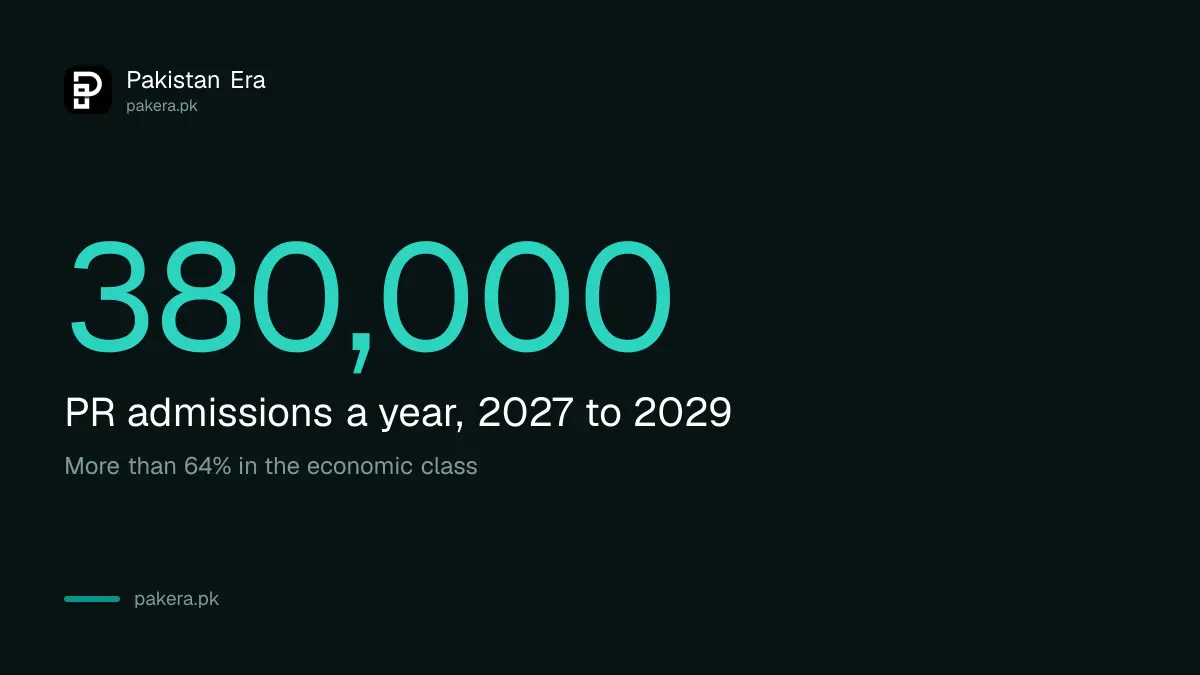
The plan holds permanent resident admissions at 380,000 in each of 2027, 2028 and 2029. That figure matches what the previous plan promised. It counts people already working or studying in Canada, not only new arrivals from abroad.
IRCC says the economic class will stay above 64% of permanent resident admissions over the three years. The economic class covers skilled workers selected through Express Entry, the Provincial Nominee Program and similar routes. Family sponsorship and refugees share the rest.
The government also says it wants permanent resident admissions to stay below 1% of Canada's population beyond 2027, and it wants to reduce the number of temporary residents. It gives no numeric target for that reduction in the backgrounder.
| Item in the plan | 2027 | 2028 | 2029 |
|---|---|---|---|
| Permanent resident admissions | 380,000 | 380,000 | 380,000 |
| New temporary resident arrivals | 370,000 | 370,000 | 370,000 |
| of which new workers | 220,000 | 220,000 | 220,000 |
| of which new international students | up to 150,000 | up to 150,000 | up to 150,000 |
| Economic class share of PR admissions | above 64% | above 64% | above 64% |
| French-speaking PR share outside Quebec | 9.5% | 10.5% | 12% |
New student arrivals stay capped at 150,000 a year
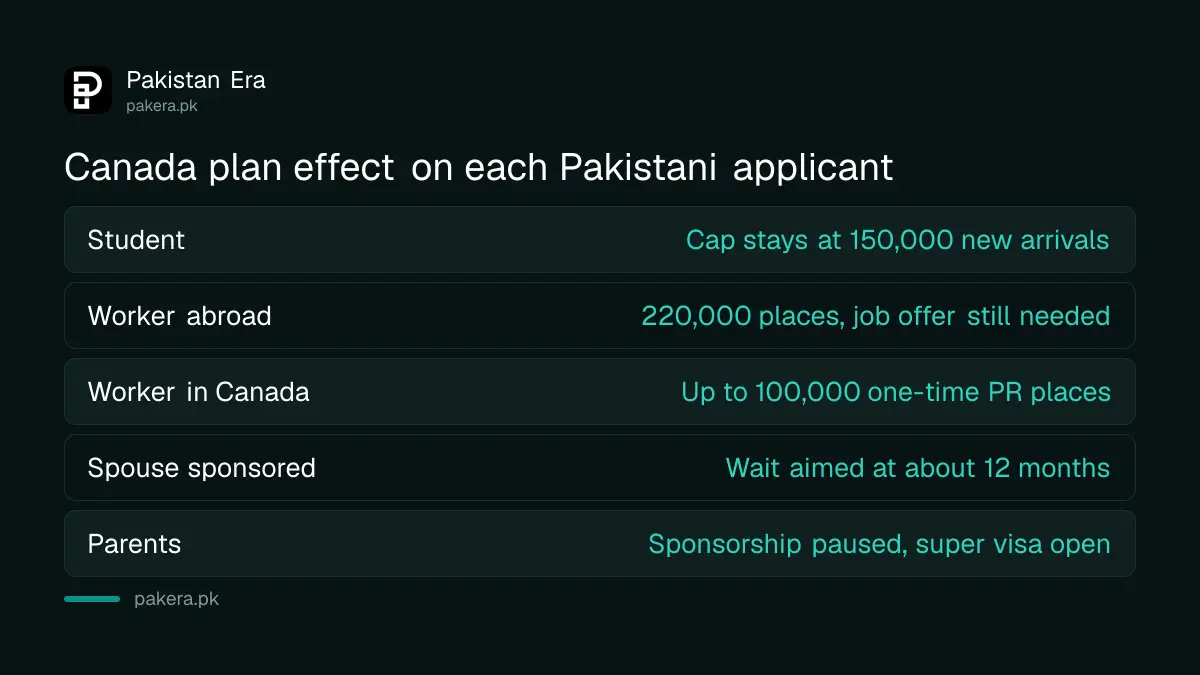
Up to 150,000 new international students can arrive in each year of the plan. That is a ceiling, not a promise. For a Pakistani student, nothing in the plan makes a study permit easier to get in 2027.
Most students still need a provincial attestation letter (PAL) from the province before applying. A PAL is a letter that shows the student holds one of the province's limited places. Our Canada PAL guide for Pakistani students explains who needs it and who is exempt. The full application steps are in our Canada study permit guide.
The practical advice is simple. Apply early, keep your funds and admission letter ready, and do not pay any agent who promises a guaranteed seat. A cap means fewer places, and fewer places attract more fraud.
220,000 new workers a year, but each still needs a real job offer
The plan allows 220,000 new temporary workers in each year. Most workers come on an employer-specific work permit, which needs a job offer from a Canadian employer. In many cases the employer also needs a labour market impact assessment (LMIA), which is approval to hire a foreign worker.
The number does not mean jobs are waiting for Pakistani applicants. It means Canada will allow that many work permit arrivals in total. Job offers sold for money in Pakistan are a common scam. Before you pay anyone, check whether your adviser is licensed using our CICC licence check guide, and read how one Karachi work visa scam worked.
The plan also says provinces will get more room under the Provincial Nominee Program and the Atlantic Immigration Program. IRCC gave no figures for those increases. The Rural Community Immigration Pilot will become permanent, which helps workers in smaller towns.
A one-time measure moves up to 200,000 people already in Canada to PR
Separate from the 380,000 figure, IRCC announced a time-limited measure for people already living in Canada. It has two groups, called cohorts, of up to 100,000 people each. This helps Pakistanis who are already in Canada on a work permit or waiting on a humanitarian decision. It does not help an applicant who is still in Pakistan.
- Workers cohort: up to 100,000 people already in Canada, plus their families. Provinces will nominate them using extra Provincial Nominee Program space. They can also pick workers who already applied under certain closed federal programmes, such as the Start-up Visa, the Self-Employed Persons Program, the Agri-Food Pilot and home care worker programmes, and the Atlantic Immigration Program.
- Humanitarian cohort: up to 100,000 people. This includes people already found eligible on humanitarian and compassionate grounds, and spouses, partners and dependent children of Canadians and permanent residents who already live in Canada.
IRCC also says the In-Canada Workers Initiative, announced in May 2026, will finish its work in 2027. That initiative speeds up permanent residence applications already in its inventory for workers in Canada.
Spouse sponsorship waits are aimed at about 12 months
The backgrounder says the extra space will "significantly help bring wait times closer to 12 months" for the spouse or common-law partner class, for people going to provinces and territories outside Quebec. That is a goal, not a guaranteed processing time.
For a Pakistani husband or wife being sponsored by a Canadian citizen or permanent resident, this is the most useful line in the plan. It does not change the fees or the rules. You still need a genuine relationship, a complete file and an eligible sponsor. Current processing times are in our Canada visa processing time guide.
Parents and grandparents are a different story. IRCC's own page, last updated on 18 August 2026, says the parents and grandparents sponsorship programme is paused and is not accepting new interest to sponsor forms. The plan does not reopen it. Families can still use the Canada super visa, which allows stays of up to 5 years at a time.
What Pakistani applicants should do now
The plan changes the size of each door, not the rules for walking through it. Here is a short list of steps, based on what IRCC published.
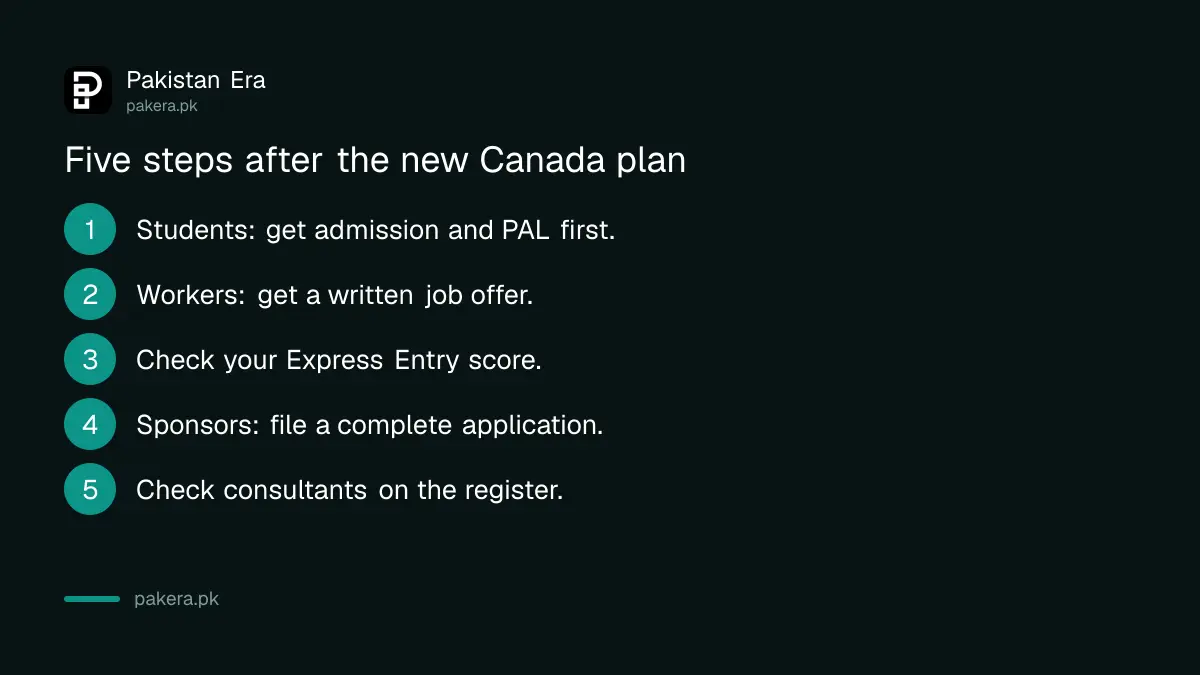
- If you are a student, secure your admission and PAL first, then apply as early as the college allows.
- If you want to work, get a written job offer from a real employer and confirm whether it needs an LMIA.
- If you hope to move to permanent residence, check your Express Entry score and the province you want, because provinces get more nomination space.
- If you are sponsoring a spouse, submit a complete file and track it in your IRCC account.
- Check every consultant on the official register before paying any fee.
Our Express Entry eligibility guide explains the federal route that most skilled Pakistanis use. IRCC said in October 2026 that it is reforming Express Entry to focus on top talent and high-wage jobs, so check the current rules before you build a profile.
What the plan does not tell you
The backgrounder we read does not split the 380,000 places into family, refugee and humanitarian numbers. It does not give new fees, new study permit rules or a target for each province. It does not mention Pakistan at all.
IRCC said it would hold a technical briefing on the plan. If the department publishes category tables or new rules after that, we will update this page. Until then, treat any social media post that quotes a "Pakistan quota" as false.
Common questions
How many students will Canada accept in 2027?
The plan sets a limit of up to 150,000 new international student arrivals in each of 2027, 2028 and 2029. It is a ceiling for all countries together, not a number reserved for any country.
Does the plan give Pakistan a quota?
No. IRCC's backgrounder does not name Pakistan or set any country quota. Pakistani applicants compete with applicants from every other country for the same places.
How many permanent residents will Canada admit?
380,000 a year from 2027 to 2029. More than 64% will be in the economic class, which includes Express Entry and provincial nominees.
Can I get PR through the 200,000 one-time measure from Pakistan?
No. The measure is for people already living in Canada. The workers cohort uses provincial nominations, and the humanitarian cohort covers people already in Canada with pending cases.
Will spouse sponsorship become faster?
IRCC says the extra space will help bring spouse and partner waits closer to 12 months for people going outside Quebec. That is a target. Check the current processing time before you plan travel.
Can I sponsor my parents to Canada now?
Not through the parents and grandparents programme, which IRCC lists as paused. The super visa is still open and lets parents and grandparents visit for up to 5 years at a time.
How we verified this
What we checked, where we read it, and what we could not confirm.
Last checked on 6 November 2026. All plan figures are from IRCC's backgrounder "Building a stronger Canada through a well-managed, predictable immigration system", dated 5 November 2026 on canada.ca. The parents and grandparents pause is from IRCC's sponsorship page, dated 18 August 2026. The Express Entry reform reference is from IRCC's news release of 16 October 2026. We did not find a category table for the plan on canada.ca at the time of checking.
About the author

Global Affairs & Political Economy Writer
Muhammad Hatim is a book lover who started writing because he enjoys it. At Pakistan Era he writes about international relations, geopolitics and the global economy, with a particular interest in South Asia and the forces behind current events.