Cash Deposit of Rs 2 Million or More in Pakistan: What Your Bank Reports to the FMU
Banks report cash deposits or withdrawals of Rs 2 million or more to the FMU in 7 working days. See what a CTR is, why splitting is a red flag, what to bring.
When you deposit or withdraw Rs 2 million or more in cash at a bank in Pakistan, the bank must report the transaction to the Financial Monitoring Unit (FMU) in a currency transaction report, known as a CTR. The law gives the bank seven working days to file it and ten years to keep the record. A CTR is routine paperwork and does not mean you are suspected of anything.
Many people hear about "the Rs 2 million rule" from a branch manager, usually at the counter with a bag of cash. We read the FMU's own question and answer sheet, the Anti Money Laundering Act, 2010 and the FMU's red flag list for banks on 22 October 2026, so you know what the report is, what it is not and what to carry.
A currency transaction report is a routine filing, not a charge
A CTR is a report a bank files with the FMU when a cash transaction passes a set amount. It covers the fact of the transaction only. It is not an accusation, a freeze or a tax notice.
The FMU is Pakistan's financial intelligence unit, set up under the Anti Money Laundering Act, 2010. Its job is to receive two kinds of report from banks and other reporting entities: CTRs, which depend on the amount, and suspicious transaction reports, which depend on the bank's suspicion. The FMU studies them and passes intelligence to law enforcement or a regulator when it sees a problem.
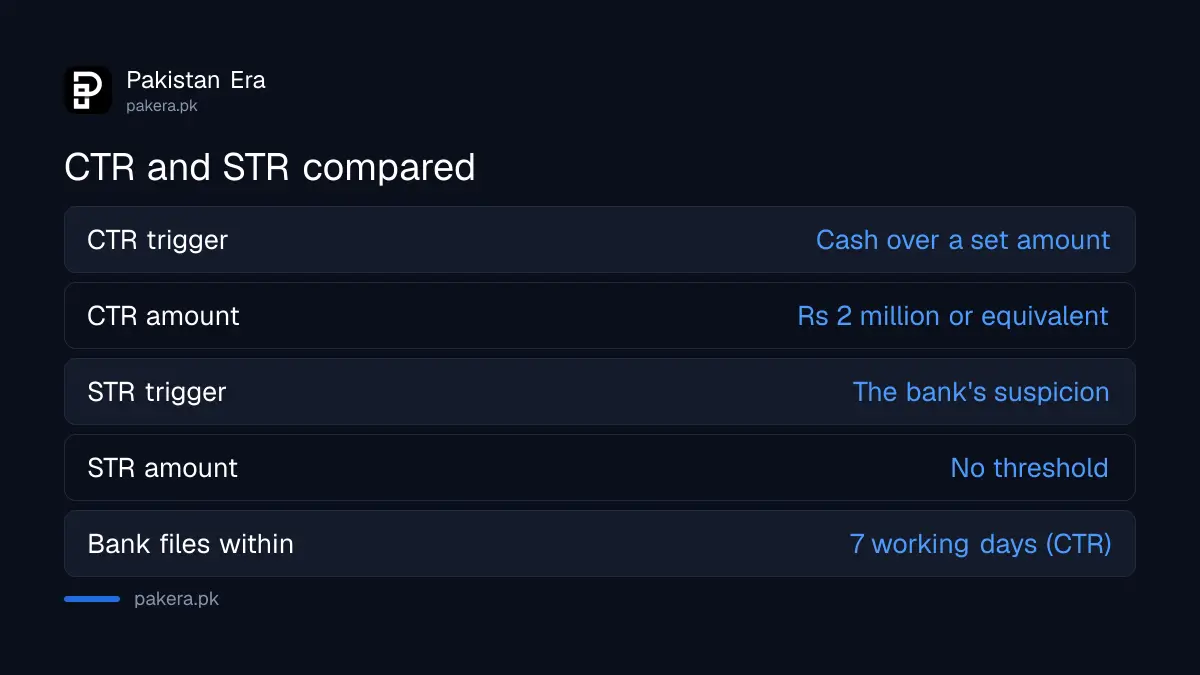
| Report | What triggers it | Threshold | Does the bank tell you? |
|---|---|---|---|
| CTR, currency transaction report | A cash transaction over the set amount | Rs 2 million or equivalent, per the FMU | Not required to, as far as we read |
| STR, suspicious transaction report | The bank suspects money laundering or terrorism financing | None | No. The law protects the confidentiality of an STR |
The Rs 2 million line comes from the FMU, and the Act says "exceeding"
The FMU's question and answer sheet says a CTR is required for a cash transaction above the specified threshold, "PKR 2 million and above or equivalent". The Act defines a CTR as a report on cash transactions "exceeding such amount" as the National Executive Committee sets by notification in the Gazette.
So the Act says exceeding, and the FMU's sheet says and above. We did not find the Gazette notification itself, so we cannot settle whether exactly Rs 2 million is on the line. If your amount is at or close to Rs 2 million, ask the branch what it will do. The FMU's wording also says "or equivalent", which covers foreign currency cash.
The sheet speaks of a "cash transaction" without limiting it to deposits. We read it as including cash withdrawals too, but the sheet does not spell this out. The tax side of large cash withdrawals is a separate matter, covered in the guide to the cash withdrawal tax for non-filers.
The bank files within seven working days and keeps the record for ten years
Under section 7 of the Act, a bank must file each CTR with the FMU immediately, and no later than seven working days after the cash transaction. It must keep its records of CTRs for at least ten years after reporting. The FMU takes reports online through its goAML system.
The FMU's sheet says paper reports are no longer accepted. The bank's staff register on goAML before they can report. You do not file anything yourself. Section 12 of the Act protects the bank and its officers from civil, criminal or disciplinary proceedings over a report they file, according to the FMU sheet.
The Act was passed in 2010. The text we read is the FMU's copy "as amended up to February 2020", so a later change could exist that we did not see.
Splitting a deposit to stay under the line is itself a red flag
The FMU's red flag list for banks names "the deposit or withdrawal of cash in amounts which fall consistently just below identification or reporting thresholds" as a warning sign. The Act separately requires a suspicious transaction report for any transaction "designed to evade any requirements" of section 7.
That makes the common trick of paying in Rs 1.9 million on Monday and Rs 1.9 million on Tuesday a bad idea. The bank sees the pattern, files a suspicious transaction report and may ask harder questions. The same list flags depositing cash with several credit slips so each looks small, and several people depositing at different branches at the same moment.
If you need to move a large sum, the clean route is a bank transfer, a pay order or a cheque. The charges for the instruments are in the guide to pay order and demand draft charges. For a property payment, there is a specific rule in the guide to lifting an account limit for one off property payment.

What to carry and say when you deposit a large amount in cash
Bring your CNIC and know where the cash came from. Large cash deposits often lead to questions about the source, and a clear answer ends them quickly. Sale proceeds, a salary advance, a business day's takings or a gift each have their own paper.
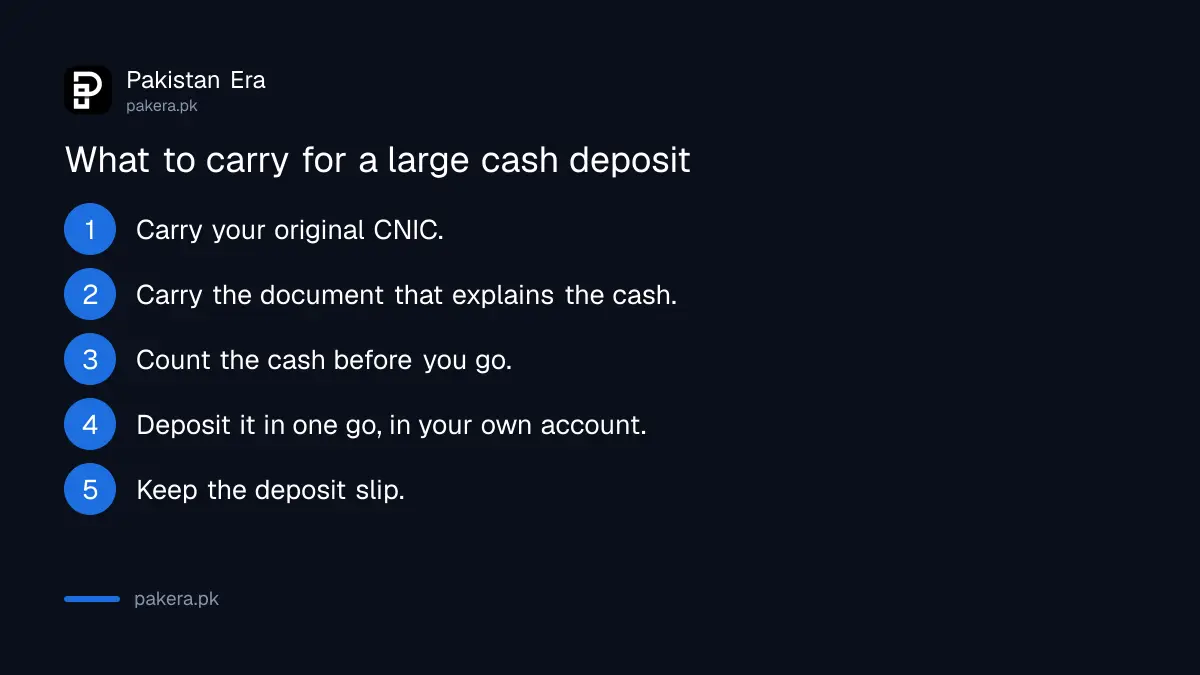
- Carry your original CNIC and your account details.
- Carry the document that explains the cash, such as a sale deed, receipt, invoice or withdrawal slip.
- Count the cash before you go. The FMU's list flags uncounted bundles that shrink on counting.
- Deposit it in one go, at one branch, in your own account.
- Ask for the deposit slip and keep it with your explaining document.
What the bank may ask for, and whether a signed declaration is enough, is in the guide to when a bank asks for income proof. A business account has its own documents, listed in the guide to business account documents.
A CTR becomes a suspicious transaction report only if the bank sees a reason
If a transaction was reported as a CTR and the bank later finds it suspicious, the FMU's sheet says the bank must also report it as a suspicious transaction. An STR has no threshold. The FMU's director general can freeze property for up to fifteen days if there are reasonable grounds to believe it is involved in money laundering.
If your account is restricted and the bank cannot explain why, the steps in the guide to a blocked or lien marked account apply. The law also protects an STR's secrecy, so the bank may not be able to tell you the real reason. A bank officer who leaks STR data faces up to five years in prison or a fine of up to Rs 2 million, according to the FMU sheet.
Common questions
Is a CTR bad for me?
No. It records that a large cash transaction happened. It is filed on every such transaction, whatever the reason.
Will the bank tell me it filed a CTR?
It may mention it, but nothing we read requires it to. You do not file or sign anything yourself.
Is the limit Rs 2 million exactly?
The FMU's sheet says Rs 2 million and above or equivalent. The Act says "exceeding" an amount fixed by notification. Ask the branch if you are near the line.
Does a CTR apply to online transfers?
No. It applies to cash. Bank to bank transfers are not currency transactions, although a bank can still report any transfer it finds suspicious.
Can I split my deposit to avoid the report?
No. Splitting just under the line is a listed red flag, and the Act requires a suspicious transaction report for transactions designed to evade section 7.
How long does the bank keep the CTR record?
At least ten years after the report, under section 7 of the Anti Money Laundering Act.
How we verified this
What we checked, where we read it, and what we could not confirm.
Last checked 22 October 2026. We read the FMU's frequently asked questions on suspicious transaction reports, the Anti Money Laundering Act, 2010 as amended up to February 2020 and the FMU's red flags for banks. We did not find the Gazette notification that sets the CTR amount, so the Rs 2 million figure is the FMU's, and we have not seen whether it changed after 2020. We did not test a deposit at any branch.
About the author

Senior Writer, Public Services and Technology
Shahid joined us in 2024 as an author. He is a senior contributor to Pakistan's leading technology websites. He writes detailed articles, mostly covering his expertise in the latest tech, mobiles, apps, gadgets, and step-by-step guides. His ideology is to help people understand the latest trends and explain complex methods through very easy-to-understand guides.