Pay Order, Demand Draft and Banker's Cheque Charges in Pakistan: Free to Rs 800, Rs 25 for Fees
Pay order, demand draft and banker's cheque charges at six Pakistani banks for July to December 2026: free to Rs 800 to issue, Rs 25 cap for fees. Compare now.
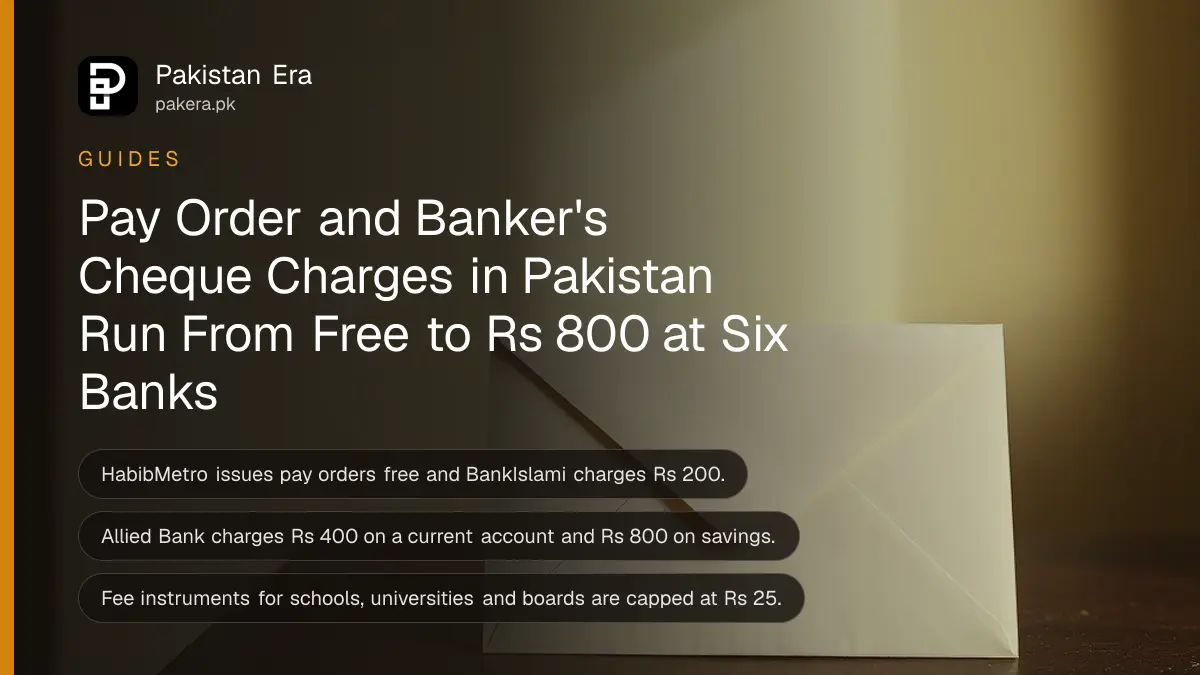
Short answer: A pay order, demand draft or banker's cheque costs between nothing and about Rs 800 at Pakistani banks in the July to December 2026 schedules we read: HabibMetro issues pay orders free, BankIslami charges Rs 200, ICBC Rs 300, Dubai Islamic Bank Rs 350, Allied Bank Rs 400 on a current account and Rs 800 on a savings account, and NBP Islamic Rs 550. Cancelling one costs Rs 250 to Rs 600, and a duplicate Rs 300 to Rs 1,000. Instruments for school, college or board fees are capped at Rs 25 or 0.5 per cent at every bank we checked.
These instruments are still the standard way to pay a university, a housing society, a court or a government department that will not take a transfer. We read six banks' schedules of charges on 19 October 2026 for the figures below. Federal excise duty is added on top at most banks.
A pay order is a bank guaranteed cheque, and most banks now issue one instrument for everywhere
A pay order is a cheque drawn by the bank on itself, paid from money it has already taken from you, so it cannot bounce for lack of funds. A demand draft was the version payable at another city, and a banker's cheque is the single instrument several banks now issue that is payable at any of their branches in Pakistan.
Allied Bank's schedule, for instance, no longer prices a separate demand draft. It lists an "Allied Banker Cheque (ABC) payable at any branch in Pakistan" and treats drafts, pay orders and banker's cheques as one family for cancellation and duplicates. NBP Islamic prices a "Banker's Cheque" and then one cancellation line for "pay orders, demand drafts, BC".
The difference that still matters is a crossing. Ask for the instrument crossed "account payee only" so it can only be deposited into the named payee's account, which is the protection explained in our page on crossed and account payee cheques.
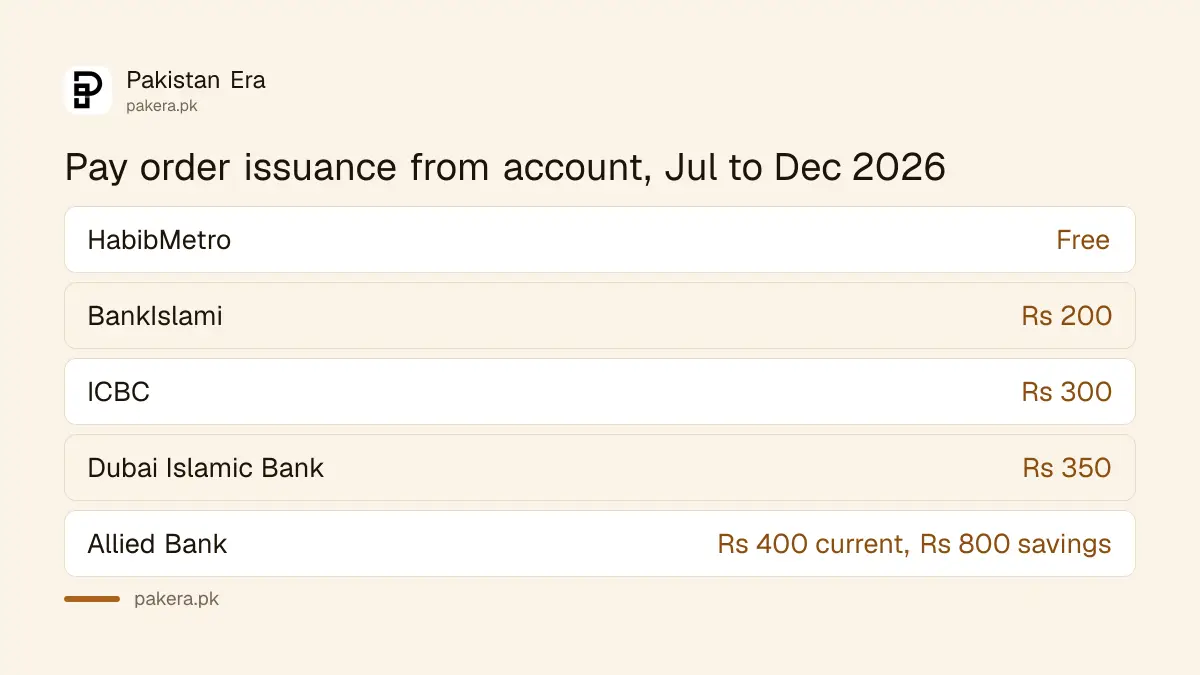
Issuance charges run from free at HabibMetro to Rs 800 at Allied Bank on a savings account
HabibMetro's schedule lists pay order issuance as free. BankIslami charges Rs 200 on its current, Sahulat and Bachat accounts. ICBC charges Rs 300. Dubai Islamic Bank charges Rs 350. Allied Bank charges Rs 400 from a current account and Rs 800 from a savings account, and NBP Islamic charges a flat Rs 550 for account holders.
| Bank, schedule July to December 2026 | Issue from account | Cancel | Duplicate |
|---|---|---|---|
| HabibMetro | Free | Rs 500 flat | Rs 500 flat |
| BankIslami | Rs 200 | Rs 400 | Rs 300 |
| ICBC Pakistan | Rs 300 | Rs 300 | Rs 1,000 |
| Dubai Islamic Bank | Rs 350 pay order | Rs 450 pay order, Rs 250 demand draft | Rs 350 |
| Allied Bank (banker's cheque, any branch) | Rs 400 current, Rs 800 savings | Rs 500 (Rs 600 if issued against cash) | Rs 500 flat |
| NBP Islamic (banker's cheque) | Rs 550 flat | Rs 450 flat | Rs 750 |
Paying cash at the counter instead of debiting your account costs more. Allied Bank charges 0.20 per cent with a minimum of Rs 1,250 for a banker's cheque issued against cash, for account holders and walk in customers alike. So pay from the account where you can; the fee is a third of the cash price or less.
Several banks waive these fees on premium or business accounts that keep a minimum balance. Allied Bank's business accounts get six free instruments a month on one tier and unlimited on another, and Dubai Islamic and BankIslami list pay orders as free on their priority grids. If you issue instruments often, the account type decides the cost more than the bank does.
School and university fee instruments are capped at Rs 25 or 0.5 per cent at every bank we read
Every schedule we read caps a pay order or draft in favour of an educational institution, including HEC and examination boards, at 0.50 per cent of the fee or Rs 25 per instrument, whichever is less. Allied Bank, NBP Islamic, Dubai Islamic, BankIslami and ICBC all carry the line; BankIslami and ICBC make the issuance free outright.
This is the one bank charge almost no one knows about. A Rs 150,000 semester fee paid by pay order should cost Rs 25, not Rs 400. If a branch charges the full rate, point to the education line in its own schedule and ask for the difference back. The same cap applies to cancelling such an instrument at Allied Bank and ICBC.
Government fees are moving away from instruments anyway. Many departments now take a PSID through a bank app, and utility and tax payments that used to need a draft can be paid at the counter under the rules in paying bills at a bank branch. Check whether the payee still needs paper before you pay for it.
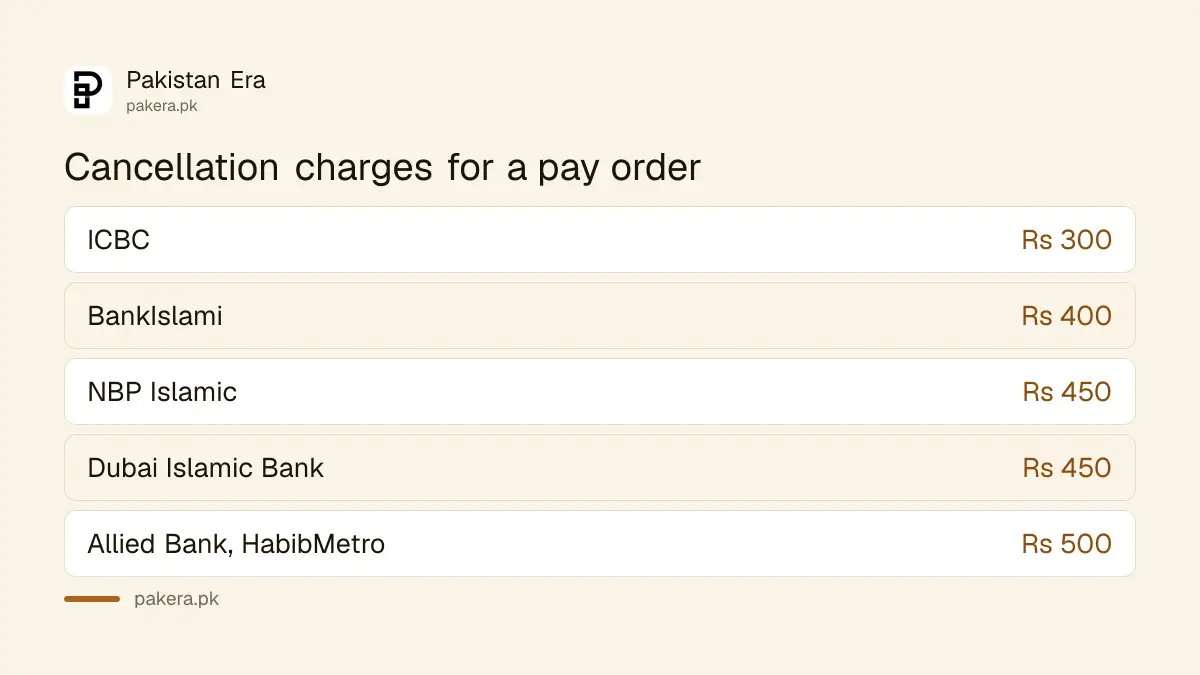
Cancelling costs Rs 250 to Rs 600 and you must return the original instrument
To cancel, take the original pay order and your CNIC to the issuing branch and sign a cancellation request; the bank credits your account less the fee. Dubai Islamic charges Rs 450 for a pay order and Rs 250 for a demand draft, Allied Bank Rs 500, NBP Islamic Rs 450, HabibMetro Rs 500, BankIslami Rs 400 and ICBC Rs 300.
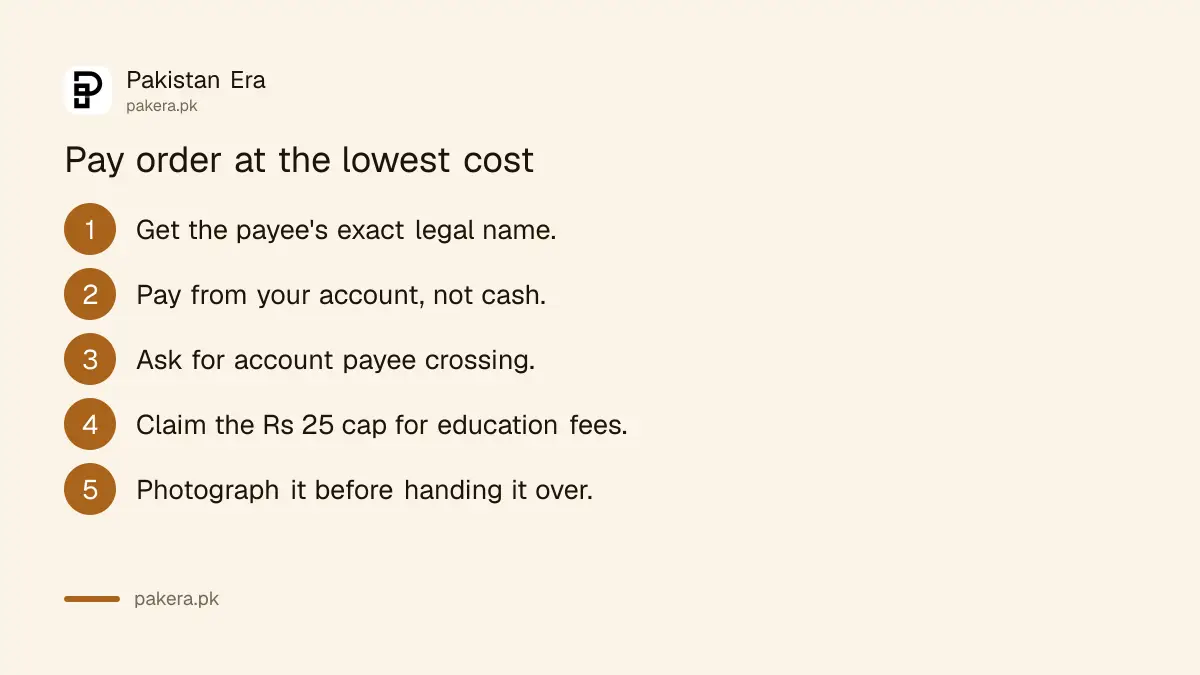
- Decide who the payee is and get the exact legal name; a wrong name means a cancellation fee and a fresh issuance fee.
- Pay from your account, not cash, and ask for the instrument crossed account payee.
- Check the education cap if the payee is a school, college, university or board.
- Photograph the instrument before handing it over, so you have the number if it is lost.
- If it is lost, ask for a stop or caution marking first, then a duplicate against an indemnity.
A lost instrument is not a cancellation. Dubai Islamic lists a separate "stop payment / caution marking of DD, PO" at Rs 350 and a duplicate at Rs 350; ICBC charges Rs 1,000 for a duplicate against a lost or stolen pay order. Banks ask for an indemnity bond because the original could still turn up.
An old pay order needs revalidation, and some banks charge for that too
A pay order does not stay payable forever. Dubai Islamic charges Rs 50 to revalidate a pay order or draft, and ICBC charges Rs 300 per instrument, free for education payments. If a payee has sat on your instrument for months, ask the bank whether it needs revalidating before they try to deposit it.
Compare the whole cost with a transfer. An interbank transfer through the app is free up to a monthly limit at most banks, as set out in our page on IBFT charges and the free limit, and a Raast transfer is free without limit. A pay order wins only when the payee insists on paper or a bank guaranteed instrument, which housing societies, courts and some universities still do.
If you are charged more than the schedule says, the complaint route is the bank first, then SBP's Sunwai portal. The wider list of charges worth avoiding is in our page on bank charges in Pakistan and how to avoid them.
Common questions about pay orders and demand drafts
What is the difference between a pay order and a demand draft?
Both are bank issued instruments paid from money already collected from you. A pay order was traditionally payable in the same city and a demand draft in another, but most banks now issue one banker's cheque payable at any branch.
How much does a pay order cost in Pakistan?
From free at HabibMetro to Rs 800 at Allied Bank on a savings account in the July to December 2026 schedules, with BankIslami at Rs 200, ICBC Rs 300, Dubai Islamic Rs 350, Allied Bank Rs 400 on a current account and NBP Islamic Rs 550. FED is extra.
Is a pay order for university fees cheaper?
Yes. Every bank we read caps instruments in favour of educational institutions, HEC and boards at 0.5 per cent of the fee or Rs 25, whichever is less. BankIslami and ICBC issue them free.
Can a pay order bounce?
Not for lack of funds, because the bank has already taken the money. It can be returned if it is stale, altered or reported lost.
How do I cancel a pay order?
Return the original to the issuing branch with your CNIC and sign a cancellation request. Fees in the schedules we read are Rs 250 to Rs 600, and the bank credits the balance to your account.
What if I lose a pay order?
Ask the bank to mark a caution on it, then apply for a duplicate against an indemnity. Duplicates cost Rs 300 to Rs 1,000 depending on the bank.
How we verified this
What we checked, where we read it, and what we could not confirm.
Last checked 19 October 2026. Charges are from the schedules of charges effective 1 July to 31 December 2026 of Allied Bank, Dubai Islamic Bank, BankIslami, NBP Islamic Banking, HabibMetro and ICBC Pakistan, all read as PDFs on 19 October 2026. We could not read the schedules of HBL, UBL, MCB and Meezan, whose websites blocked automated reading, and NBP's conventional banking schedule did not extract legibly, so those banks are not in the table. We did not buy an instrument ourselves.
About the author

Public Services and Education Journalist
Fajr Riaz is a journalist and content writer at Pakistan Era, based in Lahore. She covers the questions people meet in everyday life in Pakistan: how a public service works, what a change in the rules means, and where to find a reliable answer.