How to Claim an Unclaimed Bank Deposit From the SBP in Pakistan
A bank deposit idle for 15 years moves to the State Bank of Pakistan. See how you or your legal heirs can claim it, the Rs 100,000 rule and the papers needed.
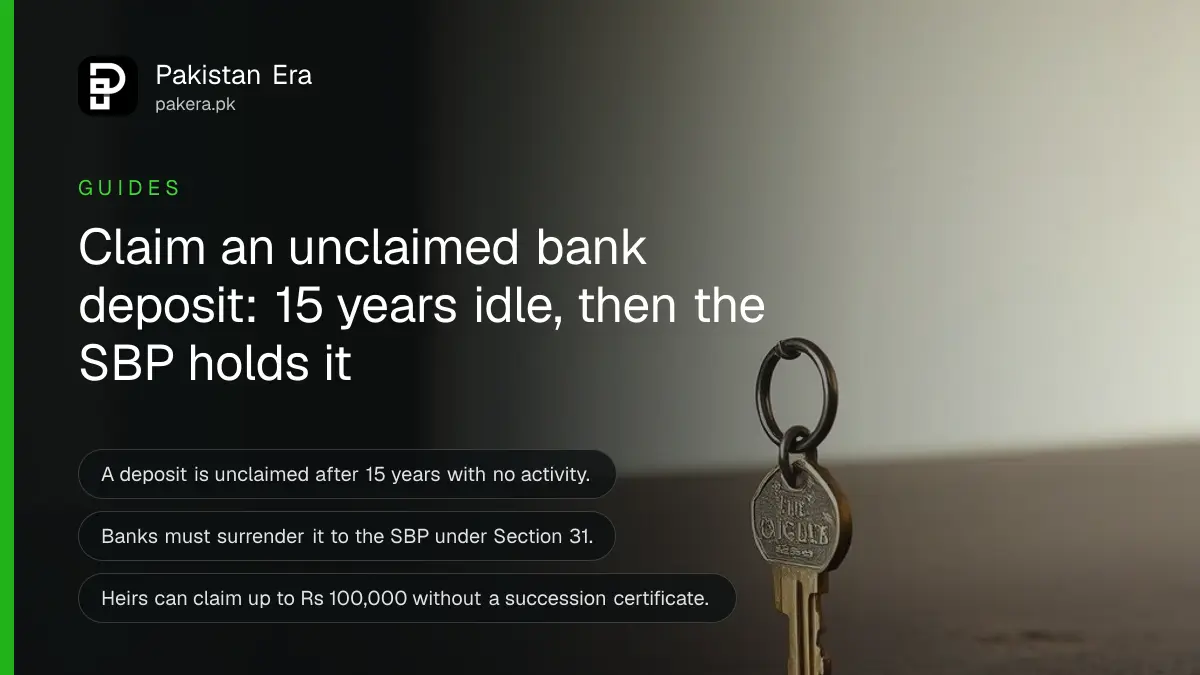
Short answer: If a bank account or deposit in Pakistan has had no transaction for fifteen years, the bank must hand the money to the State Bank of Pakistan (SBP). You can still claim it. Go to the branch where the account was opened, and the bank submits your refund claim to the SBP.
Many families find an old savings account, a fixed deposit receipt or a pay order years after the owner stopped using it. The money does not vanish. Under the Banking Companies Ordinance 1962 it moves to the SBP, which holds it until the owner or the legal heirs claim it.
We read the SBP page on unclaimed deposits and the SBP circular on refund of surrendered deposits on 12 October 2026. We could not open the SBP's searchable list of unclaimed deposits, so we cannot tell you where it sits on the new website today. This guide says where we are relying on reported detail.
A deposit is unclaimed after fifteen years of silence
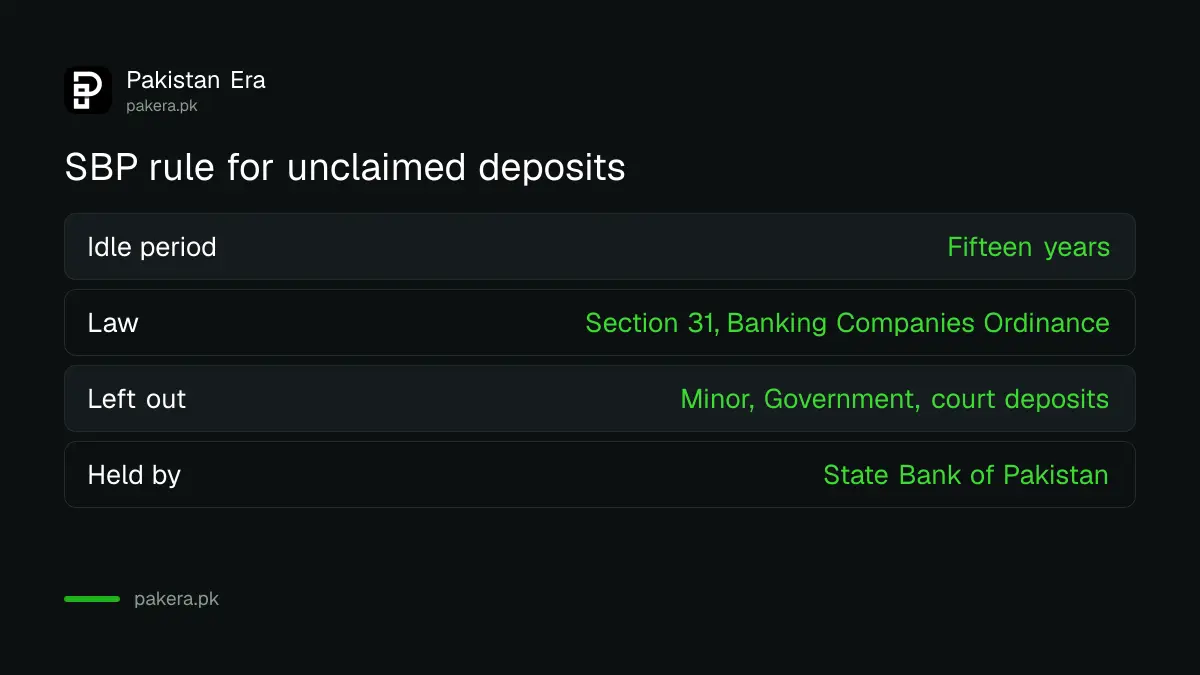
The SBP says a deposit is unclaimed when no transaction has taken place and no statement has been asked for or acknowledged by the account holder for fifteen years. Deposits in the name of a minor, the Government or a court are left out.
Fixed deposits, other deposits, cheques, drafts and bills of exchange all count. Section 31 of the Banking Companies Ordinance makes the bank surrender them to the SBP. Some older notes online say ten years. The current SBP page says fifteen, so we use fifteen.
| Question | What the SBP page says |
|---|---|
| How long must the account sit untouched? | Fifteen years |
| Which law applies? | Section 31, Banking Companies Ordinance 1962 |
| What is covered? | Fixed and other deposits, cheques, drafts, bills of exchange |
| What is left out? | Deposits of a minor, the Government or a court |
| Who holds the money after surrender? | The State Bank of Pakistan |
Start at the branch where the account was opened
The claim is made through the bank, not by posting papers to the SBP. Reports of the SBP process say the claimant approaches the branch where the account was opened or the instrument was payable. The circular confirms the bank submits the case to the SBP.
Take your CNIC and anything that shows the account: an old passbook, a deposit receipt, a statement, a cheque book or a letter. If you do not have the account number, give the branch your full name, your CNIC number and the approximate year you opened it.
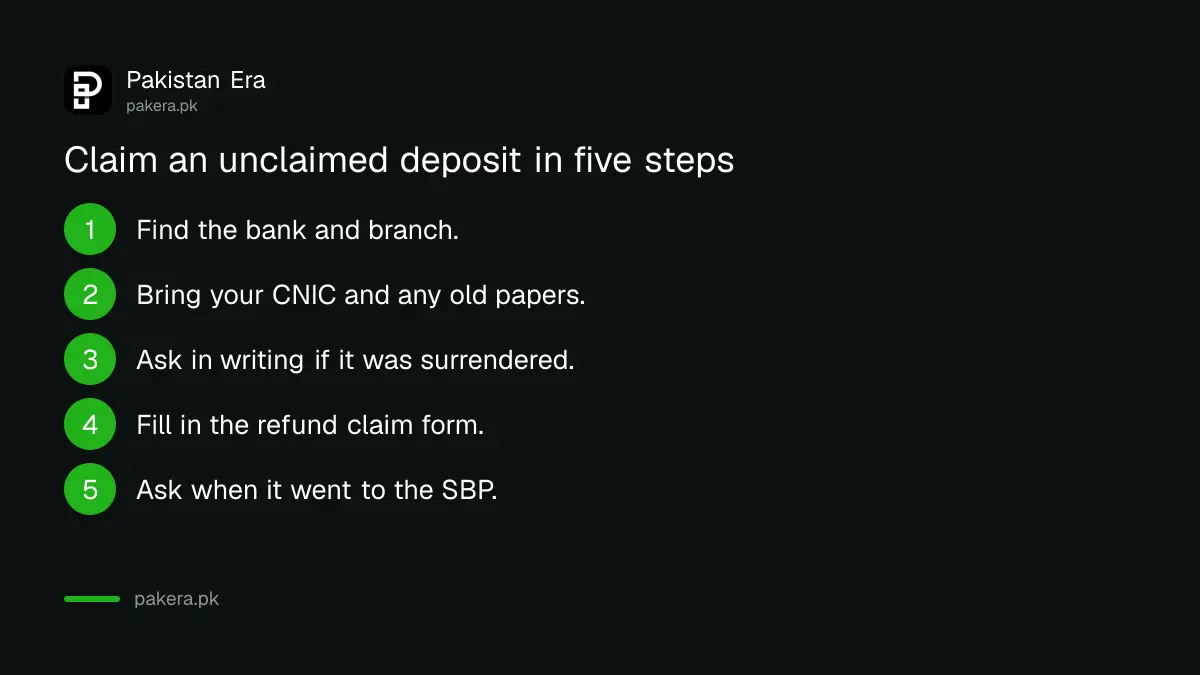
- Find the bank and the branch where the account was opened.
- Bring your CNIC and any paper that shows the account.
- Ask in writing whether the balance was surrendered to the SBP.
- Fill in the bank's refund claim form and ask for a stamped copy.
- Ask for the date the bank sent the claim to the SBP.
Heirs can claim up to Rs 100,000 without a succession certificate
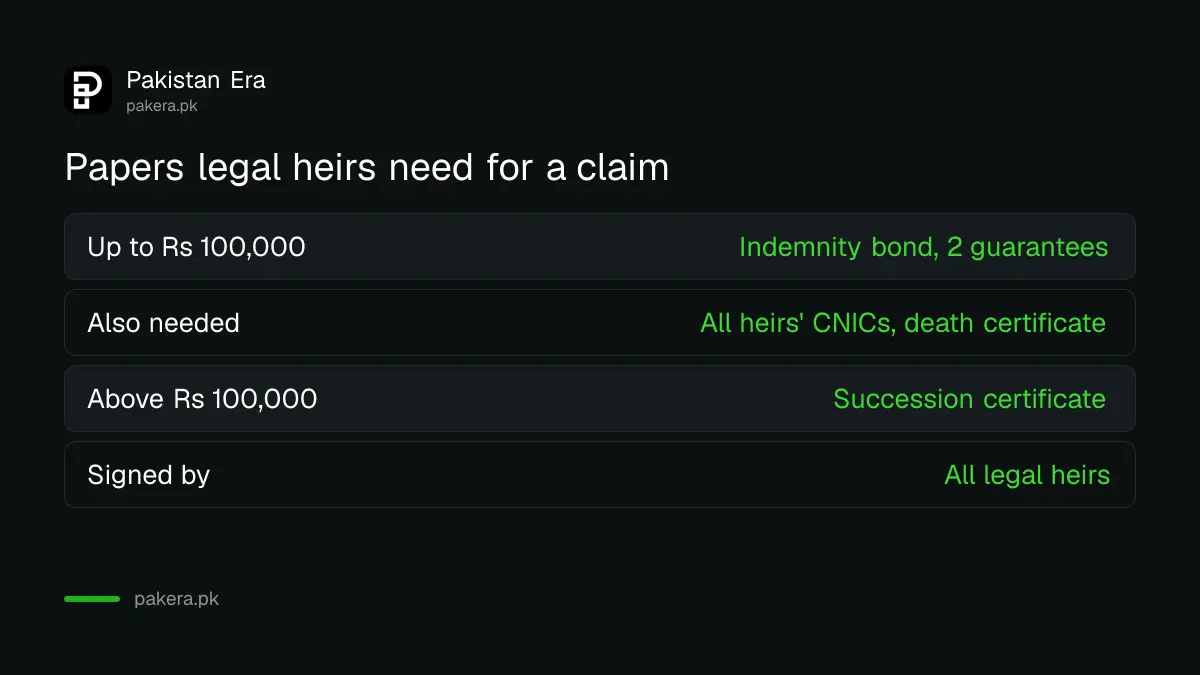
For a deceased account holder, the SBP's 2012 circular lets banks submit claims of Rs 100,000 and below without a succession certificate. The heirs must sign an indemnity bond on stamp paper, give two personal guarantees, and bring their CNICs and the death certificate.
The bank must also be satisfied that the heirs are genuine. The indemnity bond has to be signed by all the legal heirs. For claims above Rs 100,000 the bank continues to ask for a succession certificate, which a court issues. We did not check a current court fee for it.
| Claim size | Papers the circular lists |
|---|---|
| Rs 100,000 or less | Application from all heirs, CNIC copies, death certificate, indemnity bond signed by all heirs, two personal guarantees |
| Above Rs 100,000 | Succession certificate, as usual |
Check first that the account is not just dormant or blocked
An account that is merely dormant has not been surrendered. Our guide on reactivating a dormant bank account is the right route if the account is under fifteen years old. If a CNIC expired and blocked it, see unblocking an account for an expired CNIC.
If a court or an agency froze the account, that is a different process, which we cover in our guide on getting a frozen bank account released. Ask the branch which status your account has before you start a refund claim.
If the bank does not act, complain in writing
Write to the bank's complaint unit and keep the receipt. The SBP's own page sets an acknowledgement within 48 hours and a final reply within 15 days at the most, except fraud cases, which get 30 days. After that, take it to the regulator.
Our guide on the SBP Sunwai complaint portal shows how to lodge it, and our guide on complaining to the Banking Mohtasib covers the next step. We found no stated number of days for an unclaimed refund itself, so we cannot promise a timeline.
Common questions
How do I know if my deposit was surrendered to the SBP?
Ask the branch where the account was opened, in writing. The SBP says banks report such deposits to it, and the SBP has published lists by year and bank, which we could not open.
Is there a fee to claim an unclaimed deposit?
We found no fee in the SBP pages we read. The heirs' route needs stamp paper for the indemnity bond, and the circular names a Rs 100 stamp paper for the bank's own indemnity to the SBP.
Can I claim for a parent who died?
Yes, as a legal heir. For Rs 100,000 or less, all heirs sign an indemnity bond and the bank submits the claim. Above that amount, you need a succession certificate.
What if the account was in a minor's name?
The SBP page leaves deposits in a minor's name out of the unclaimed rule. Ask the bank how it treats the account, and keep the child's birth record and your CNIC ready.
Does the interest keep growing after surrender?
We did not find an SBP statement on profit after surrender, so we do not state one. Ask the bank what amount it will claim for you.
How we verified this
What we checked, where we read it, and what we could not confirm.
We read the SBP page on unclaimed deposits, CPD Circular Letter No. 1 of 2012 on the refund procedure, and the SBP consumer protection page on complaint timelines on 12 October 2026. The branch rule is from a report of an SBP page that we could not open. The searchable list and any current claim form are not verified.
About the author

Technology Journalist & Multimedia Producer
Ahmad Ali is a technology journalist and multimedia producer at Pakistan Era, joining the team in October 2026. He covers consumer technology and digital life for Pakistani readers, combining research with hands-on product testing.