Check If You Qualify Under the CDA's Katchi Abadi Rules in Islamabad: The 2002 Survey Date
CDA Urban Regeneration Regulations 2025 for Islamabad katchi abadis: who qualifies, the 31 December 2002 survey date, what the CDA will do and what to keep now.
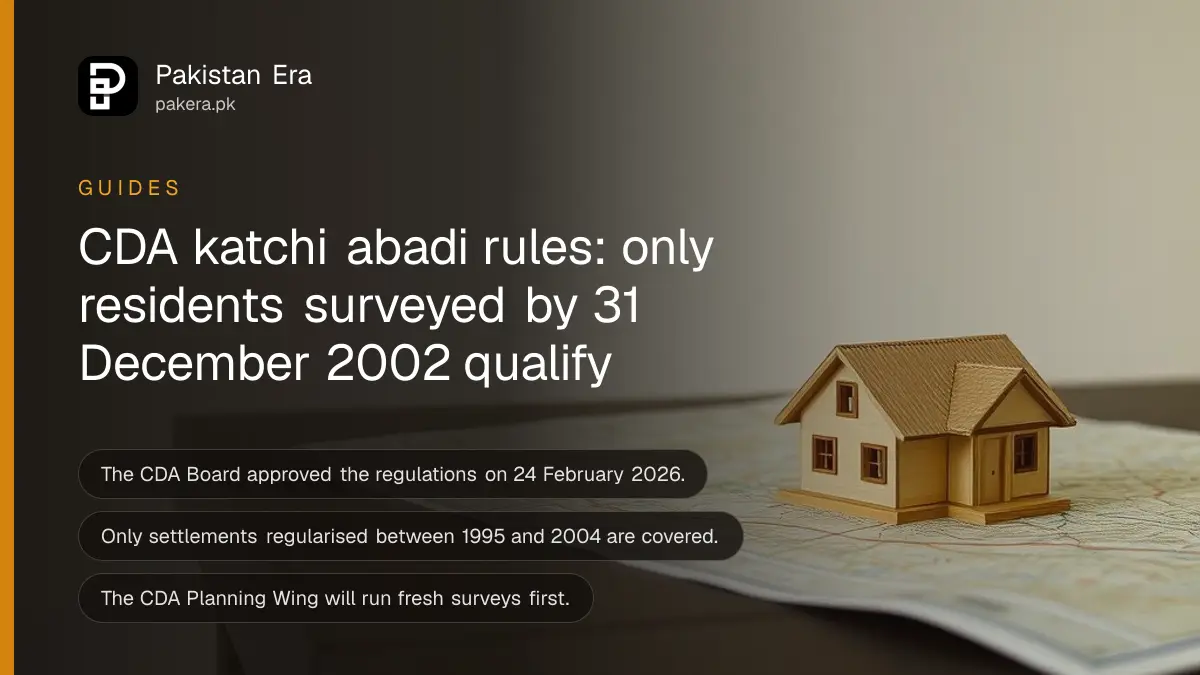
Short answer: Under the CDA's Urban Regeneration Regulations 2025, only residents recorded in surveys done up to 31 December 2002 qualify as entitled occupants of a recognised katchi abadi in Islamabad. The CDA Board approved the rules on 24 February 2026. The CDA will run fresh surveys before any upgrade scheme starts.
A family in an Islamabad katchi abadi has lived on the same plot for twenty years. They hear that the CDA will "regularise" the settlement. The question they ask is simple: are we on the list? The date 31 December 2002 decides that.
We read the CDA's own news release on the regulations on 13 October 2026. It is dated 25 February 2026. This guide sets out what the CDA has said, what it has not published, and what you can do now. A katchi abadi is an informal settlement, built without approval on state land.
The CDA Board approved the regulations on 24 February 2026
The CDA Board approved the Islamabad Capital Territory Urban Regeneration/Renewal (Regulations, Upgradation and Relocation) Regulations 2025 at its second meeting of 2026. The CDA says it acted on directions of the Supreme Court of Pakistan and under the CDA Ordinance 1960.
The aim is to regularise and upgrade katchi abadis that are already recognised. The rules cover Islamabad Capital Territory only.
This is not new news. It is a rule that is approved, and it matters because many families have not yet checked their position.
Only recognised settlements are covered
The regulations apply to katchi abadis that the federal government declared regularised between 1995 and 2004. A settlement outside that group is not covered by these rules, so a new or unrecognised colony cannot use them.
The CDA release does not publish the list of settlements. We could not find a list on the CDA pages we checked. Ask the CDA Planning Wing in writing whether your settlement is on it. A different problem is a private housing scheme sold without approval. That is not a katchi abadi, and the steps are in the guide on what to do if you paid for a plot in an illegal housing scheme in Islamabad.
The 31 December 2002 survey date decides who qualifies
The CDA says only residents recorded in surveys conducted up to 31 December 2002 will qualify as entitled occupants. A family that arrived after that date, or was never recorded, is not named by the release as eligible.
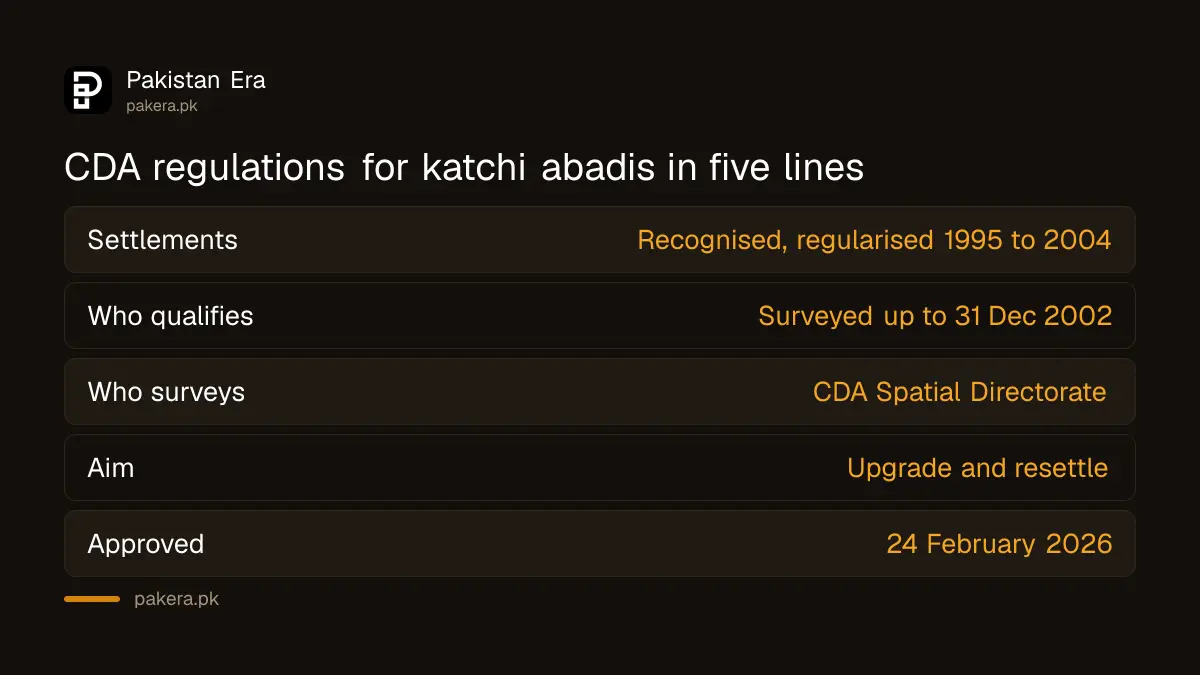
| Question | What the CDA release says |
|---|---|
| Which settlements? | Recognised katchi abadis declared regularised between 1995 and 2004 |
| Who qualifies? | Residents recorded in surveys up to 31 December 2002 |
| Who surveys? | CDA Planning Wing, Spatial Directorate, with fresh surveys |
| What happens? | Upgradation, resettlement, infrastructure and basic amenities |
| Legal basis | CDA Ordinance 1960 and Supreme Court directions |
The release does not say what proof counts as being recorded in a survey. It does not say what happens to a family that cannot show it. Those details may be in the regulation text, which we have not read.
What the CDA says it will do next
The CDA Planning Wing's Spatial Directorate will conduct fresh surveys to prepare schemes. The schemes are for upgradation, resettlement, better infrastructure and basic amenities. The release also names road construction and repairs and beautification.
- The Spatial Directorate surveys a recognised settlement.
- The CDA prepares a scheme for upgrade or resettlement.
- Entitled occupants are identified from the survey records up to 31 December 2002.
- Roads, services and amenities are built or repaired.
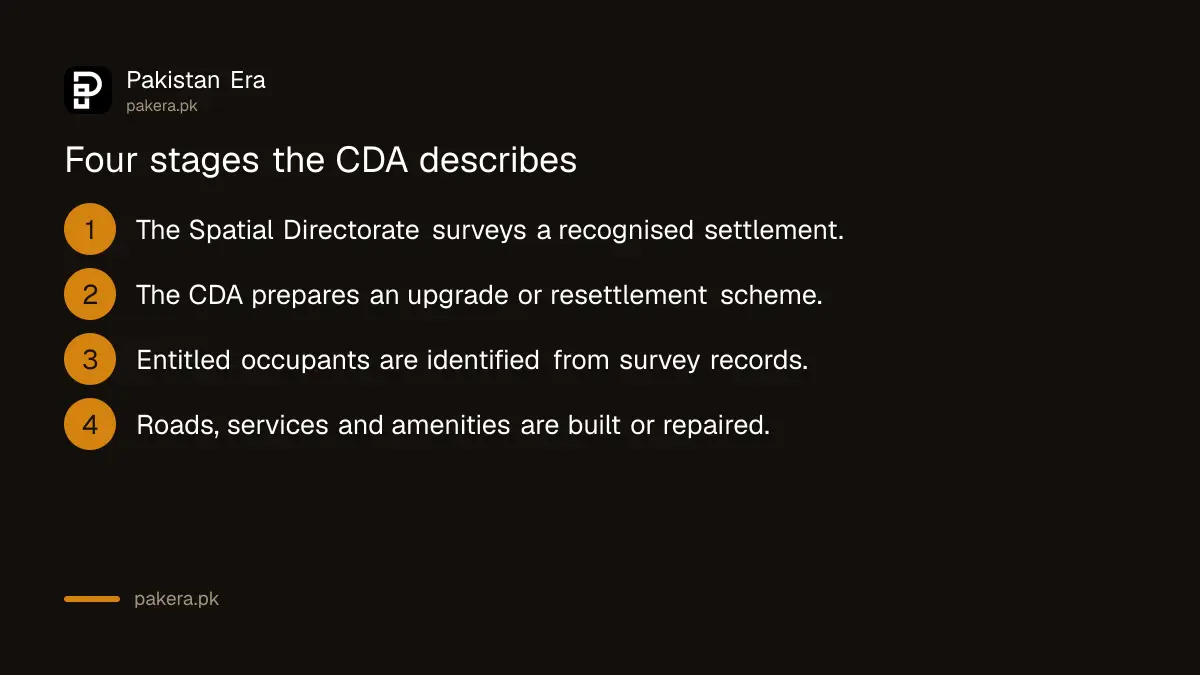
The order of these steps is our plain-language reading of the release. The CDA has not published a timetable, a budget or a start date for any named settlement.
Prepare your own file now
You cannot apply for anything yet, because the CDA has not opened an application. You can still keep proof that you lived in the settlement. This is our suggestion, not a CDA requirement. Keep copies in one folder and do not hand over originals.
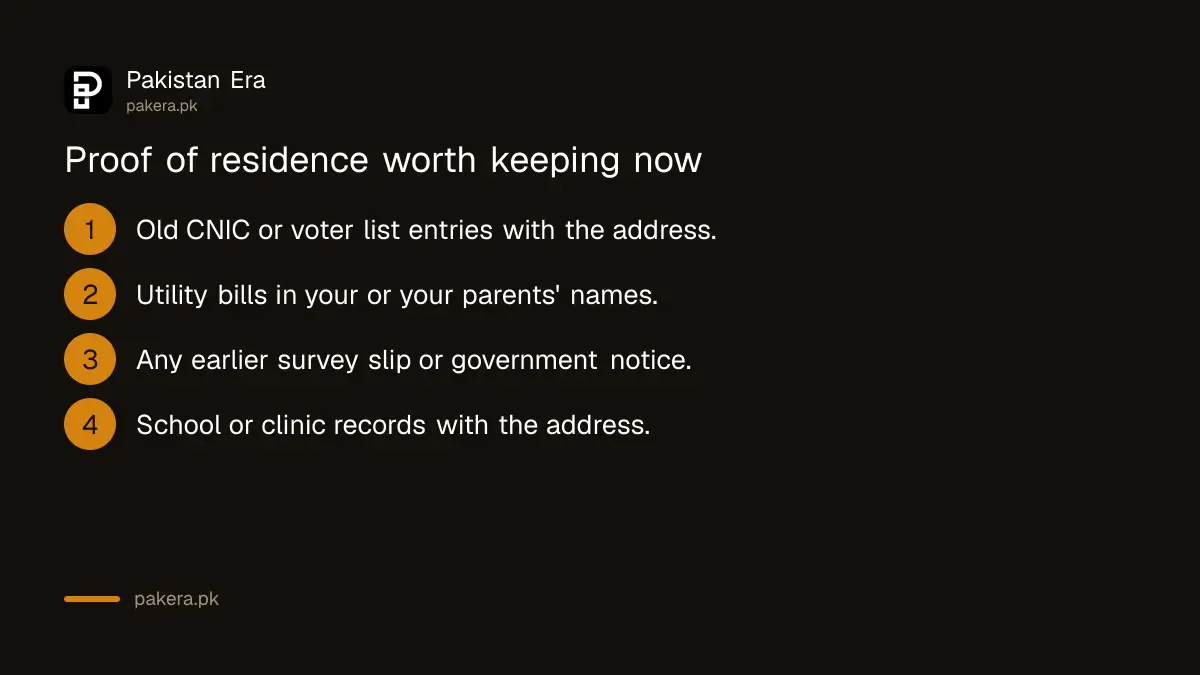
- Old CNIC and voter list entries that show the address.
- Utility bills in your name or your parents' names.
- Any earlier survey slip, receipt or notice from a government office.
- School or clinic records with the address.
Be careful with anyone who offers to put your name on a list for a fee. The CDA has not announced one. If you later hold a CDA plot, the steps for dues and papers are in the guide to checking CDA plot dues and the page on transferring a CDA plot or house.
Common questions
Who qualifies under the CDA urban regeneration regulations?
Residents recorded in surveys conducted up to 31 December 2002, in recognised katchi abadis, qualify as entitled occupants, says the CDA.
When did the CDA approve the regulations?
The CDA Board approved them at its meeting on 24 February 2026.
Which katchi abadis are covered?
Those that the federal government declared regularised between 1995 and 2004. The CDA has not published a list on the pages we read.
Can I apply now?
We found no application process. The CDA says its Spatial Directorate will conduct fresh surveys first.
Does this cover illegal private housing schemes?
No. The regulations concern recognised katchi abadis. Illegal private schemes are a separate matter that the CDA seals or acts against.
Who made the regulations?
The CDA Board approved them under the CDA Ordinance 1960, in line with Supreme Court directions.
How we verified this
What we checked, where we read it, and what we could not confirm.
Last checked on 13 October 2026, Pakistan time. We read the CDA's news release on the regulations. We did not find the full regulation text, the list of recognised settlements or any application notice, so those points are unverified. The documents in the last section are our own suggestion and are not a CDA list.
About the author

Senior Writer, Public Services and Technology
Shahid joined us in 2024 as an author. He is a senior contributor to Pakistan's leading technology websites. He writes detailed articles, mostly covering his expertise in the latest tech, mobiles, apps, gadgets, and step-by-step guides. His ideology is to help people understand the latest trends and explain complex methods through very easy-to-understand guides.