Check Your Load Shedding Hours in Pakistan: NEPRA Found Four Companies Under-Reported Them
NEPRA says PESCO, QESCO, SEPCO and HESCO reported fewer load shedding hours than its monitors found. See the fines, the rules and how to log your own hours.
Short answer: NEPRA says PESCO, QESCO, SEPCO and HESCO reported fewer load shedding hours than its own monitoring found. Its monitoring shows more than 8 to 10 hours a day. Load shedding based on bill recovery losses is not endorsed by NEPRA. Keep a log of your own hours and complain.
If your area has long power cuts but the company says there is almost none, you are not imagining it. NEPRA's annual report says the numbers some companies send do not match what its monitors see.
We downloaded and read NEPRA's Performance Evaluation Report of Distribution Companies for 2024-25 from nepra.org.pk on 13 October 2026. It covers the year to June 2025. Section 2.6 deals with load shedding.
NEPRA found more load shedding than the companies reported
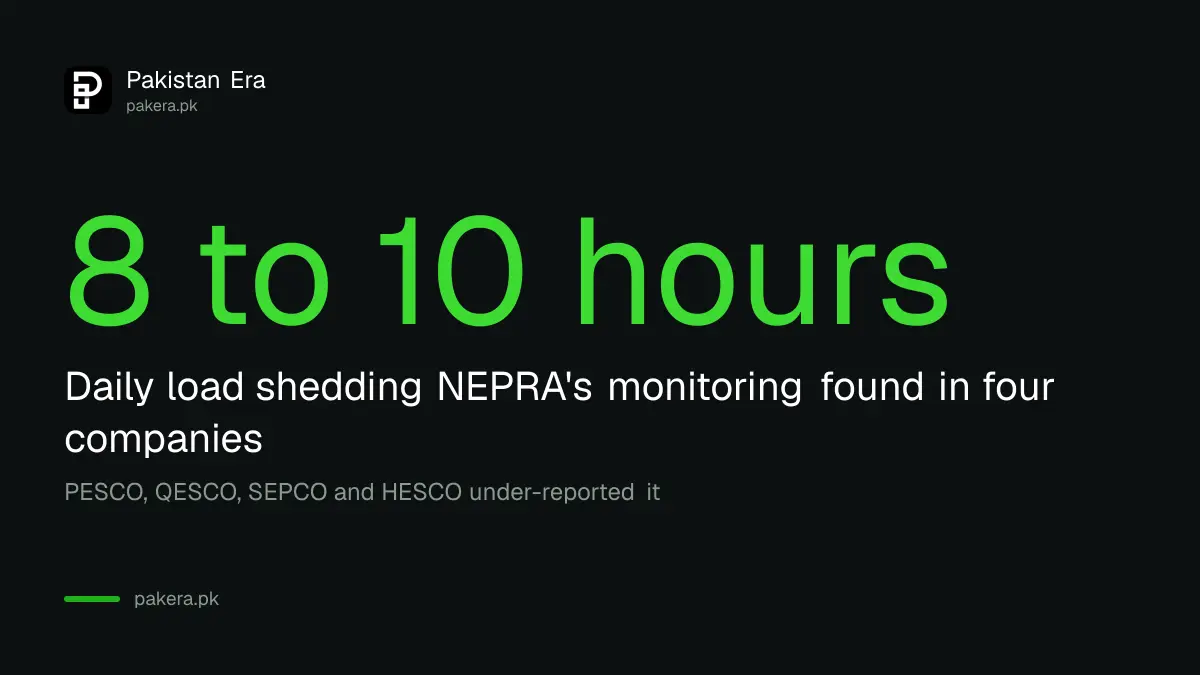
The report says PESCO, QESCO, SEPCO and HESCO reported lower daily load shedding than NEPRA observed. NEPRA's own monitoring shows actual cuts above 8 to 10 hours a day in those companies. It calls this significant under-reporting.
In the same report IESCO, FESCO, GEPCO and LESCO reported negligible load shedding. NEPRA did not dispute those figures. It says it watches daily demand, the generation each company is allocated and the power each actually draws.
Load shedding based on losses is not endorsed
PESCO, QESCO, SEPCO, HESCO and K-Electric cut power by feeder using AT&C losses. That means the line loss plus unpaid bills on that feeder. NEPRA says this contradicts the 2005 rules and has no NEPRA endorsement.
NEPRA says this system, in place since 2013, has not improved recovery. It says paying customers lose power because of a few defaulters. It also says many feeders stay in the same or a worse load shedding category.
| Point in NEPRA's 2024-25 report | What it says |
|---|---|
| When load shedding is allowed | Only for national generation shortage or transmission limits |
| Loss-based feeder shedding | Used by PESCO, QESCO, SEPCO, HESCO and K-Electric; not endorsed |
| Fine on five companies | Rs 50 million each, initially |
| Extra fine on SEPCO and HESCO | Rs 100,000 per day |
| K-Electric feeders free of loss-based shedding | 69% in FY 2025, from 76% in FY 2022 |
Fines were issued and some are on hold
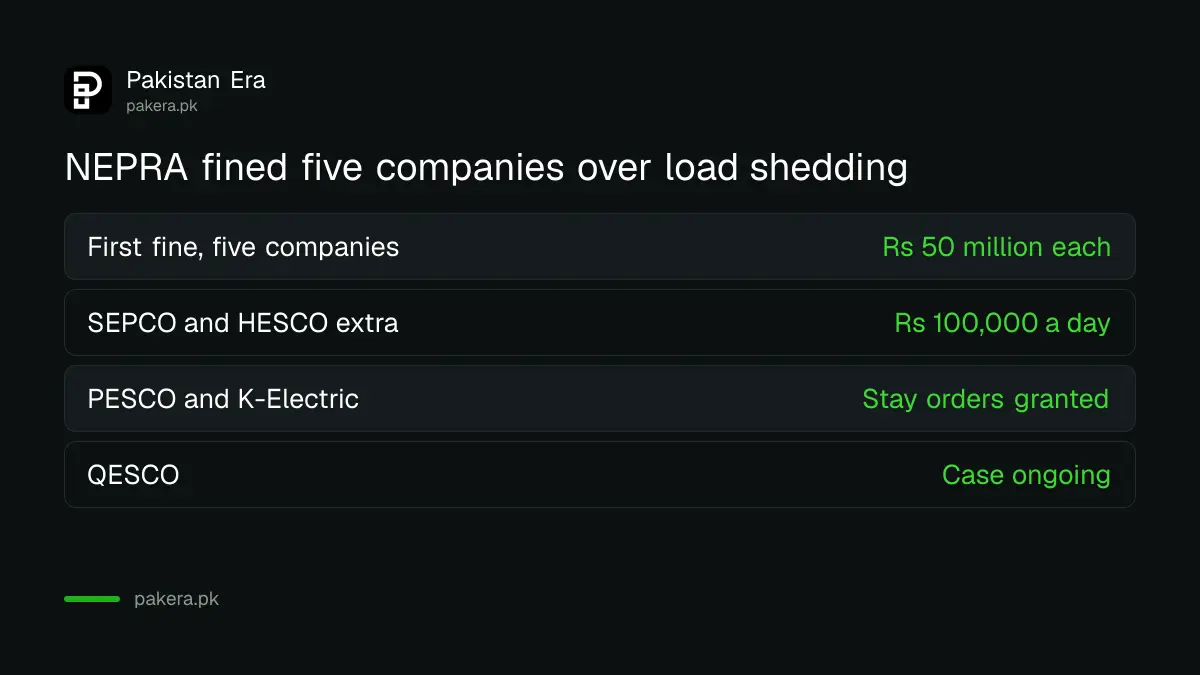
NEPRA took legal action against PESCO, QESCO, HESCO, SEPCO and K-Electric. Each was fined Rs 50 million at first. SEPCO and HESCO also got a fine of Rs 100,000 per day. PESCO and K-Electric won stay orders from the Appellate Tribunal.
The QESCO case was still going when the report was written. We have not checked the cases since. A stay order stops NEPRA from going further for now. It does not say the company was right.
Load shedding has a fixed order under the rules
The 2005 rules say a company must be ready to shed up to 30% of its load when NTDC asks, in a set order. Rural areas and residential customers on separate urban feeders come first. Schools, hospitals and defence sites come last.
- Rural areas and urban residential customers on separate feeders.
- Non-industrial consumers in urban areas.
- Agricultural consumers with a dedicated supply.
- Industrial consumers.
- Schools and hospitals.
- Defence and strategic installations.
NEPRA has told companies to follow this order so one class does not carry the whole burden. For the rules that apply today and how to complain, see our check on whether your load shedding is legal.
Log your own hours and complain with proof
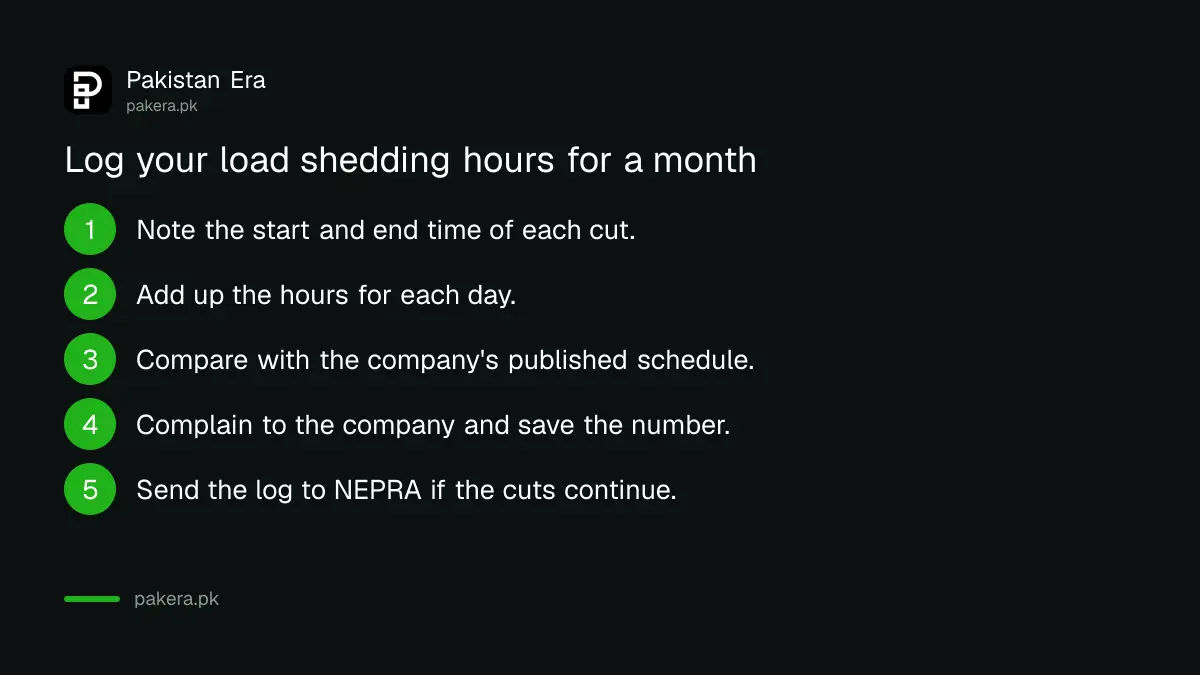
NEPRA says company numbers can be wrong. Your own log is evidence. Write the start and end of each cut for a month, then count the daily hours. If they are far above the company's schedule, send the log with your complaint.
Start with the company's complaint line and keep the number. Then use the NEPRA Asaan Approach app. Karachi readers can also see how NEPRA treated unannounced cuts there in NEPRA's order to K-Electric.
One more point matters for readers in Karachi. The report says K-Electric's share of feeders free from loss-based load shedding fell from 76% in 2022 to 69% in 2025. NEPRA has told K-Electric that any unavoidable cut must be done at the PMT level, meaning the local transformer, and not across whole areas.
The report also says K-Electric's investment plan to 2030 aims to remove load shedding from 95% of its feeders. That is a plan, not a result. We have not tested it.
Common questions
Which companies did NEPRA say under-reported load shedding?
PESCO, QESCO, SEPCO and HESCO, according to the report. It says actual cuts there exceed 8 to 10 hours a day.
What is AT&C-based load shedding?
It is cutting power to feeders with high losses and unpaid bills. NEPRA says it punishes paying customers and is not part of the 2005 rules.
Has the system been stopped?
The report says it has continued for over twelve years. We have not checked for a change since June 2025.
Were the companies fined?
Yes, initially Rs 50 million each for five companies. PESCO and K-Electric won stay orders, and QESCO's case was ongoing when the report was written.
Is load shedding allowed for any other reason?
The report says companies may shed load only in cases of national generation shortage or transmission limits.
Is my area one of the worst?
We cannot say for your street. The report gives company-level figures, so keep your own log to prove what you face.
How we verified this
What we checked, where we read it, and what we could not confirm.
Last checked on 13 October 2026. Source: NEPRA Performance Evaluation Report of Distribution Companies, FY 2024-25, Executive Summary and Section 2.6. The table of reported daily hours was not clear enough in our copy to print per company.
About the author

Senior Writer, Public Services and Technology
Shahid joined us in 2024 as an author. He is a senior contributor to Pakistan's leading technology websites. He writes detailed articles, mostly covering his expertise in the latest tech, mobiles, apps, gadgets, and step-by-step guides. His ideology is to help people understand the latest trends and explain complex methods through very easy-to-understand guides.