Check How Many Power Cuts You Should Get a Year in Pakistan: NEPRA's Limit Is 13
NEPRA allows 13 power interruptions per customer a year. See each company's 2024-25 figure, from IESCO at 15.39 to PESCO at 176.62, and how to log your cuts.
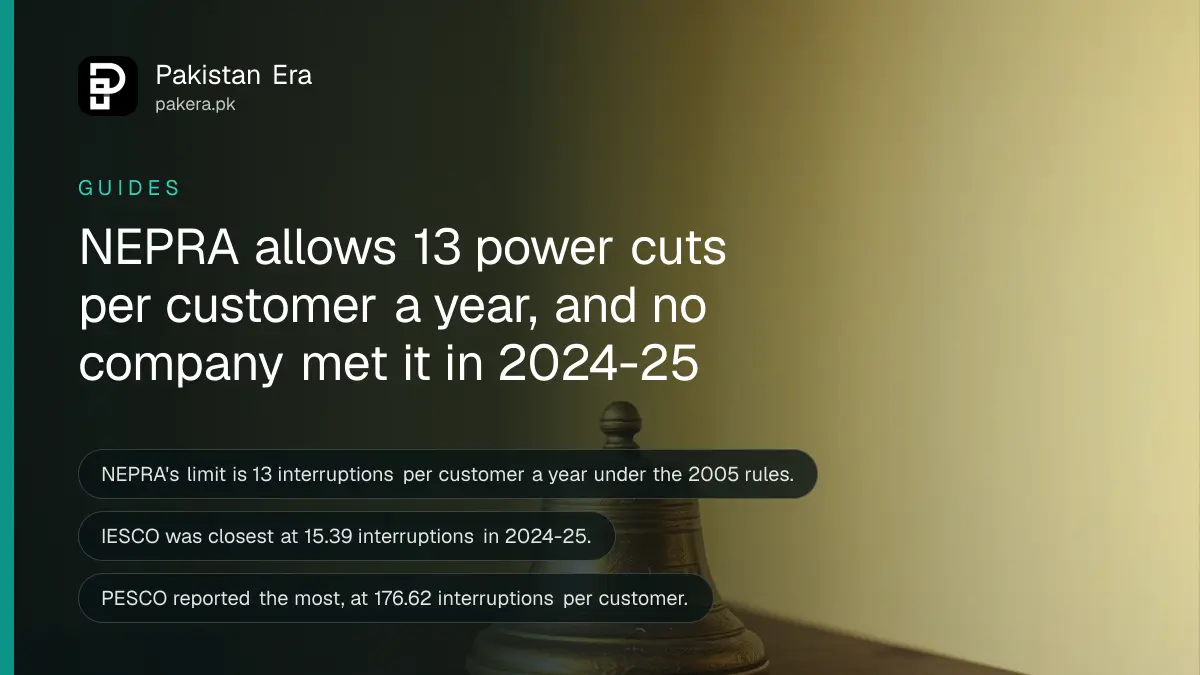
Short answer: NEPRA's rule says a power company should give each customer no more than 13 interruptions a year. In 2024-25 every company reported more. LESCO reported 28.16, IESCO 15.39, and PESCO 176.62. Keep a simple outage log and use it when you complain.
Many homes in Pakistan lose power many times a month. Until now it was hard to say whether that was normal or a breach of a rule. NEPRA's annual report gives a number you can hold your company to.
We downloaded and read NEPRA's Performance Evaluation Report of Distribution Companies for 2024-25 from nepra.org.pk on 13 October 2026. It covers the year to June 2025. The figures below are what each company reported, as printed in Table 05 of that report.
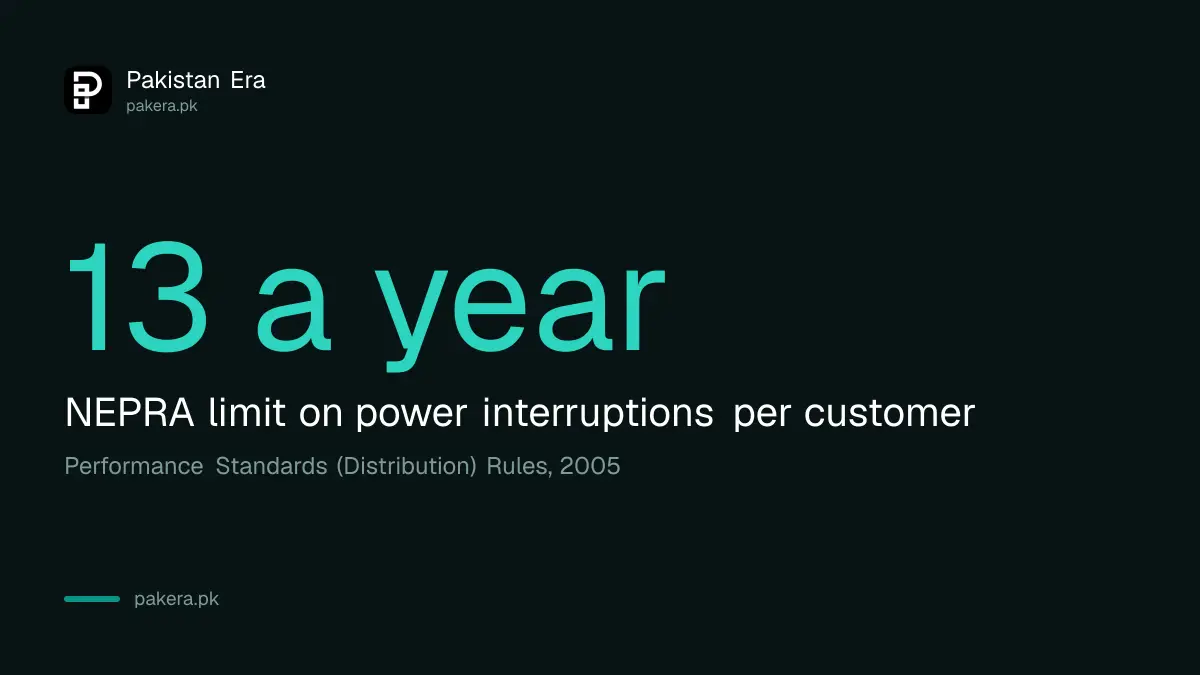
The limit is 13 interruptions per customer a year
Under the Performance Standards (Distribution) Rules, 2005, a company must keep its average at 13 interruptions or fewer per customer each year. NEPRA calls this measure SAIFI. It counts how often the average customer loses supply.
The same rules also set a limit for how long cuts last, called SAIDI. The report says every company failed that benchmark too. The SAIDI table in our copy was too scrambled to print per-company figures, so we leave them out.
No company met the limit in 2024-25
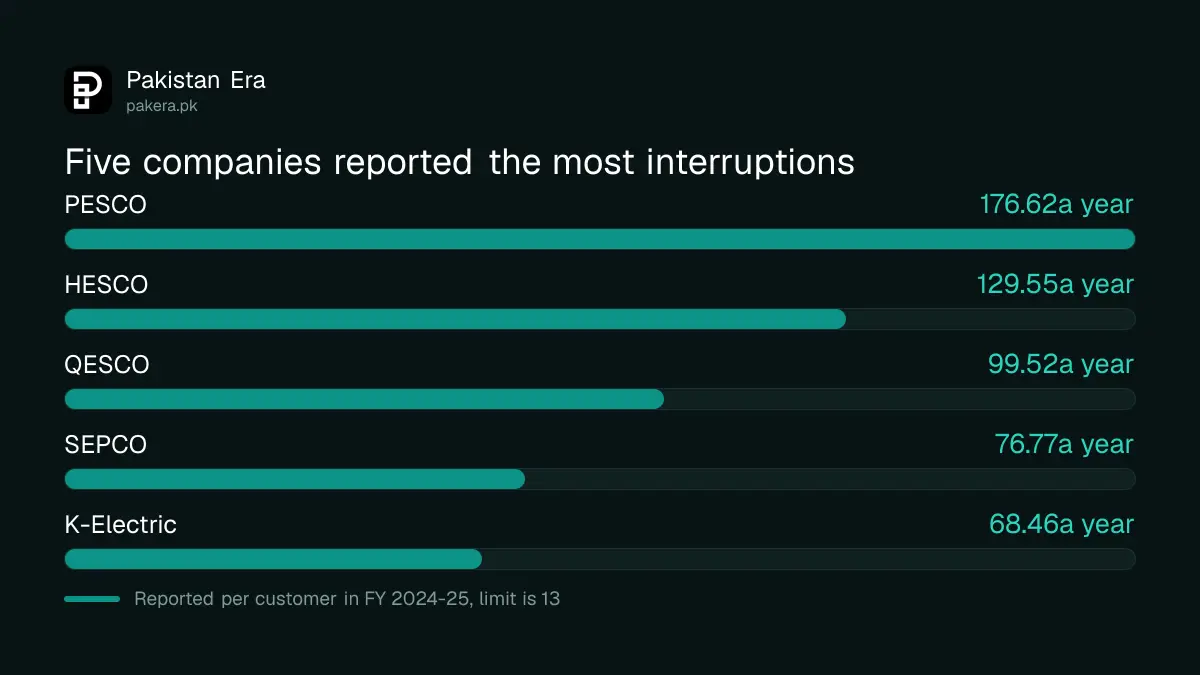
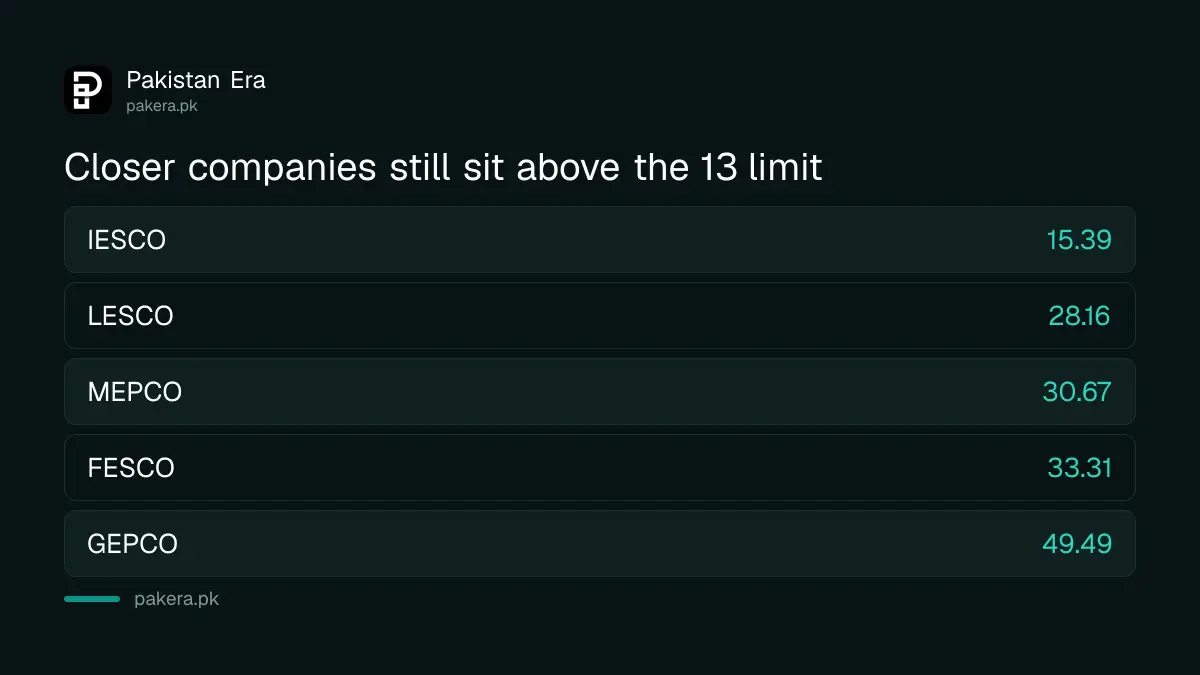
NEPRA says none of the ten companies reached the 13 limit. IESCO, GEPCO, FESCO, LESCO and MEPCO were closer. PESCO, QESCO, SEPCO, HESCO and K-Electric were far above it, with PESCO the highest at 176.62.
| Company | Reported interruptions a year | NEPRA limit |
|---|---|---|
| IESCO | 15.39 | 13 |
| LESCO | 28.16 | 13 |
| MEPCO | 30.67 | 13 |
| FESCO | 33.31 | 13 |
| GEPCO | 49.49 | 13 |
| K-Electric | 68.46 | 13 |
| SEPCO | 76.77 | 13 |
| QESCO | 99.52 | 13 |
| HESCO | 129.55 | 13 |
| PESCO | 176.62 | 13 |
The report's chart shows slightly different decimals for three companies: IESCO 15.31, GEPCO 49.41 and K-Electric 68.64. We used the table. The gap does not change the order. TESCO is not included in the report because its data was found unreliable.
Treat these numbers as a floor, not a ceiling
NEPRA says the outage data itself is uncertain. Most companies have no automatic system to record every interruption, especially on low-voltage lines. So the true number of cuts in your street may be higher than the figure the company reported.
The report also says investment money approved for the networks has not produced a clear improvement. We only report what NEPRA wrote. It is a regulator's view of company-supplied data.
Keep an outage log for one month
A log turns a feeling into evidence. Write the date, the time the power went off, the time it came back and whether the company told you first. One month of notes is enough to show a pattern to the company or to NEPRA.
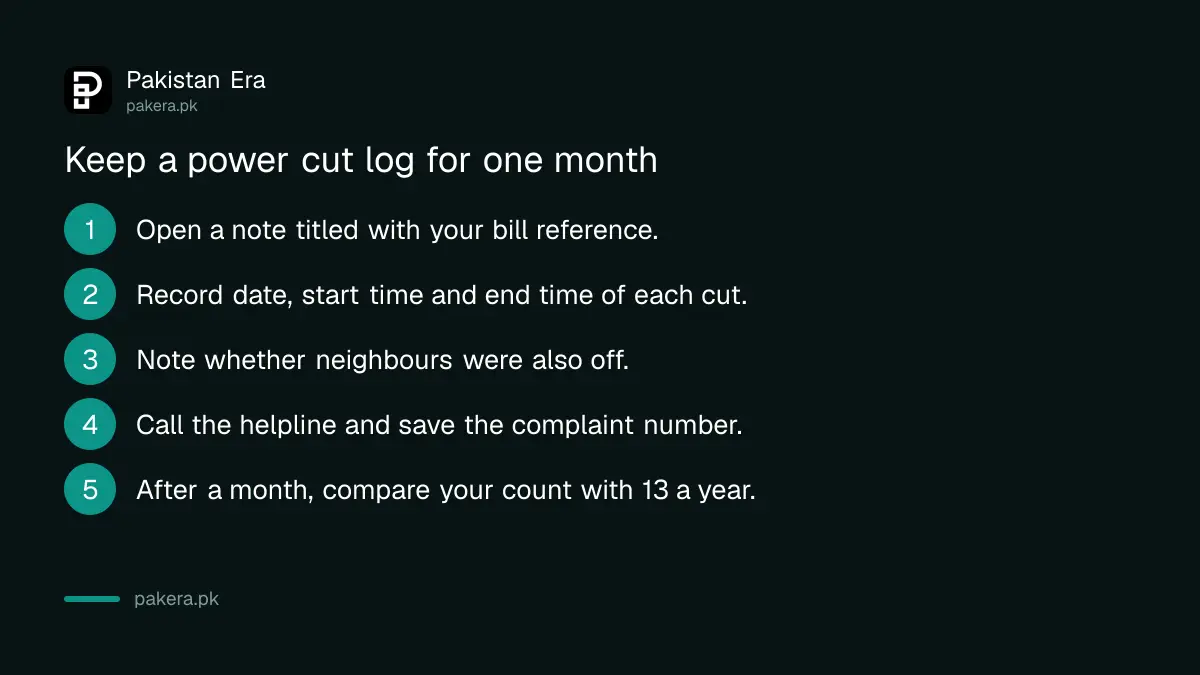
- Open a note on your phone and title it with your bill's reference number.
- Record each cut: date, start time, end time and the cause if you were told.
- Note whether the neighbours were also off, so you can tell a street fault from a house fault.
- Call your company's helpline and write down the complaint number each time.
- After a month, count the cuts and compare them with the 13 a year limit.
Take the log to your company, then to NEPRA
Start with your company's complaint line so a record exists. If the cuts continue, register the case with NEPRA. Our steps for the NEPRA Asaan Approach app show how to file and track it.
If the cuts look like scheduled load shedding, the rules are different. We explain when load shedding is legal and how to complain in our check on whether your load shedding is legal. For the newer deadlines on fixing faults, see NEPRA's new service deadlines.
One caution. The 13 a year limit comes from the 2005 rules, which this report uses. NEPRA notified new Performance Standards (Distribution) Regulations in August 2026 with fault-fixing clocks. They apply going forward and we did not check how they treat the yearly limit.
Ask yourself a simple question when you read the table. Does the number match what you see at home? If your street loses power more often than your company's figure suggests, your log is the proof. It also helps neighbours join the same complaint, which is harder for a company to ignore.
Share the log with the people on your street. Ten matching logs show a feeder problem and not a single faulty house connection.
Common questions
What does SAIFI mean?
It is the average number of power interruptions a customer has in a year. NEPRA uses it to judge how reliable a company's network is.
Which company had the most interruptions in 2024-25?
PESCO reported 176.62 interruptions per customer, the highest in NEPRA's table. HESCO followed with 129.55 and QESCO with 99.52.
Which company was closest to the limit?
IESCO reported 15.39 against the limit of 13. LESCO was next at 28.16.
Does the limit include load shedding?
The report does not say in the pages we read. We could not verify whether scheduled load shedding is counted, so check the report before you rely on it for that.
Can NEPRA fine a company for too many cuts?
The report says NEPRA has taken legal action and fined several companies over load shedding and safety. It does not list a fine for the interruption count itself.
Where can I read the table myself?
It is Table 05 on page 12 of the Performance Evaluation Report of Distribution Companies 2024-25 on the NEPRA website.
How we verified this
What we checked, where we read it, and what we could not confirm.
Last checked on 13 October 2026. Source: NEPRA Performance Evaluation Report of Distribution Companies, FY 2024-25, Section 2.3 and Table 05. These are company-reported figures, and NEPRA itself questions how complete the outage records are.
About the author

Senior Writer, Public Services and Technology
Shahid joined us in 2024 as an author. He is a senior contributor to Pakistan's leading technology websites. He writes detailed articles, mostly covering his expertise in the latest tech, mobiles, apps, gadgets, and step-by-step guides. His ideology is to help people understand the latest trends and explain complex methods through very easy-to-understand guides.