Check Whether an Investment Is Shariah Compliant in Pakistan: 308 of 536 Listed Securities Are
308 of 536 listed securities in Pakistan are Shariah compliant, worth Rs 10.6 trillion. See who certifies them and four checks to run before you invest.
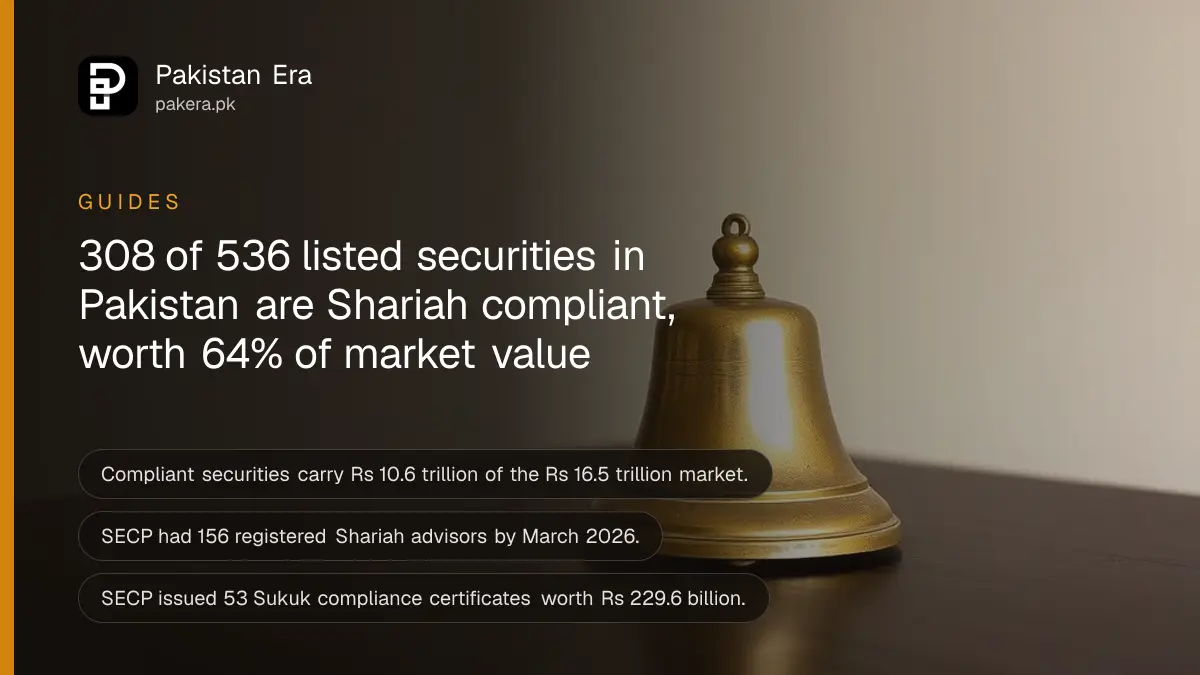
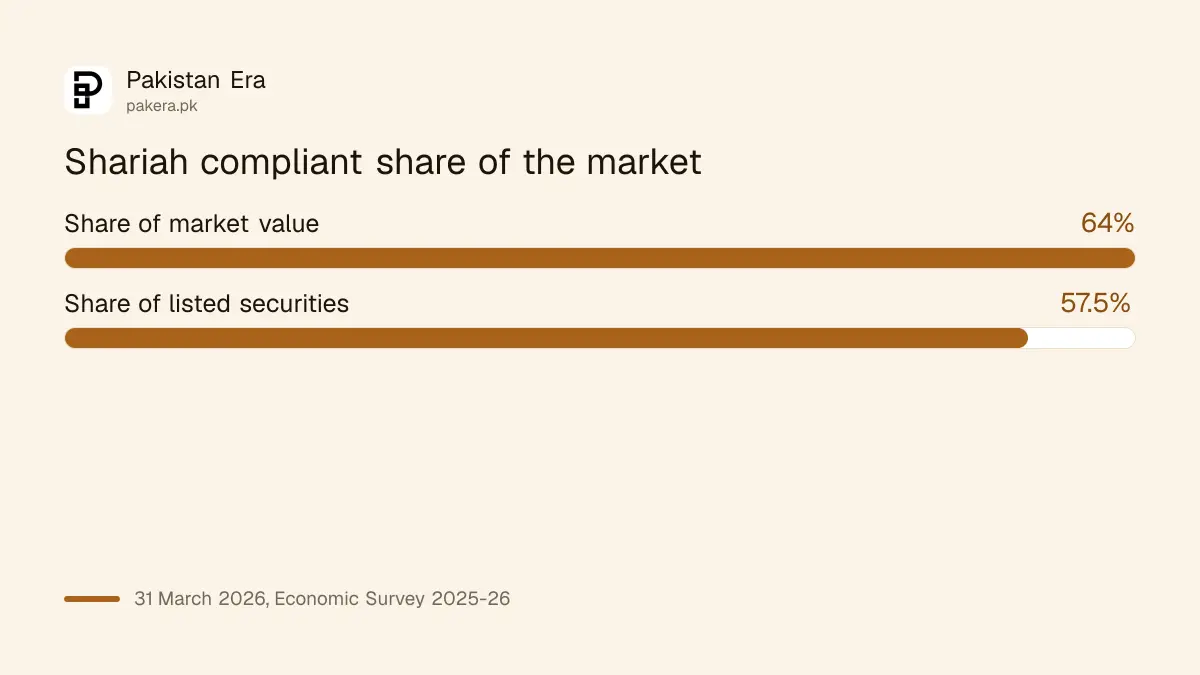
Short answer: On 31 March 2026, 308 of the 536 securities listed on the Pakistan Stock Exchange (57.5 percent) were Shariah compliant. Together they made up Rs 10.6 trillion, or 64 percent, of the market's Rs 16.5 trillion value. The Finance Division's Economic Survey 2025-26 reports this. Ask who certified a product before you trust the label.
A friend says a share is halal. A fund brochure says Shariah compliant. A bank advertises Islamic investing. For a believer who wants to avoid interest, the label decides the purchase, so the label deserves a check.
We read the Islamic finance section of the Economic Survey 2025-26 on 14 October 2026. The Survey reports how large the Shariah compliant market is and who supervises it. It does not publish a list of compliant shares, and we have not seen one, so we explain below how to ask.
Shariah compliant securities are 64 percent of market value
The Survey says 308 securities, or 57.5 percent of the 536 listed, are Shariah compliant. Their market capitalisation is Rs 10.6 trillion, which is 64 percent of the total Rs 16.5 trillion. That means compliant companies are larger on average than the rest.
Market capitalisation is the price of all a company's shares added together. Bigger companies carry more weight. So the 64 percent figure says that if you pick a compliant share, you are not choosing a small corner of the market. You are choosing most of it.
The figures are for the end of March 2026. Companies move in and out of the compliant group when their accounts change, so the numbers will have moved since.
SECP registers Shariah advisors under 2023 rules
The Survey says SECP registered 16 new Shariah advisors between 1 July 2025 and 31 March 2026, bringing the total to 156. They include 11 individuals, 3 advisory companies and 2 bank Shariah boards. They work under the Shariah Governance Regulations, 2023.
A Shariah advisor is a scholar or firm that reviews a product against Islamic rules and signs off. In practice, an Islamic fund or a Sukuk needs one. A product with no named advisor is a warning sign.
| Measure | Figure |
|---|---|
| Listed securities that are Shariah compliant | 308 of 536 (57.5 percent) |
| Market value of those securities | Rs 10.6 trillion (64 percent) |
| Registered Shariah advisors | 156 |
| New advisors, July 2025 to March 2026 | 16 |
| Registered Modaraba companies | 24 |
Modarabas are Islamic partnership companies. One partner brings money and the other runs the business, and they share profit or loss at an agreed ratio. Twenty of the 24 operate and are listed on the exchange, and four are winding up.
Sukuk are the fast growing Islamic bond
Between July 2025 and March 2026 SECP issued 53 certificates of Shariah compliance to corporate Sukuk issuers, for Rs 229.6 billion. Government Sukuk issuance reached Rs 1.86 trillion in that period, and secondary market trading passed Rs 1.38 trillion.
A Sukuk is an Islamic bond. You do not lend money for interest. You own a share of an asset and receive a rental or profit share. For the government, a Sukuk works like a loan, and its borrowing plan is explained in our report on the FY2027 borrowing plan.
If you buy government paper through a bank, ask whether it is a PIB or a Sukuk. Our guide to buying a Pakistan Investment Bond shows the conventional route.
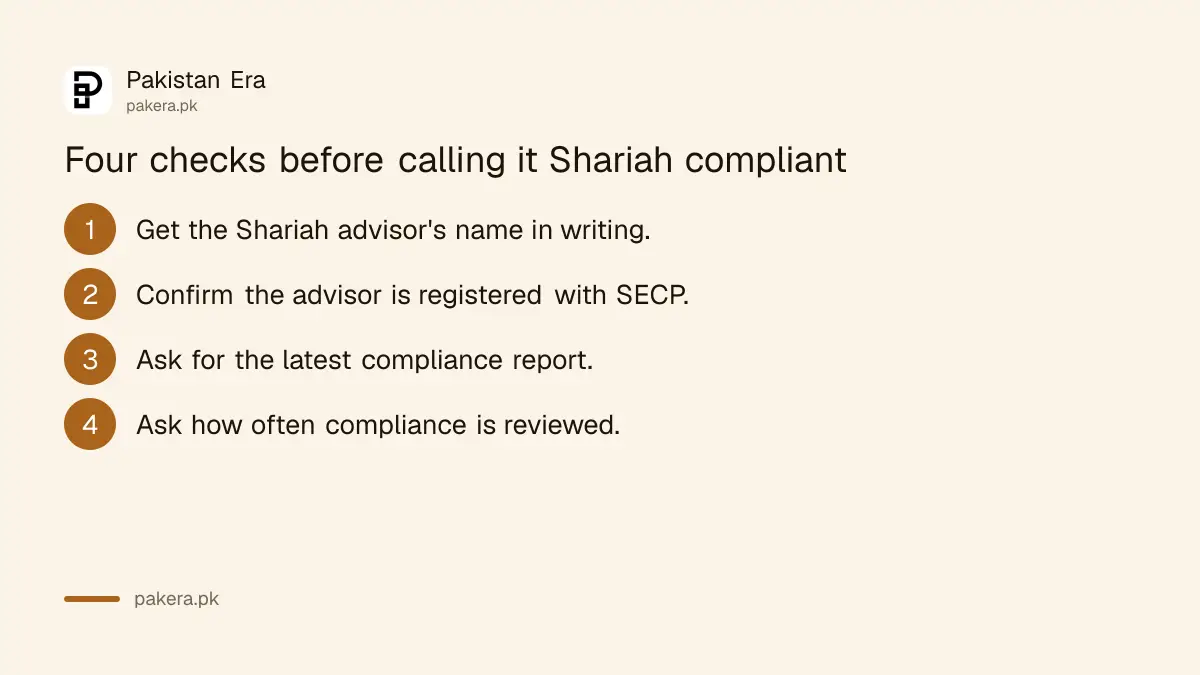
Four checks before you call an investment halal
Ask for the name of the Shariah advisor, confirm the advisor is registered with SECP, read the certificate or the fund's Shariah report, and ask how often compliance is reviewed. A broker or fund manager who cannot answer these four questions is guessing.
- Ask the seller for the Shariah advisor's name in writing.
- Ask SECP whether that advisor or company is registered. We could not open SECP's site to confirm where its list is posted.
- Ask for the latest Shariah compliance report or certificate for the share, fund or Sukuk.
- Ask how often compliance is reviewed, since a company can fall out of the compliant group.
On the exchange's data portal we saw index tickers such as KMI30 and KMIALLSHR. The page did not say what they track, so do not treat them as a halal list without asking your broker. Before you trade, check the broker too, using our guide to the PSX TREC holder check.
A scholar's opinion is a personal matter. We are not issuing a ruling. We are showing how to verify who made one.
Where to start if you are new to the market
A first time investor can open a short form account to buy shares. Our guide to the PSX Sahulat account explains it. For a fund instead of shares, read how mutual funds work with a CNIC.
Start small and write down what you bought and why. If a seller pushes a fast decision, that is a reason to wait.
Questions about Shariah compliant investing
How many Pakistani listed securities are Shariah compliant?
The Economic Survey says 308 of 536 listed securities, or 57.5 percent, on 31 March 2026.
What share of market value do they hold?
They carry Rs 10.6 trillion, which is 64 percent of the market's Rs 16.5 trillion value.
Who is a Shariah advisor?
A scholar or firm registered with SECP that reviews a product against Islamic rules. The Survey counts 156 registered advisors.
What is a Modaraba?
An Islamic partnership company where one partner provides capital and the other manages the business. The Survey lists 24 registered Modarabas.
Is every Sukuk Shariah compliant?
The Survey says SECP issued Shariah compliance certificates to 53 corporate Sukuk issuers in the period. Ask for the certificate for the Sukuk you want.
How we verified this
What we checked, where we read it, and what we could not confirm.
Last checked on 14 October 2026, Pakistan time. We read the capital markets chapter of the Finance Division's Economic Survey 2025-26. We did not find a list of compliant shares on an official page, we could not open SECP's own site, and we are not offering a religious ruling.
About the author

Public Services and Education Journalist
Fajr Riaz is a journalist and content writer at Pakistan Era, based in Lahore. She covers the questions people meet in everyday life in Pakistan: how a public service works, what a change in the rules means, and where to find a reliable answer.