Choose the Right BISP Programme for Your Family: Kafaalat, Nashonuma, Taleemi Wazaif or Hunarmand
BISP runs Kafaalat, Nashonuma, Taleemi Wazaif and Hunarmand. See who qualifies for each, the stipends BISP lists and the order to approach them for your family.
BISP runs four programmes a family can use: Benazir Kafaalat (cash for the household), Benazir Nashonuma (mothers and children under two), Benazir Taleemi Wazaif (children in school) and Benazir Hunarmand (skills training). Kafaalat comes first, because Nashonuma and Taleemi Wazaif are open only to Kafaalat beneficiaries. Hunarmand needs a place in BISP's Dynamic Registry instead.
Most families hear about one programme and miss the others they qualify for. We read BISP's own pages for all four on 22 October 2026. This guide puts the rules side by side so you can see which one your family should ask about, and in what order.
Kafaalat is the entry point for two of the other programmes
Benazir Kafaalat is BISP's core cash programme, which BISP says covers about 9 million families. A household qualifies through a Proxy Means Test score taken from the NSER survey. The cut-off on BISP's page is 32, and 37 for a household with a differently abled person. Our guide to the Kafaalat PMT cut-off explains the score.
BISP's Kafaalat page still shows Rs 8,500 per beneficiary per quarter. Our page on how much the BISP payment is explains that newer figures are reported, and that the page has not been updated. Do not rely on either number without checking your own SMS.
Four programmes compared by who qualifies and what you get
| Programme | Who qualifies | What BISP lists |
|---|---|---|
| Benazir Kafaalat | Households under the PMT cut-off, 32 or 37 with a disabled member | Quarterly cash, now through a digital wallet |
| Benazir Nashonuma | Pregnant or breastfeeding women aged 18 to 59 in Kafaalat, and children under 2 | Rs 3,500 or Rs 4,000 a quarter, nutritious food, health checks |
| Benazir Taleemi Wazaif | Children of active Kafaalat beneficiaries in school or college | Rs 1,500 to Rs 4,000 a quarter by level and sex |
| Benazir Hunarmand | People aged 18 to 40 with at least Matric in the Dynamic Registry | Skills training |
Hunarmand's page names only one registrant per family. It does not list a training length, a stipend or a helpline, and we did not find them elsewhere on the page.
Nashonuma and Taleemi Wazaif attach to a child's age
Nashonuma covers a child until the second birthday. Its documents include a valid NADRA family registration certificate and an immunisation card, as we set out in the guide to Nashonuma papers.
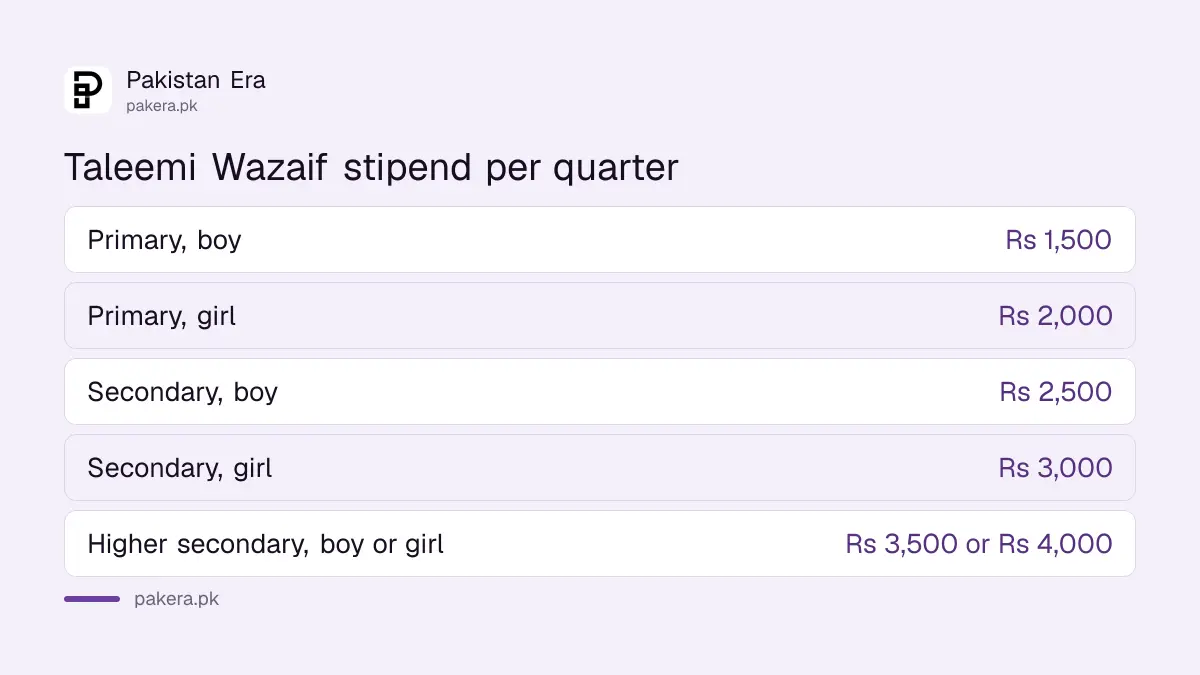
Taleemi Wazaif takes over once a child is in school. BISP gives age bands: primary 4 to 12, secondary 8 to 18, higher secondary 13 to 22. A girl gets Rs 500 more than a boy at each level, and a one-time Rs 3,000 bonus on finishing primary. The child must attend at least 70 percent of school days in a quarter. Three quarters in a row below that means suspension. The papers are in our guide to enrolling a child in Taleemi Wazaif.
Hunarmand is separate and needs a Matric certificate
BISP says only people registered in the Dynamic Registry can join Hunarmand. That is the same NSER-based registry that decides Kafaalat. An applicant needs a Matric certificate, must be 18 to 40, and applies on the Hunarmand portal or at the nearest tehsil office with an original CNIC and a working mobile number. The steps are in our guide to Hunarmand registration.
Registration is only the first step. BISP's page says applications are reviewed and only eligible people are selected.
A simple order to follow for your family
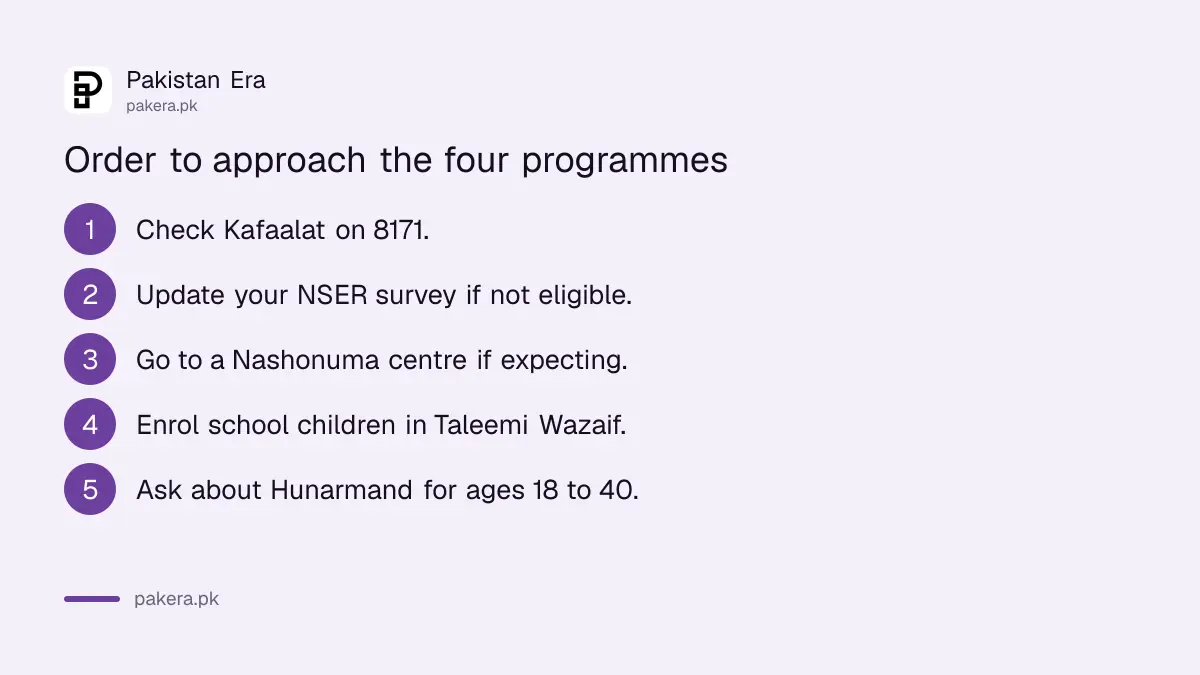
- Check Kafaalat first: send your CNIC to 8171 or visit your BISP tehsil office.
- If you are not in, update your NSER survey as explained in our note on BISP not eligible.
- If you are in and expecting a child or have a child under two, go to a Nashonuma centre.
- If a child is in school, take the B-form and admission slip to enrol in Taleemi Wazaif.
- If a member is 18 to 40 with Matric, ask about Hunarmand.
Where the programme pages disagree with each other
BISP's pages were not all written at the same time. The Kafaalat page still describes cash paid through HBL and Bank Alfalah after biometric checks. BISP's 2026 press releases say payments are moving to digital wallets that can be cashed at the agent of any of six partner institutions. Our guide to withdrawing BISP money from a partner bank agent sets out the newer method.
When a programme page and a recent press release differ, trust the newer BISP document and confirm with your tehsil office. We flag the Rs 8,500 line on the Kafaalat page for the same reason: it is an older amount.
Finally, check that nobody charges you to join any of the four. BISP lists no fee on any of these pages. A person who asks for money to "approve" a programme is not acting for BISP.
Common questions
Can one family use more than one BISP programme?
Yes. Nashonuma and Taleemi Wazaif are built on Kafaalat, so a family can hold all three. Hunarmand has its own entry rule.
Do I need Kafaalat to get Taleemi Wazaif?
Yes. BISP describes it as for children of active Kafaalat beneficiaries.
What is the Kafaalat cut-off score?
32 on BISP's page, and 37 for households with a differently abled person.
Who can join Benazir Hunarmand?
People aged 18 to 40 with at least Matric, who are in the BISP Dynamic Registry. Only one person per family can register.
How much is the Taleemi Wazaif stipend?
Rs 1,500 for a primary boy, rising to Rs 4,000 for a higher secondary girl, per quarter.
Where do I call for help?
BISP's helpline is 0800-26477, as shown on its site.
How we verified this
What we checked, where we read it, and what we could not confirm.
Last checked 22 October 2026. We read BISP's pages for Benazir Kafaalat, Taleemi Wazaif and Hunarmand, plus the Nashonuma page, on 22 October 2026. The pages carry no application deadlines, and the Kafaalat amount on BISP's page is older than the figure now reported.
About the author
Public Services and Education Journalist
Fajr Riaz is a journalist and content writer at Pakistan Era, based in Lahore. She covers the questions people meet in everyday life in Pakistan: how a public service works, what a change in the rules means, and where to find a reliable answer.