How to Claim Pre-emption (Shufa) on a Property Sale in Punjab: 3 Demands and a 4 Month Limit
A Punjab co-owner or neighbour can claim a sold property by pre-emption. See the three demands in order, the 4 month suit limit and the one third deposit.
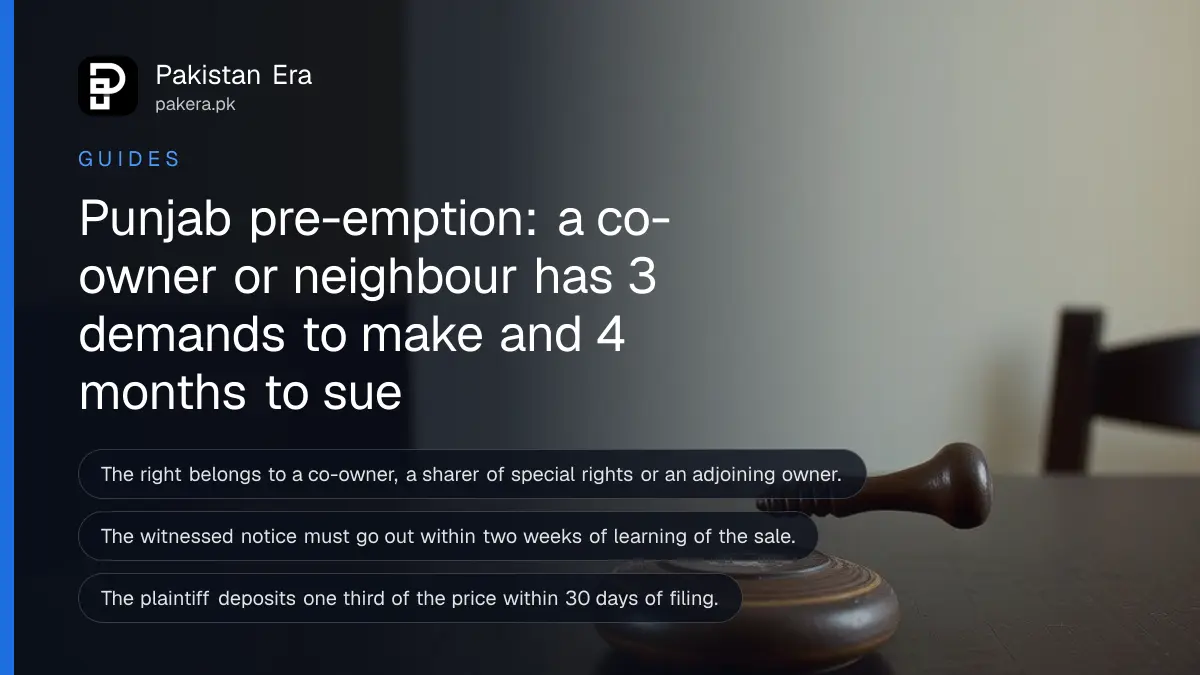
Short answer: Pre-emption (shufa) lets a co-owner, a neighbour with shared rights, or an adjoining owner buy a Punjab property in place of the buyer, at the same price. You must make three demands in order: speak up at once, send a witnessed notice within two weeks, then file a suit. The suit must be filed within four months of the registered sale deed, and you deposit one third of the price within 30 days of filing.
A man in Sargodha learns that his brother has sold a share of the family land to an outsider. By the time the tea is poured, the clock has started. Under Punjab's pre-emption law he can still take that share, but only if he acts in the right order and on time. Miss one demand and the right is gone.
We read the Punjab Pre-emption Act 1991 on the Punjab Code, the provincial law database, on 12 October 2026. Section numbers below come from that text.
Three kinds of owner hold the right, in a fixed order
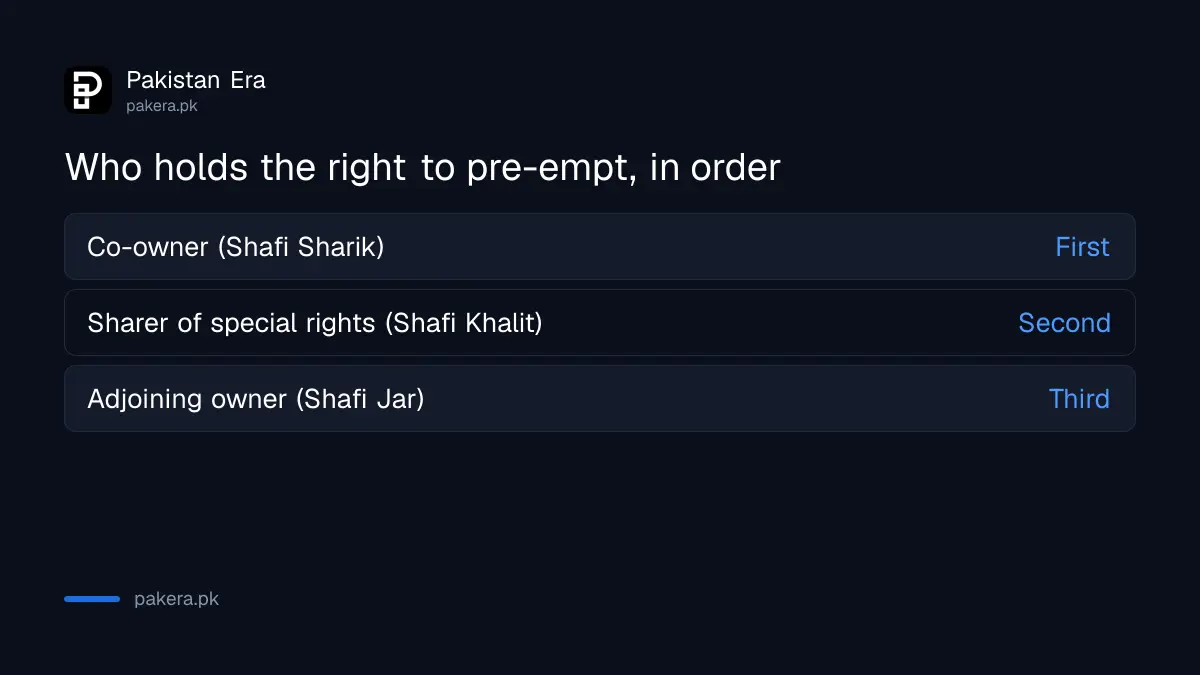
Section 6 of the Act names three groups. The first group has priority over the second, and the second over the third. A co-owner beats a neighbour.
| Priority | Name in the Act | Who this is |
|---|---|---|
| First | Shafi Sharik | A co-owner in the undivided property that was sold |
| Second | Shafi Khalit | Someone who shares special rights, such as a right of way or of irrigation |
| Third | Shafi Jar | An owner of land adjoining the property sold |
If several people sit in the same group, section 8 lets them claim together, and section 9 splits the property equally among those equally entitled. A person cannot claim only a part. Section 19 says the claim must be for the whole property that can be pre-empted.
Only a sale creates the right
Section 5 says the right arises on a sale of immovable property. Section 2 then lists what is not a sale for this purpose. An inheritance, a will, a plain gift and a court auction in execution of a decree do not trigger it. Nor does an exchange of agricultural land, or a transfer as dower.
A gift with a return (hiba bil-iwaz) does count as a sale. So a "gift" dressed up to avoid the neighbour can still be challenged. If the transfer you are watching is a genuine hiba, the process is described in the note on registering a hiba gift of property in Punjab.
Section 23 also excludes waqf property and property owned by the federal or a provincial government or a local authority.
Three demands must come in the right order
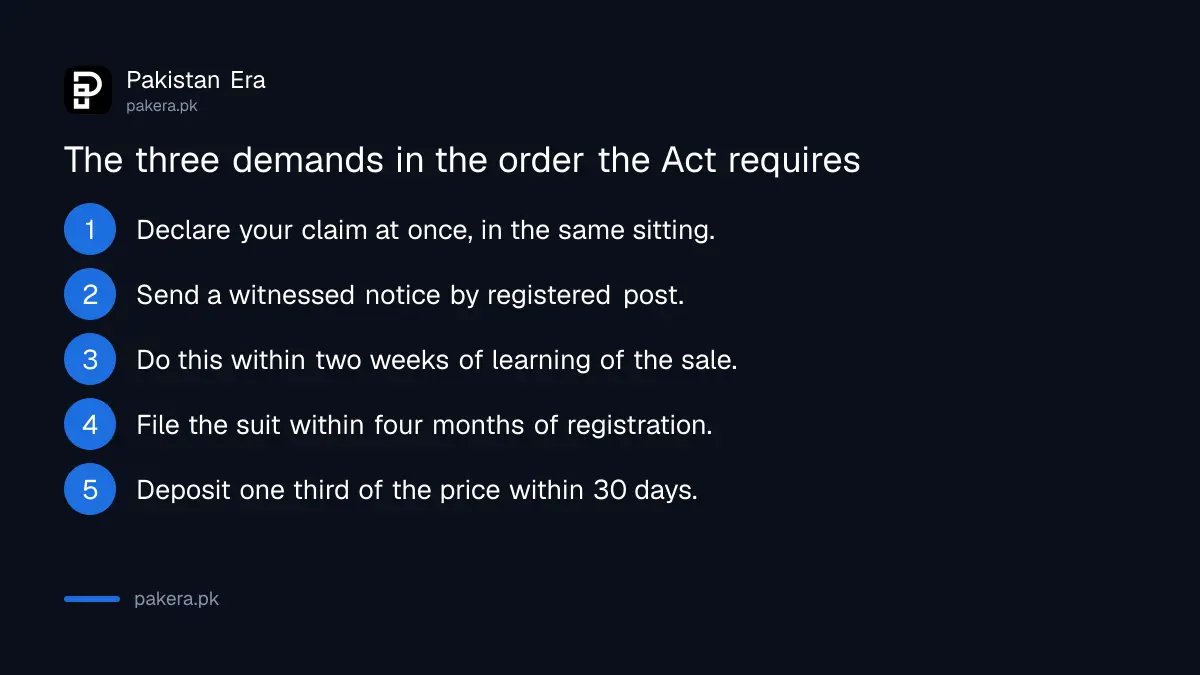
Section 13 is the heart of the law. The right is extinguished unless the demands are made in this order. We have set them out as steps.
- Talb-i-muwathibat, the immediate demand. Declare your intention to claim in the same sitting in which you learn of the sale. Any words that show the intention are enough.
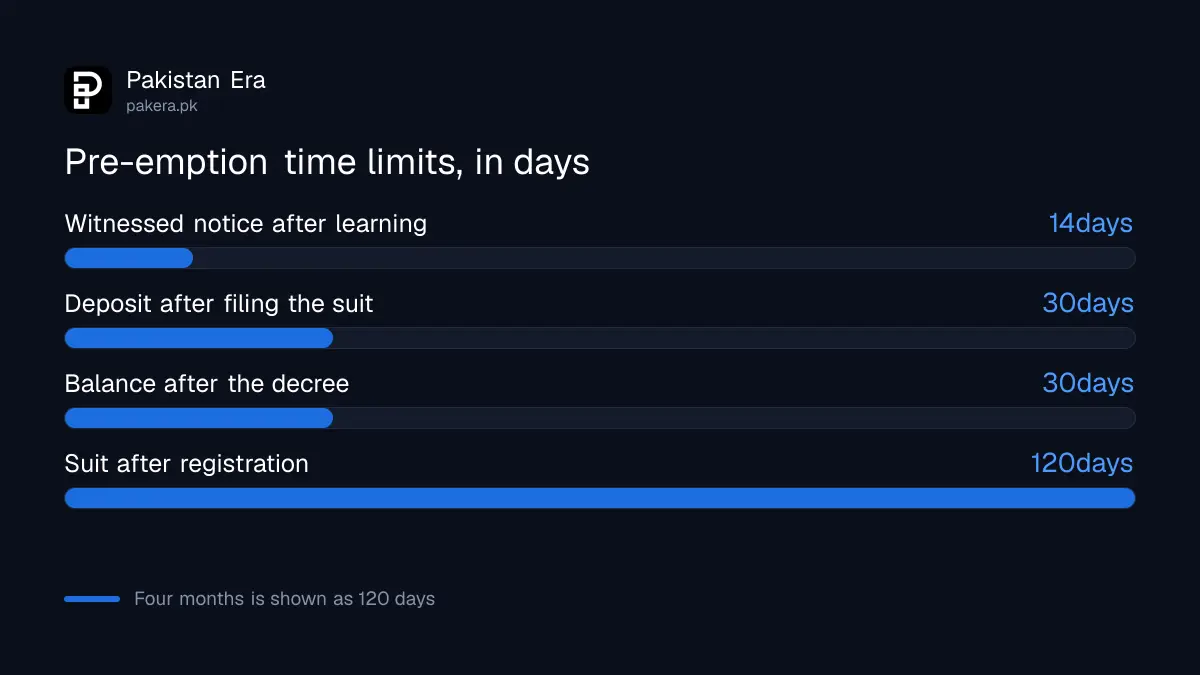
- Talb-i-ishhad, the demand by witnesses. Within two weeks of learning of the sale, send the buyer a written notice, attested by two truthful witnesses, by registered post with acknowledgement due. Where there is no post office, you may make the demand before two witnesses.
- Talb-i-khusumat, the demand by suit. File a suit in the competent court to enforce the right.
Keep proof of each step. Write down the date, the time, the place and the names of the people who heard your first words. Keep the postal receipt and the signed acknowledgement of the notice. Courts decide these cases on exactly this proof.
The suit has a four month limit and a deposit
Section 30 sets the limit at four months. The clock runs from the date of registration of the sale deed. If the sale was done by mutation, it runs from the attestation of the mutation. If neither applies, it runs from the date the buyer takes physical possession, or from your knowledge of the sale.
Section 24 then requires the plaintiff to deposit one third of the sale price in cash, within a period the court fixes, not beyond 30 days of filing the suit. If you fail to deposit, or withdraw the sum, the suit is dismissed. If the sale deed shows no price, or an inflated one, the court asks for one third of the probable value.
When the court decrees in your favour, it fixes the price. Section 27 lets it replace a price not fixed in good faith with the market value. Under section 25 you deposit any balance within 30 days of the decree. The suit follows ordinary civil rules, so the general time limits for civil suits in the note on how long you have to sue in Pakistan sit beside this one.
Time does not stop for a minor or a person of unsound mind here. Section 8 of the Limitation Act says its disability rules do not apply to suits to enforce a right of pre-emption.
How you find out about a sale in time
Section 31 says the officer who registers a sale deed or attests a mutation must give public notice within two weeks, by displaying it at the main entrance of a mosque and another public place of the village. The buyer pays for the notice.
That notice is easy to miss. A co-owner should therefore check the land record from time to time. A fard shows every owner and any new mutation, and the steps are in the guide to getting a fard of land in Punjab. Mutations for sales are described in the note on recording a land sale mutation at an Arazi Record Centre.
Ways the right is lost, and a caution on the text
Section 15 says the right is waived if you accept the sale or do something that amounts to waiver. Section 17 ends it if you sell the property on which your claim rests before the court's decree. Section 16 passes the right to your legal heirs if you die after making a demand.
The Punjab Code text carries footnotes recording that the Shariat Appellate Bench of the Supreme Court, in PLD 1994 SC 1, held two provisions repugnant to Islam. One is the exclusion of urban and cantonment property in section 2(a). The other is the requirement in section 6(2) to prove need or harm. Both ceased to have effect on 31 December 1993. We did not read later judgments. Pre-emption is a technical area, so a lawyer should check the current position before a suit is filed.
Common questions
Does pre-emption apply to urban plots and houses in Punjab?
The Punjab Code footnotes say the exclusion of urban property ceased to have effect on 31 December 1993. We did not check later judgments, so confirm with a lawyer.
What is talb-i-muwathibat?
It is the immediate demand. You declare your intention to claim, in the same sitting in which you learn of the sale. Any words showing that intention are enough.
How long do I have to file the suit?
Four months. The clock usually runs from the registration of the sale deed, or from the attestation of the mutation if there was no registered deed.
How much must I deposit?
One third of the sale price in cash, within the time the court fixes, which cannot be more than 30 days after filing. Failure leads to dismissal.
Can I claim only part of the property?
No. Section 19 makes the right indivisible, and the claim must be for the whole property that can be pre-empted.
Does an inheritance or a gift trigger pre-emption?
No. The Act excludes inheritance, a will and a plain gift. A gift with a return (hiba bil-iwaz) is treated as a sale.
How we verified this
What we checked, where we read it, and what we could not confirm.
We read the Punjab Pre-emption Act 1991 on the Punjab Code on 12 October 2026. The Code's own footnotes record the Supreme Court rulings mentioned above. We did not read any later judgment or rules, and we did not check a court fee. This is general information, not legal advice.
About the author

Senior Writer, Public Services and Technology
Shahid joined us in 2024 as an author. He is a senior contributor to Pakistan's leading technology websites. He writes detailed articles, mostly covering his expertise in the latest tech, mobiles, apps, gadgets, and step-by-step guides. His ideology is to help people understand the latest trends and explain complex methods through very easy-to-understand guides.