How to Deposit Your Will With the Registrar in Pakistan: Sealed Cover and Safe Keeping
Section 42 of the Registration Act lets you leave a sealed will with the Registrar and take it back at any time. See the cover rules and how heirs collect it.
Short answer: Under section 42 of the Registration Act, 1908, you can leave your will with the Registrar in a sealed cover. You can do it yourself or through an authorised agent, at any time. The cover must show your name and the name and address of the person who gets the will after your death.
A will in a drawer can be lost, hidden or burned. A will in a Registrar's fire-proof box cannot. The Registration Act lets any person who has made a will leave it with the Registrar, and lets the family collect it later.
We read the Registration Act, 1908 on the Pakistan Code (pakistancode.gov.pk), the federal text, on 14 October 2026. The Act sets the process. Each province sets its own fee table, so ask your Registrar for the current charge. To learn how to write the will itself, see how to write a valid will in Pakistan.
You can register a will or only deposit it
The Act offers two separate options. Section 27 says a will may be presented for registration, or deposited, at any time. Registration puts the will on public record. A deposit leaves it sealed in the Registrar's custody until your death.
A will is the one document the four month deadline does not cover. The testator can present it to any Registrar or Sub-Registrar under section 40, and the person named as executor can do so after death. Registration of a will is optional, but it creates an official record.
Deposit keeps the contents private. Registration does not hide them. Choose deposit if you want the content kept secret until your death. Choose registration if you expect the will to be challenged and want an official record of who signed it.
Deposit is done with the Registrar, not a Sub-Registrar
Section 42 says the testator deposits the will with any Registrar. The testator can go in person or send a duly authorised agent. The will goes in a sealed cover with the testator's name, the agent's name if any, and a statement of what the document is.
The testator must also write on the cover the name and address of the person to whom the original will be delivered after death. Choose this person with care. Section 45 later directs the Registrar to deliver the will to the testator's nominee or representative.
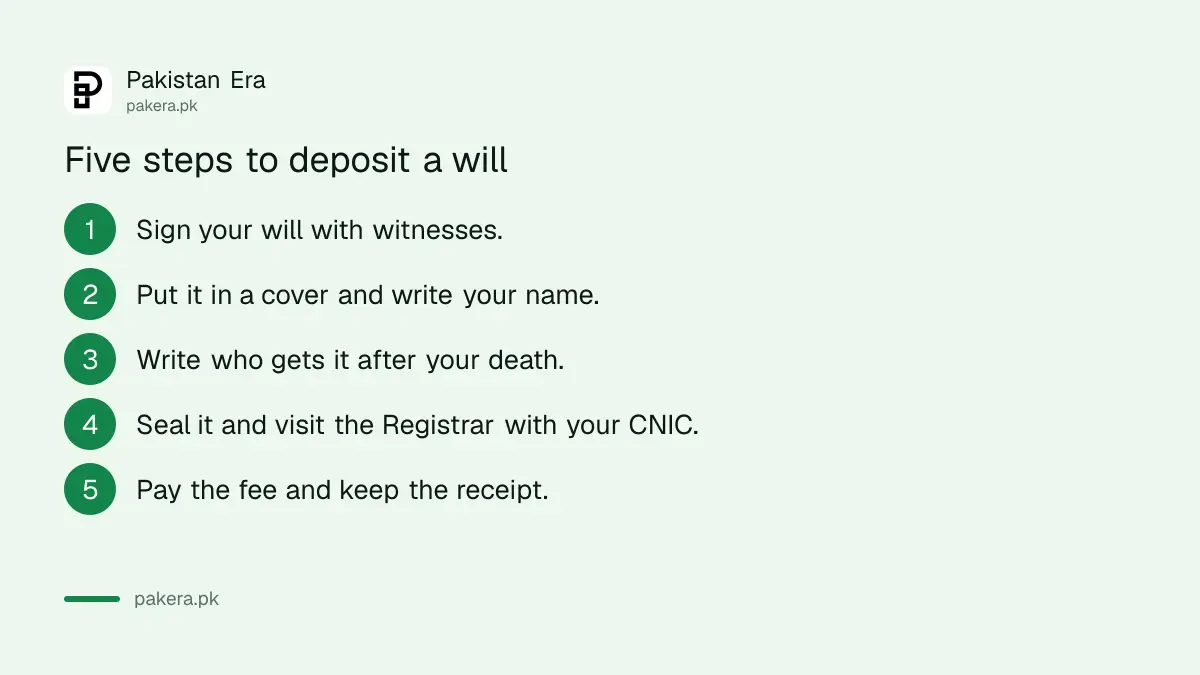
- Sign your will, with witnesses, and put it in a cover.
- Write your name on the cover, and your agent's name if someone will go for you.
- Write a short statement of what the document is, such as "will of the testator."
- Write the name and address of the person who should receive it after your death.
- Seal the cover and take it to the Registrar, with your CNIC, and pay the fee.
The Registrar records the deposit and locks it away
Under section 43, if the Registrar is satisfied that the person presenting the cover is the testator or his agent, he copies the writing on the cover into Register-book No. 5. He notes the year, month, day and hour, and the names of persons who vouch for the testator's identity.
He also notes any legible mark on the seal. The sealed cover is then placed and kept in his fire-proof box. Bring one or two people who can identify you, in case the Registrar wants witnesses, and a CNIC.
Because the Registrar is satisfied about identity at deposit, a later claim that the will was not the testator's own is harder to make. That is the value of the step.
You can take the will back whenever you want
Section 44 says a testator who deposited a cover can withdraw it. He applies to the Registrar who holds it, personally or by a duly authorised agent, and the Registrar delivers it once satisfied that the applicant is the testator or his agent.
So a deposit does not lock you in. If your family or your wishes change, you can withdraw the will and write a new one. Then deposit the new one. Keep a note of the Registrar's office and the deposit date.
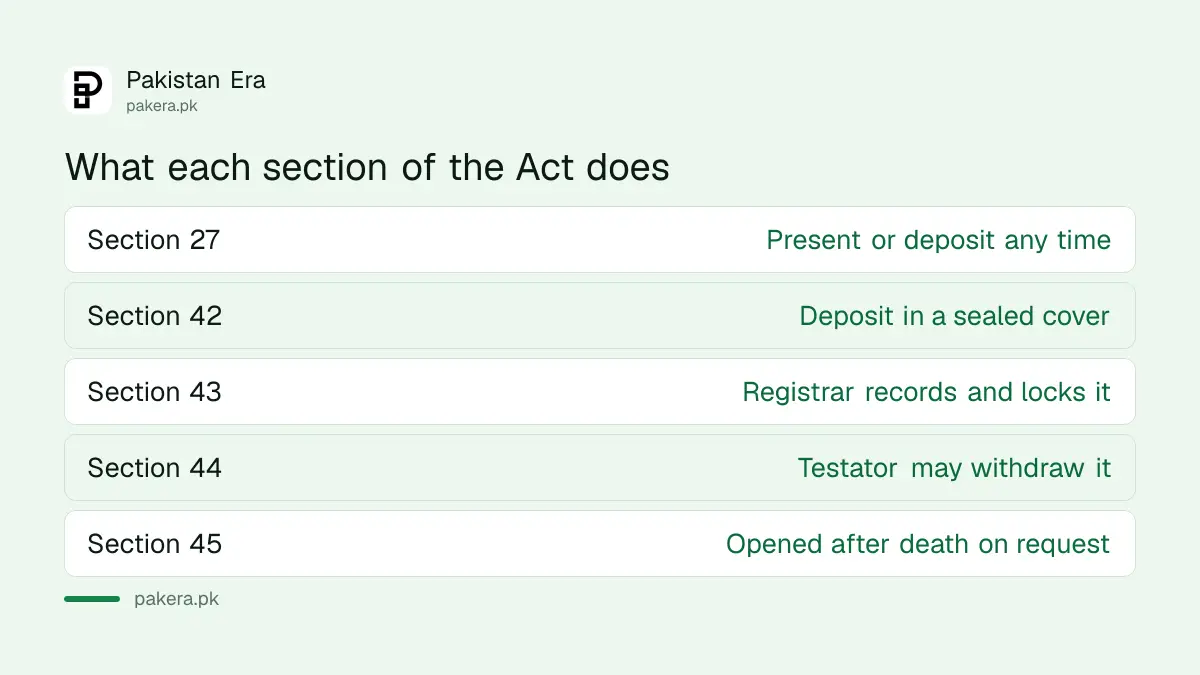
| Step | Who | Section |
|---|---|---|
| Present a will for registration, any time | Testator, or executor after death | 27, 40 |
| Deposit a sealed will with the Registrar | Testator or authorised agent | 42 |
| Record in Register-book No. 5 and lock away | Registrar | 43 |
| Withdraw the cover | Testator or authorised agent | 44 |
| Open after death and deliver to nominee | Registrar, at applicant's request | 45 |
After your death the family applies to open the cover
Section 45 says that on the testator's death, someone can apply to the Registrar to open the cover. If the Registrar is satisfied that the testator is dead, he opens it in the applicant's presence. He copies the contents into Book No. 3 at the applicant's cost.
The Registrar then delivers the will to the nominee named on the cover or to the testator's representative. Keep a copy of the death certificate ready. For the next step, getting legal heirs recognised, read how to get a succession certificate.
The deposit does not decide who inherits. The Registrar only keeps the paper. For the default shares under inheritance law, see who gets what under Pakistani inheritance law.
Tell the right person where the will is
A deposited will helps only if someone knows about it. Tell your executor and one trusted relative which Registrar's office holds it and when you deposited it. Without that, the will may sit in the box for years.
Section 45(2) says that if nobody takes steps on a deposited will, the Registrar follows the procedure the Act sets for disposal of such wills. We did not read that procedure in detail, so do not leave it to chance.
Also keep the receipt for the fee and the Registrar's deposit entry number. They let your family find the record fast. Where land is involved, our page on transferring inherited land in Punjab explains the next step.

Common questions
Can I deposit my will with the Registrar in Pakistan?
Yes. Section 42 of the Registration Act, 1908 lets a testator deposit a will in a sealed cover with any Registrar, in person or through an authorised agent.
What is the difference between registering and depositing a will?
Registration puts the will on record in the usual way. Deposit leaves it sealed in the Registrar's fire-proof box, and it is opened only after death. Both can be done at any time.
Can I take my will back after depositing it?
Yes. Section 44 lets the testator or an authorised agent withdraw the sealed cover from the Registrar who holds it.
Who gets the will after I die?
The person you name on the cover, under section 42(2). On application, the Registrar opens the cover in the applicant's presence and delivers the will to your nominee or representative.
How much does it cost?
The Act leaves the fee to the provincial table, which includes a charge for safe custody. We did not find the current figure, so ask your Registrar before you go.
Is a registered will final?
No. The Act only records and keeps the will. A will can still be challenged in court, and the Registrar does not decide who inherits.
How we verified this
What we checked, where we read it, and what we could not confirm.
Last checked 14 October 2026. We read sections 27, 40 to 45 and 78 of the Registration Act, 1908 on pakistancode.gov.pk. This is the federal text. We did not find the current deposit fee for any province, and we did not check which Registrar offices accept deposits in person. Confirm both with your district Registrar.
About the author

Senior Writer, Public Services and Technology
Shahid joined us in 2024 as an author. He is a senior contributor to Pakistan's leading technology websites. He writes detailed articles, mostly covering his expertise in the latest tech, mobiles, apps, gadgets, and step-by-step guides. His ideology is to help people understand the latest trends and explain complex methods through very easy-to-understand guides.