EU CBAM for Pakistani Exporters: Carbon Charge on Steel, Cement, Aluminium and Fertiliser
Since 1 January 2026 EU buyers pay a carbon charge on steel, cement, aluminium and fertiliser. See the EUR 82.32 price and what Pakistani sellers must do.
Since 1 January 2026 the EU charges its importers for the carbon released while making steel, cement, aluminium and fertiliser. The legal duty sits with the EU buyer, not the Pakistani seller. But a buyer who must pay €82.32 per tonne of CO2 for the third quarter of 2026 will ask you for your emissions data.
The rule is called the Carbon Border Adjustment Mechanism, or CBAM. For three years it only asked importers to report. That test phase ended on 31 December 2025. We read the European Commission's CBAM pages on 15 October 2026, and every rule and price below comes from them. Pakistan's exporters have another EU worry too, the GSP+ rules from 2027, but CBAM is a separate charge on carbon, not a tariff.
CBAM has charged EU importers for embedded carbon since 1 January 2026
The Commission says CBAM ran as a reporting-only phase from 2023 to 2025 and applies in its definitive regime from 1 January 2026. Importers now need authorisation, must report, and must buy and surrender CBAM certificates that match the carbon embedded in imports.
"Embedded carbon" means the emissions released while the goods were made. Two plants making the same product can release very different amounts. CBAM turns that gap into a cost.
The Commission describes CBAM as a complement to the EU Emissions Trading System, the EU's own carbon market. The aim is that imported goods pay a carbon price similar to what EU factories pay.
Six sectors are covered, and four matter most to Pakistani sellers
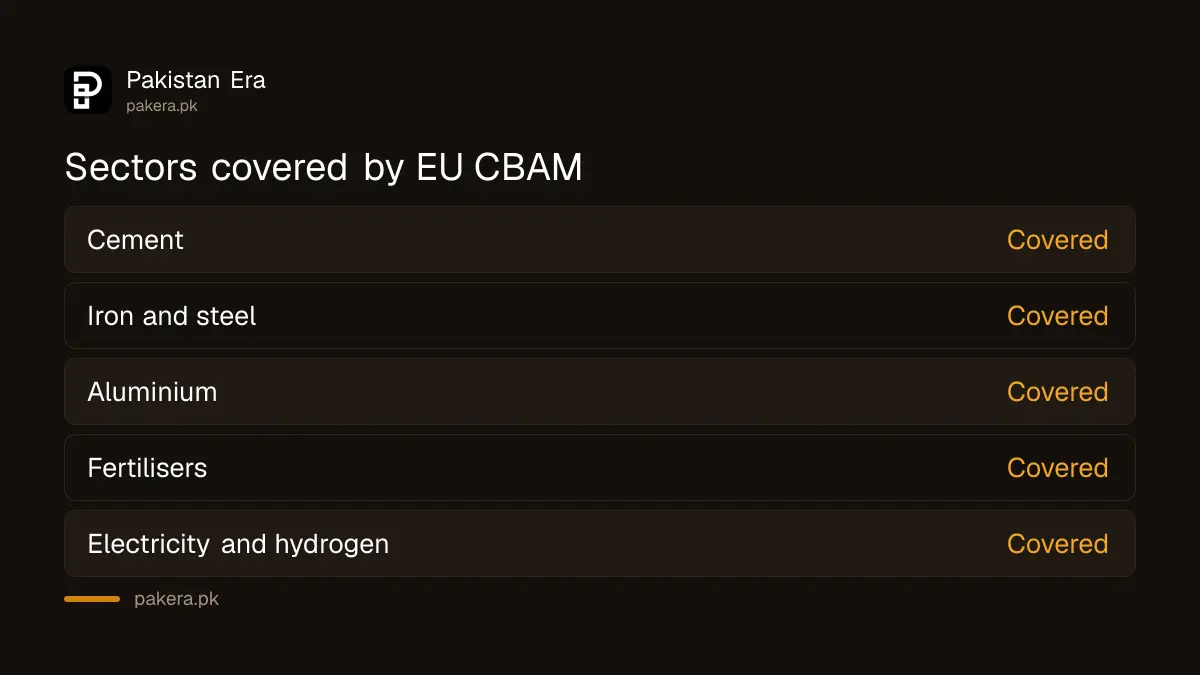
CBAM covers cement, iron and steel, aluminium, fertilisers, electricity and hydrogen. For Pakistani exporters the four goods sectors are the practical risk: cement, iron and steel, aluminium and fertilisers. The Commission publishes a separate guide for non-EU producers in each of these.
| Sector | Commission guidance for non-EU producers |
|---|---|
| Cement | Factsheet dated 31 October 2024 |
| Iron and steel | Factsheet dated 31 October 2024 |
| Aluminium | Factsheet dated 31 October 2024 |
| Fertilisers | Factsheet dated 31 October 2024 |
| Electricity and hydrogen | Covered by CBAM, with separate rules |
Check your product code before you assume you are safe. The list of covered goods is set by customs code, and small parts can be caught. The Commission's template examples cover steel from blast furnaces, steel from electric arc furnaces, and screws and nuts.
Your EU buyer pays the certificates but will ask you for data
The Commission puts the duty on the EU importer, who declares the emissions in its imports and surrenders certificates each year. A Pakistani producer does not buy certificates. But the importer needs your plant's emissions figures, and the Commission offers non-EU producers a template.
If you do not supply real data, the Commission's pages say default values and benchmarks for 2026 exist. We did not open the default tables, so we cannot say how they compare with real figures. A buyer may price in a margin for risk, so real data can win you the order.
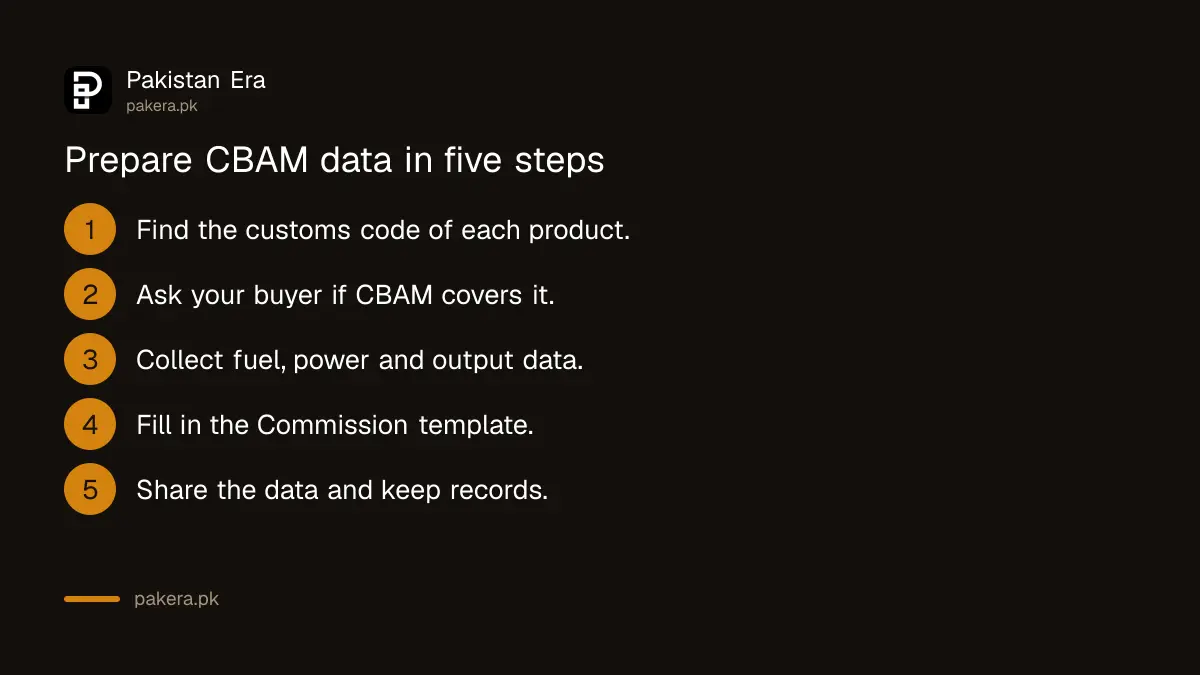
- Find the customs code of each product you sell to the EU.
- Ask your EU buyer whether the code is covered by CBAM.
- Collect your plant's fuel, power and production data for each product.
- Fill in the Commission's communication template for installations.
- Share the data with your buyer and keep dated records.
Importers above 50 tonnes a year must be authorised declarants
An EU importer that brings in more than the single threshold of 50 tonnes of CBAM goods must apply to become an authorised CBAM declarant. Authorised declarants buy certificates from the national authority of the EU country where they are established.
That 50 tonne line matters to small exporters. A buyer under the line may not need authorisation, though the Commission pages we read do not spell out everything such a buyer must do. A buyer over the line has a legal reason to ask you for data.
Access to the CBAM Registry, the system for declarations, goes through the national competent authority. From February 2027 all certificates are bought on one common central platform.
The third quarter 2026 certificate price is €82.32
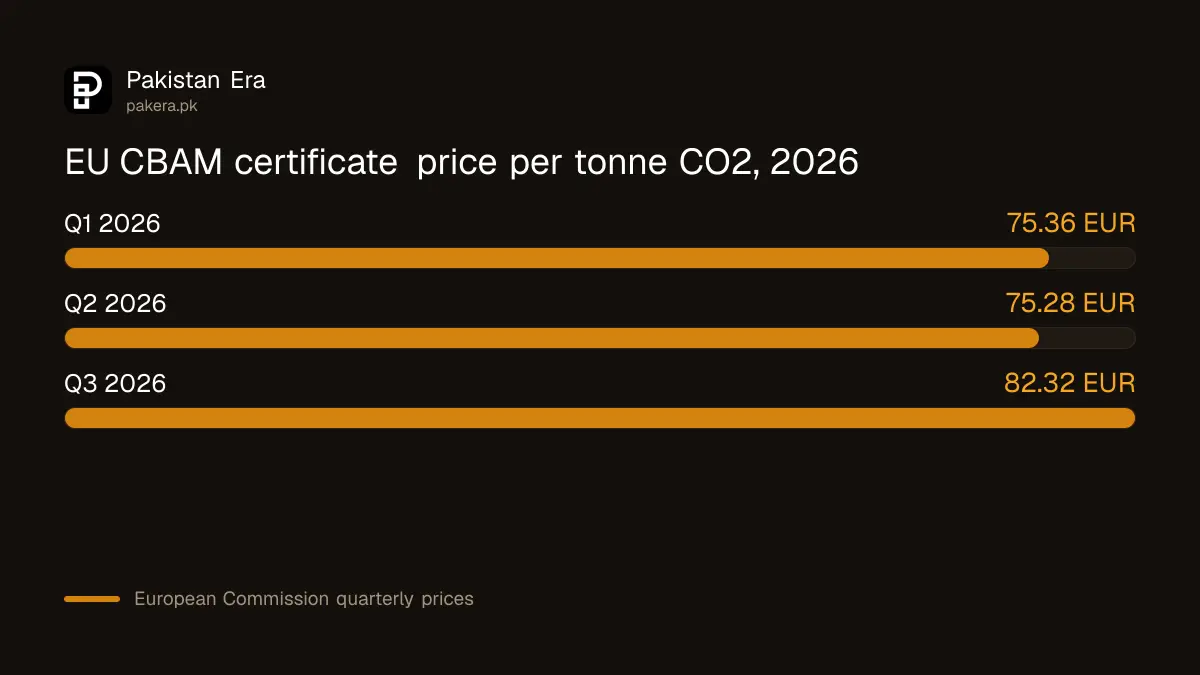
The Commission sets the CBAM certificate price from EU carbon auction prices, in euros per tonne of CO2. In 2026 it publishes one price a quarter, and the third quarter price is €82.32. From 2027 it publishes a price every week.
| Quarter of 2026 | Published | Price per tonne of CO2 |
|---|---|---|
| Q1 | 7 April 2026 | €75.36 |
| Q2 | 6 July 2026 | €75.28 |
| Q3 | 5 October 2026 | €82.32 |
| Q4 | 4 January 2027 | Not yet published |
Here is a worked example, and it is our arithmetic, not a Commission figure. A tonne of product with 2 tonnes of embedded CO2 would carry about €165 at the Q3 price, before any adjustment the rules allow. Real bills depend on the verified data, so treat this as scale only.
Help exists for developing countries, and a clean plant sells better
The Commission says it offers guidance and technical support to developing countries and Least Developed Countries to green their industry and use CBAM. It publishes a document listing programmes. A plant with lower emissions can show a smaller bill to its buyer.
Exporters who are new to EU sales also need the basics. Registering as an exporter on WeBOC comes first, and EXIM Bank export credit insurance can cover unpaid invoices. On the US side, the new US tariff on Pakistani goods is a different charge that your US buyer pays.
Common questions about CBAM for Pakistani exporters
Does a Pakistani exporter pay CBAM?
No, the Commission puts the duty on the EU importer. The importer buys and surrenders the certificates. But the importer needs your emissions data.
When did CBAM start charging?
CBAM applies in its definitive regime from 1 January 2026. The reporting-only transitional phase ran from 2023 to 2025.
Which goods are covered?
Cement, iron and steel, aluminium, fertilisers, electricity and hydrogen. Check the customs code of your product with your buyer.
What is the current certificate price?
The Commission published €82.32 for the third quarter of 2026 on 5 October 2026. The fourth quarter price is due on 4 January 2027.
Is there a minimum amount?
An importer bringing in more than 50 tonnes of CBAM goods must become an authorised CBAM declarant. The Commission pages we read do not describe what applies below that line.
Where do I find the official forms?
The Commission's CBAM site has the communication template for installations, examples for each sector, and an e-learning course on filling it in.
How we verified this
What we checked, where we read it, and what we could not confirm.
Last checked 15 October 2026. Dates, sectors, the 50 tonne threshold, the certificate price table and the support for developing countries come from the European Commission's CBAM pages and its price of CBAM certificates page, which we opened that day. We did not open the customs code list, the default value tables or the legal text, so check them before you sign a contract. The worked example is our own arithmetic.
About the author

Global Affairs & Political Economy Writer
Muhammad Hatim is a book lover who started writing because he enjoys it. At Pakistan Era he writes about international relations, geopolitics and the global economy, with a particular interest in South Asia and the forces behind current events.