How to Evict a Tenant in Sindh: 6 Grounds Before the Rent Controller, 2 Months for Widows and Retirees
Evict a tenant in Karachi or urban Sindh through the Rent Controller on 6 grounds, or with 2 months' notice if you are a widow, retired or 60. See the steps.
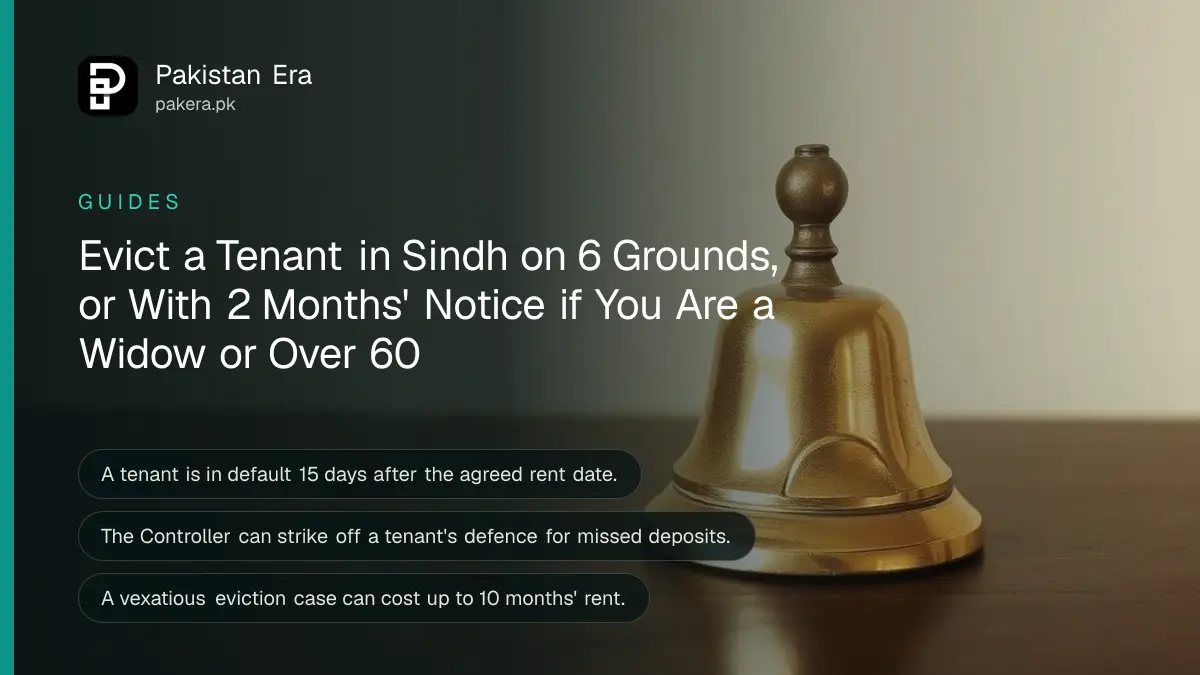
To evict a tenant in Karachi or any urban area of Sindh, apply to the Rent Controller under section 15 of the Sindh Rented Premises Ordinance 1979, on one of six grounds such as unpaid rent, subletting, damage, nuisance, rebuilding or your own use. Widows, orphans, retired employees and owners aged 60 or more have a faster route: two months' written notice under section 14.
Changing the locks, cutting the electricity or throwing out the furniture is not one of those routes. Section 13 says no tenant can be evicted except under the Ordinance, and section 11 makes cutting power, gas or water without the Controller's order an offence. We read the Sindh Rented Premises Ordinance 1979 on the Sindh Code on 20 October 2026, in the copy amended up to 2001.
The Sindh law covers rented buildings and land in urban areas
The Ordinance applies to all rented premises in an urban area of Sindh, meaning land under a town committee, municipal committee or corporation, such as Karachi, Hyderabad or Sukkur. Government-owned premises are excluded. Hotels are excluded too. A Controller must have worked as a Civil Judge for at least three years.
"Tenant" includes someone who stays on after the tenancy ends, and the heirs of a tenant who has died. "Rent" includes unpaid water and electricity charges the tenant was meant to pay. So a tenant who leaves utility bills unpaid can be in default on rent too.
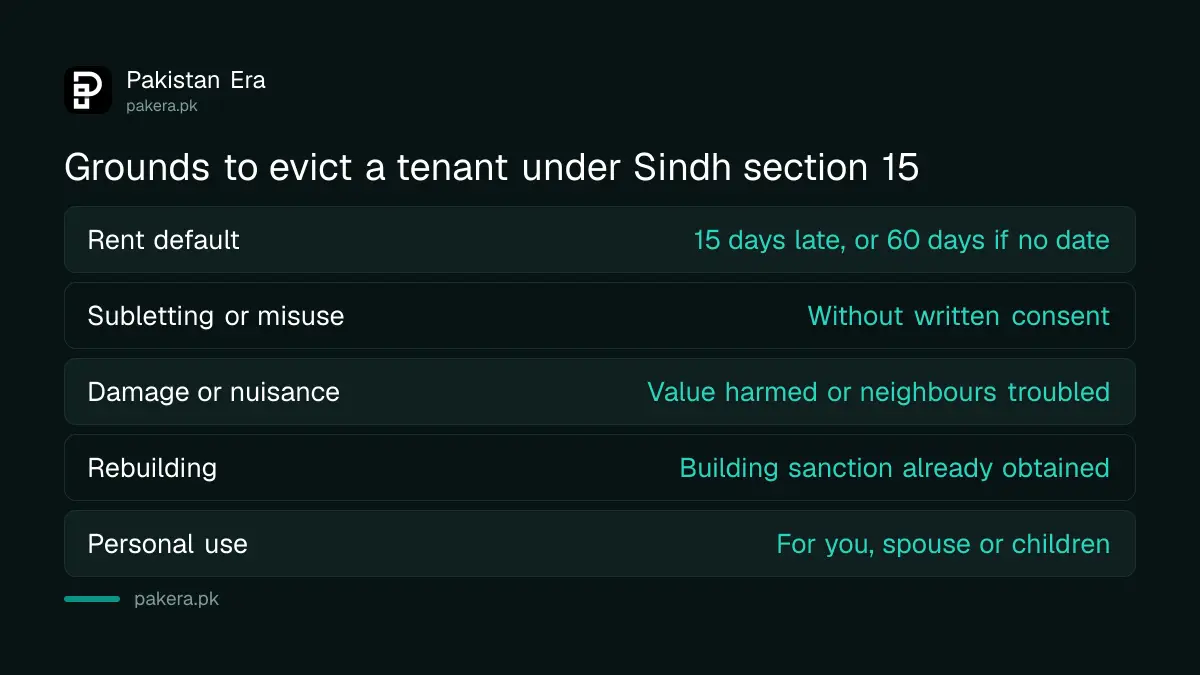
Six grounds in section 15 let the Controller order eviction
Section 15(2) lists the grounds. The Controller orders the tenant to hand over possession if satisfied that the tenant defaulted on rent, sublet or misused the premises, damaged them, caused a nuisance, or that the landlord needs them for rebuilding or in good faith for personal use.
| Clause | Ground | What you must show |
|---|---|---|
| 15(2)(ii) | Rent not paid | Unpaid 15 days after the agreed date, or 60 days after it fell due if no date was agreed |
| 15(2)(iii) | Subletting, change of use, breach of terms | Done without your written consent |
| 15(2)(iv) | Damage | Acts likely to reduce the value or use of the premises |
| 15(2)(v) | Nuisance | Activities causing nuisance to neighbours |
| 15(2)(vi) | Rebuilding | Sanction from the competent building authority already obtained |
| 15(2)(vii) | Personal use | Needed in good faith for you, your spouse or your children |
The first default has a safety valve for the tenant. If rent default is the only ground, and on the first day of hearing the tenant admits it, the Controller must let the tenant pay all arrears by a fixed date and then reject the case. That applies only if there was no earlier default and the arrears are six months or less. A second default does not get that chance.
Written consent matters for the subletting ground. If you allowed a relative of the tenant to move in by a phone call, you will struggle to prove it was without consent. Put permissions in writing, and keep the tenancy agreement attested as section 5 requires.
Widows, orphans, retirees and owners over 60 can use section 14
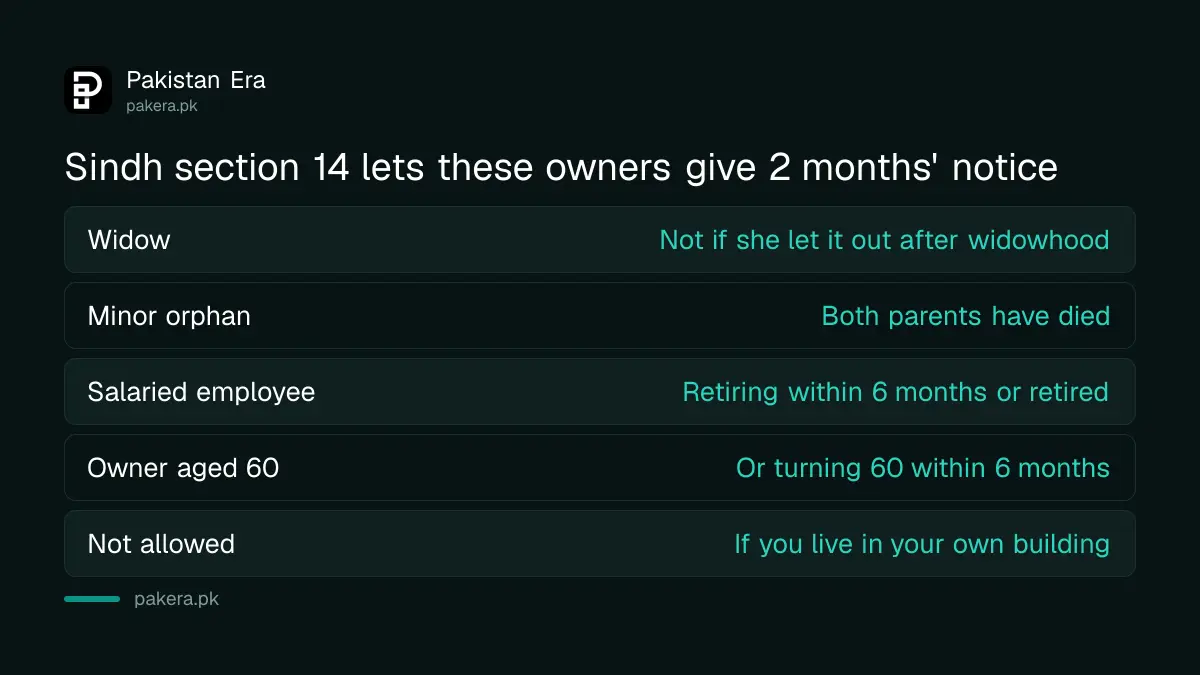
Section 14 lets certain landlords get back a building for personal use by written notice of at least two months. If the tenant does not leave, the Controller orders eviction in a summary manner, with force if needed. An appeal court cannot stay a section 14 order.
The landlords who qualify are:
- a widow;
- a minor whose parents have both died;
- a salaried employee due to retire within six months, or already retired;
- a person who will turn 60 within six months, or is already 60 or older.
Two limits apply. It does not work if you rented the building out after you retired, turned 60 or became a widow or orphan. And it does not work if you already live in a building you own in any locality. So a retired teacher renting out a second flat while living in her own house cannot use it.
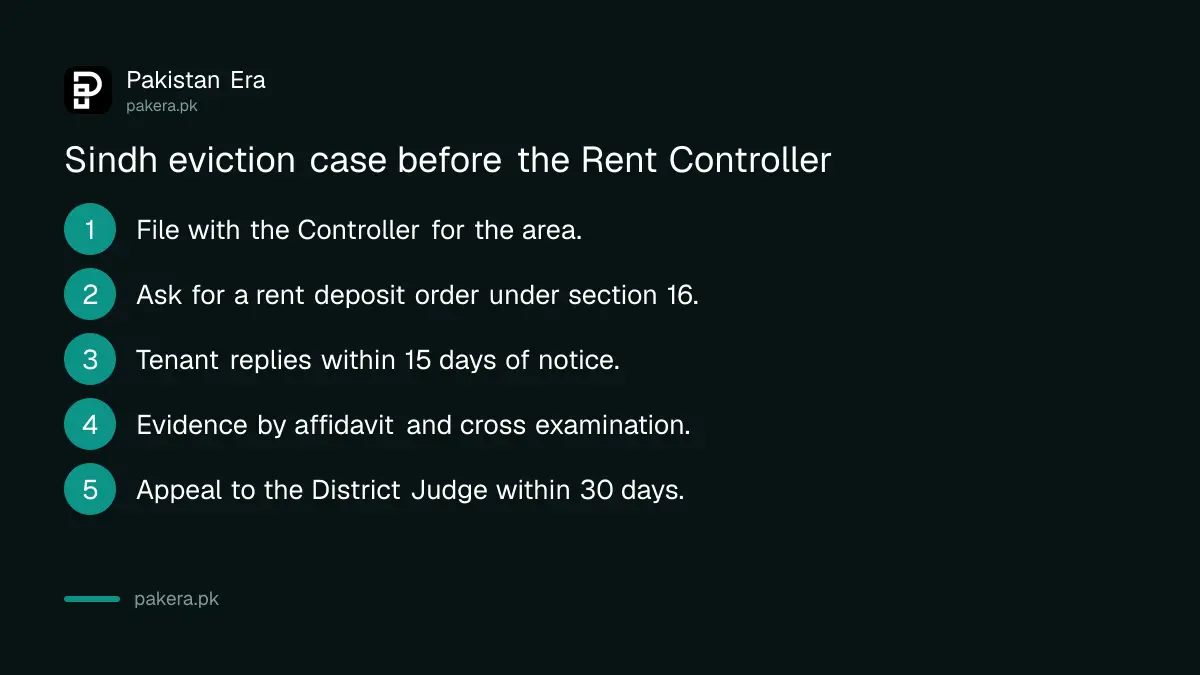
How a case moves before the Rent Controller
The Controller issues notice and the tenant has up to 15 days to file a written reply. If the tenant ignores a served notice, the Controller can pass an ex parte order. Evidence is given by affidavit with cross examination, and appeals go to the District Judge within 30 days.
- Collect the attested tenancy agreement, rent receipts and any written notices.
- File the eviction application with the Rent Controller for the area where the premises are.
- Ask the Controller under section 16 to fix arrears and order the tenant to deposit rent by the 10th of each month during the case.
- Reply to the tenant's written statement and file witness affidavits.
- Get the order. The Controller also executes it, so no separate suit is needed.
- If either side appeals, the District Judge hears it, or sends it to an Additional District Judge.
Section 16 is the landlord's strongest tool. If the tenant fails to deposit the arrears or the monthly rent as ordered, the Controller strikes off his defence and puts the landlord in possession. In 2026 a reported Supreme Court ruling on a rent default raised during a Sindh case also touched on this.
A false or careless claim can cost the landlord
If the Controller finds an eviction application frivolous or vexatious, he may order the landlord to pay the tenant up to ten times the monthly rent. And a landlord who evicts for personal use, then re-lets or uses the place otherwise within a year, can be fined up to one year's rent.
In that case the evicted tenant can also ask the Controller to restore possession. For rebuilding, the landlord must demolish within six months and start building within two years, or the tenant can apply to move back in. New owners have a duty too: after a sale or inheritance, the new owner must tell the tenant by registered post, and the tenant is not in default if he pays within 30 days of when that letter should have arrived.
If your tenant says you refused his rent, he may have sent it by money order or deposited it with the Controller, and those receipts count as payment. The tenant's side of that is in paying rent in Sindh when the landlord refuses it. Landlords in other provinces work under different laws, such as the Punjab Rent Tribunal route.
Common questions
How long does a Sindh tenant have to pay rent before default?
Fifteen days after the agreed date. If no date was agreed, 60 days after the rent fell due. The default date for payment is the 10th of the following month.
Can I evict a tenant in Karachi without going to court?
No. Section 13 says a tenant can be evicted only under the Ordinance, which means an order from the Rent Controller. Cutting utilities without the Controller's order is an offence under section 11.
Who can use the two month notice in section 14?
A widow, a minor orphan, a salaried employee retiring within six months or retired, and a person aged 60 or turning 60 within six months, who needs the building for personal use.
What if the tenant stops paying rent during the case?
Ask the Controller to order deposit of arrears and monthly rent under section 16. If the tenant fails, his defence is struck off and you get possession.
Where does an appeal against a Rent Controller order go?
To the District Judge of the district, within 30 days of the order. The District Judge can hear it or pass it to an Additional District Judge.
Does the Sindh rent law apply to villages?
No. It applies to premises in urban areas, meaning areas under a town committee, municipal committee or corporation.
How we verified this
What we checked, where we read it, and what we could not confirm.
We read the Sindh Rented Premises Ordinance 1979 on the Sindh Law Department's Sindh Code site on 20 October 2026: sections 2 to 5, 10, 11, 13 to 19, 21 and 22, with the amendment notes up to 2001. That copy may not show later amendments, and we did not check court fees or how long cases take in practice in Karachi. Ask a lawyer before filing if the case is contested.
About the author

Senior Writer, Public Services and Technology
Shahid joined us in 2024 as an author. He is a senior contributor to Pakistan's leading technology websites. He writes detailed articles, mostly covering his expertise in the latest tech, mobiles, apps, gadgets, and step-by-step guides. His ideology is to help people understand the latest trends and explain complex methods through very easy-to-understand guides.