GEPCO Load Shedding Schedule: 4 Hours a Day on Most of 1,090 Feeders in Gujranwala, Sialkot and Gujrat
GEPCO load shedding schedule: about 850 of 1,090 feeders carry 4 separate one hour cuts a day and about 200 carry none. Find your feeder and hours in 3 steps.
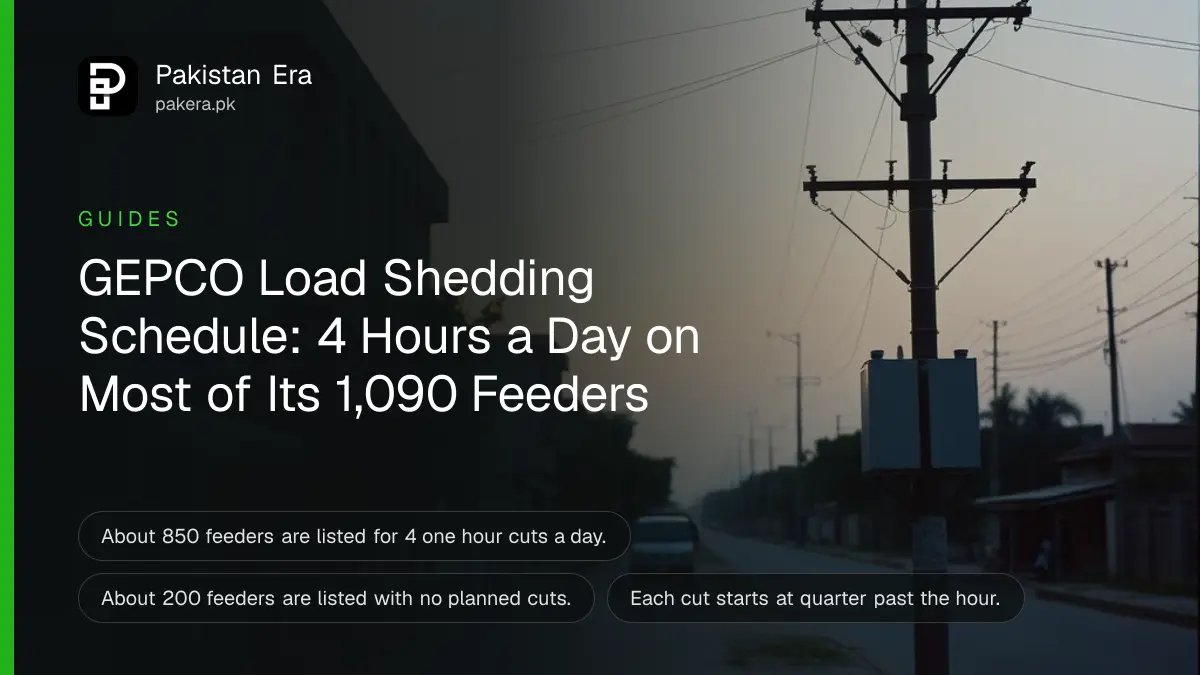
GEPCO's load management file lists about 850 of its 1,090 feeders for four separate one hour cuts a day, and about 200 feeders for no planned cuts at all. Open the file, search your feeder name from your bill, and read the times along that row. The file does not state a date, so check your feeder on PITC's live portal too.
Gujranwala Electric Power Company (GEPCO) serves Gujranwala, Sialkot, Gujrat, Narowal, Hafizabad and Mandi Bahauddin. We downloaded its "GEPCO Load Management Schedule" on 7 November 2026 and counted every row. The file's own properties show it was created on 14 January 2026, so read it as GEPCO's standing plan rather than today's exact cuts.
Most GEPCO feeders are listed for 4 hours a day
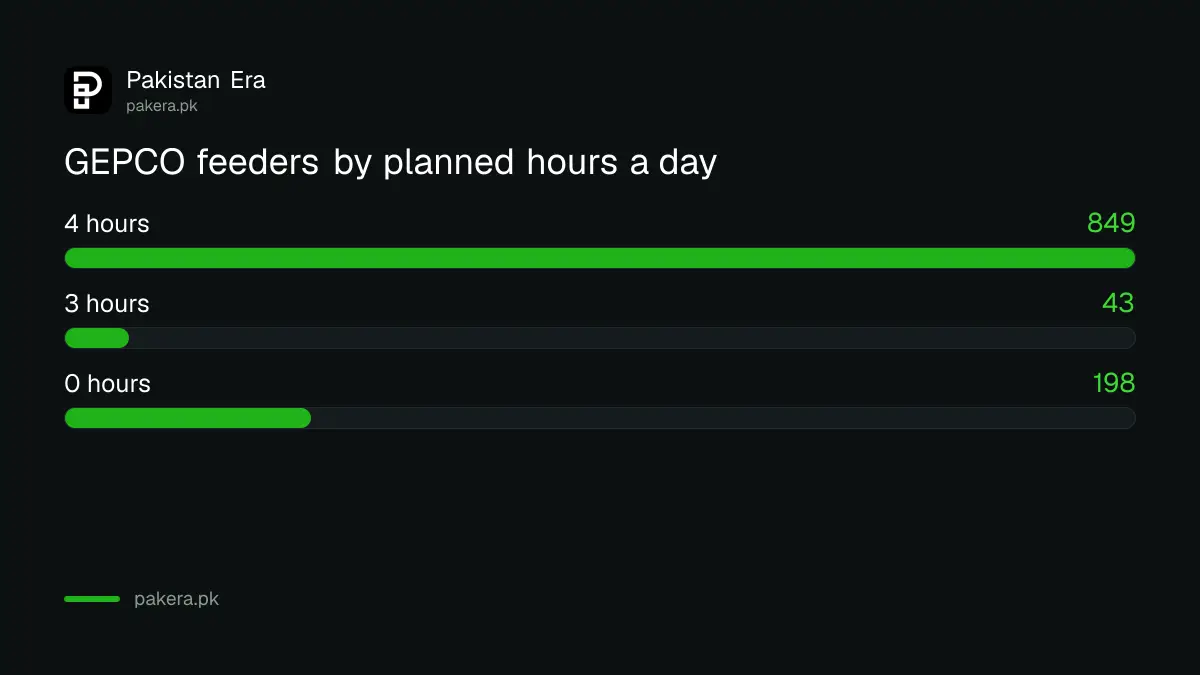
GEPCO's file has 1,090 numbered feeders. About 849 show 4 hours a day, 43 show 3 hours, and about 198 show none. These are planned hours. Actual cuts can be longer when a fault or a shortage hits your feeder.
| Planned hours a day | Feeders (about) | Share |
|---|---|---|
| 4 hours | 849 | 78% |
| 3 hours | 43 | 4% |
| 0 hours | 198 | 18% |
Some text in the file runs together, which is why we say "about". The pattern is clear even so. Most feeders do not lose power for one long stretch. They lose it in single hours spread across the day and night.
Each cut starts at quarter past the hour
The file's 24 columns run from 12:15 am to 12:15 am the next night, one hour each. A number in a column means that feeder is off for that hour. Each feeder's row shows its own four slots.
Here are ten rows from across the file, to show the shape. The number after the name is the feeder code, the same code PITC's portal accepts.
| Feeder | Code | Cuts start at |
|---|---|---|
| Faisal Colony (U.I) | 21404 | 3:15 am, 12:15 pm, 6:15 pm, 10:15 pm |
| Allama Iqbal Road (ID) | 21424 | 7:15 am, 11:15 am, 3:15 pm, 8:15 pm |
| Fruit Mandi (CD) | 81401 | 6:15 am, 11:15 am, 4:15 pm, 8:15 pm |
| Nokhar (TD) | 16301 | 2:15 am, 12:15 pm, 10:15 pm, 11:15 pm |
| Mustafa Abad (R) | 44605 | 6:15 am, 10:15 am, 6:15 pm, 10:15 pm |
| Chamb AJK (R) | 108812 | 8:15 am, 12:15 pm, 4:15 pm, 11:15 pm |
| Luk (TD) | 108006 | 4:15 am, 10:15 am, 5:15 pm, 8:15 pm |
| Triggerry (R) | 96907 | 1:15 am, 8:15 am, 2:15 pm, 8:15 pm |
| Phalwair (U) | 80213 | 3:15 am, 11:15 am, 5:15 pm, 10:15 pm |
| Furnace-3 (F) | 5025 | None planned |
Across the whole file, the busiest single start time is 5:15 pm, with about 200 feeders off in that hour. The evening hours from 5:15 pm to 7:15 pm carry the most cuts. The hours just after midnight carry the fewest.
Feeders with F, B-3 and E labels show no planned cuts
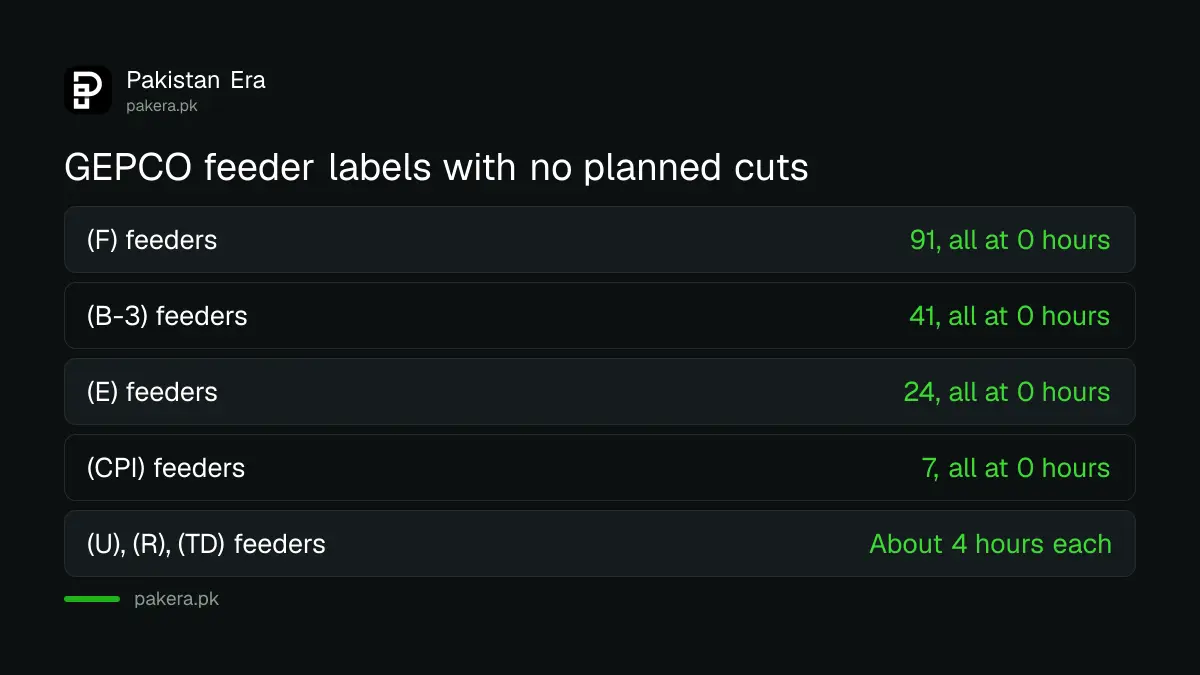
Each feeder name ends with a letter code in brackets. Every feeder labelled F, B-3, E or CPI in the file shows zero hours. Feeders labelled U, R, TD, CD, ID or U.I show about 4 hours.
The file does not explain these labels, so we will not guess at each one. GEPCO's other reports use groups such as Exempted, Domestic Urban and Industrial Dominated, which fit the pattern. If your feeder has one of the zero hour labels and you still lose power at set times every day, that is worth asking your sub-division about.
Check your feeder in three steps
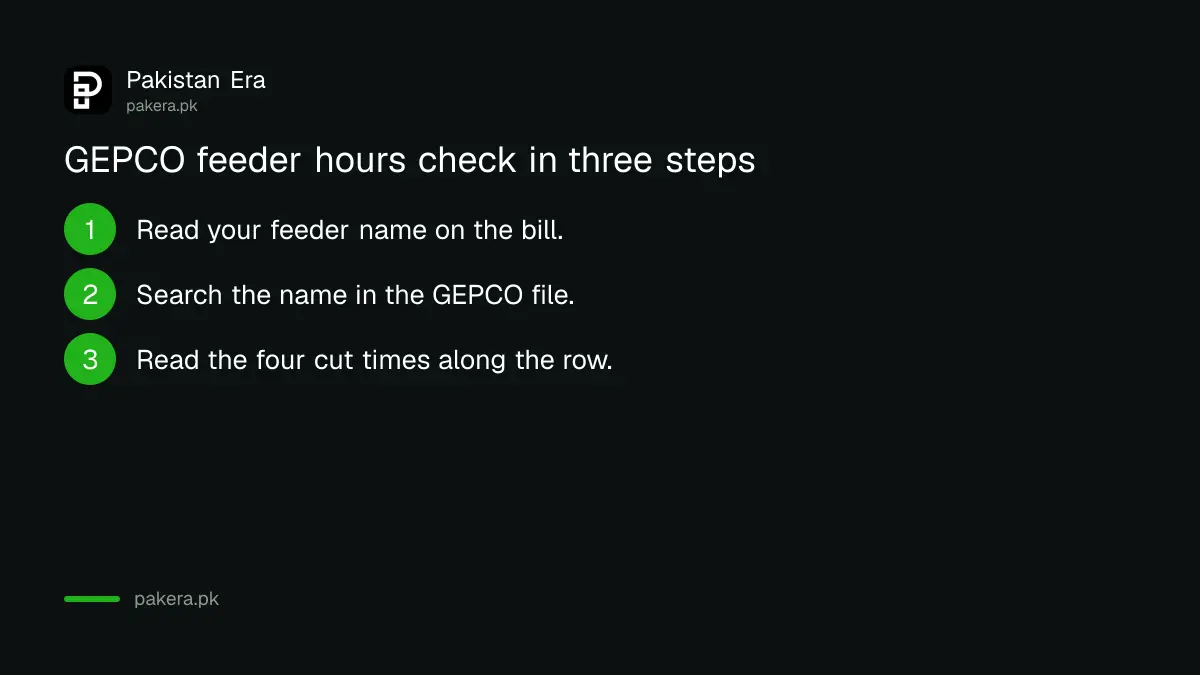
You need your feeder name or code. It is on your GEPCO bill, or you can find it from your 14 digit reference number. Then search the file, or use PITC's live portal for today's plan.
- Find your feeder name on your bill. Our GEPCO online bill check shows a duplicate bill if you do not have one.
- Open GEPCO's complete schedule file and search for the name or code.
- Read the columns with a number. Each one is a one hour cut starting at 15 minutes past.
- Compare with PITC's load shedding portal, which shows one feeder for yesterday, today and tomorrow.
- Check for a planned cut as well. GEPCO's earlier lists, such as the 5 November shutdown schedule, show that maintenance runs on top of these hours.
Why your feeder gets the hours it gets
Load shedding in Pakistan's government companies is set feeder by feeder, largely by how much power that feeder loses or goes unpaid. So two nearby streets on different feeders can have different hours, even in one city.
NEPRA has recorded GEPCO's losses, and the target against the actual figure is in GEPCO's loss target. If you plan to buy backup power, four one hour cuts need much less battery than one long cut, and UPS and battery sizing shows how to work it out. For a cut outside your listed slots, use GEPCO's 118 complaint line and office numbers.
Common questions
How many hours of load shedding does GEPCO have?
Its file lists about 4 hours a day for most feeders, 3 hours for 43 feeders, and none for about 198 feeders.
Where is the GEPCO load shedding schedule?
On GEPCO's website under Load Shedding Schedule. The page links the complete feeder PDF and PITC's consumer portal.
Is the GEPCO file up to date?
The file itself has no date on its pages, and its properties show January 2026. Use PITC's portal to see your feeder's plan for today.
Why does my feeder's cut start at 15 minutes past the hour?
GEPCO's file sets its hourly columns from 0:15 to 1:15 and so on across the day. So every cut in the file starts and ends at 15 minutes past.
Can I check by reference number instead of feeder name?
Yes, on PITC's portal. Type your 14 digit reference number or your feeder code to see the plan for your feeder.
What we checked
We read GEPCO's Load Shedding Schedule page and its complete feeder file on 7 November 2026, and counted the rows ourselves by script. We did not confirm that GEPCO applies each row today, so treat the hours as its published plan.
About the author

Tax, Bills and Technology Writer
Ali Akhtar is a young and curious voice here at Pakistan Era. He is currently pursuing his A-Levels and has a growing interest in Pakistan’s changing industrial landscape and educational trends. Ali likes to write in a way that helps him explain and explore the world around him. His writing reflects the perspective of the new generation navigating the evolving trends of Pakistan where technology, youth innovation, and shifting opportunities are reshaping the country’s future.