How to Get Possession of a CDA Plot in Islamabad: Documents and Fee
Get possession of a CDA plot in Islamabad: the four documents, the Land Survey step and why CDA's two pages list different fees. Confirm the amount first.
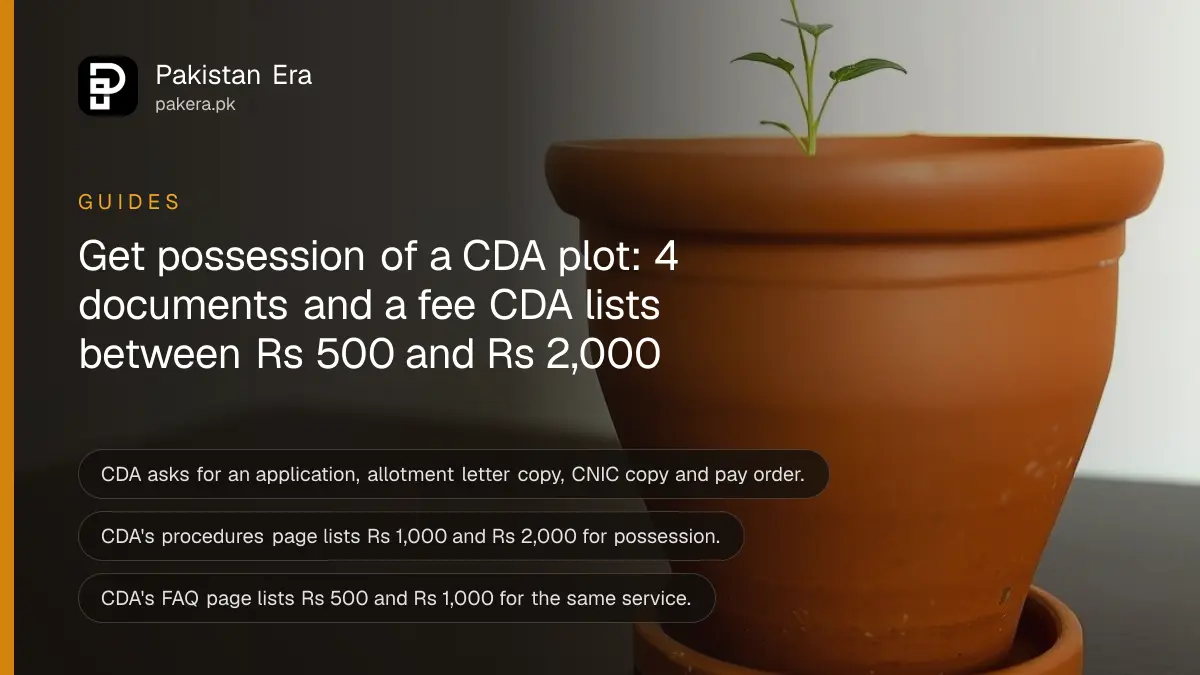
Short answer: To get possession of a CDA plot in Islamabad, apply at One Window Operation with an attested allotment letter, an attested CNIC copy and a pay order. CDA's pages disagree on the amount: one lists Rs 1,000 for the first possession and Rs 2,000 for the second, the other Rs 500 and Rs 1,000.
An allotment letter says the plot is yours on paper. It does not put you on the ground. Possession is the step where CDA's survey staff show you the plot and give you a certificate. Without that certificate, your building plan application and later your completion certificate are both stuck.
We read CDA's procedures page and frequently asked questions page on 13 October 2026. They are undated. We did not apply for possession, so the steps follow what CDA lists, and we say clearly where its two pages differ.
Possession is the handover of the plot on the ground
Possession means CDA's Land Survey staff physically deliver the plot to the allottee or attorney and issue a certificate. The certificate is proof that you have been given the plot, and CDA asks for it with a building plan.
CDA's list for approval of building plans includes the allotment or transfer letter and the possession certificate. So think of possession as the step between buying a plot and building on it. A buyer who skips it will meet the same request at the plan counter.
If you bought from a previous owner, you first need the plot in your name. See the steps to transfer a CDA plot, because possession is requested by the allottee or the attorney.
The application needs four documents
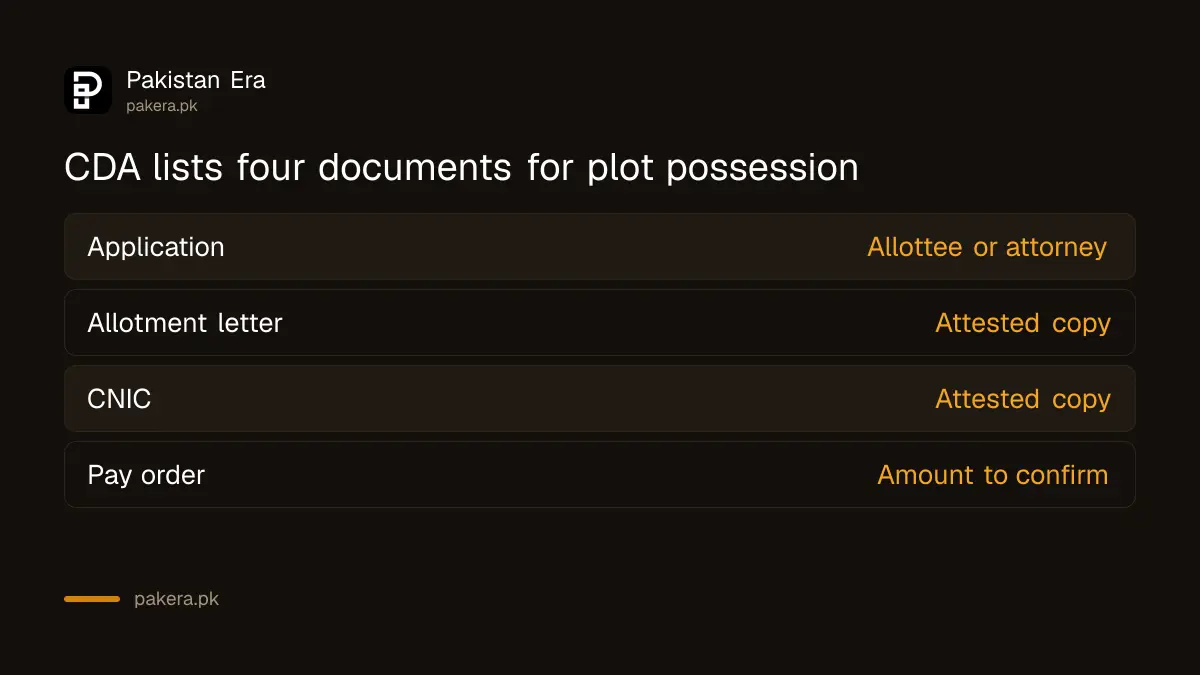
CDA lists four items: an application from the allottee or attorney, an attested copy of the allotment letter, an attested copy of the CNIC of the allottee or attorney, and a pay order. The application goes to the One Window Operation counter at the CDA Secretariat.
| Document | Detail |
|---|---|
| Application | Written by the allottee or attorney |
| Allotment letter | Attested copy |
| CNIC | Attested copy, allottee or attorney |
| Pay order | Amount differs on CDA's two pages |
If an attorney applies, bring the attorney's papers as well. CDA also lists an acceptance of general power of attorney form among its Estate Management forms.
CDA's two pages list different possession fees
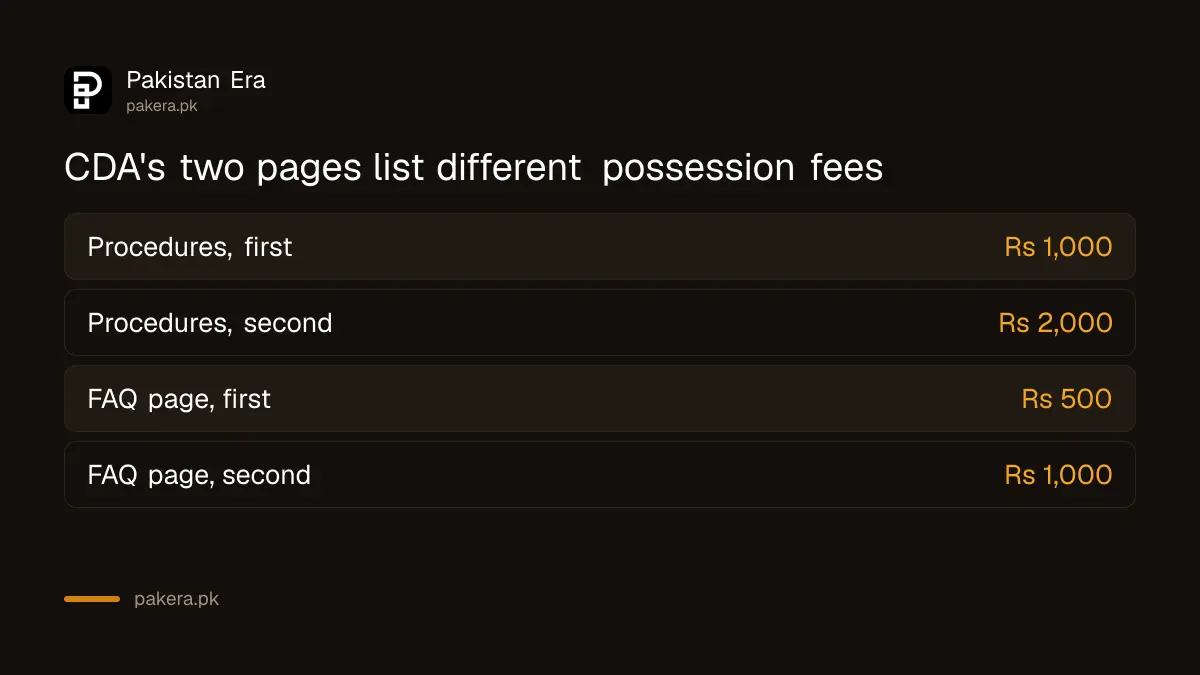
The procedures page lists a pay order of Rs 1,000 for the first possession and Rs 2,000 for the second. The frequently asked questions page lists Rs 500 for the first and Rs 1,000 for the second. We could not tell which page is current.
| CDA page | First possession | Second possession |
|---|---|---|
| Procedures | Rs 1,000 | Rs 2,000 |
| Frequently asked questions | Rs 500 | Rs 1,000 |
Neither page explains what a "second" possession means. It may apply to a plot that was handed over once before, but that is our guess. The safe step is to ask the counter and get the demand in writing before you buy the pay order.
Four CDA offices touch the file
Your file moves from the One Window counter to a Deputy Director of Estate Management, then to the Land Survey counter inside One Window, and finally to the survey staff who deliver the plot and sign the certificate.
- One Window Operation checks the status of your plot.
- The file goes to Deputy Director Estate Management I or II.
- If there are no dues or stay orders, the Deputy Director sends it to the Land Survey counter.
- Land Survey staff deliver the plot and issue the possession certificate.
- The certificate goes to you and to the Deputy Director.
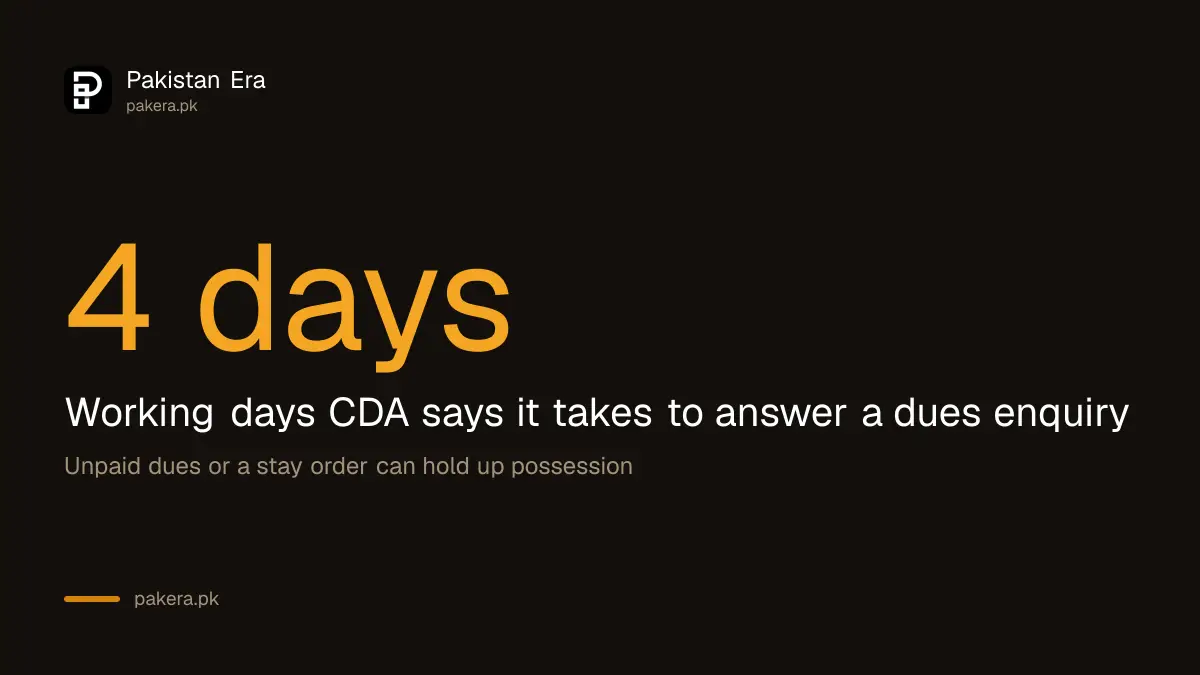
The second step is where files get stuck. If CDA finds unpaid dues, the file waits. To learn what you owe before you apply, use the steps in the page on checking CDA plot dues. CDA says it answers a dues enquiry within four working days.
A court stay order stops the process as well.
CDA also restricts action on a plot with a disputed title or one sent to its fraudulent allotment scrutiny committee.Keep the certificate for the next steps
Once you hold the certificate, keep an attested copy with your allotment letter. You will need it for a building plan, for a completion certificate and when you sell. The original stays in a safe place at home.
The building plan comes next. The steps are in the page on getting a building plan approved by CDA. If the plot is in a private housing society instead, the rules differ, and the page on checking whether a housing society is approved is the right place to start.
And if you paid for a plot in a scheme that CDA calls illegal, possession from CDA will not be available at all. Read what to do if you paid for a plot in an illegal scheme.
Common questions
What documents do I need for CDA plot possession?
You need an application, an attested allotment letter copy, an attested CNIC copy and a pay order.
How much is the CDA possession fee?
It depends on which CDA page you trust. The procedures page lists Rs 1,000 and Rs 2,000, and the FAQ page lists Rs 500 and Rs 1,000. Ask the counter.
Who delivers possession?
Land Survey staff deliver the plot and issue the certificate, after the Deputy Director of Estate Management forwards your file.
Can an attorney apply for me?
Yes. CDA's list says the allottee or the attorney can apply and provide the CNIC copy.
What stops a possession request?
Outstanding dues or a stay order can stop it, according to CDA's FAQ.
Do I need the certificate to build?
CDA lists the possession certificate among the documents for building plan approval, so you should have it first.
How we verified this
What we checked, where we read it, and what we could not confirm.
Last checked on 13 October 2026, Pakistan time. We read the CDA procedures page and its frequently asked questions page. They are undated and disagree on the fee. We did not apply for possession or call CDA, so the meaning of "second" possession is unconfirmed.
About the author

Public Services and Education Journalist
Fajr Riaz is a journalist and content writer at Pakistan Era, based in Lahore. She covers the questions people meet in everyday life in Pakistan: how a public service works, what a change in the rules means, and where to find a reliable answer.