Know What Counts as a Telecom Crime in Pakistan: Up to 3 Years or Rs 10 Million Under the PTA Act
What Section 31 of the PTA Act punishes in Pakistan: illegal telecom services, unlicensed radio, tampering. Up to 3 years or Rs 10 million, after a Gilgit raid.
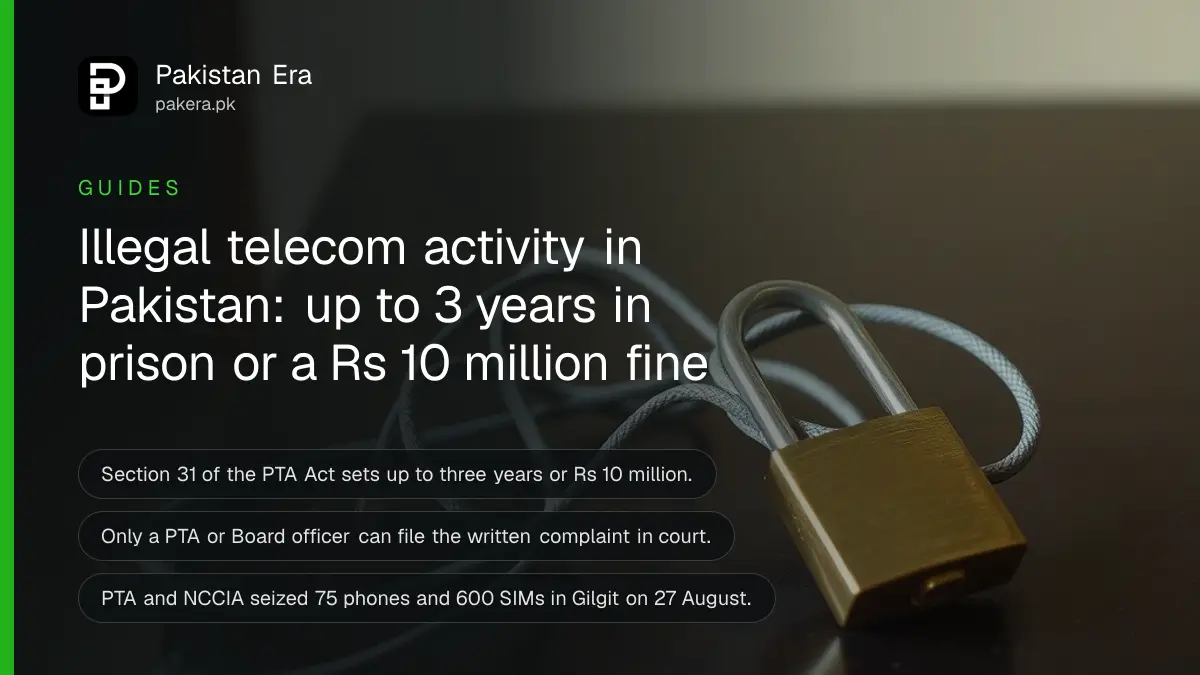
Short answer: Under Section 31 of the Pakistan Telecommunication (Re-organization) Act, 1996, running a telecom service without permission, using unapproved radio equipment or taking a service without paying for it is a crime. The punishment is up to three years in prison, a fine of up to Rs 10 million, or both.
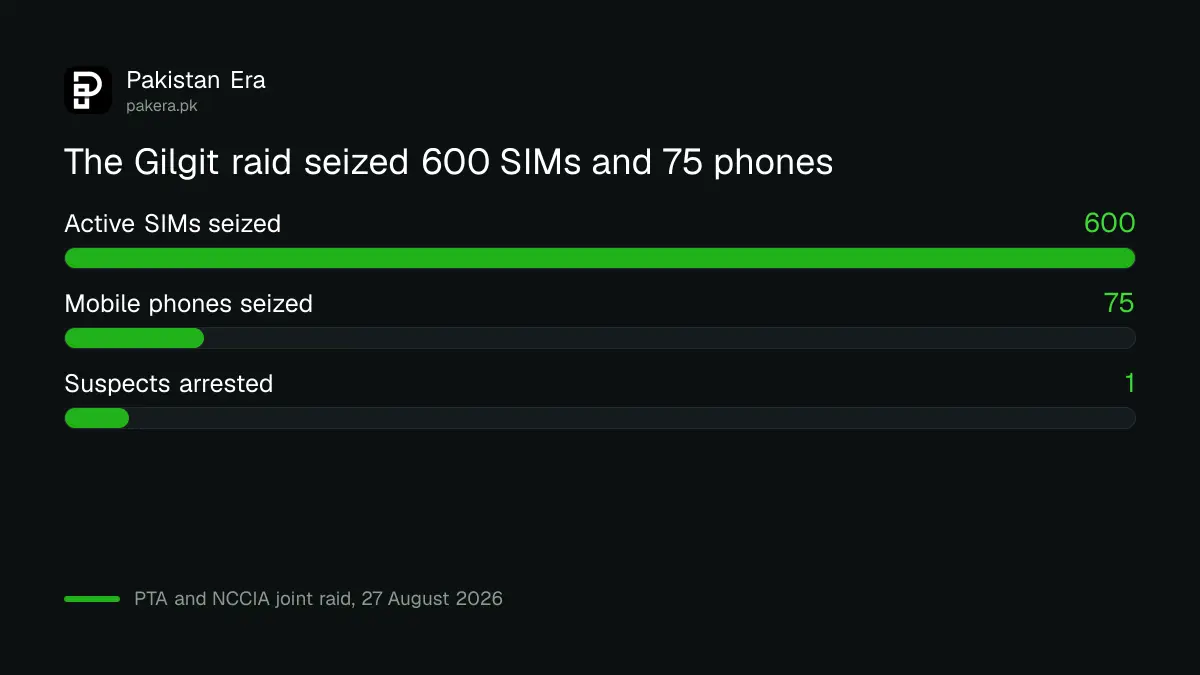
On 27 August 2026 PTA and the National Cyber Crime Investigation Agency (NCCIA) raided a house in Gilgit. PTA says the team seized 75 mobile phones and 600 active SIMs and arrested one suspect. The aim was to stop mobile balance being recharged through illegally issued SIMs to exploit a tax exemption in Gilgit-Baltistan. NCCIA registered an FIR.
We read the consolidated PTA Act, amended up to 2024, on PTA's website on 13 October 2026. This page explains what Section 31 lists, what other penalties exist and what an ordinary person should avoid. It is general information, not legal advice. If you are accused, speak to a lawyer.
Section 31 covers a long list of acts
Section 31(1) covers anyone who runs a telecom system or service against the Act or a licence, uses unlicensed radio apparatus, tampers with equipment, intercepts messages, blocks delivery of a message or uses radio spectrum without authority. Each item carries the same punishment.
The Act's list, in plain words, is:
- Running a telecom system or service, or owning wireless apparatus, against the law or a licence.
- Knowingly sending or receiving messages over such an illegal system.
- Dishonestly getting a telecom service to avoid paying for it.
- Sending a message you know to be false, made up, indecent or obscene.
- Changing the content of a message on a public network while working on it, outside your duty.
- Blocking or obstructing the sending or delivery of a message.
- Intercepting a message or revealing what it says, without authority.
- Mischief, and damaging, removing or tampering with telecom equipment.
- Decoding the contents of a message on a public network without authority.
- Attacking or blocking a person who runs or maintains a public telecom network.
- Breaking the rules made under section 29(4).
- Blocking a PTA or Board officer who is inspecting a place or equipment, or not giving information after ten days of written notice.
- Using the radio frequency spectrum without the required authorisation.
Conspiring, trying or helping someone else to do any of these gets the same punishment.
The penalty is up to three years, Rs 10 million, or both
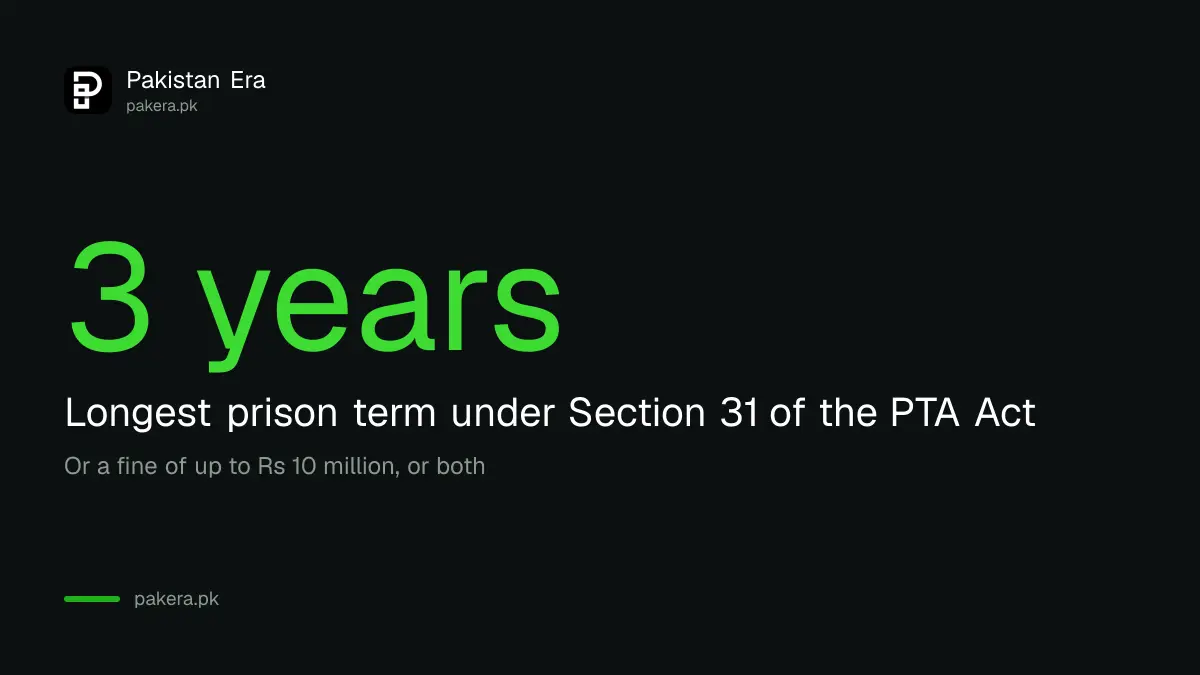
Section 31(2) says every Section 31 offence is punishable with up to three years in prison, a fine of up to Rs 10 million, or both. The original law said two years. A 2006 amendment raised it to three.
The court can order the fine, or part of it, to be paid to a person who suffered mental or monetary loss because of the offence. If the accused is a company, every executive director, chief executive, principal officer and secretary is liable. Summons go to the chief executive, principal officer or secretary.
One safeguard matters. Under Section 31(5), no court can take up an offence under the Act unless an officer authorised by PTA or the Board files a written complaint. A private person cannot start a case under this section on his own. In the Gilgit case, PTA says NCCIA registered an FIR under applicable law, without naming the section.
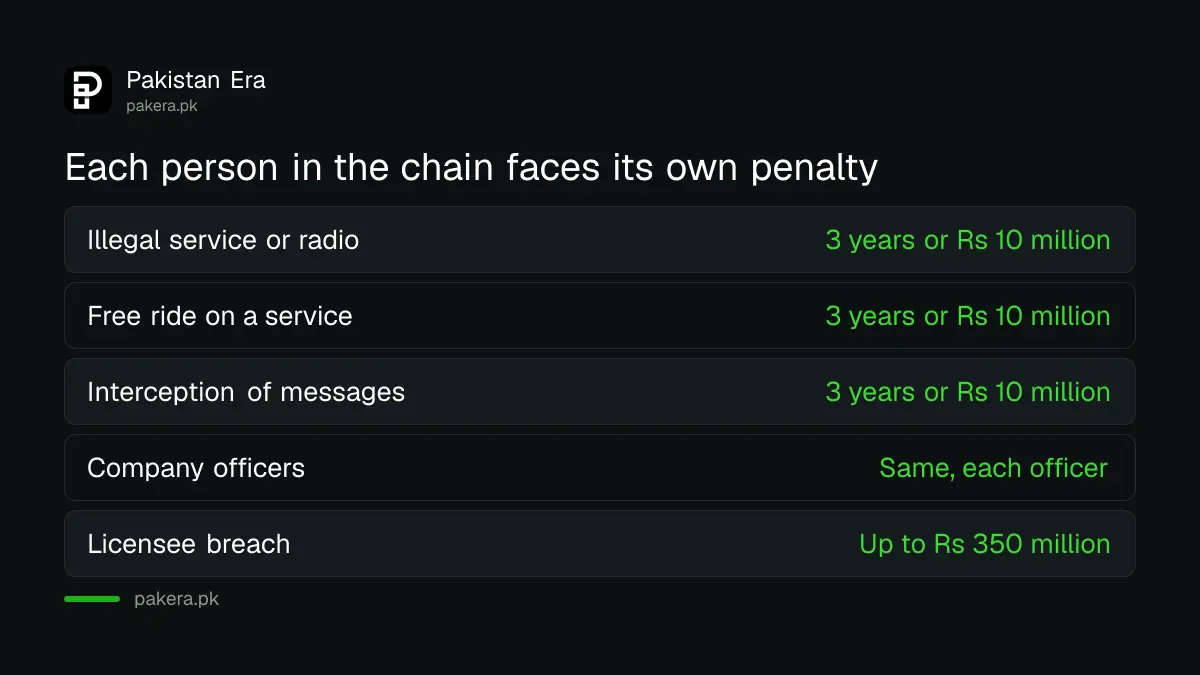
| Act | Who can be punished | Penalty in the Act |
|---|---|---|
| Illegal telecom service or unlicensed radio | Operator, user and helper | Up to 3 years or Rs 10 million, or both |
| Taking a service without paying | The person who does it | Same |
| Intercepting or revealing a message | The person who does it | Same |
| Company breaks the law | Chief executive and named officers | Same, for each officer |
| Licensee breaks its licence | The licence holder | Fine up to Rs 350 million, or suspension |
Search warrants can reach SIMs, radios and unapproved terminals
Section 32 lets a court issue a search warrant when PTA or the Board gives information that unlicensed telecom systems, wireless apparatus or unapproved terminal equipment are kept or used. The person named in the warrant can enter, search and seize the equipment.
The warrant also applies where a licensed service is used against national security and public safety. Equipment seized that has no obvious owner passes to PTA or the Board. That is why a raid like the one in Gilgit can end with phones and SIMs taken away.
Unapproved equipment is not only a business matter. A phone, a router or a signal booster that PTA has not approved can be seized too. Before buying, check the device in our guides on PTA type approval for routers and modems and signal repeaters.
Licensed companies face fines up to Rs 350 million
Section 23 is for licensees, not households. If a licence holder breaks the Act or its licence, PTA can ask it to show cause within 30 days. If the company does not answer or fix the fault, PTA can fine it up to Rs 350 million or suspend or end the licence.
Suspension or termination, an extra condition, or an administrator is allowed only if the breach is grave or persistent. Fines go to the Federal Consolidated Fund under Section 23A. A company that disagrees can appeal PTA's decision to the Telecommunication Appellate Tribunal within 30 days.
This is the section PTA uses on operators, not on a customer who got a bad bill. If your own problem is a service fault or a charge, use the route in the PTA complaint guide.
Avoid the common ways ordinary people get pulled in
You do not need to run a network to be at risk. Lending your CNIC for SIMs, running a recharge setup on SIMs registered to others, or knowingly using an unlicensed internet line can fall under the same Section 31 wording. Check your own exposure first.
Start with the SIMs in your name. The guide to checking SIMs registered on your CNIC shows how. If you find one you do not know, follow how to report an unknown SIM. If your home internet comes from a person with no licence, compare it with PTA's list in the page on checking an internet provider is PTA licensed.
If you saw an illegal telecom setup, such as a stack of SIMs running a call or recharge business, tell PTA on 0800-55055. We have not checked whether PTA takes tips on that line, so ask the operator on the call for the right channel.
Common questions
What is the maximum punishment under Section 31 of the PTA Act?
It is up to three years in prison, a fine of up to Rs 10 million, or both. The same punishment applies to anyone who plots, tries or helps to commit the offence.
Can a private person file a case under Section 31?
No. A court takes up the offence only on a written complaint from an officer authorised by PTA or the Board, under Section 31(5).
Is using an unlicensed internet provider a crime?
Section 31(1)(b) covers anyone who knowingly sends or receives messages over a system run against the Act. Whether a case is brought depends on PTA. Check your provider on PTA's list.
What happened in the Gilgit raid?
PTA says it seized 75 phones and 600 active SIMs on 27 August 2026 and one suspect was arrested. NCCIA registered an FIR and began an investigation.
How much can PTA fine a mobile operator?
Section 23 lets PTA fine a licensee up to Rs 350 million after a show-cause notice, or suspend or end the licence if the breach is grave or persistent.
Does the Act punish a company's bosses?
Yes. For a company, every executive director, chief executive, principal officer and secretary is liable to the same punishment under Section 31(6).
How we verified this
What we checked, where we read it, and what we could not confirm.
Last checked on 13 October 2026, Pakistan time. We read PTA's consolidated Pakistan Telecommunication (Re-organization) Act, 1996, amended up to 2024, sections 23, 31 and 32, and PTA's press release on the joint raid in Gilgit. We did not read the FIR or the charges in that case, and we have not checked how often courts have applied Section 31.
About the author

Technology Journalist & Multimedia Producer
Ahmad Ali is a technology journalist and multimedia producer at Pakistan Era, joining the team in October 2026. He covers consumer technology and digital life for Pakistani readers, combining research with hands-on product testing.