Khyber Pakhtunkhwa Cabinet Approves Draft Police Act 2026, Not Yet Law
The KP cabinet approved a draft Police Act 2026 on 23 September. It is not law until the assembly passes it. What could change for police and for citizens.
The Khyber Pakhtunkhwa cabinet approved a revised draft of the KP Police Act 2026 on Wednesday 23 September 2026. The approval came at the cabinet's 59th meeting, chaired by Chief Minister Sohail Afridi, the state news agency APP reported.
Update, 17 October 2026: the KP Governor asked on 13 October for a summary on police pay. See the police martyrs package.
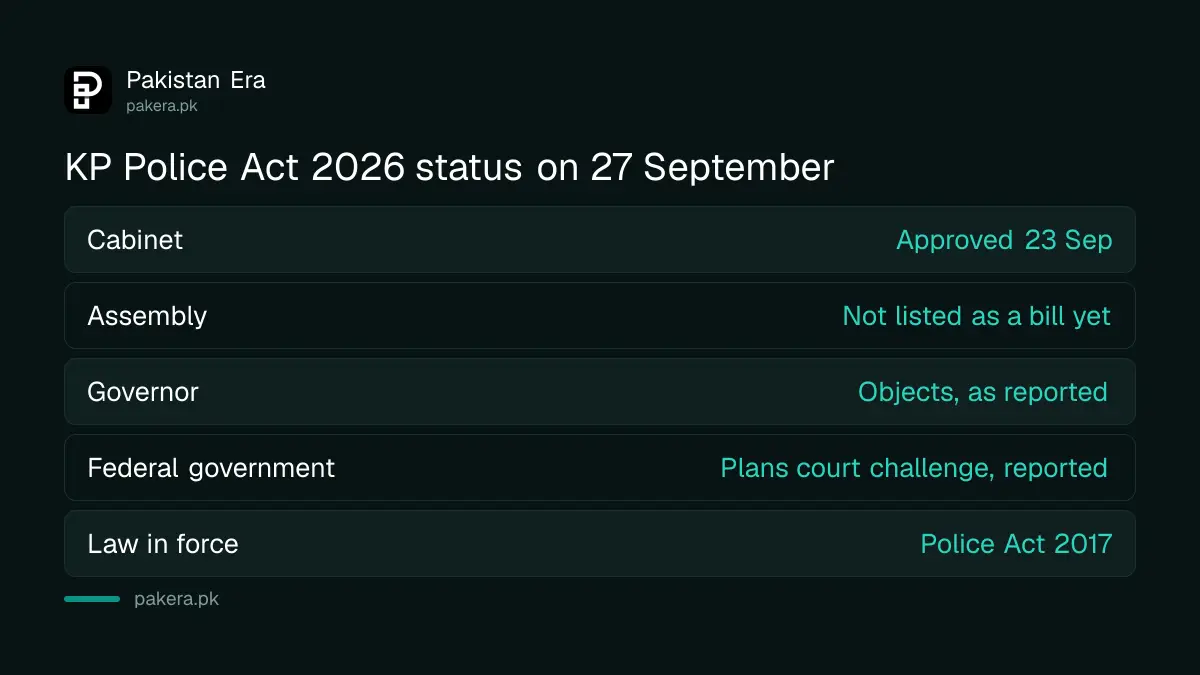
The draft is not law yet. It still has to pass the provincial assembly and get the governor's assent, and on 27 September we could not find it on the assembly's list of bills. Nothing changes at your local police station today.
The cabinet approved a draft, not a law
The KP Police Act 2026 is a cabinet-approved draft bill. It becomes law only after the Khyber Pakhtunkhwa Assembly passes it and the governor signs it, or the assembly passes it again over his objections. Until then the Police Act 2017 still applies.
APP said the cabinet approved the draft after a sub-committee reviewed objections raised by ministers. Information Minister Shafi Jan said the sub-committee made its recommendations "in consultation with police authorities". The Inspector General of Police attended the meeting.
APP also said the draft "will now be placed before the provincial assembly in its upcoming session". We checked the KP Assembly government bills page on 27 September 2026. The Police Act 2026 was not listed yet.
The law it would replace, the Khyber Pakhtunkhwa Police Act 2017, is published on the KP Police website with its later amendment.
Each stage the draft still has to clear
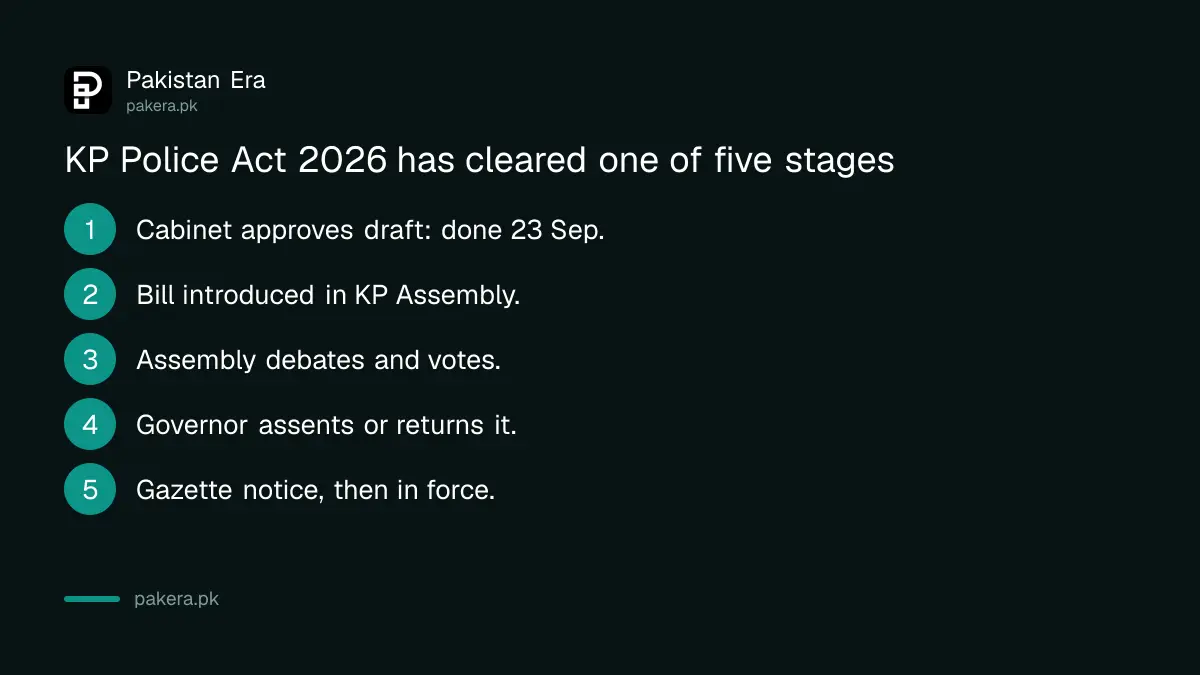
A provincial bill in Pakistan goes through several steps before it is law. The KP Police Act 2026 has cleared only the first one, cabinet approval. The assembly vote, the governor's assent and official notification in the Gazette are still ahead.
- Cabinet approves the draft. Done on 23 September 2026.
- The government introduces the bill in the provincial assembly.
- The assembly debates it, may send it to a committee, and votes.
- The governor gives assent, or returns it with objections.
- The Act is published in the Gazette and comes into force.
Under Article 116 of the Constitution, if the governor returns a bill and the assembly passes it again, it goes back to him and assent is then deemed given after a set period. So a governor can delay a provincial bill, but cannot block it on his own.
The draft shifts control of senior police posts to the government
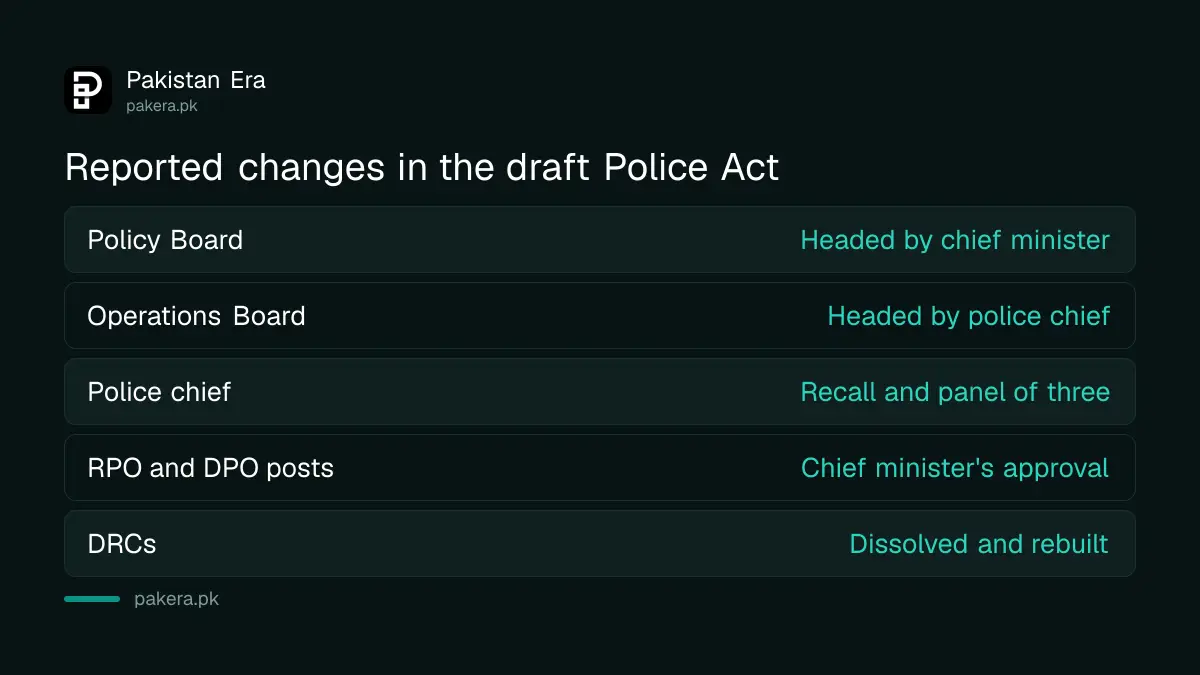
Reports of the draft say it gives the provincial government and the chief minister more say over the police. The chief minister would head a Police Policy Board, and the government could ask the federal government to replace the Inspector General. These details are reported, as the draft text is not public.
Press reports quote the draft and a statement from the information minister's office. According to those reports:
| Area | What the draft reportedly says | Status |
|---|---|---|
| Policy | Police Policy Board headed by the chief minister | Reported |
| Operations | Police Operations Board headed by the police chief | Reported |
| Police chief | Government can seek his recall and a panel of three officers | Reported |
| Senior postings | Regional and district police officers posted with the chief minister's approval | Reported |
| Planning | Annual policing plan presented to the Policy Board | Reported |
| Court replies | Cleared by the Law Department and Advocate General first | Reported |
The police chief is called the Provincial Police Officer in the law, but most people know the post as the IGP. IGPs are officers of the Police Service of Pakistan, a federal service, which is why the federal government is involved in the choice.
Dispute resolution councils would be rebuilt from scratch
The change most likely to reach ordinary people concerns dispute resolution councils, or DRCs. The information minister's office said all existing DRCs would be dissolved and set up again under the new law, with clearer rules. This comes from the minister's statement as reported.
DRCs are local panels of residents, linked to the police, that help settle minor disputes between people without a full court case. A family quarrel over a boundary wall or a small money dispute are the usual examples.
The minister's office said the new law would fill "the existing gap in the legal framework" for DRCs. It said the aim was more "transparency, accountability and uniformity".
What it does not yet say is how members will be picked, or what happens to cases already before a DRC when it is dissolved. If you have a matter before a DRC, keep your papers and ask the police station in charge before the new law, if passed, takes effect.
Police complaints still work the same way for now
Nothing in the draft is in force, so the way you complain about police in Khyber Pakhtunkhwa has not changed. The KP Police website lists the IGP Helpline, which takes complaints by SMS, free call, mobile app, WhatsApp, online form, email, post or in person.
The online form is the Police Access Service at complaints.kppolice.gov.pk. KP Police also takes online FIR requests and gives each one a tracking ID. Islamabad runs its own online police complaint form, separate from KP's.
The debate comes in a hard week for KP police. Radio Pakistan said the Dera Ismail Khan checkpost attack on 26 September killed 11 people.
The governor and the federal government object
Governor Faisal Karim Kundi has reportedly said he will not sign the draft in its present form because he thinks it is unconstitutional. The federal government has reportedly said it will challenge the law in the Supreme Court. Neither step can happen formally until the assembly acts.
The governor was reported as saying he would examine whatever the assembly passes and return it with objections. Minister of State for Interior Talal Chaudhry reportedly said on 24 September that the draft conflicts with the Constitution and the rules of the Police Service of Pakistan.
Reports also say the Peshawar High Court struck down parts of a 2024 amendment in February that had given the chief minister more power over postings. We have not read that judgment, so we note it as reported.
Common questions
Is the KP Police Act 2026 in force?
No. The cabinet approved a draft on 23 September 2026. It must pass the provincial assembly and get assent before it is law.
When did the KP cabinet approve the Police Act 2026?
On Wednesday 23 September 2026, at its 59th meeting, chaired by Chief Minister Sohail Afridi, according to APP.
Will dispute resolution councils close?
Under the draft, the existing councils would be dissolved and formed again under the new law, according to the information minister's statement as reported. Nothing changes until it is passed.
Can the governor stop the bill?
He can return it with objections. Under Article 116, if the assembly passes it again, assent is deemed given after a set period.
How do I complain about KP police today?
Use the IGP Helpline or the Police Access Service online form, both listed on the KP Police website.
How we verified this
What we checked, where we read it, and what we could not confirm.
Last checked on 27 September 2026. The date, the 59th meeting, the chief minister's chairing, the sub-committee and the plan to put the draft to the assembly are from the APP report of 23 September 2026. We checked the KP Assembly government bills page on 27 September and the bill was not listed. The complaint channels are from the KP Police website. The draft's provisions, the DRC plan, the governor's objection and the federal challenge are reported, because the draft text is not published and we found no release on the KP government's own sites. The assent rule is from Article 116 of the Constitution.
About the author

Tax, Bills and Technology Writer
Ali Akhtar is a young and curious voice here at Pakistan Era. He is currently pursuing his A-Levels and has a growing interest in Pakistan’s changing industrial landscape and educational trends. Ali likes to write in a way that helps him explain and explore the world around him. His writing reflects the perspective of the new generation navigating the evolving trends of Pakistan where technology, youth innovation, and shifting opportunities are reshaping the country’s future.