Sales Tax on Shop and Office Rent in Khyber Pakhtunkhwa: 3%, and Shops Up to 350 Sq Ft Are Exempt
KPRA sales tax on rent in Khyber Pakhtunkhwa: 3% on shops and offices, small shops up to 350 sq ft and homes exempt, managed high-rise flats taxed. Full rules.
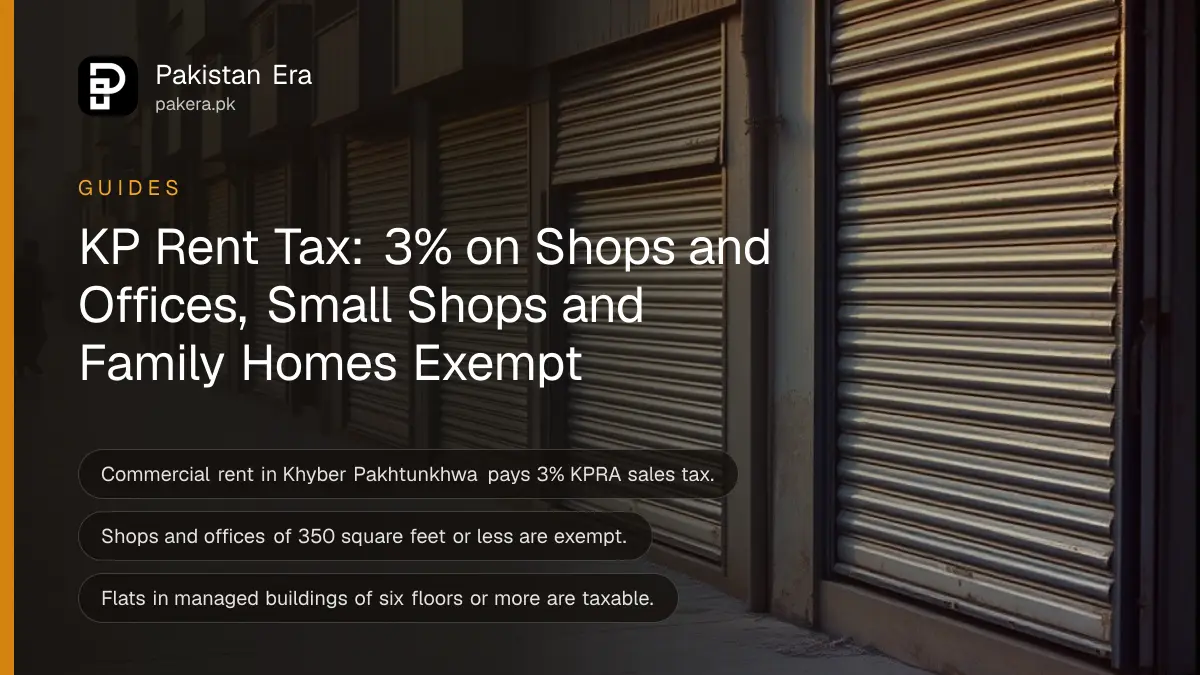
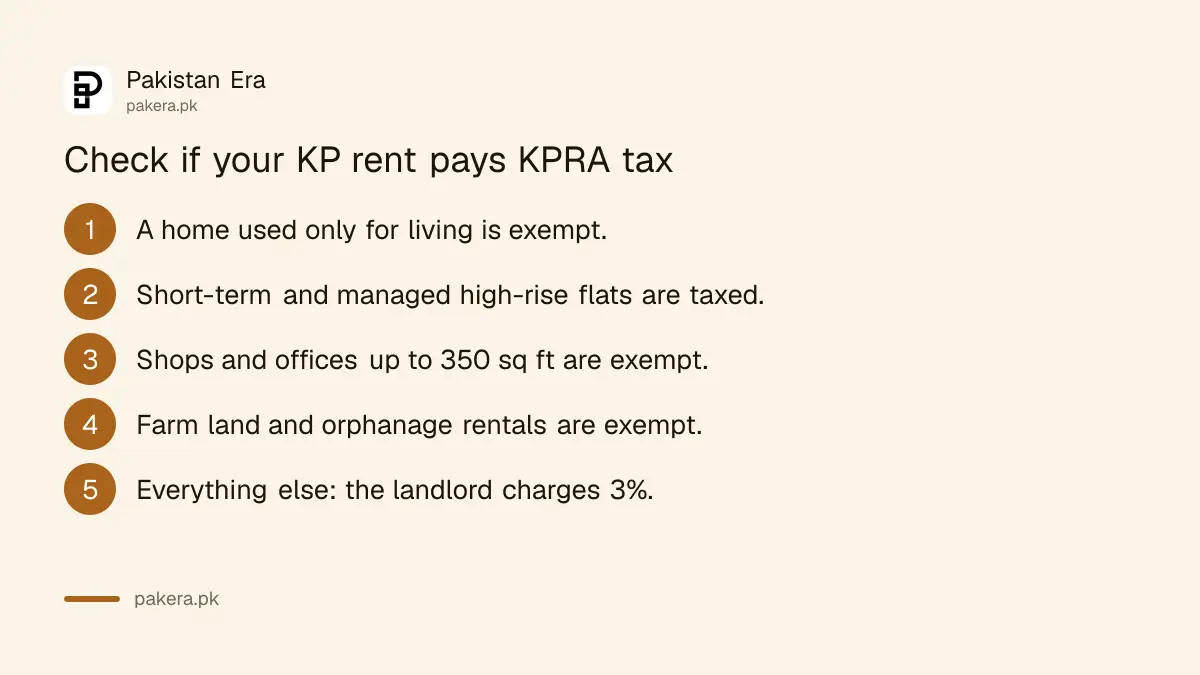
Commercial rent in Khyber Pakhtunkhwa now carries KPRA sales tax at 3%, without input tax adjustment. Shops, offices and business premises of up to 350 square feet are exempt, and so is a house rented only for living in. Flats in managed high-rise buildings and short-term rentals stay taxable.
Renting property became a named service in the Khyber Pakhtunkhwa Sales Tax on Services Act 2022 through a Gazette notification of 13 May 2026, which inserted items 38 to 44 into the Second Schedule. The exemptions sit in entry 31 of the First Schedule. We read both in the version KPRA has published with the Finance Act 2026.
Renting property pays 3% in Khyber Pakhtunkhwa
Item 38 charges 3% on rental or leasing services involving your own or leased property, and on real estate services of the same kind. The rate has no input tax adjustment. The landlord who provides the service is the person liable to pay it.
On a shop rented for Rs 100,000 a month, the tax is Rs 3,000 a month, or Rs 36,000 a year. The landlord adds it to the rent invoice, collects it from the tenant and pays it to KPRA with the monthly return.
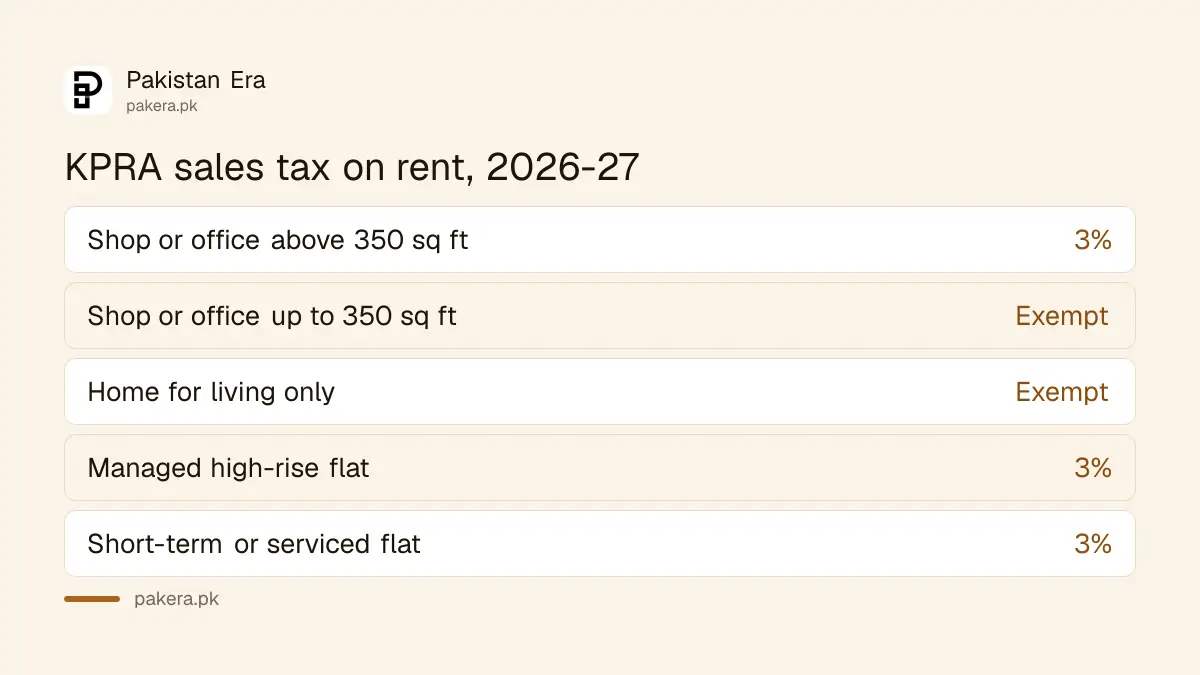
| Type of rental in Khyber Pakhtunkhwa | KPRA sales tax |
|---|---|
| Shop, office or business premises above 350 sq ft | 3% |
| Shop, office or business premises up to 350 sq ft | Exempt |
| House or building used only for living, non-commercial | Exempt |
| Flat in a managed high-rise (six or more floors) | Taxable at 3% |
| Vacation home or serviced apartment, short term | Taxable at 3% |
| Land used only for farming, livestock or forestry | Exempt |
| Renting of meters (electricity, gas, water) | 5% |
| Apartment maintenance and rent collection services | 5% |
Seven kinds of rental are exempt
Entry 31 of the First Schedule exempts rent between religious bodies, farm land, homes used only for living, hostels of recognised schools and colleges, property rented to government for public welfare projects, orphanages and shelters of registered non-profits, and small shops and offices of up to 350 square feet.
- Property rented by one religious body to another religious body.
- Vacant land or premises used only for agriculture, aquaculture, farming, forestry or animal husbandry.
- Buildings used only as homes and meant for non-commercial use.
- Buildings used only as hostels and boarding homes of a recognised educational institution.
- Property rented to government or public sector bodies for public welfare projects only.
- Buildings for orphanages or shelters run by registered non-profit organisations.
- Commercial shops, offices or business premises with a covered area of 350 square feet or less.
The 350 square foot test
The small shop exemption turns on covered area, not rent. A 300 square foot shop in a busy Peshawar bazaar pays no KPRA tax, whatever the rent. A 400 square foot office on the edge of town pays 3% on its rent. Keep the measured area in the rent agreement.
When a residential flat is taxed
A home is exempt only when it is rented for living and for non-commercial use. The proviso to entry 31 brings two kinds of home back into tax: short-term arrangements such as vacation homes and serviced apartments, and flats in high-rise buildings managed or secured by the owner or the owner's agent.
The schedule defines a high-rise building as one with six or more floors, counting basements. So a flat in a managed tower in Hayatabad with six floors including the basement is taxable at 3%. A flat in a four-storey block, or a house rented to a family, is not.
What landlords and tenants should do
A landlord with a taxable rental must register with KPRA, add 3% to each rent invoice, and file and pay monthly. A tenant should ask for a sales tax invoice and check the landlord's registration. Federal income tax on the same rent is a separate matter under FBR rules.
- Landlords: follow the steps to register with KPRA, then file the monthly KPRA return.
- Tenants: check the landlord on the KPRA active taxpayer list before paying tax on rent.
- Rent agreements: say whether the rent is inclusive or exclusive of the 3% sales tax, and record the covered area.
Rent is also taxed by FBR as income from property. The income tax on rental income applies to the landlord, and some tenants must deduct withholding tax on rent. The provincial property tax on the building is a third, separate charge, worked out through the KP property tax calculator.
Common questions
Is there sales tax on shop rent in Khyber Pakhtunkhwa?
Yes. Renting a shop, office or business premises pays 3% KPRA sales tax, unless the covered area is 350 square feet or less.
Is house rent taxed by KPRA?
No, if the house is used only for living and not for commercial use. Short-term rentals and managed high-rise flats are taxed.
When did KPRA start taxing rent?
Items 38 to 44 were inserted into the Second Schedule through a Gazette notification dated 13 May 2026, which added rental services at 3%.
Who pays the KPRA tax on rent, the landlord or the tenant?
The landlord is liable as the service provider. In practice the landlord adds the 3% to the rent and collects it from the tenant.
Can a landlord claim input tax at 3%?
No. The 3% rate on rental services is charged without any input tax adjustment.
What is a high-rise building for KPRA rent tax?
A building with six or more floors, counting basements. Flats in such buildings managed by the owner or an agent are taxable.
How we verified this
What we checked and where we read it.
Last checked 15 November 2026. The 3% and 5% rates come from Second Schedule items 36 and 38, and the exemptions from First Schedule entry 31, of the Khyber Pakhtunkhwa Sales Tax on Services Act 2022, updated with the Finance Act 2026, published on the KPRA website. Footnotes record that items 38 to 44 of the Second Schedule and entries 31 to 35 of the First Schedule were inserted through the Gazette notification of 13 May 2026. Section 10 sets liability on the registered person providing the service. Worked examples are our own arithmetic.
About the author

Tax, Bills and Technology Writer
Ali Akhtar is a young and curious voice here at Pakistan Era. He is currently pursuing his A-Levels and has a growing interest in Pakistan’s changing industrial landscape and educational trends. Ali likes to write in a way that helps him explain and explore the world around him. His writing reflects the perspective of the new generation navigating the evolving trends of Pakistan where technology, youth innovation, and shifting opportunities are reshaping the country’s future.