Tax to Deduct From Rent in Pakistan 2026-27: Who Must and How Much
Companies, clinics and big renters must deduct tax before paying rent. FBR slabs for 2026-27 run from nil to 25 per cent. See who deducts and how much.
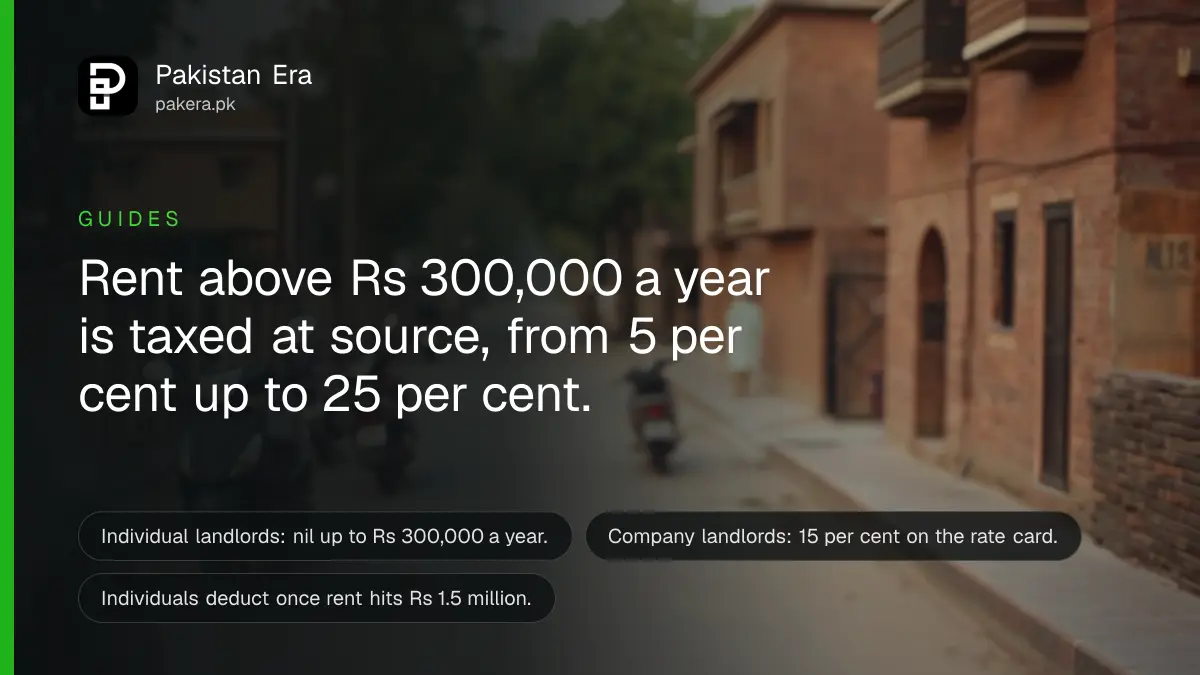
If you pay rent to an individual landlord and the total is under Rs 300,000 a year, nothing is deducted. Above that, the tax runs from 5 per cent of the excess up to a Rs 155,000 base plus 25 per cent on rent over Rs 2 million. Who has to deduct it depends on who you are.
Most renters never think about this, because most renters are individuals paying below the limit. The rule bites companies, schools, clinics, shops and large households. It also bites the landlord, who finds a smaller amount in the bank than the agreement promised.
We read the withholding tax on rent in the FBR rate card for tax year 2027 and in the Income Tax Ordinance, 2001, as amended to 30 June 2026. Both come from FBR's own download site. This page covers the tenant's duty. The landlord's own tax on rent sits in what landlords in Pakistan pay in tax on rent.
The rule: a prescribed person must deduct tax before paying rent
Section 155 of the Ordinance says a prescribed person who pays rent must deduct tax from the gross amount. Gross rent includes advance payments, rent of furniture and fixtures, and amounts for services connected with the property. It applies whatever head of income the rent falls under. A non-adjustable deposit counts too, because gross rent includes the amount covered by section 16.
One more point. The Ordinance used to say this deduction was the landlord's final tax. That sub-section was omitted by the Finance Act, 2010. So the Ordinance no longer makes the deduction final. The landlord still declares the rent in the return and counts the deducted tax against it.
Who counts as a prescribed person
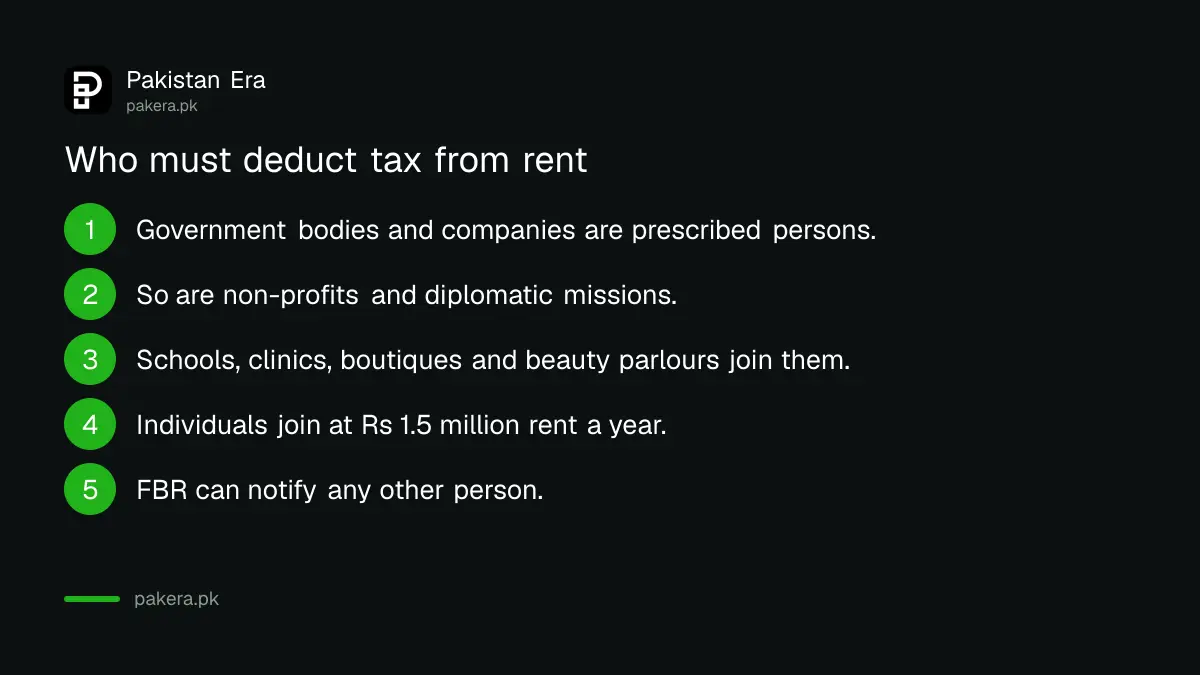
You are a prescribed person if you are a government body, a company or an organisation of the kinds listed in section 155(3). An individual or association of persons joins the list once gross rent paid reaches Rs 1.5 million in a year. That is Rs 125,000 a month.
The list we read in the Ordinance is this:
- The Federal Government, a Provincial Government or a Local Government.
- A company.
- A non-profit organisation or a charitable institution.
- A diplomatic mission of a foreign state.
- A private educational institution, a boutique, a beauty parlour, a hospital, a clinic or a maternity home.
- An individual or association of persons paying gross rent of Rs 1.5 million or more in a year.
- Any other person FBR notifies for this section.
So a family paying Rs 80,000 a month deducts nothing, because the year's rent is Rs 960,000. A beauty parlour paying the same Rs 80,000 does deduct, because the Ordinance names it.
The 2026-27 rates when the landlord is an individual
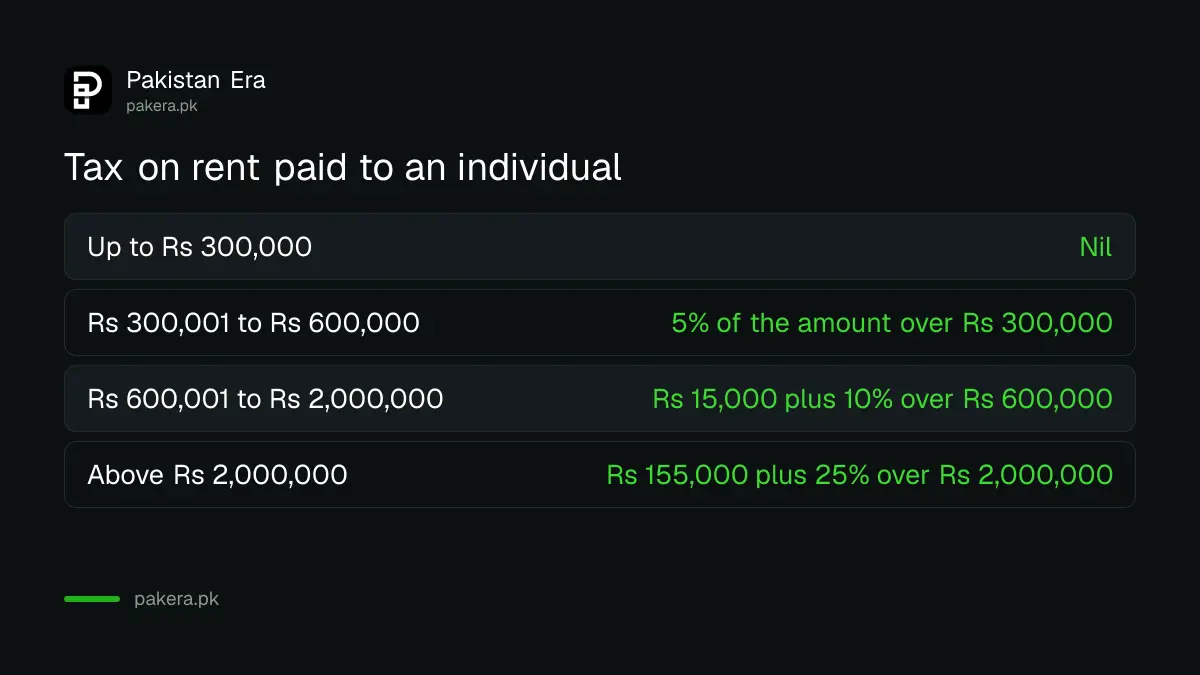
When the person being paid is an individual or association of persons, the rate is a slab on the annual gross rent. Nothing is deducted up to Rs 300,000. Above that, 5 per cent applies to the excess, then Rs 15,000 plus 10 per cent, then Rs 155,000 plus 25 per cent.
| Gross rent in a year | Tax to deduct |
|---|---|
| Up to Rs 300,000 | Nil |
| Rs 300,001 to Rs 600,000 | 5 per cent of the amount over Rs 300,000 |
| Rs 600,001 to Rs 2,000,000 | Rs 15,000 plus 10 per cent of the amount over Rs 600,000 |
| Above Rs 2,000,000 | Rs 155,000 plus 25 per cent of the amount over Rs 2,000,000 |
The rate card prints this slab once for individuals and associations of persons. It does not show a separate higher rate for a landlord who is not on the Active Taxpayer List. The Ordinance itself, in Division V of Part III of the First Schedule, carries the same four slabs.
The rate when the landlord is a company
When the person being paid is a company, the card shows a flat 15 per cent for a landlord on the Active Taxpayer List and 30 per cent for one who is not. There are no slabs. A company landlord is charged on the whole gross rent from the first rupee.
The Ordinance text for Division V gives 15 per cent for a company. The 30 per cent figure comes from the card, which cites the Tenth Schedule. We have not traced that rule, so ask your adviser before you deduct 30 per cent.
Worked examples with real rent figures
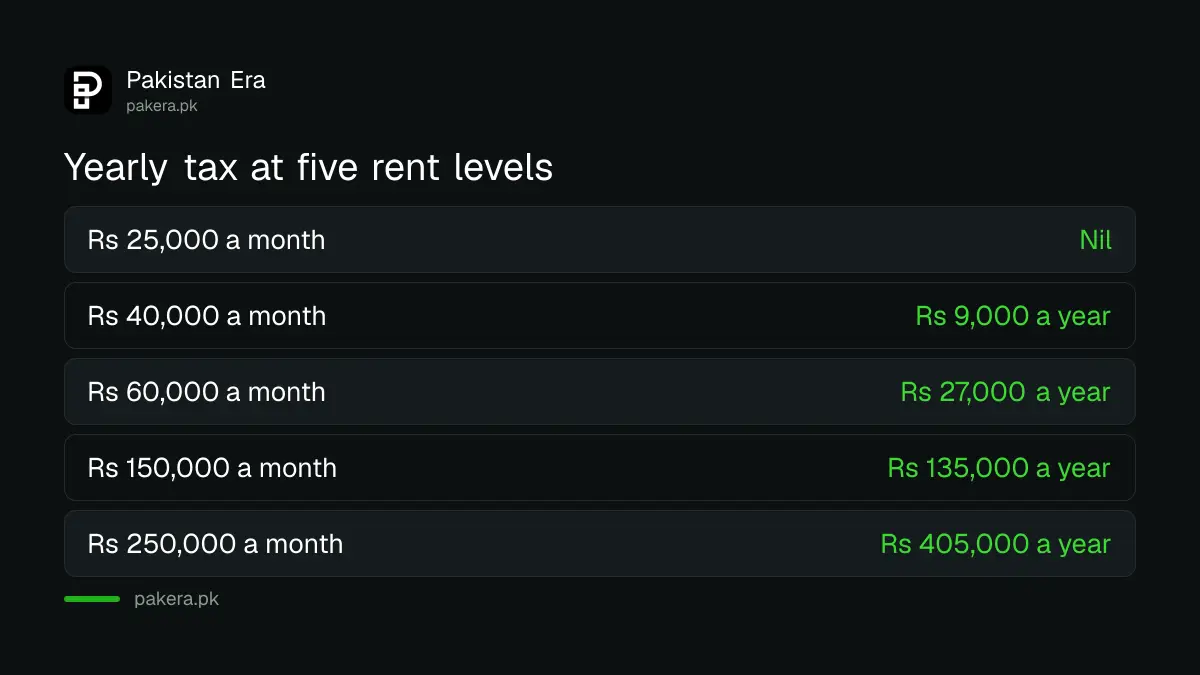
Annual rent decides everything, so multiply the monthly rent by twelve first. Then find the row in the table. These examples assume the tenant is a prescribed person and the landlord is an individual.
- Rs 25,000 a month is Rs 300,000 a year. Tax to deduct: nil.
- Rs 40,000 a month is Rs 480,000 a year. Tax: 5 per cent of Rs 180,000, which is Rs 9,000 a year.
- Rs 60,000 a month is Rs 720,000 a year. Tax: Rs 15,000 plus 10 per cent of Rs 120,000, which is Rs 27,000 a year.
- Rs 150,000 a month is Rs 1,800,000 a year. Tax: Rs 15,000 plus 10 per cent of Rs 1,200,000, which is Rs 135,000 a year.
- Rs 250,000 a month is Rs 3,000,000 a year. Tax: Rs 155,000 plus 25 per cent of Rs 1,000,000, which is Rs 405,000 a year.
We found no monthly table in the card or the Ordinance. How a payer spreads the annual figure through the year is a point to settle with an adviser.
What to do on payment day
Deduct the tax, pay the landlord the rest and deposit the tax with FBR. Then give the landlord evidence of the deduction. That evidence is what lets the landlord claim credit when filing.
- Confirm you are a prescribed person, using the list above.
- Add up the gross rent for the year, including advances and any service charges.
- Check whether the landlord is an individual or a company, and find the matching rate.
- Deduct the tax from the payment and pay the balance to the landlord.
- Deposit the tax with FBR. Paying with a PSID is the usual route.
- Give the landlord proof of the deduction, and keep a copy for your own records.
Our view: do not leave this to memory. If your rent agreement is written at a net figure, change it before the next payment so both sides know who bears the tax. A company that has paid rent for years without deducting should ask an adviser what it owes now.

What the landlord should check
Expect a smaller transfer from any company, clinic or school tenant. Ask for proof of deduction every time. Then declare the full gross rent, not the amount that reached your account, when you file your income tax return.
Tenancy law is separate. How much a landlord can raise rent sits under provincial law, and a rent agreement on stamp paper is the usual written form.
Common questions about tax on rent
Do I deduct tax if I rent a house as an individual?
Only if your gross rent reaches Rs 1.5 million in a year, which is Rs 125,000 a month. Below that an individual is not a prescribed person.
Is there a limit below which no tax is deducted?
Yes. For an individual landlord the rate is nil on gross rent up to Rs 300,000 in a year. A company landlord has no such limit on the rate card.
Does the tax apply to a security deposit?
Yes, when the deposit is a non-adjustable amount. The Ordinance says gross rent includes the amount covered by section 16, and it also covers advance payments.
Is the deducted tax the landlord's final tax?
No. The sub-section that made it final tax was omitted in 2010. The landlord declares the rent and counts the deduction as tax already paid.
What if I do not deduct the tax?
We did not read the penalty provisions for this duty, so we cannot give you a figure. Missing a deduction is a compliance failure for the payer, so speak to an adviser early.
How we verified this
What we checked, where we read it, and what we could not confirm.
Last checked 7 October 2026. We read the FBR Withholding Income Tax Rate Card, updated up to 30 June 2026 as per Finance Act, 2026, on FBR's download site, and section 155 and Division V of Part III of the First Schedule in the Income Tax Ordinance, 2001, amended up to 30 June 2026. The card says the statute prevails if the two differ. We have not traced the Tenth Schedule rule behind the non-listed rate and have not read the penalty sections for this duty. Nothing here is tax advice.
About the author

Tax, Bills and Technology Writer
Ali Akhtar is a young and curious voice here at Pakistan Era. He is currently pursuing his A-Levels and has a growing interest in Pakistan’s changing industrial landscape and educational trends. Ali likes to write in a way that helps him explain and explore the world around him. His writing reflects the perspective of the new generation navigating the evolving trends of Pakistan where technology, youth innovation, and shifting opportunities are reshaping the country’s future.