How KPPSC Scores Candidates in Khyber Pakhtunkhwa: 100 Marks, 50 for the Interview
KPPSC marks non-test posts out of 100: 30 academic, 50 interview, up to 10 for experience. See how each mark is counted and the 60 percent interview pass mark.
Short answer: For posts without a syllabus based exam, KPPSC scores each candidate out of 100: 30 for academic record, 50 for the interview, up to 10 for experience, and small marks for a first position, Hifz-ul-Quran and extra qualifications. The interview pass mark is 60 percent.
Two candidates with the same degree can land far apart on a KPPSC merit list. The gap often comes from the interview and from small marks that people forget to claim, such as a board position or extra experience.
We read KPPSC's Marking System document, listed in the downloads on its website, on 14 October 2026. It is regulation 29 of the Commission's rules and applies to posts filled other than by a syllabus based competitive examination. The document has no date, and KPPSC has amended its regulations since. Check your advertisement for any change.
The 100 marks split into seven parts
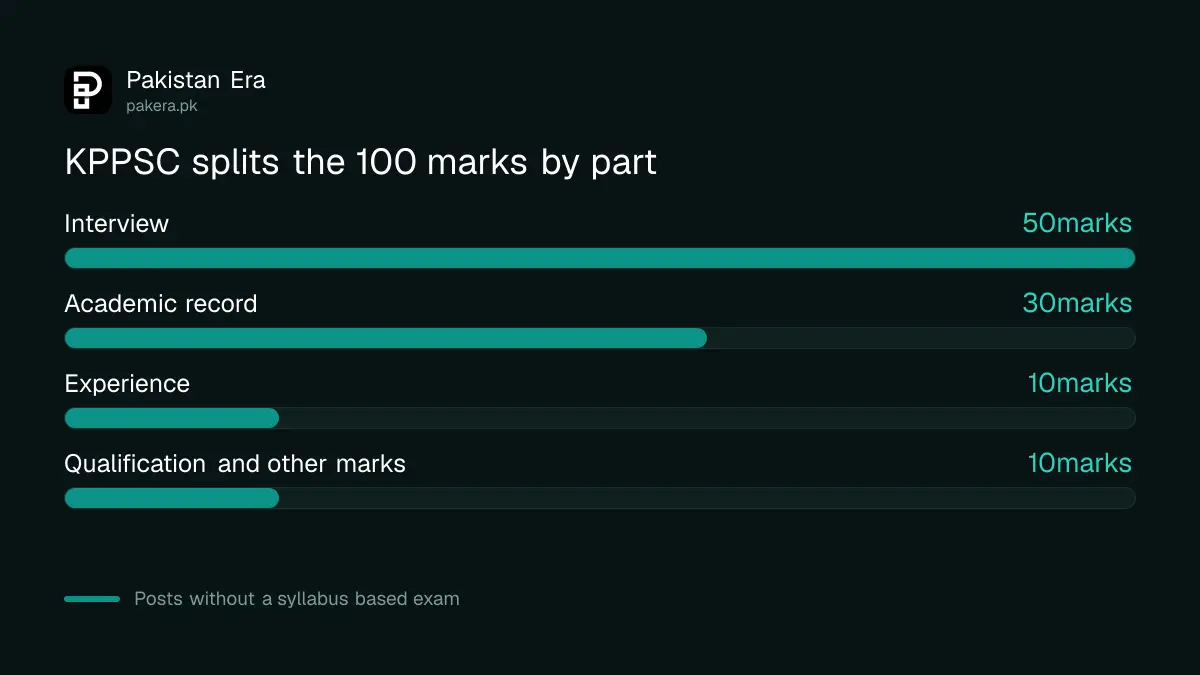
The 100 marks are shared between academic record (30), a first position in a board or university (2), Hifz-ul-Quran (3), an additional relevant qualification (2), a higher relevant qualification (3), experience (10) and the interview (50). The interview alone carries half the score.
| Part | Marks |
|---|---|
| Academic record | 30 |
| Standing first in board or university | 2 |
| Hifz-ul-Quran | 3 |
| Additional relevant qualification | 2 |
| Higher relevant qualification | 3 |
| Experience | 10 |
| Interview | 50 |
The marks from a screening test or an ability test count only for shortlisting. They are not added to this 100. So a high test score gets you an interview call, but it does not carry forward.
Academic marks use percentages, not divisions
KPPSC counts your last three board or university results, and turns them into a percentage of the 30 marks. A candidate with 2,150 out of 3,650 gets 17.67 marks, which rounds to 18. A fraction of 0.5 or more becomes a full mark.
For professional posts, the last three or four professional examinations are used, based on percentage, not on division. For non-professional posts, the last three board or university examinations count. For a lecturer post, the Intermediate, Bachelor and Master results count.
Where the basic qualification is only Intermediate or a Bachelor degree, the last two or three examinations including Matriculation are taken. If you cannot show proof of marks for an examination, KPPSC treats you as having passed in parts, with the lowest passing marks. Keep every marks sheet ready, as our guide to checking your KPPSC result, DMC and interview letter also advises.
- Add the marks you obtained in each counted examination.
- Add the total marks of the same examinations.
- Divide obtained by total and multiply by 30.
- Round 0.5 and above up to the next mark, and ignore anything below 0.5.
Experience earns one mark a year after the minimum
Experience marks apply only when experience is part of the required qualification. KPPSC deducts the minimum required period first. It then gives one mark per extra year up to five years, then one mark for every two completed years. Part years are ignored.
If the post needs no experience, the 10 experience marks are added to the interview, which then carries 60. For teaching or specialist posts in medicine, one mark per year counts after the required postgraduate qualification, and earlier experience counts only for eligibility.
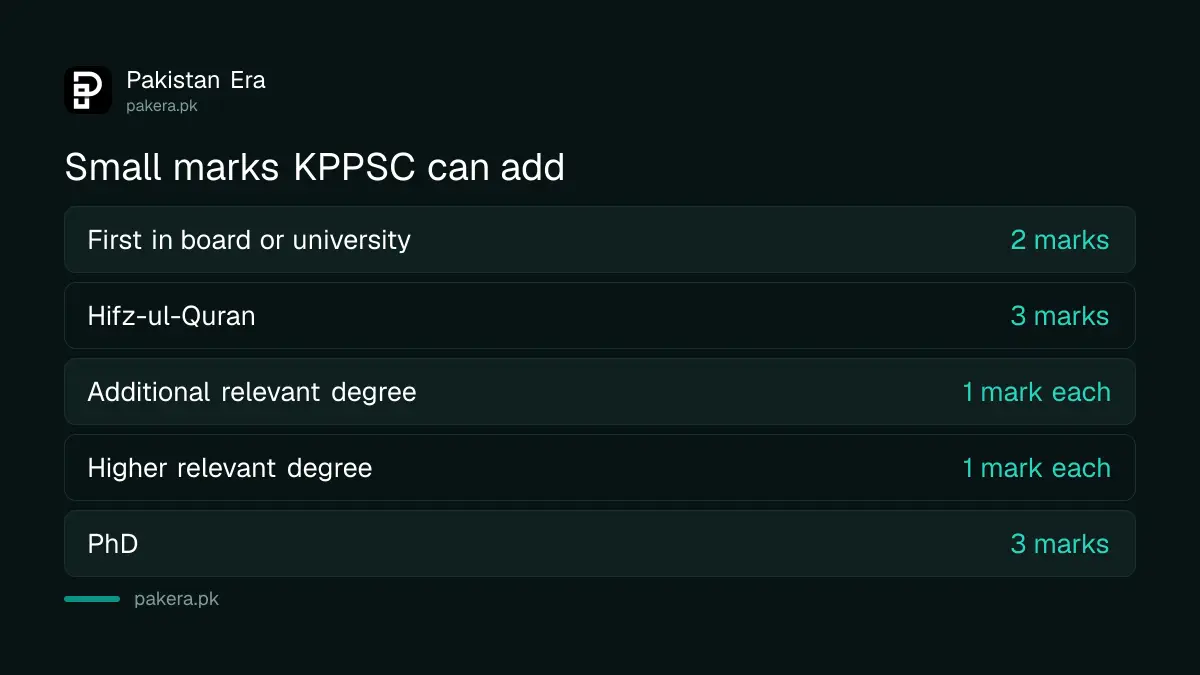
The same page of rules gives small marks for extras. Two marks go to a candidate who stood first in the last board or university exam, but only if the result was 60 percent (Grade B) or more. Hifz-ul-Quran gets 3 marks, awarded after testing in the interview. Each additional or higher relevant diploma or degree gets one mark, and a PhD gets three. A repeat of the same degree earns nothing.
You must score 60 percent in the interview
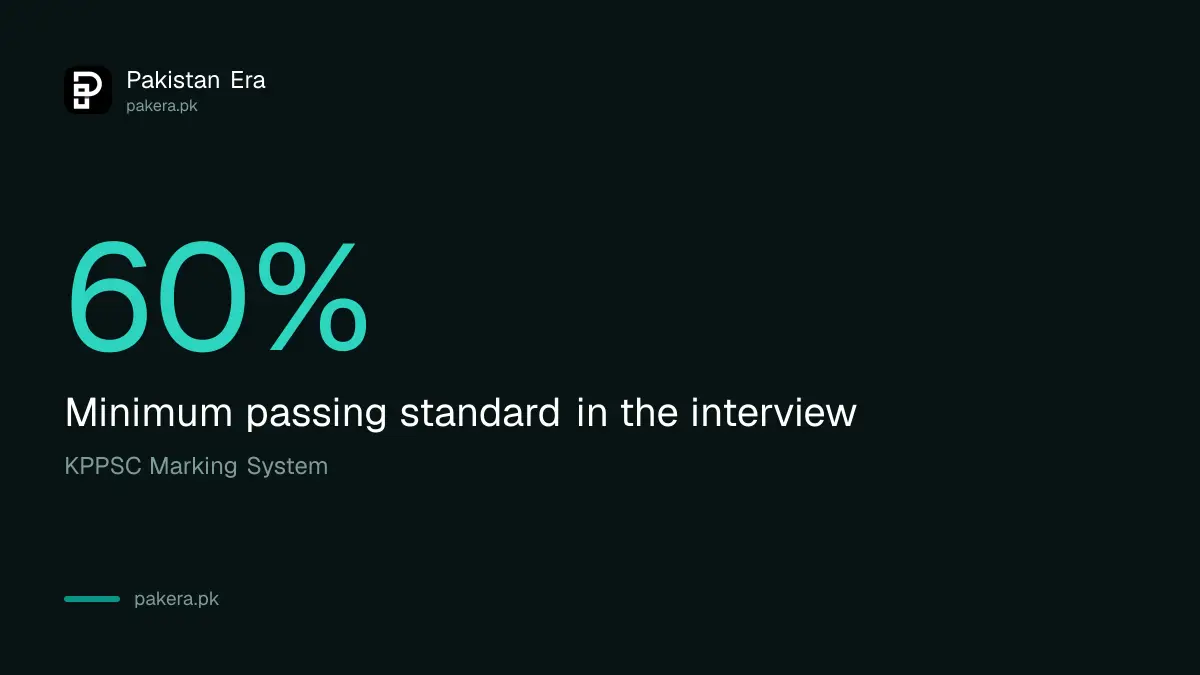
KPPSC sets the minimum passing standard in the interview at 60 percent. On a 50 mark interview, that is 30 marks. Your academic marks cannot rescue a failed interview, so prepare for it as seriously as for a written test.
Check the dates and panels when the Commission publishes them. The KPPSC interview programme for November 2026 lists posts, panels and dates. Bring original documents for each claim you made on the form, because the marks above depend on proof.
You can also see how results appear in practice in our look at KPPSC test results by CNIC. Our other guide on applying for KPPSC jobs online covers the application step. Recruitment for some posts goes through the PMS exam and not this scoring, so read the advertisement first.
Common questions
How many marks is the KPPSC interview worth?
It is worth 50 of the 100 marks, and the pass mark is 60 percent. If experience is not a requirement, its 10 marks join the interview.
Do KPPSC screening test marks count in the final merit?
No. KPPSC's marking rules say screening and ability test marks count only for shortlisting.
How does KPPSC count experience marks?
Only when experience is required. It deducts the minimum period, then gives one mark per extra year up to five years, then one mark per two years.
Does a PhD earn extra marks?
Yes, three marks for a PhD or equivalent relevant qualification. Other relevant diplomas or degrees earn one mark each, within the marks set for that part.
Does this scoring apply to every KPPSC post?
No. It covers posts filled other than by a syllabus based competitive examination. Posts like PMS follow their own written exam rules.
How we verified this
What we checked, where we read it, and what we could not confirm.
Last checked on 14 October 2026, Pakistan time. We read the KPPSC downloads page and its Marking System document. The document is undated, and we could not confirm whether a later regulation amendment changed any figure. We also did not check how each advertisement applies it to a specific post.
About the author

Senior Writer, Public Services and Technology
Shahid joined us in 2024 as an author. He is a senior contributor to Pakistan's leading technology websites. He writes detailed articles, mostly covering his expertise in the latest tech, mobiles, apps, gadgets, and step-by-step guides. His ideology is to help people understand the latest trends and explain complex methods through very easy-to-understand guides.