Private DNA Test Cannot Stop Child Maintenance in Punjab, Lahore High Court Rules, Rs 25,000 a Month Upheld
The Lahore High Court ruled a DNA test a father arranged privately cannot beat Article 128 or stop child maintenance, and upheld Rs 25,000 a month in Punjab.
یہ صفحہ اردو میں پڑھیں
A father cannot stop paying child maintenance in Punjab by showing a DNA report he arranged privately. The Lahore High Court has ruled that such a report, taken without a court order and without the mother's consent, cannot displace the legal presumption that a child born during a marriage is the husband's child. The judgment, approved for reporting, was uploaded to the court's reported judgments page on 16 November 2026.
The court also upheld a raise in the child's maintenance from Rs 10,000 to Rs 25,000 a month, with a 10 per cent rise every year. For mothers fighting maintenance cases, and for fathers thinking of a DNA test, the ruling sets out clear limits.

What the Lahore High Court decided
The court dismissed a father's petition against two lower court decrees in Gujranwala. It held that a child born during a valid marriage is the husband's legitimate child, and that a private DNA report cannot undo that. The maintenance, iddat and dowry awards all stand.
Justice Asad Ali Bajwa decided Writ Petition No. 50430 of 2026 after a hearing on 21 October 2026. The father, who lives in England, had challenged a Family Court decree of 6 October 2025 and an appeal decree of 6 July 2026.
| Claim | Family Court, Gujranwala | After appeal (upheld by the High Court) |
|---|---|---|
| Child maintenance | Rs 10,000 a month, 10% yearly rise | Rs 25,000 a month, 10% yearly rise |
| Wife's maintenance for iddat | Rs 12,000 a month, Rs 36,000 in total | Unchanged |
| Dowry articles | Listed items, or Rs 970,000 as their value | Unchanged |
| Dower | Claim declined | Unchanged |
Why the private DNA report failed
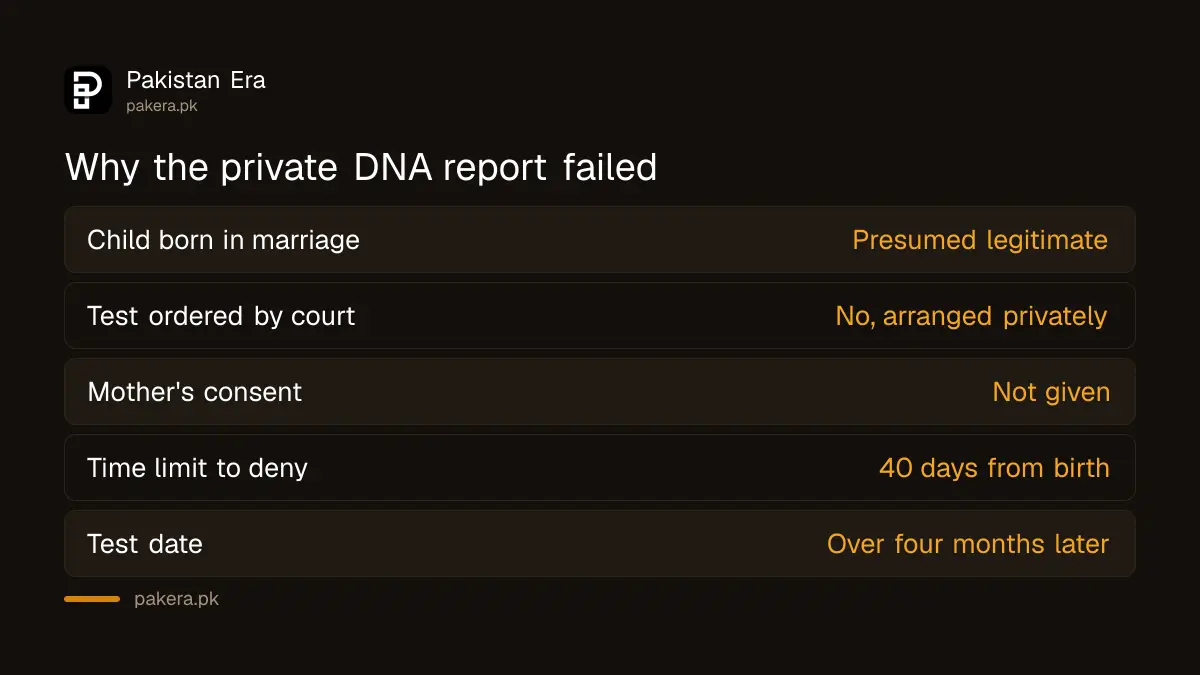
The father arranged the DNA test himself, without any court supervising it and without the mother agreeing. The court said a one-sided report like this cannot override the conclusive presumption of legitimacy in Article 128 of the Qanun-e-Shahadat Order, 1984.
Article 128 says a child born during a valid marriage, and not earlier than six lunar months after it, is conclusive proof that the child is the husband's. The court listed the facts that settled it here:
- The marriage took place on 18 August 2019 and the child was born on 27 April 2022, while the marriage was intact.
- The father went with the mother to the hospital for the delivery, as his own witness admitted.
- The father's mother was also at the hospital at the time of the birth.
- The trial court had already rejected the paternity denial on 5 April 2023.
The judgment also points to the time limit for denying paternity under Muslim law. Relying on an earlier Supreme Court ruling, it says a father who wants to challenge paternity can do so within 40 days of the birth at most. This DNA test was done on 5 September 2022, more than four months after the birth.
A secret DNA test breaks privacy rights, the court said
The court held that taking a child's sample without the mother's consent and without a court's permission violates the dignity and privacy of both mother and child under Articles 9 and 14 of the Constitution. Even a court must ask whether a DNA test is in the child's best interest.
The judgment says a court can order a DNA test only with the consent of the person concerned, or without consent where a law allows it. It warned that if courts accepted privately arranged reports in general, it "would amount to create anarchy in the society". A child, the court said, cannot speak for itself but still has rights to privacy, dignity and protection from emotional harm.
How the court judged the maintenance amount
Child maintenance depends on two things: what the child reasonably needs, and what the father can pay. A father who claims he has no income must prove it. Here, his family admitted he lived in the United Kingdom and sent money home, so the raise to Rs 25,000 stood.
The court said maintenance covers food, clothing and housing, plus school, health care and the other needs of a growing child. It should match the family's social status, so a child is not held back because the marriage ended. If a father cannot earn, the duty can pass to the paternal grandfather if he can afford it.
For a mother still to file, the steps are the same as before this ruling:
- File a suit for maintenance in the Family Court of your district. The court fee is Rs 15.
- Ask the court to fix interim maintenance on the father's first appearance.
- If he denies paternity, put the birth date, the marriage date and any hospital record on file.
- Oppose any private DNA report. Cite Article 128 and this judgment, which is published as 2026 LHC 8831.
- Ask for an annual increase in the decree. If the court sets none, the Family Courts Act adds 10 per cent a year automatically.
The full process, including documents, is in the guide to filing a maintenance case in a Punjab family court. A wife's own claim is covered under claiming wife maintenance in Pakistan.
The dowry claim also stood
The mother claimed dowry worth Rs 4,673,983. The Family Court accepted only part of the list and valued the proven items at Rs 970,000. The High Court refused to disturb that, because the lower courts had weighed the evidence item by item.
The father's side argued she had not proved the dowry. The court noted that his own witness admitted her brothers were businessmen who could afford a dowry, and that the father produced no evidence to the contrary. The steps for recovering dowry and haq mehr in Punjab show how to build that list.
Common questions
Can a father refuse child maintenance by getting a DNA test?
Not with a private test. The Lahore High Court held that a DNA report arranged without a court order and without the mother's consent cannot displace the presumption that a child born during the marriage is the husband's child.
Can a family court order a DNA test in Pakistan?
The judgment says a court can order one only with the consent of the person concerned, or where a law permits it, and must first ask whether the test serves the child's best interest. It is not ordered on a simple request.
Is there a time limit to deny paternity?
The judgment, relying on an earlier Supreme Court ruling, says a Muslim father who wants to challenge paternity can do so within a maximum of 40 days from the birth.
Does child maintenance go up every year in Punjab?
Yes. If the Family Court does not set an annual increase, section 17-A of the Family Courts Act raises the maintenance automatically by 10 per cent each year.
What if the father lives abroad and says he has no income?
He has to prove it. In this case the court relied on his family's admissions that he lived in the United Kingdom and sent money home, and upheld Rs 25,000 a month.
Can this judgment be appealed?
A High Court judgment can be challenged before the Supreme Court within the time the law allows. Until any higher court says otherwise, it stands as a reported Lahore High Court ruling.
How we verified this
What we checked and where we read it.
We read the full judgment in Writ Petition No. 50430 of 2026, decided by Justice Asad Ali Bajwa, on 17 November 2026. It is listed on the Lahore High Court reported judgments page with an upload date of 16 November 2026, file 2026LHC8831. The Rs 15 court fee and the 10 per cent automatic increase come from sections 19 and 17-A of the Family Courts Act, 1964, read on the Punjab Code the same day. Party names are left out on purpose. To find other rulings, see searching Lahore High Court judgments online.
About the author

Global Affairs & Political Economy Writer
Muhammad Hatim is a book lover who started writing because he enjoys it. At Pakistan Era he writes about international relations, geopolitics and the global economy, with a particular interest in South Asia and the forces behind current events.