Nipah Virus and Pakistan: What NIH's Alert Says on Symptoms, Travel From India and Date Palm Sap
NIH's Nipah alert says Pakistan had no human case on 28 January 2026. See the signs, the 21 day watch after travel from India and the date palm sap risk.
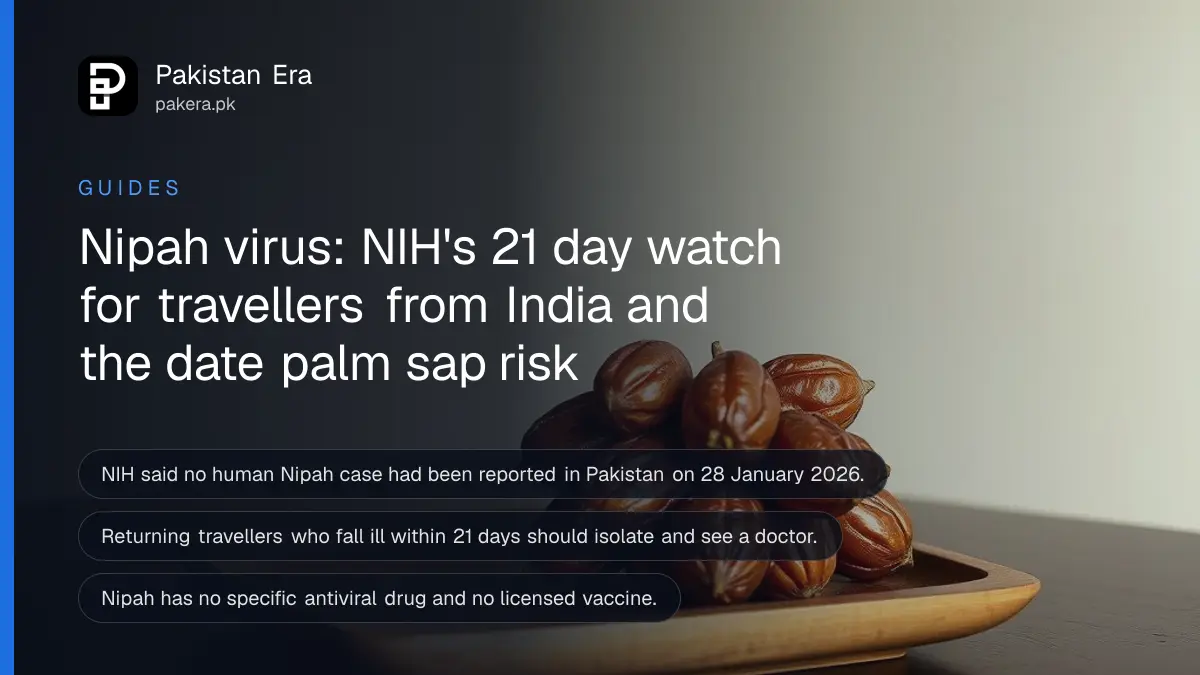
Short answer: NIH's Nipah alert of 28 January 2026 said Pakistan had not reported a human case, but asked doctors and border health staff to watch for imported ones after an outbreak in West Bengal, India. If you return from an affected area and develop fever, headache or confusion within 21 days, self-isolate and tell a doctor where you travelled.
A man lands in Lahore from Kolkata. Three days later he has a fever, a bad headache and a sore throat. He assumes it is flu. A doctor who does not ask where he has been could miss something rare and dangerous.
We read the National Institute of Health (NIH) alert on the Nipah virus outbreak in West Bengal, India, F.No.1-22/Advisory/CDC/2026, dated 28 January 2026, in full on 13 October 2026. It is the newest Nipah item on NIH's advisories list. It is a technical alert for health departments, and we have turned it into plain guidance. We did not find any later NIH notice on this virus, so treat the case picture below as of 28 January 2026.
What Nipah is and how dangerous it is
NIH calls Nipah virus a highly pathogenic virus that spreads from animals to people and causes severe respiratory illness and fatal brain inflammation. It puts the case fatality rate at 40 to 75 percent and says the virus can also pass from person to person.
The alert said that, as of January 2026, an outbreak had been confirmed in West Bengal with at least five confirmed cases, including health workers in Kolkata. The World Health Organization (WHO) says Nipah outbreaks occur almost every year in Bangladesh, with periodic reports from India.
There is no specific antiviral treatment and no licensed vaccine, NIH says. Care is supportive, and severe patients may need intensive care. NIH adds that the clinical value of ribavirin is inconclusive and that it is not routinely recommended.
The signs and the timing
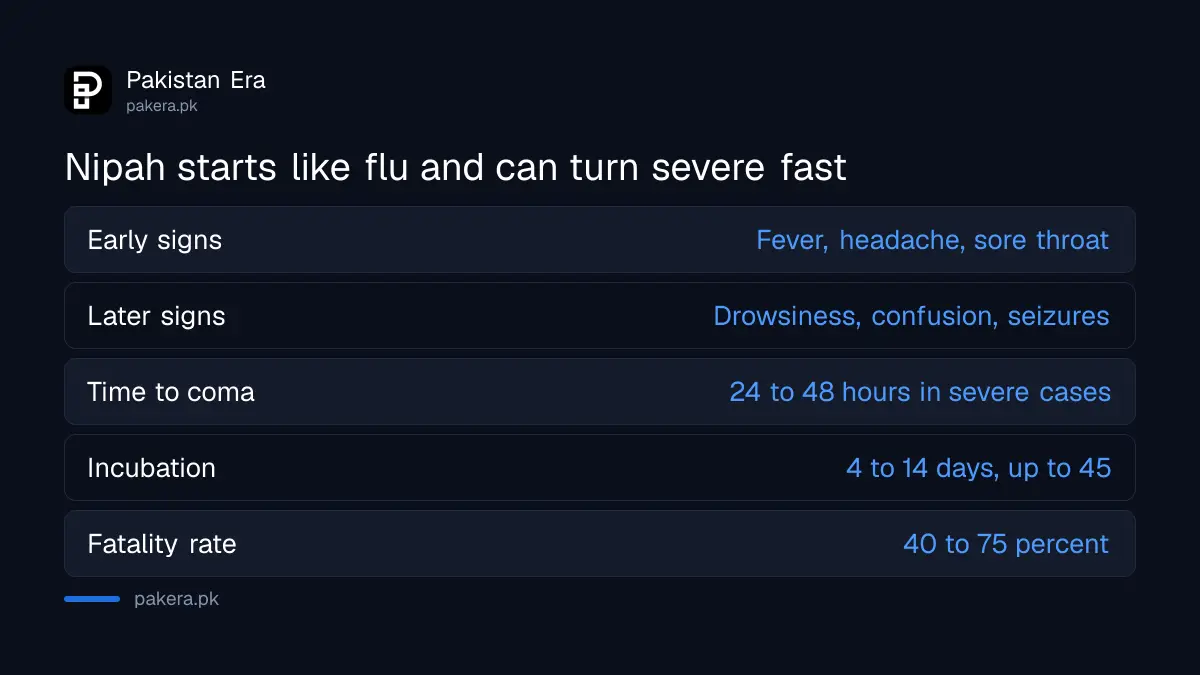
NIH lists fever, headache, muscle pain, vomiting and sore throat first. It can progress to dizziness, drowsiness, altered consciousness and seizures, and then coma within 24 to 48 hours. The incubation period is usually 4 to 14 days, and as long as 45 days has been documented.
WHO gives a similar picture, with fever, headache, confusion, breathing difficulty or cough, and says about one in five survivors has long term brain effects.
These first signs look like flu, typhoid or dengue. What makes a doctor think of Nipah is the travel and exposure history. So the history you give matters more than the symptom list.
How people catch it
NIH names three routes. First, food contaminated with the saliva or urine of fruit bats, such as raw date palm sap. Second, direct contact with infected animals, mainly fruit bats or pigs. Third, close unprotected contact with an infected person's secretions or body fluids, often in healthcare settings.
WHO adds practical steps for the food route. Boil freshly collected date palm juice, wash and peel fruit, and discard any fruit with bite marks. Handle sick animals with protective gear, and keep strict hygiene in clinics and hospitals.
Another animal-linked infection, CCHF, spreads through tick bites and animal contact, as set out in checking for CCHF after a tick bite or animal contact.
What NIH asks of travellers
NIH's alert tells travellers to avoid contact with symptomatic people or contaminated materials. Anyone who returns from an affected area and develops symptoms within 21 days should self-isolate, seek medical attention and tell the provider about travel and exposure.
It also says three groups should avoid any travel, including international travel, until they no longer pose a risk: suspected, probable or confirmed cases, identified contacts under the 21-day monitoring period, and people with compatible symptoms.
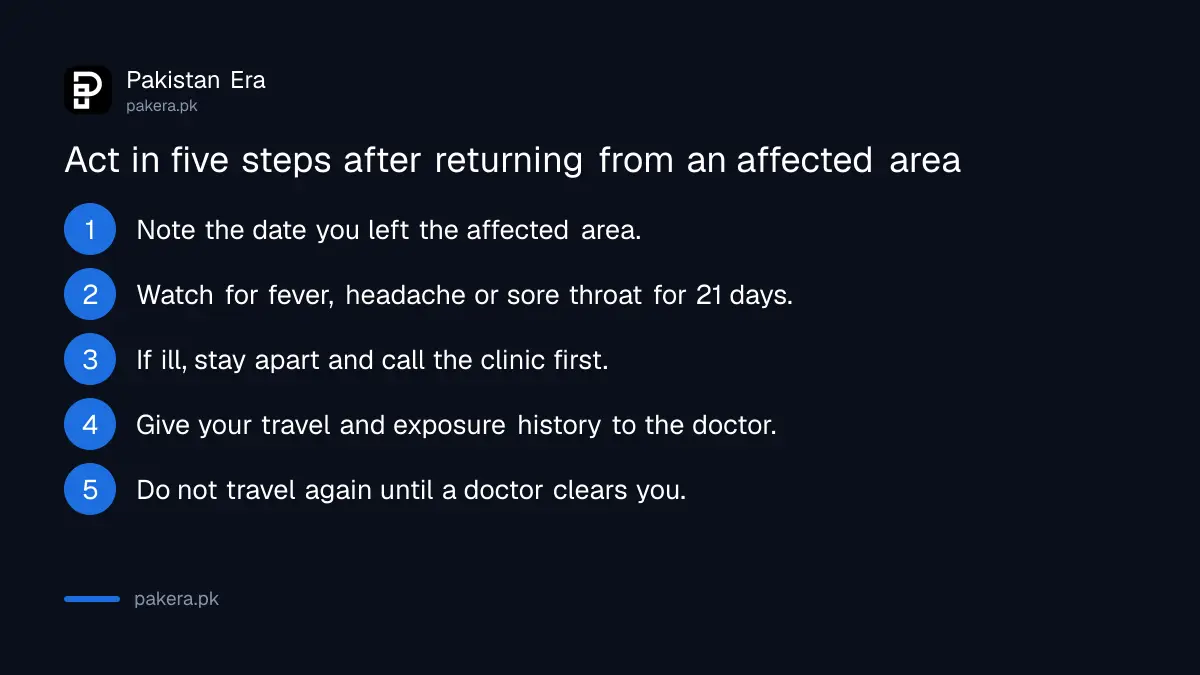
- Note the date you left the affected area.
- Watch for fever, headache, sore throat or confusion for 21 days.
- If symptoms start, stay apart from others and call the clinic first.
- Tell the doctor your travel history and any contact with animals or sick people.
- Do not travel again until a doctor clears you.
What the health system is told to do
NIH asks every province to name at least one tertiary hospital or infectious disease unit with trained staff, PPE including N95 masks and clear referral paths. Samples go in triple packaging at 2 to 8 degrees Celsius to NIH's virology department in Islamabad for RT-PCR confirmation.
At points of entry, NIH asks for thermal screening and contingency plans for travellers from affected areas, with a risk based approach that names West Bengal and Kerala. Rapid response teams are to be on standby, and emergency operations centres on watch mode.
| Question | What NIH's alert says |
|---|---|
| Human case in Pakistan | None reported as of 28 January 2026 |
| Incubation | Usually 4 to 14 days, up to 45 days documented |
| Fatality rate | 40 to 75 percent |
| Treatment and vaccine | No specific antiviral, no licensed vaccine |
| Monitoring period for contacts | 21 days |
| Confirmation test | RT-PCR at NIH Islamabad |

Mpox is another infection that can arrive with travellers, and its signs are listed in how to spot mpox and what to do in Pakistan.
Common questions
Has Pakistan reported a Nipah case?
NIH's alert of 28 January 2026 said no human case had been reported in Pakistan. We found no later NIH notice, and we could not check current counts.
Is there a vaccine for Nipah?
No. NIH says there is no specific antiviral treatment and no licensed vaccine. WHO says the same.
How long should I watch for symptoms after travel?
NIH uses a 21 day monitoring period for contacts and for returning travellers. The incubation is usually 4 to 14 days, but up to 45 days has been documented.
Is raw date palm sap safe?
NIH lists fruit products such as raw date palm sap as a route of infection, because bats can contaminate it. WHO advises boiling freshly collected date palm juice.
Where are suspected cases tested?
NIH says samples go to its virology department in Islamabad for RT-PCR confirmation. A doctor, not the patient, arranges this.
How we verified this
What we checked, where we read it, and what we could not confirm.
Last checked on 13 October 2026, Pakistan time. We read NIH's advisories page and its alert PDF dated 28 January 2026, and the WHO Nipah virus fact sheet. The WHO fact sheet gives an incubation of 3 to 14 days; we use NIH's 4 to 14 for Pakistan. We could not verify the outbreak's current status or any airport screening in practice. This page does not replace a doctor.
About the author

Senior Writer, Public Services and Technology
Shahid joined us in 2024 as an author. He is a senior contributor to Pakistan's leading technology websites. He writes detailed articles, mostly covering his expertise in the latest tech, mobiles, apps, gadgets, and step-by-step guides. His ideology is to help people understand the latest trends and explain complex methods through very easy-to-understand guides.