Pakistan Railways Refunds Half Your Fare After the Train Leaves
Ninety per cent back 48 hours ahead, and up to half within three hours after the train has gone. Complaints carry published deadlines.
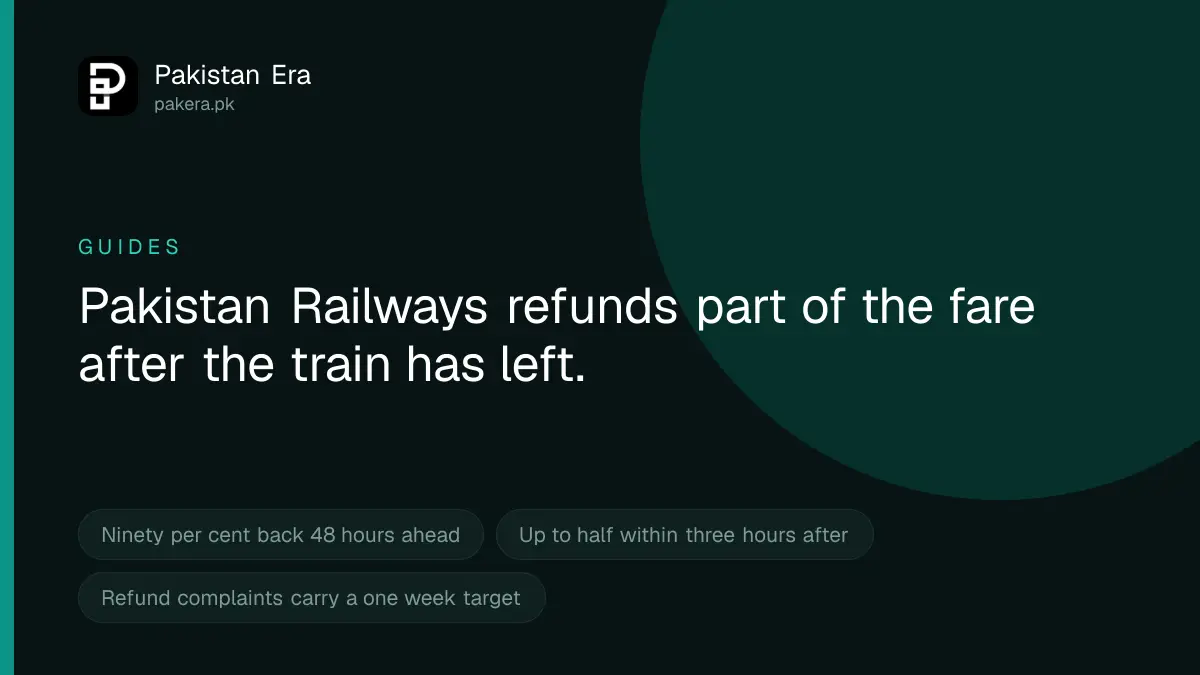
Pakistan Railways refunds up to half your fare for three hours after the train has already left. Most people assume a missed train means the money is gone, so they never ask.
Cancel earlier and you get more. Ninety per cent comes back if you cancel more than 48 hours ahead.
We read the refund policy and the complaint resolution times on pakrail.gov.pk on 8 September 2026.
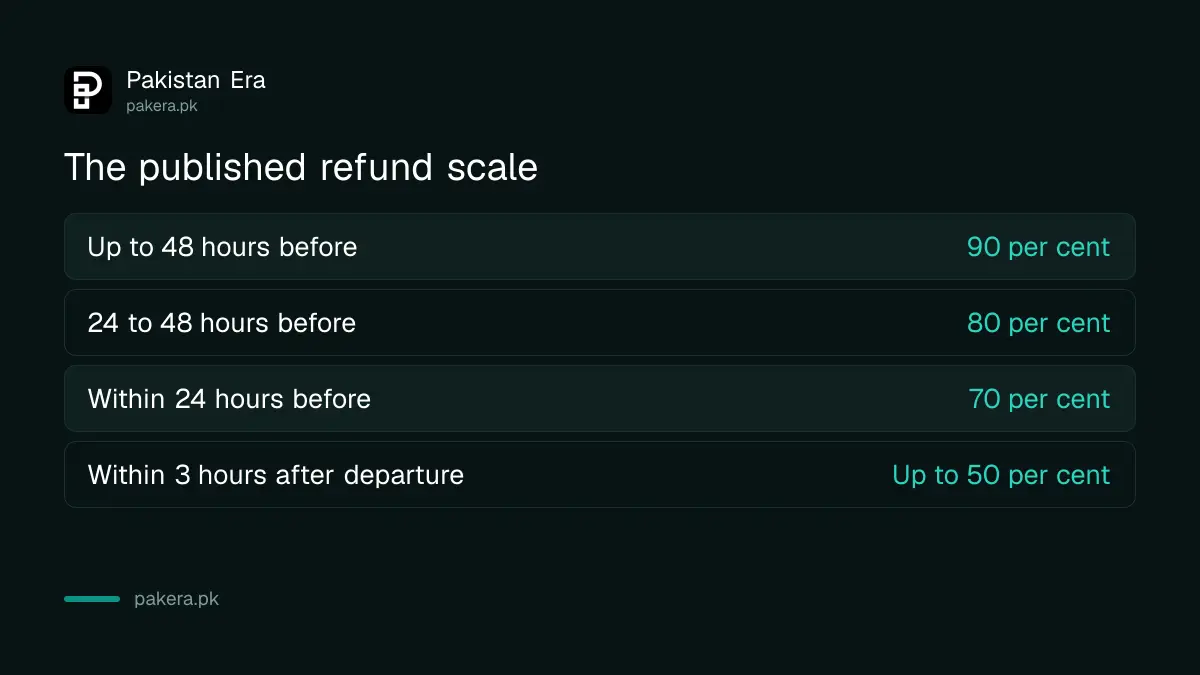
The refund scale
| When you refund | What you get back |
|---|---|
| Up to 48 hours before departure | 90 per cent |
| Between 24 and 48 hours before | 80 per cent |
| Within 24 hours before departure | 70 per cent |
| Within three hours after departure | Up to 50 per cent |
The policy is published for computerised passenger paper tickets and is dated 25 August 2011, so it has been in force a long time without being widely known.
The three hour window is the useful part
Everything before departure is a normal cancellation scale, and it behaves the way people expect. The closer you get, the less you keep.
What is unusual is that the scale does not stop at departure. A ticket refunded within three hours after the train has left still returns up to fifty per cent.
That covers the situation people actually find themselves in. You did not cancel because you were trying to make the train, and then you missed it.
Three hours is short. If you have missed a train, the refund counter is the next thing to do, not something to deal with tomorrow.
What the wording does and does not settle
Two limits are worth being straight about.
The policy says up to fifty per cent for the after departure window, not fifty per cent. Up to is a ceiling, so the amount actually paid may be less and the counter decides it.
The page we read sets out the percentage scale by time. It does not spell out separate treatment for confirmed, waitlisted or reservation against cancellation tickets, and it does not name a clerkage charge. We are not going to invent rules that are not published, so ask at the counter what applies to your specific ticket type.
The policy is also written for computerised passenger paper tickets. If you booked through an app or an agent, ask which route the refund has to go through before you join a queue.
Complaints have published deadlines
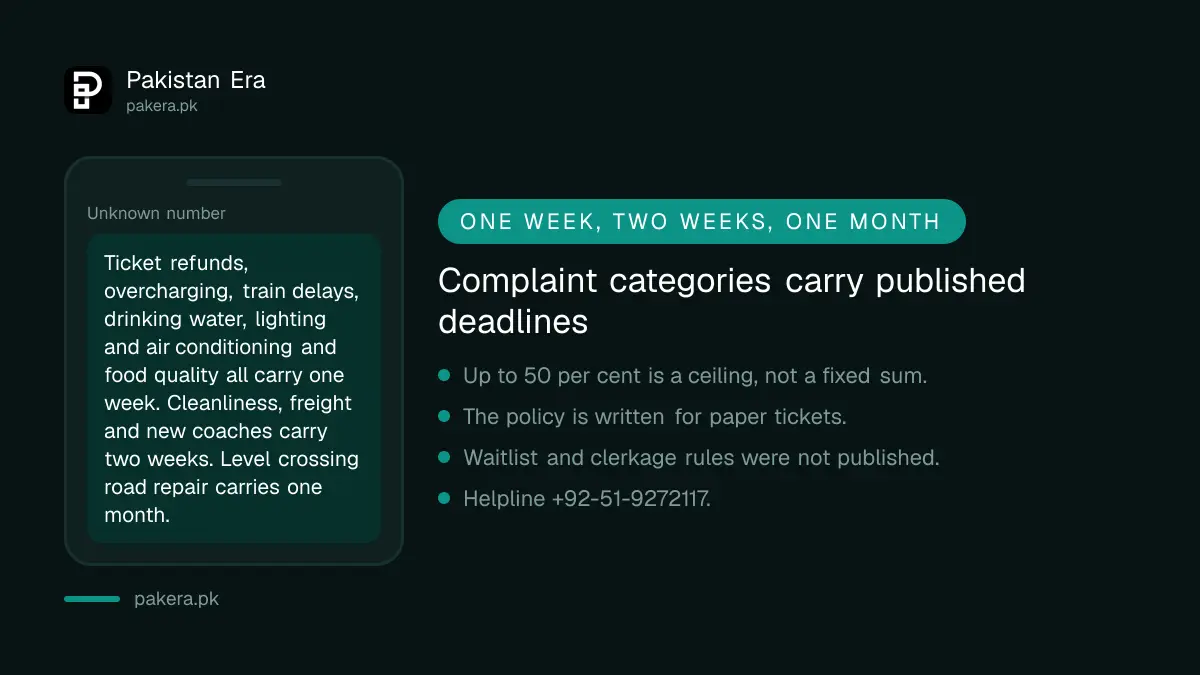
Pakistan Railways publishes a resolution time against each category of complaint, which turns a vague grievance into something with a date on it.
Ticket refunds, online and advance, carry a target of one week. So does overcharging and ticket black marketing, non attendance at the inquiry office, train delays in arrival or departure, vending stalls at stations, clean drinking water, train lighting and air conditioning, and food quality in trains.
Two weeks is the target for train stoppage or new train provision and additional coaches, passenger reservation quota enhancement, coach and station cleanliness, freight issues, and provision of inquiry 117 at stations.
Road surface repair at level crossings carries one month, the longest on the list.
The contact number published alongside is +92-51-9272117.
How to make the complaint land
- Name the category, because the published target is set per category.
- Give the train number, the date and the coach or seat, since a complaint without those is hard to trace.
- Keep the ticket, and photograph it before handing anything over.
- Put it in writing rather than only by phone, so there is a dated record.
- Note the date you lodged it, then measure the one week or two week target from that.
The target is what gives a follow up its footing. A complaint about a refund that has sat for three weeks is measurably outside a published one week standard, and that is a stronger thing to say than that it has taken a while.
Where else this pattern shows up
Published service deadlines are becoming the normal way to hold a public service to account in Pakistan, and railways is not the only place they exist.
Our guide to the new NEPRA deadlines for electricity companies covers restoration times and same day reconnection, and our guide to the Right to Public Services Act in Punjab covers a law that puts a clock on notified government services and can pay compensation to the applicant.
For a purchase dispute rather than a service one, our guide to taking a shop to consumer court covers that route, and our guide to the Pakistan Citizen Portal covers the general federal channel.
Before you buy the ticket
The railway publishes a fares and rates table and a fares and seat availability tool on the same site, so the fare and the availability can both be checked before you commit.
That is worth doing when your plans are uncertain, because the refund scale means the cost of changing your mind is known in advance. Cancelling two days out costs you a tenth of the fare. Cancelling on the day costs you three tenths.
Our guide to the goods transport strike covers a different part of the same network, and what happens when it stops.
Common questions
Can I get a refund after my train has left?
Yes. The policy allows up to 50 per cent if the ticket is refunded within three hours after departure.
How much do I get back if I cancel early?
Ninety per cent up to 48 hours before departure.
What about cancelling the day before?
Eighty per cent between 24 and 48 hours before, and 70 per cent within 24 hours.
Is the after departure refund guaranteed at 50 per cent?
No. The policy says up to 50 per cent, which is a ceiling rather than a fixed amount.
How long should a refund complaint take?
The published resolution time for ticket refunds, online and advance, is one week.
Which complaint takes longest?
Road surface repair at level crossings, with a published target of one month.
How we verified this
What we checked, where we read it, and what we could not confirm.
Last checked 8 September 2026. We read the refund policy and the complaints resolution time pages on pakrail.gov.pk, the Pakistan Railways site, on that date. The refund scale of 90 per cent up to 48 hours before departure, 80 per cent between 24 and 48 hours before departure, 70 per cent within 24 hours before departure, and up to 50 per cent where tickets are refunded within three hours after departure, together with the note that the policy applies to computerised passenger paper tickets and took effect on 25 August 2011, are taken from the refund policy page. The page we read set out the percentage scale by time and did not state separate rules for confirmed, waitlisted or reservation against cancellation tickets, and did not name a clerkage charge, so this article states none and tells readers to ask at the counter. The complaint categories and their published resolution times, one week for overcharging and ticket black marketing, non attendance at inquiry office 117, train delays in arrival or departure, vending stalls at stations, clean drinking water provision, train lighting and air conditioning, food quality in trains, and ticket refunds online and advance; two weeks for train stoppage, new train provision and additional coaches, passenger reservation quota enhancement, coach and station cleanliness, freight issues for goods and passengers, and provision of inquiry 117 at stations; and one month for road surface repair at level crossings, are taken from the complaints resolution time page, as is the contact number +92-51-9272117. The existence of a fares and rates table and a fares and seat availability tool is as published on the same site. Fares and specific ticket conditions change, so confirm the position for your ticket with Pakistan Railways before relying on it. Nothing here is legal advice.
About the author

Tax, Bills and Technology Writer
Ali Akhtar is a young and curious voice here at Pakistan Era. He is currently pursuing his A-Levels and has a growing interest in Pakistan’s changing industrial landscape and educational trends. Ali likes to write in a way that helps him explain and explore the world around him. His writing reflects the perspective of the new generation navigating the evolving trends of Pakistan where technology, youth innovation, and shifting opportunities are reshaping the country’s future.