Payroll Card Rules in Pakistan: Consent, Free Issue and 90 Days of History, Says SBP
SBP says a payroll card cannot be issued without your consent, must be free to issue, can be cancelled and must show 90 days of history. See your five rights.
Under SBP's rules, a bank cannot issue you a prepaid payroll card without your consent, cannot charge you to issue it, and must let you cancel it. You can still take cash from a teller at the issuing bank's branch. The bank must show at least 90 days of card history online, and it cannot share card revenue with your employer.
Some employers pay salary onto a card instead of into a bank account. It is easy for the company and sometimes awkward for the worker. The State Bank of Pakistan (SBP) has set clear limits on what the card issuer may do. We read them in SBP's Business Conduct and Fair Treatment of Consumers Regulatory Framework on 14 October 2026. It is part of BPRD Circular No. 04 of 2025. The payroll card rules sit in section 3.2.2.1, point 6.
Nobody can issue a payroll card in your name without your consent
SBP's framework says a payroll card shall not be issued without the employee's consent. The word is "employee", so the rule protects you as the worker, not the company. A signature on a company form that you did not read is not a good basis for consent.
If a card arrives that you never agreed to, tell the bank in writing that you did not consent. Keep a copy. The framework also lets you cancel the card later, so consent is not a one-way door.
Issuing the card must be free for you
The framework says customers shall not be charged for issuance of payroll cards. That covers the card itself. It does not say every later fee is banned, so read the bank's schedule of charges for withdrawals, replacement and other services.
SBP's wider rules also help. A bank may charge only the issuance cost, if any, when it issues or renews a debit or credit card, and an annual fee starts only after you activate the card. Our guide on the debit card annual fee rule explains that point. Whether that wider rule applies to a payroll card as a type of prepaid card is not stated in the section we read, so ask the bank.
You can cancel the card and get paid another way
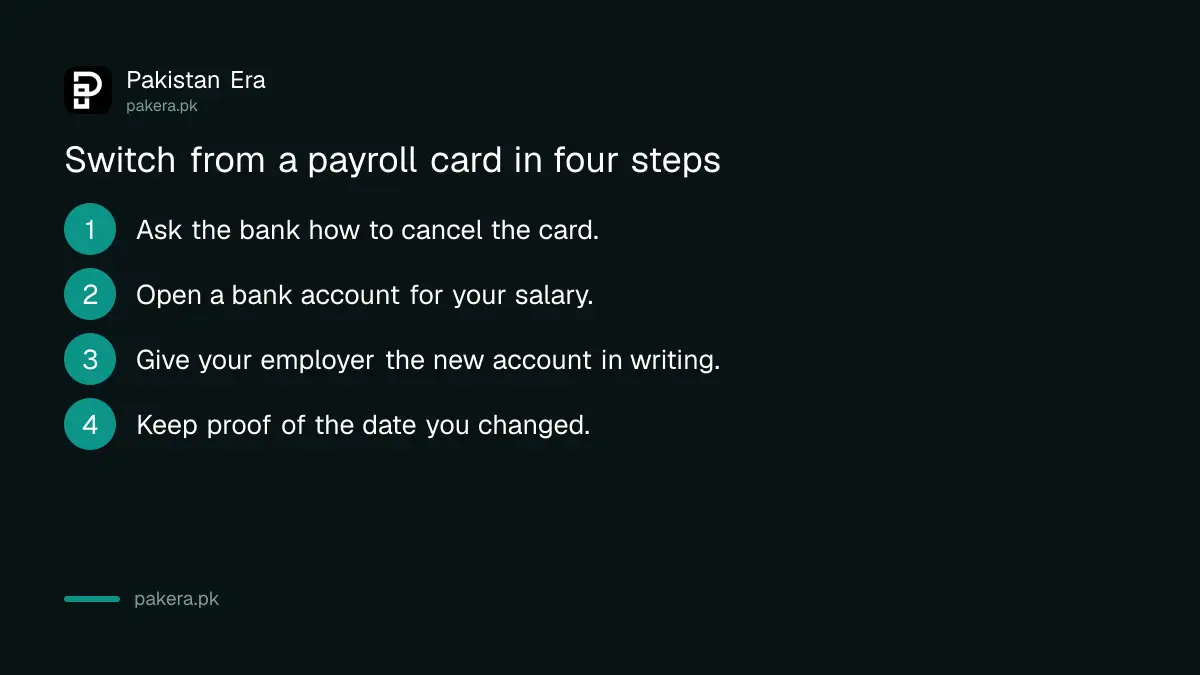
Point 6(c) says customers reserve the right to cancel the prepaid payroll card facility. The bank must also give each payroll customer, in clear language, the procedure for receiving payroll through alternative means. That could mean a normal bank account, for example.
The framework does not say how your employer must react to a cancellation. That is an employment matter between you and your employer. If you cancel the card, tell your employer in writing and give them your new account details at once so your salary is not delayed. For a late salary, the guide on claiming unpaid salary in Punjab covers one route.
The bank must show your history and let you withdraw cash at a branch
Two more rules protect your access to the money. The issuing bank must make an electronic history of the card's transactions available, for example on a website, covering at least 90 days. And you must be allowed to withdraw cash from the tellers of the issuing bank's branches, not only from machines.
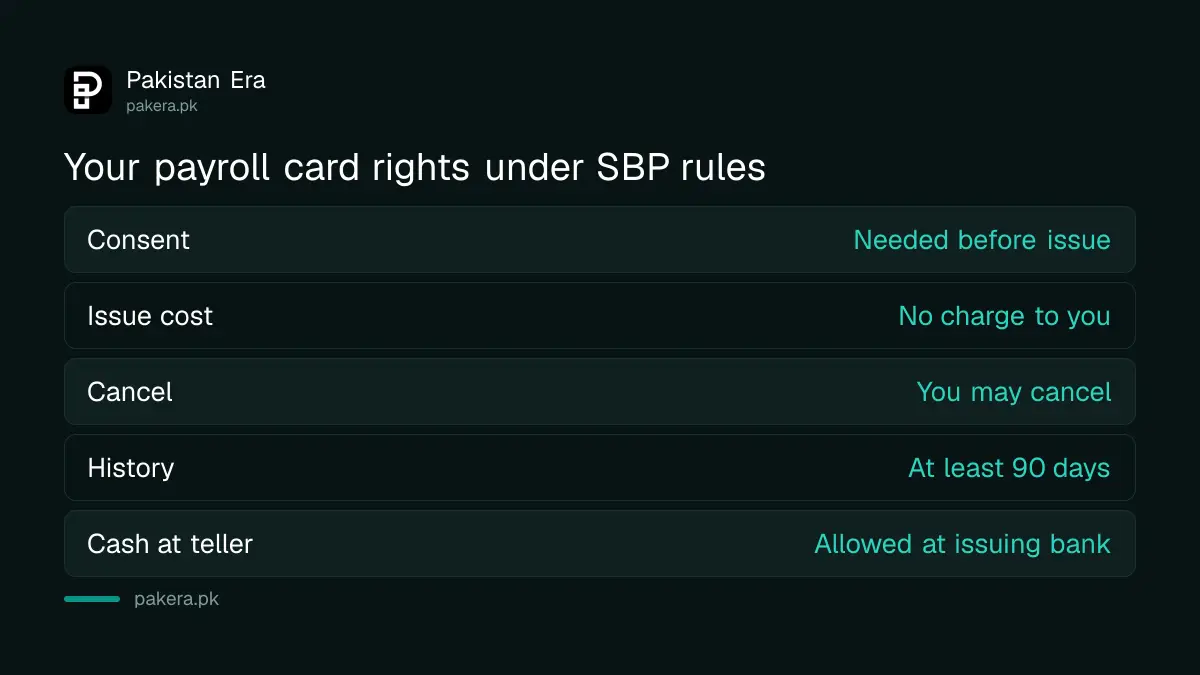
| Your right | What SBP's framework says |
|---|---|
| Consent | No card issued without the employee's consent |
| Issue cost | No charge for issuing the payroll card |
| Cancel | You may cancel; the bank explains other ways to receive pay |
| History | Electronic history covering at least 90 days |
| Cash | Withdrawal allowed at tellers of the issuing bank |
| Employer revenue | The bank may not share payroll card revenue with the employer |
The bank cannot split card revenue with your employer
The framework prohibits the bank from sharing any payroll card related revenue with the employer. The aim is plain: a company should not profit from putting its staff on a card. The issuing bank also stays responsible for customer service to you, not the employer.
If you think a company is getting a cut, you cannot prove it from the outside. What you can do is ask the bank for its schedule of charges for the card and compare it to what you are being charged.
What to do if your payroll card rights are ignored
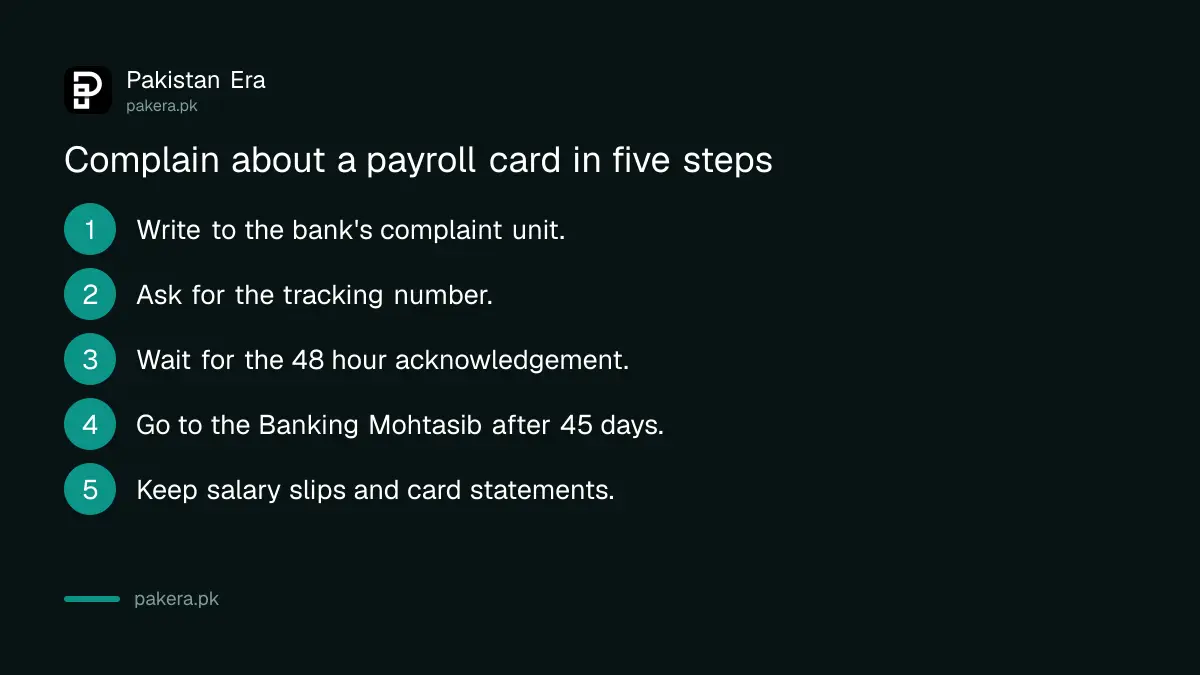
- Write to the issuing bank's complaint unit and name the right you think was broken.
- Ask for the complaint tracking number by SMS or email.
- Wait for the acknowledgement, which the bank owes within 48 hours.
- If the bank has not answered in 45 days, or the answer is unsatisfactory, go to the Banking Mohtasib Pakistan.
- Keep your salary slips and card statements for the period.
The Banking Mohtasib complaint guide lists what to attach. Cash limits at machines are separate, and the page on ATM cash withdrawal limits covers those.
Common questions about payroll cards in Pakistan
Can my employer force me to take a payroll card?
SBP's rule says the card cannot be issued without your consent. Whether your employer may insist on a card as a condition of pay is an employment question the framework does not answer.
Do I pay to get a payroll card?
No. The framework says customers shall not be charged for issuance of payroll cards. Other charges may follow the bank's schedule of charges.
Can I take cash from a branch counter?
Yes. SBP says payroll customers shall be allowed cash withdrawal from the tellers of the issuing bank's branches.
How long must my card history be available?
At least 90 days, in electronic form such as a website, according to the framework.
Who do I ask when something goes wrong?
The issuing bank, not your employer. SBP says the issuing bank remains responsible for providing customer service support to payroll customers.
How we verified this
What we checked, where we read it, and what we could not confirm.
Last checked 14 October 2026. The payroll card rules are section 3.2.2.1, point 6, of SBP's Business Conduct and Fair Treatment of Consumers Regulatory Framework. The framework defines a payroll card by reference to PSD Circular No. 04 of 2016, which we did not read. Escalation steps are from SBP's consumer protection page. We have not checked how any bank applies these rules in practice.
About the author

Global Affairs & Political Economy Writer
Muhammad Hatim is a book lover who started writing because he enjoys it. At Pakistan Era he writes about international relations, geopolitics and the global economy, with a particular interest in South Asia and the forces behind current events.