Pay and Pensions Take 80 to 88% of Power Company Running Costs in NEPRA 2027 Requests
Pay and pensions are 80 to 88 per cent of running costs in eight power company requests for 2027. See LESCO, IESCO, MEPCO and FESCO before NEPRA hearings.
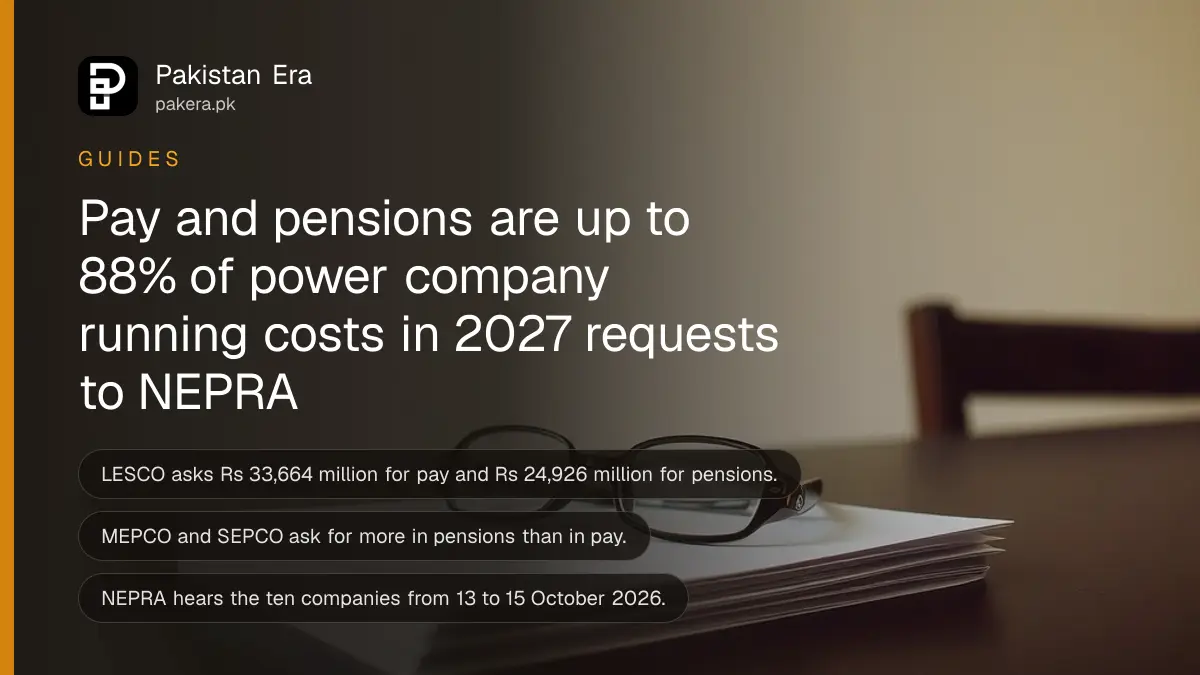
Pay and pensions make up roughly four fifths of the running costs that Pakistan's power distribution companies ask NEPRA to allow for 2027. LESCO asks for Rs 33,664 million in pay and Rs 24,926 million in post-retirement benefits. MEPCO asks for more in pensions than in salaries. NEPRA hears these requests from 13 to 15 October 2026.
We read the hearing notices for all ten companies on nepra.org.pk. Eight of them split the cost lines far enough to compare pay and pensions. The shares below are our own sums from NEPRA's figures, in million rupees.
LESCO asks for the biggest pay bill
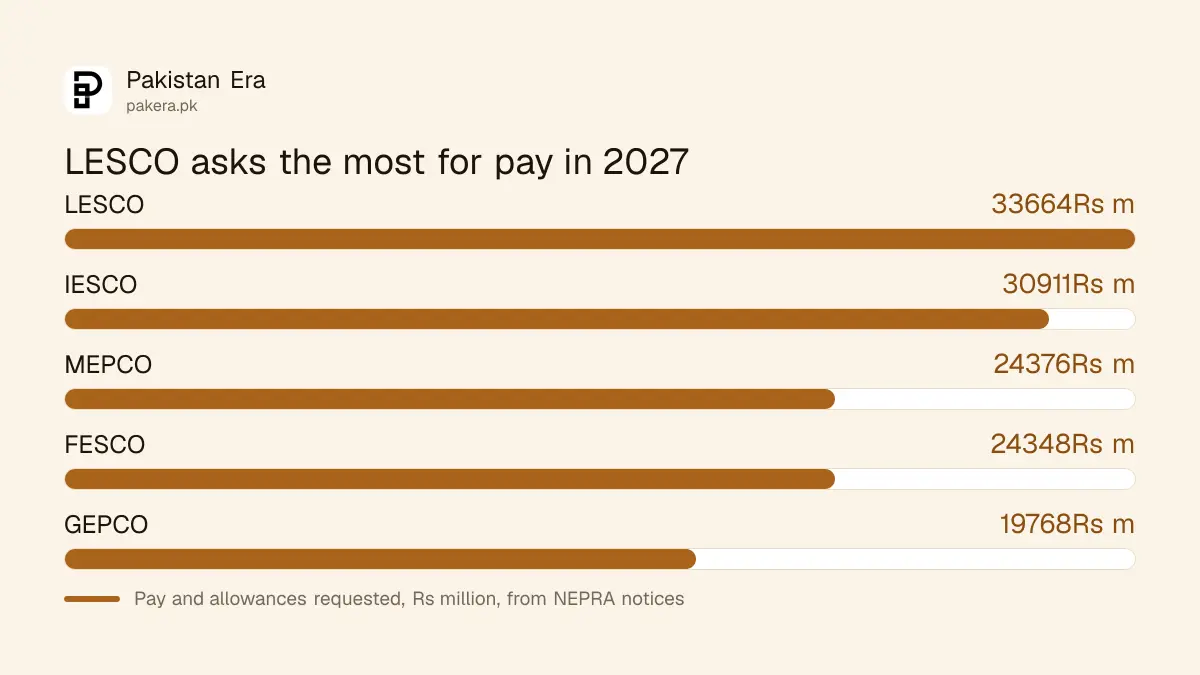
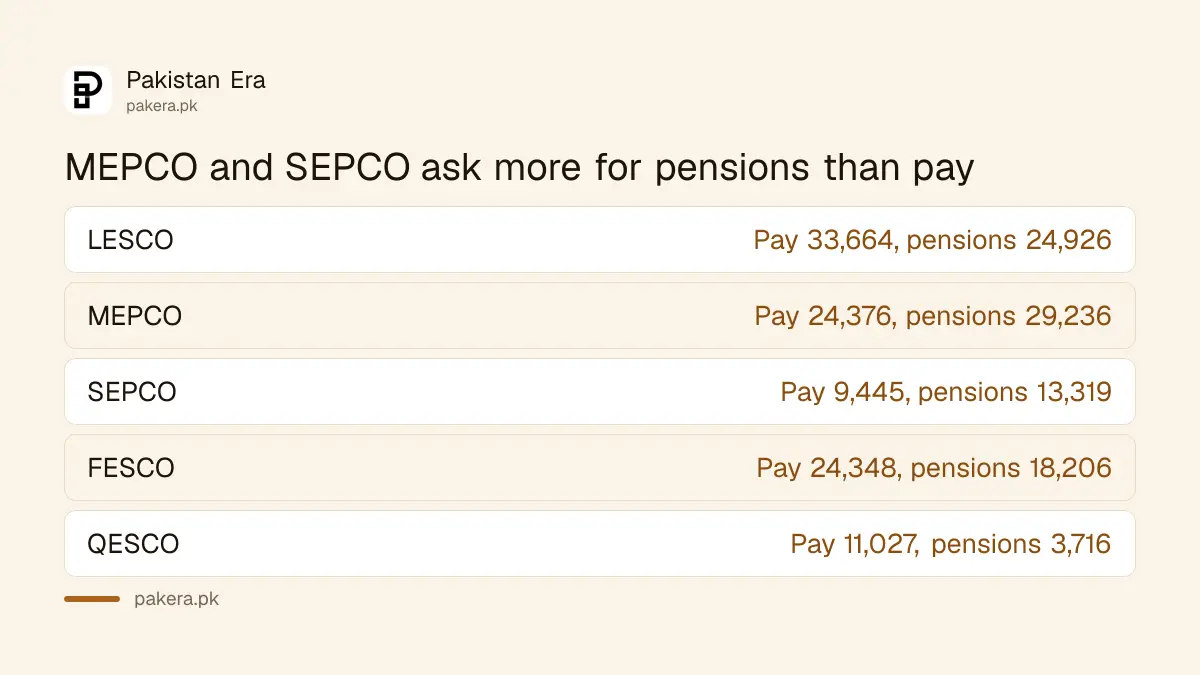
LESCO in Lahore asks for Rs 33,664 million in pay and allowances and Rs 24,926 million in post-retirement benefits for 2027. Together that is Rs 58,590 million, about 85 per cent of its total operation and maintenance cost of Rs 68,945 million.
Operation and maintenance, or O&M, is the cost of running the network: staff, repairs, travel and vehicles. It is separate from the cost of buying electricity. LESCO's notice lists the power purchase price on its own, at Rs 646,629 million.
Post-retirement benefit means pensions and other benefits paid to people who have left the company. LESCO asks for Rs 22,715 million of it under distribution and Rs 2,211 million under supply.
MEPCO asks for more in pensions than in pay
MEPCO in Multan asks for Rs 29,236 million in post-retirement benefits, more than the Rs 24,376 million it asks for pay and allowances. Of the eight companies, only MEPCO and SEPCO ask for more in pensions than in pay.
SEPCO in Sukkur asks for Rs 13,319 million in post-retirement benefits against Rs 9,445 million in pay. For the other six companies, pay is the larger line.
The notices do not explain why. A hearing is where NEPRA can ask. We do not claim a reason that the notice does not give.
Four fifths of running cost goes to staff
For the eight companies that list both lines, pay plus pensions is between 80 and 88 per cent of O&M cost. FESCO in Faisalabad is highest at 88 per cent. HESCO in Hyderabad is lowest at 80 per cent.
| Company | Pay (Rs million) | Pensions (Rs million) | Total O&M (Rs million) | Share of O&M |
|---|---|---|---|---|
| LESCO | 33,664 | 24,926 | 68,945 | 85% |
| IESCO | 30,911 | 20,677 | 62,983 | 82% |
| MEPCO | 24,376 | 29,236 | 62,264 | 86% |
| FESCO | 24,348 | 18,206 | 48,293 | 88% |
| GEPCO | 19,768 | 12,519 | 38,889 | 83% |
| SEPCO | 9,445 | 13,319 | 28,191 | 81% |
| HESCO | 12,108 | 6,407 | 23,272 | 80% |
| QESCO | 11,027 | 3,716 | 18,251 | 81% |
The share is pay plus pensions divided by total O&M, rounded. PESCO's notice gives one O&M total of Rs 42,441 million without a pay line. TESCO shows pay of Rs 1,680 million, pensions of Rs 750 million and a separate actuarial retirement cost of Rs 3,206 million. We left those two out of the table so the columns match.
These are requests, and NEPRA has not decided them
Each company filed under its multi-year tariff, a formula NEPRA sets for several years. The 2027 filing "indexes" the cost lines, which means it updates them for inflation and other changes. NEPRA tests whether each line fits the formula.
Nothing on your bill changes now. NEPRA decides first, and the federal government then notifies the consumer tariff. Our piece on the 2027 tariff hearings lists the ten slots. Your bill is built from unit price slabs that these tariffs feed into.
Fixed charges, the part of a bill you pay whatever you use, are also on NEPRA's list of questions for the companies it has read.
How to ask a question at the hearing
Any interested person can send written comments or speak. Pick one line in your company's notice and ask NEPRA to justify it. Specific questions are more useful than general complaints.
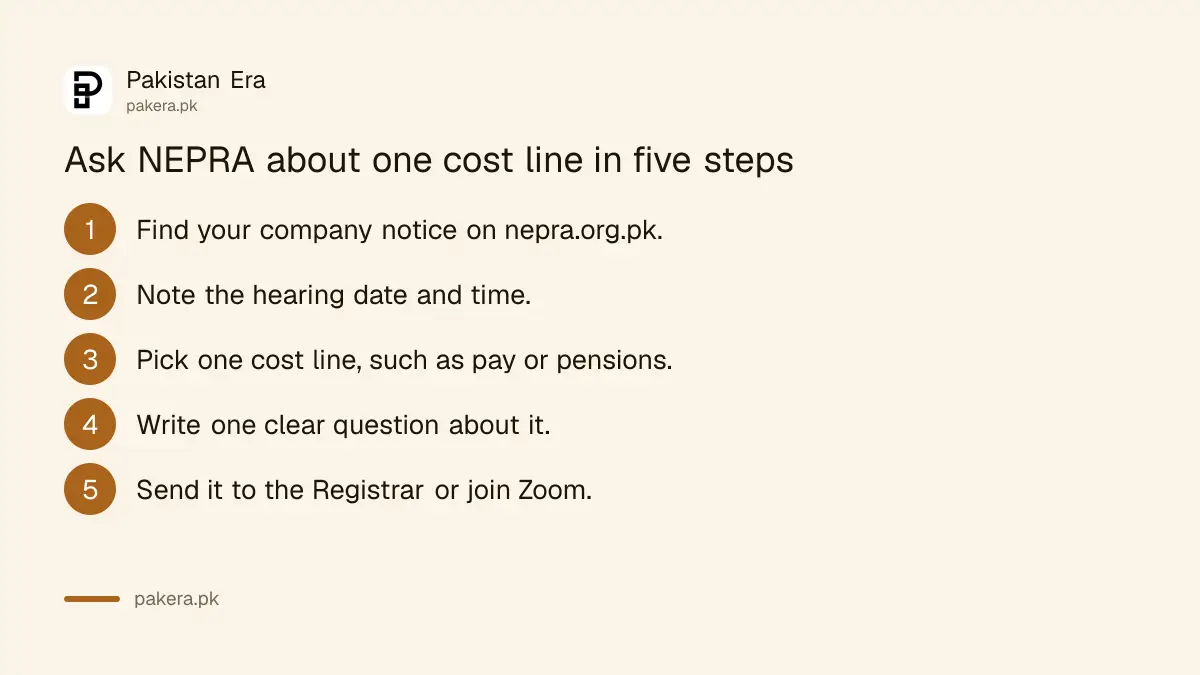
- Find your company's notice of hearing on nepra.org.pk.
- Note the date and time. LESCO is heard on 14 October at 2:00 pm, IESCO on 15 October at 2:00 pm.
- Pick one cost line, such as pay or post-retirement benefits.
- Write one clear question about it.
- Send it to the NEPRA Registrar, or join the Zoom call at the time given.
The steps for joining are in our guide to taking part in a NEPRA hearing.
Common questions
How much does LESCO ask for in salaries for 2027?
LESCO asks for Rs 33,664 million in pay and allowances, the largest pay line of the eight companies we compared.
Which company asks for more in pensions than salaries?
MEPCO does, with Rs 29,236 million in post-retirement benefits against Rs 24,376 million in pay. SEPCO is the other, at Rs 13,319 million against Rs 9,445 million.
What does O&M cost mean on a NEPRA notice?
It means operation and maintenance cost: pay, pensions, repairs, travel and vehicle costs. It does not include the price of electricity the company buys.
Will these costs raise my bill?
Only if NEPRA allows them and the federal government notifies a new tariff. The notices do not give a per unit effect.
Why are PESCO and TESCO missing from the table?
Their notices do not list pay and pensions in the same way as the other eight, so the columns would not match.
How we verified this
What we checked, where we read it, and what we could not confirm.
Last checked on 13 October 2026, Pakistan time. We read the hearing notices of the ten companies on nepra.org.pk. The SEPCO and LESCO notices do not print the unit, and we read them as million rupees because their totals match the others. Shares and the comparison of pay with pensions are our own arithmetic. We have not read any company's answers to NEPRA.
About the author

Tax, Bills and Technology Writer
Ali Akhtar is a young and curious voice here at Pakistan Era. He is currently pursuing his A-Levels and has a growing interest in Pakistan’s changing industrial landscape and educational trends. Ali likes to write in a way that helps him explain and explore the world around him. His writing reflects the perspective of the new generation navigating the evolving trends of Pakistan where technology, youth innovation, and shifting opportunities are reshaping the country’s future.