Choice Number Plate Reserve Prices in Punjab: From Rs 500 to Rs 10,000, and How to Bid
Punjab Excise sets reserve prices for choice number plates from Rs 500 to Rs 10,000. See the price by kind of number, the Rs 100 fee and the bidding rules.
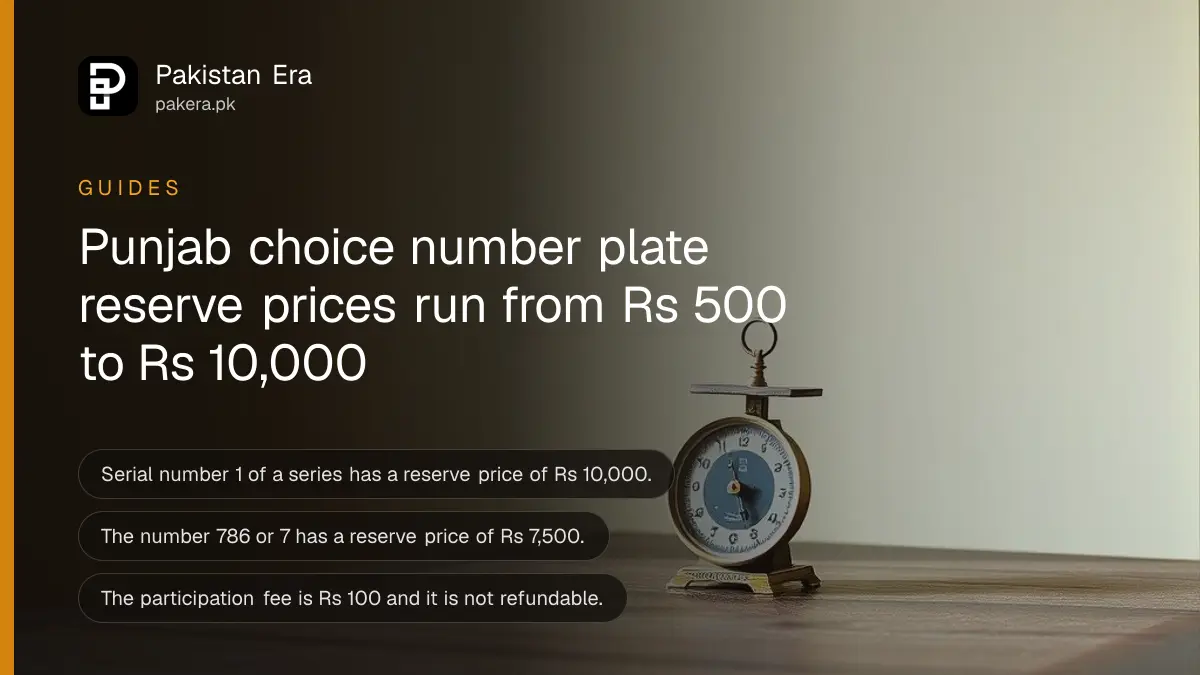
Short answer: In Punjab a choice registration number has a minimum "reserve price" set by the Excise Department. Serial number 1 starts at Rs 10,000, 7 and 786 at Rs 7,500, other single digits and common patterns at Rs 5,000. Any other number starts at Rs 2,000 for a car and Rs 500 for other vehicles.
People often ask what a number like 786 or 1234 will cost at the Excise e-auction. The department's own policy page answers part of it. It lists reserve prices, the minimum below which a number cannot be sold. The final price is whatever the highest bidder offers on top.
We read that policy page on the Excise, Taxation and Narcotics Control Department's website on 12 October 2026. The page carries no date, so check the e-Auction portal for the price shown on your series before you pay.
Reserve prices run from Rs 500 to Rs 10,000
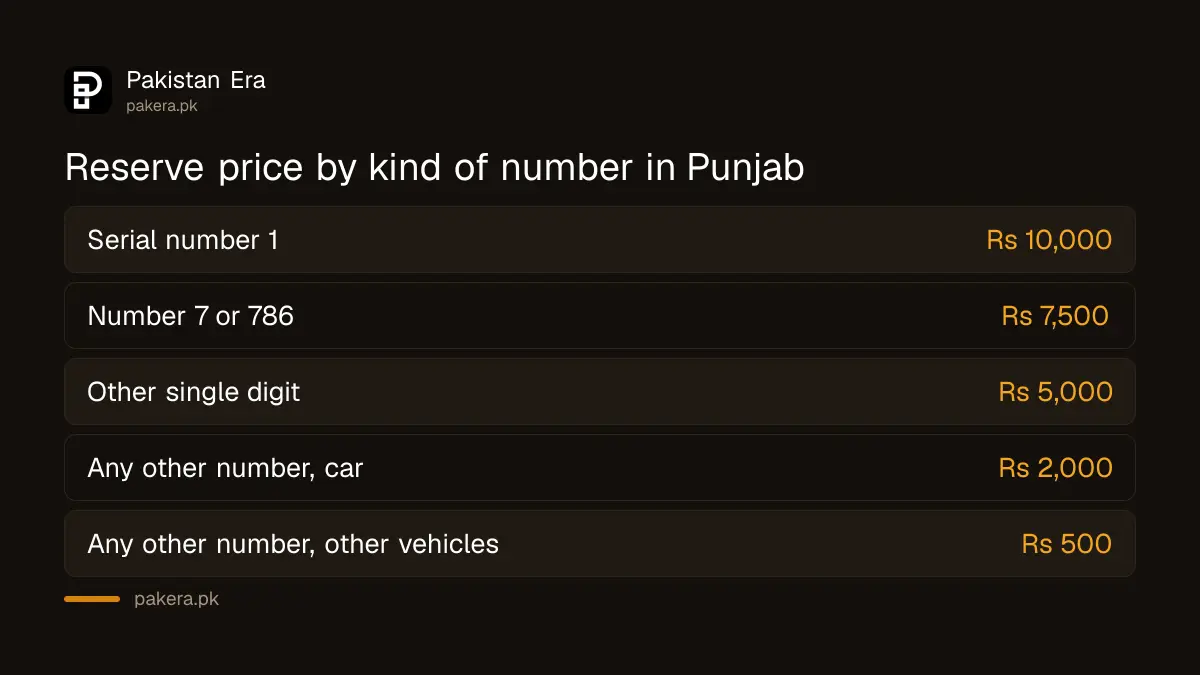
The policy sorts numbers into groups. The group decides the reserve price. A number can not be allotted below its reserve price, and the winning bid is charged on top of the normal registration fee.
| Kind of number | Reserve price |
|---|---|
| Serial mark 1 of a series | Rs 10,000, all vehicles |
| Serial mark 7 or 786 | Rs 7,500, all vehicles |
| Any other single digit | Rs 5,000, all vehicles |
| Listed patterns such as 10, 11, 22, 99, 100, 111, 313, 555 and round hundreds | Rs 5,000, except motorcycles and rickshaws |
| Listed four digit patterns such as 1000, 1111, 1234, 7777 and 9900 | Rs 500 and Rs 1,000 shown on the page, the second marked for commercial vehicles |
| 302 and 420 of each series | Rs 2,000 for private cars and commercial vehicles |
| Any other number | Rs 2,000 for four wheelers, Rs 500 for other vehicles |
The four digit row is not clear on the page. It shows two prices beside one long list, so we report both and leave the split to the portal.
An ordinary number can be bought at a fixed Rs 10,000
The policy also says any registration mark that is not on the attractive list can be issued by the registration office to an applicant at a fixed Rs 10,000, first come, first served. So you do not have to bid for a plain number. You do have to bid for the attractive ones.
If you want a high end personalised plate in Gold or Platinum style, that is a separate scheme with much higher prices. It is set out in the explanation of the vanity number plate auction in Punjab.
You pay a Rs 100 fee, then the reserve price, before you can bid
To enter an auction you first pay a Rs 100 participation fee, which is not refunded. You then pay the reserve price through e-Pay. For a number with a higher average price, the system asks for the average price if that is more than the reserve.
The payment is not extra for a winner. The amount is adjusted against the registration fee challan of the number you won. Unsuccessful bidders have their amount adjusted against the registration fee of the vehicle they register, using the chassis number and CNIC or NTN they gave.
How the bidding runs
Registration for a series stays open for the dates in the monthly schedule. Bidding then runs for 35 hours 59 minutes 59 seconds, from 9 am on the first day to 8:59:59 pm on the second day. Results are published at 9 pm on the same day bidding closes.
Bids move in steps. For a four wheeler the step is Rs 500. For all other vehicles it is Rs 200. If the top bid is raised in the last 15 minutes, the system adds one more minute and keeps adding it until nobody raises the bid.
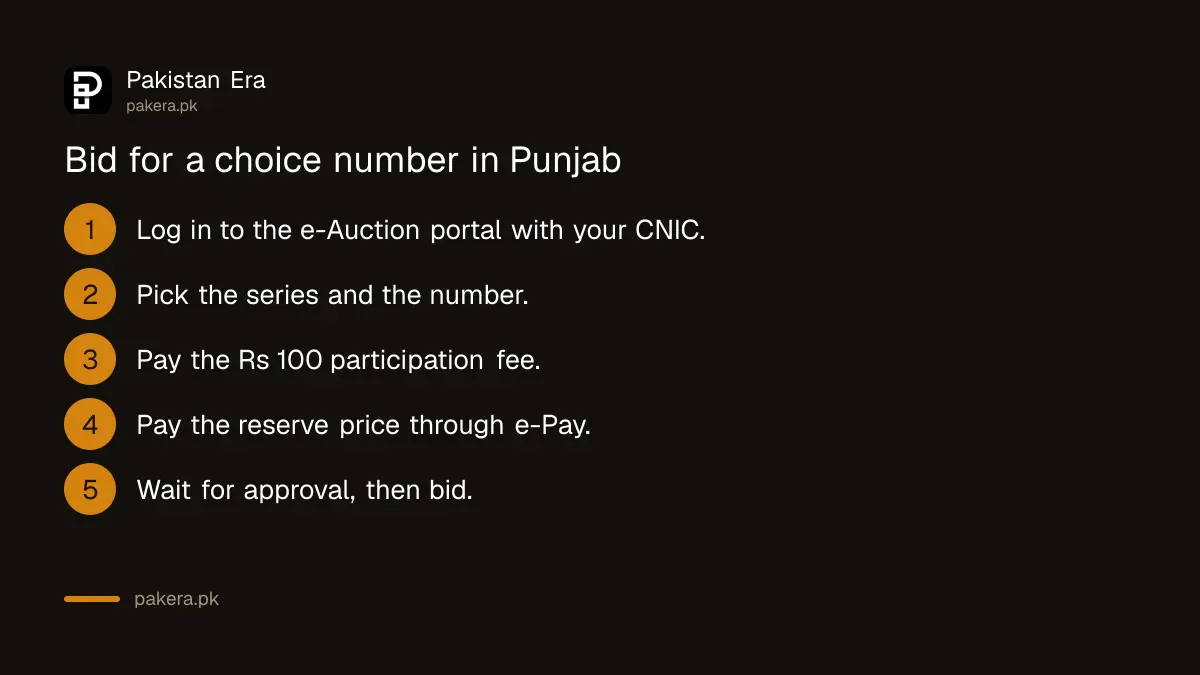
- Log in to the e-Auction portal with your CNIC and password.
- Choose the series and the number. The number must be available for that round.
- Pay the Rs 100 participation fee through e-Pay.
- Pay the reserve price or average price, whichever is higher.
- Wait for approval. The system sends your login ID and password.
- Bid in steps of Rs 500 for a car or Rs 200 for other vehicles.
- If you win, pay the bid and register the vehicle within 15 days.
Rules that can cost you money if you miss them
One AIN (Automated Identification Number) can contest only one number. If you want numbers for two vehicles, you register separately for each vehicle. A winning number can only go to a vehicle you own, and it cannot be moved to a vehicle owned by anyone else afterwards.
If a winner does not deposit the bid in the given time, the reserve price is forfeited and the number is cancelled. The department pays no interest on money you deposit. It may also cancel any bidding process or final allotment.
Numbers nobody wins in a series go to re-auction. The October dates are in the report on the latest re-auction results and the next bidding days.
Common questions
What is a reserve price?
It is the lowest price at which the department will sell a number. Bidding starts from there.
Is the Rs 100 participation fee refundable?
No. The policy page says it is non-refundable.
How much more is a motorcycle number than a car number?
It is usually cheaper. For numbers outside the listed patterns the reserve is Rs 500 for other vehicles against Rs 2,000 for four wheelers.
How soon must I register the vehicle after I win?
Within 15 days of the result. The Director General can allow 30 more days only in extreme cases.
Can I bid on two numbers with one login?
Each AIN contests one number. For another vehicle you register separately and get a separate AIN.
Is the winning bid the total I pay?
No. The policy says the highest bid is charged in addition to the prescribed registration fee.
How we verified this
What we checked, where we read it, and what we could not confirm.
We read the Excise Department's policy for allotment of attractive registration marks and its e-auction schedule on 12 October 2026. The policy page is undated and parts of its price table are unclear in print, so confirm the reserve price on the portal at eauction-excise.punjab.gov.pk before you pay.
About the author

Public Services and Education Journalist
Fajr Riaz is a journalist and content writer at Pakistan Era, based in Lahore. She covers the questions people meet in everyday life in Pakistan: how a public service works, what a change in the rules means, and where to find a reliable answer.