Power Companies Want Rs 1.35 More a Unit From September
Distribution companies have asked NEPRA for Rs 34 billion over three months. It is a request, not a decision, and the reasons are uncomfortable.
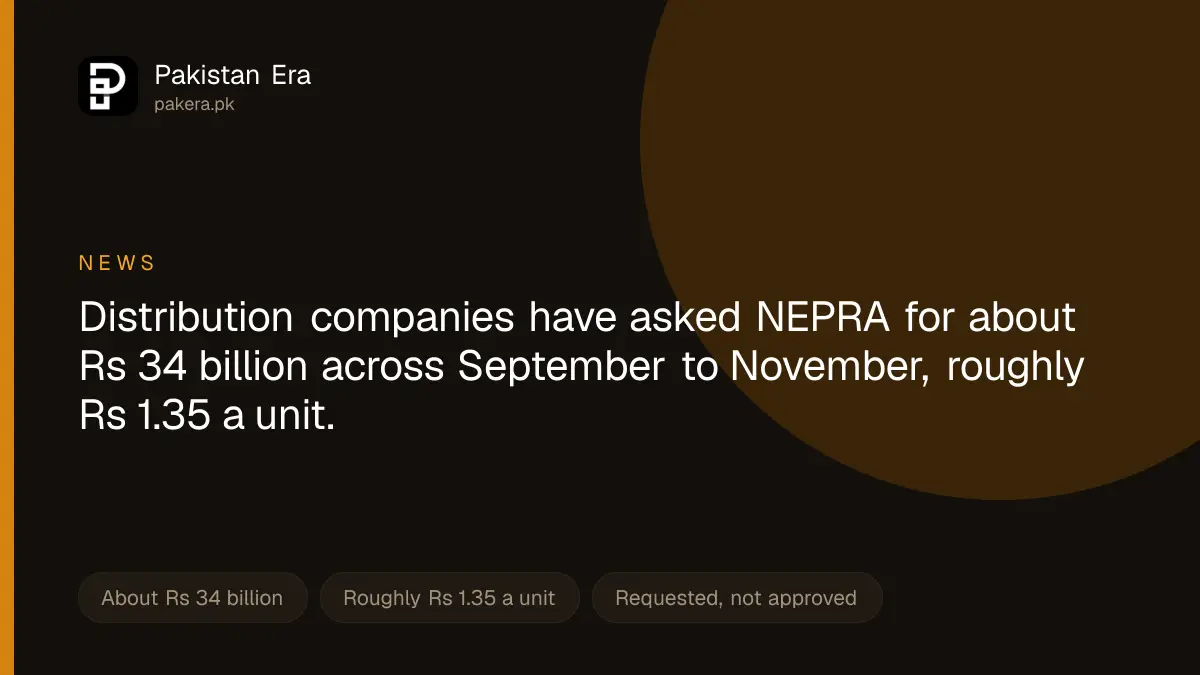
Pakistan's electricity distribution companies have asked for about Rs 34 billion more from consumers across September, October and November. On a bill, that is roughly Rs 1.35 a unit.
Before you budget for it: this is a request. NEPRA held the hearing on Wednesday and has not decided.
Where this has actually reached
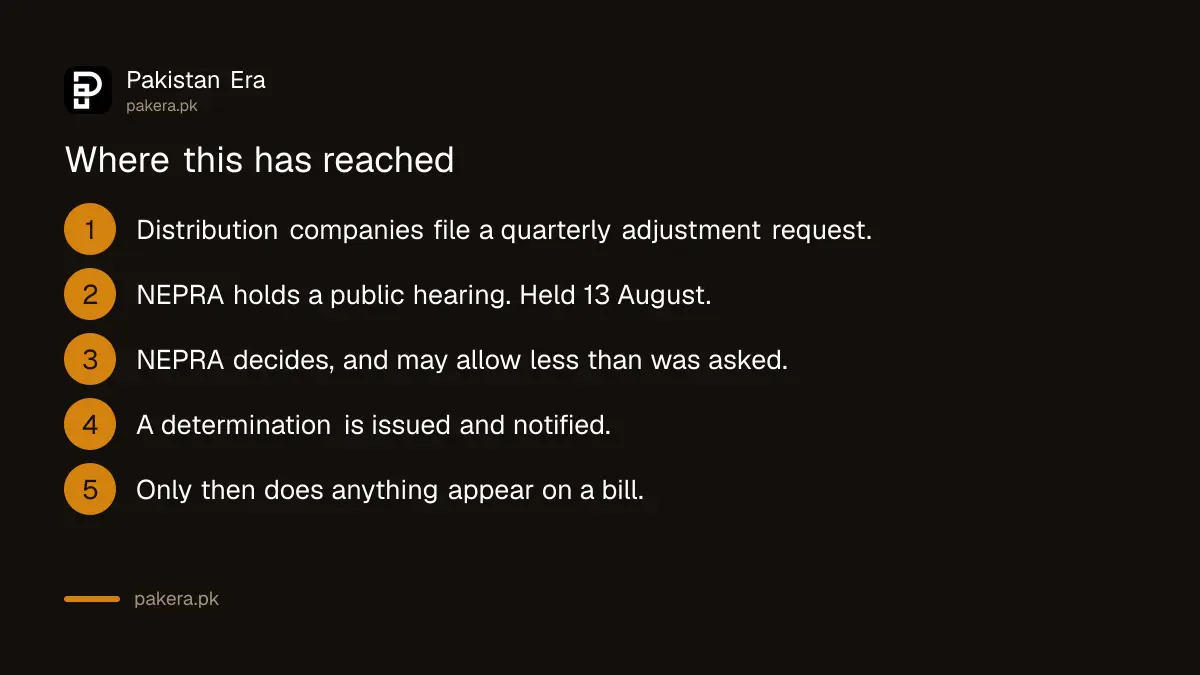
- Distribution companies file a quarterly adjustment request. Done.
- NEPRA holds a public hearing. Held on 13 August 2026.
- NEPRA decides, and it can allow less than was asked for.
- A determination is issued and notified.
- Only then does anything reach a bill.
Regulators regularly allow less than the amount sought. So the Rs 1.35 figure is the ceiling of the ask, not a number anyone has agreed to charge you.
What is being asked for
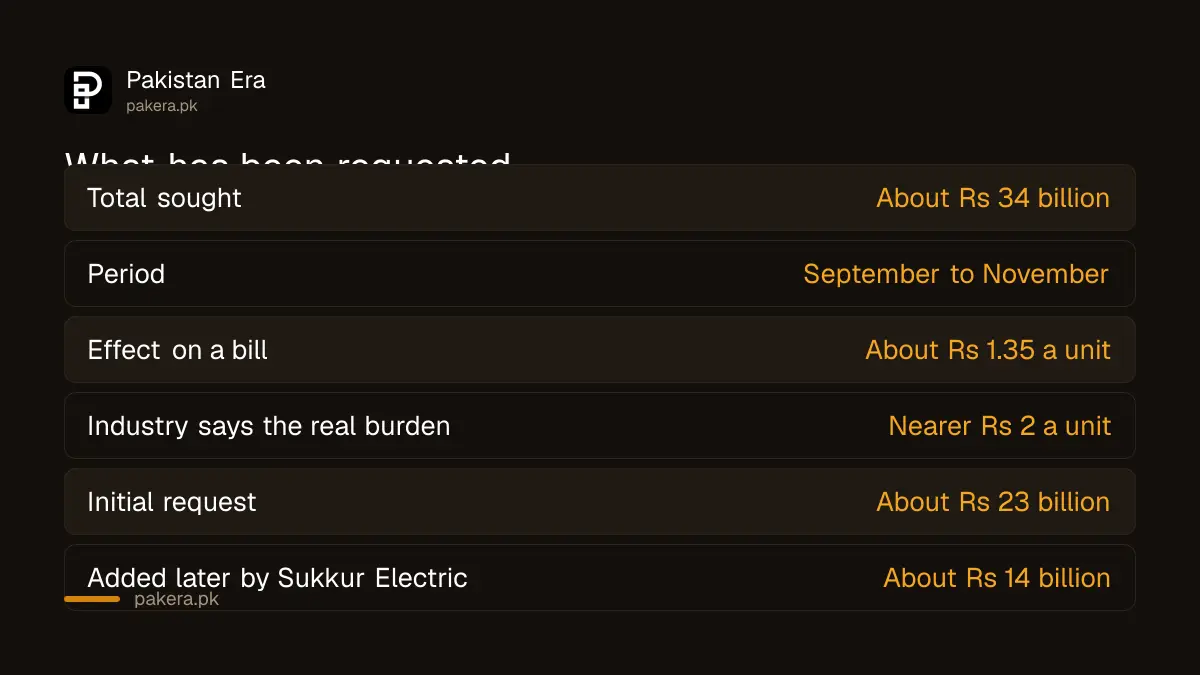
| Item | Amount |
|---|---|
| Total sought | About Rs 34 billion |
| Period covered | September to November |
| Effect per unit | About Rs 1.35 for three months |
| Industry says the real burden is | Nearer Rs 2 a unit |
| Originally requested | About Rs 23 billion |
| Added later by Sukkur Electric | About Rs 14 billion |
That last pair is worth noticing. The request grew by about Rs 14 billion, roughly 60 per cent on top of the original figure, from one company added after the fact.
Representatives of the Karachi Chamber of Commerce and the Korangi Association of Trade and Industry asked for an immediate review of the package at the hearing.
Why the bill goes up when people use less
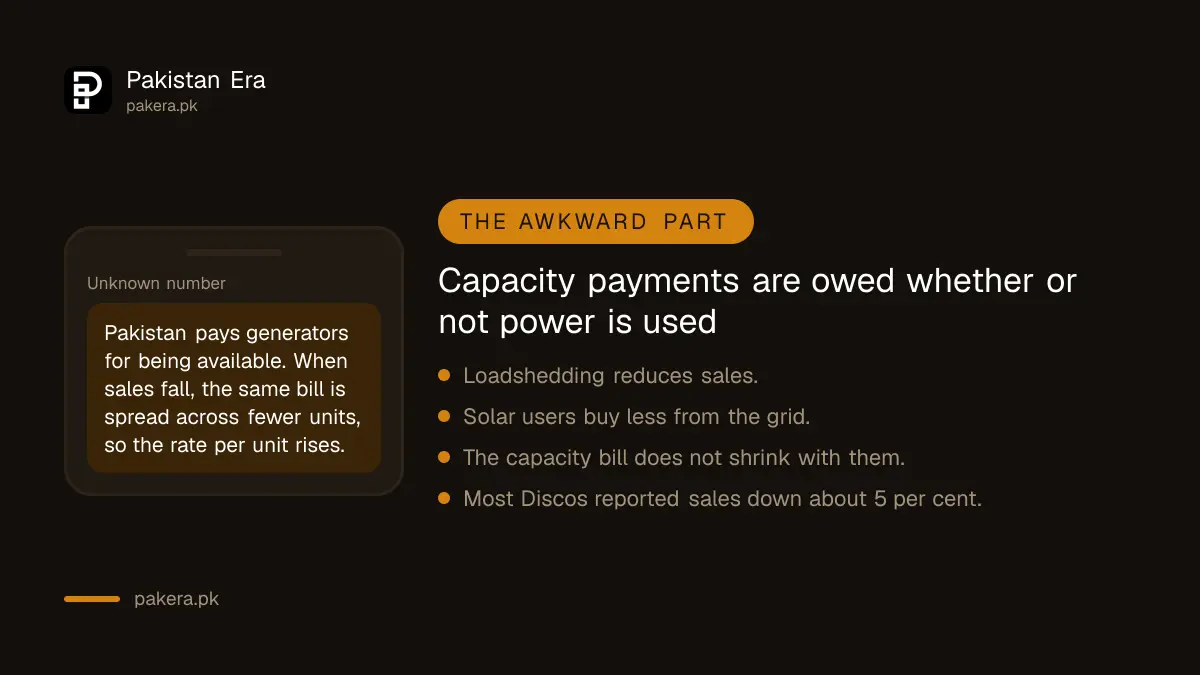
This is the part that sounds wrong and is not, and it is worth understanding properly because it explains most of what happens to your bill.
Pakistan does not only pay for electricity it uses. It pays generators for being available to produce it, under long term contracts. That obligation is owed whether the power is taken or not.
So think of it as a fixed bill that has to be divided among the units actually sold. If the country buys fewer units, the same fixed amount is spread thinner, and the rate per unit goes up. Fewer sales, higher rate, same total.
Most major distribution companies reported sales down about 5 per cent. Three reasons were given at the hearing: loadshedding, reduced sales generally, and solar.
This is not solar users being punished
It would be easy to read the last paragraph as blaming people who installed panels. That is not what the record says, and it is not what the arithmetic says either.
The same effect follows from loadshedding, which is not a consumer decision at all. If the supply is cut, the units are not sold, and the capacity bill still has to be covered. A NEPRA member at the hearing pointed at excessive loadshedding as the suspected cause of the sales drop, and noted it particularly affects paying customers.
So the honest description is that the per unit rate rises whenever volumes fall, for whatever reason. Solar is one reason. Loadshedding is another, and at this hearing it was the one the regulator's own member raised.
If you are weighing solar, the current rules are in systems up to 25kW needing no approval and what you are paid for exporting at night.
What to do while this is decided
Three things, none of them dramatic.
Do not budget for Rs 1.35 yet. Wait for the determination. If you want to plan for something, plan for a smaller number.
Learn to read the adjustment lines on your bill. Quarterly adjustments appear as their own line, separate from your units. Most people never look, then get a shock. We break every line down in what each item on your electricity bill means.
Check your meter reading against the bill. A tariff rise makes every billing error more expensive, and errors are common enough that we wrote a guide to overbilling and how to complain to NEPRA.
What we are not telling you
We are not giving you a rupee figure for your household. The effect depends on your slab, your category and your province, and one number would be wrong for most readers.
We are not predicting what NEPRA will allow. It may approve the full amount, part of it, or none.
We are not calling this unfair or blaming anyone for it. Distribution companies have filed a request under the process available to them, industrial consumers have objected, and a regulator will decide. That is the system working as designed, whatever anyone thinks of the design.
We also cannot tell you why Sukkur Electric's Rs 14 billion arrived after the initial filing, because that was not explained in what we read.
Questions readers are asking
Is electricity going up Rs 1.35 a unit?
Not yet, and possibly not by that much. Companies have requested it. NEPRA held a hearing on 13 August and has not issued a determination.
What is a quarterly tariff adjustment?
A periodic recalculation that passes certain costs from distribution companies to consumers, applied for a limited period rather than permanently.
Which months would it cover?
September to November, if approved.
Why does using less electricity raise the rate?
Because capacity payments are owed whether power is used or not. When fewer units are sold, that fixed cost is divided across fewer units and the per unit rate rises.
Are solar users to blame?
No. Falling volumes raise the per unit rate whatever the cause, and at this hearing a NEPRA member pointed at excessive loadshedding as the suspected reason for the drop.
Who objected to the request?
Industrial consumers, including representatives of the Karachi Chamber of Commerce and the Korangi Association of Trade and Industry, who asked for an immediate review.
How will I know if it is approved?
NEPRA issues a determination which is then notified. Until that happens, nothing changes on your bill.
About the author

Public Services and Education Journalist
Fajr Riaz is a journalist and content writer at Pakistan Era, based in Lahore. She covers the questions people meet in everyday life in Pakistan: how a public service works, what a change in the rules means, and where to find a reliable answer.